
NCERT Solutions Class 8 Maths Part 2 Chapter 7: Area
Answers to the questions inside the chapter and to all five Figure it Out sets in Chapter 7, Area, of Ganita Prakash, Grade 8 Part 2. Page numbers follow the book (pages 148–171). Questions that ask you to choose your own measurements have one worked example; other choices work the same way. Short notes: Part 2 Chapter 7 notes.
Rectangles and squares (pages 148–150)
Cutting a square into four parts with the same area. Some ways: four equal strips; four small squares; four triangles made by the two diagonals; any two perpendicular lines through the centre, which give four identical pieces; or a bump pushed out of one part and the same bump taken into its neighbour.
Which rectangle needs more rangoli powder? The 7 cm × 4 cm rectangle holds 28 unit squares and the 8 cm × 3 cm one holds 24, so the 7 cm × 4 cm rectangle needs more.
Each triangle in the 7 cm × 4 cm rectangle. The diagonal makes two identical triangles, each ½ × 7 × 4 = 14 cm².
Can perimeter stand in for area? Two rectangles. A 10 cm × 1 cm rectangle has perimeter 22 cm and area 10 cm²; a 5 cm × 4 cm rectangle has perimeter 18 cm and area 20 cm². The first has the larger perimeter and the smaller area. Other shapes: a comb of 15 unit squares has perimeter 32 units, while a 4 × 4 square has perimeter 16 and area 16.
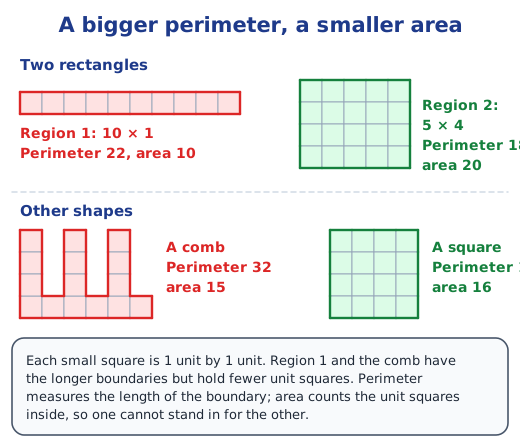
Figure it Out (pages 150–152)
1. (i) The 21 in² rectangle is 7 in long, so it is 3 in tall. The 28 in² rectangle is 4 + 3 = 7 in tall, so it is 4 in wide. The 35 in² rectangle is 3 + 4 = 7 in wide, so it is 5 in tall. The 14 in² rectangle is 5 + 2 = 7 in tall, so the missing width is 14 ÷ 7 = 2 in. (ii) The 29 m² rectangle is 4 m tall, so its width is 29 ÷ 4 = 7.25 m. The 11 m² rectangle has the same 4 m height, so its width is 11 ÷ 4 = 2.75 m. Reading 50 m² as the area of the whole rectangle with the thick outline, the lower part is 50 − 29 = 21 m², and its height is 21 ÷ 7.25 ≈ 2.9 m (exactly 84/29 m).
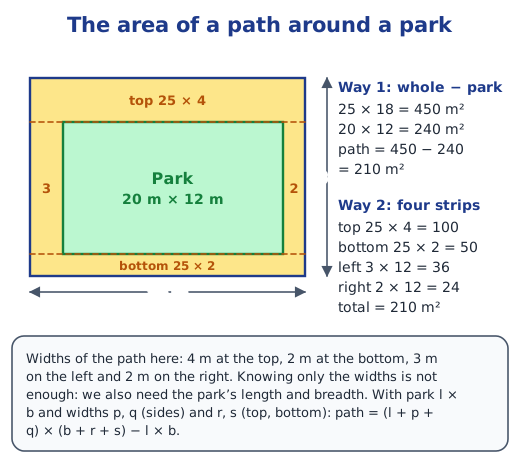
2. (i) Measure the length and width of the outer rectangle ABCD and of the park EFGH. Area of the path = area of ABCD − area of EFGH. For example, ABCD 40 m × 30 m and EFGH 32 m × 20 m give 1200 − 640 = 560 m². (ii) The widths alone are not enough; we also need the park’s length l and width b. With widths p and q on the left and right and r and s at the top and bottom, area = (l + p + q)(b + r + s) − lb, or the sum of four strips. For a park 20 m × 12 m with widths 3, 2, 4 and 2 m: 25 × 4 + 25 × 2 + 3 × 12 + 2 × 12 = 100 + 50 + 36 + 24 = 210 m². (iii) No. The path is always ABCD minus EFGH, and moving ABCD changes neither area; it only changes how the width is shared between the sides.
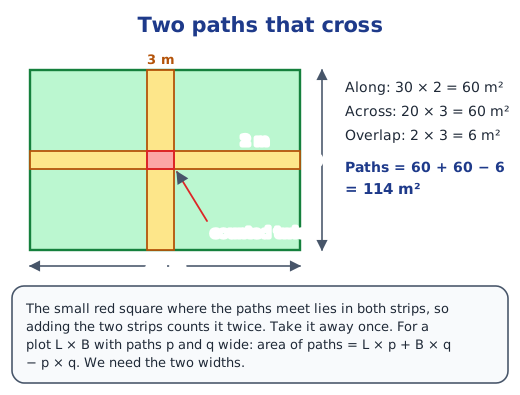
3. We need the widths of the two paths. If the path along the 14 m side is p m wide and the path along the 12 m side is q m wide, the paths cover 14p + 12q − pq, because the square where they cross is in both strips. For p = 2 m and q = 1 m: 28 + 12 − 2 = 38 m².
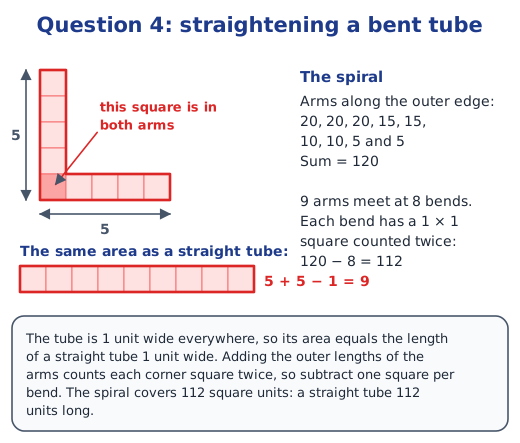
4. Hint first: the bent tube’s arms are 5 and 5 units on the outside, and the 1 × 1 corner square belongs to both arms, so its area is 5 + 5 − 1 = 9 square units, and the straight tube must be 9 units long. The spiral is 1 unit wide with arms 20, 20, 20, 15, 15, 10, 10, 5 and 5 along the outer edge, which add up to 120. Its 9 arms meet at 8 bends, and each bend’s corner square has been counted twice, so the area is 120 − 8 = 112 square units, the same as a straight tube 112 units long.
5. Region 3 is the half of the square below the diagonal. The line from the corner meets the diagonal at its midpoint, so regions 1 and 2 have equal bases (the two halves of the diagonal) and the same height: each is a quarter of the square. Doubling the side makes the square 2 × 2 = 4 times as big, and each region is a fixed part of it, so each region becomes 4 times as big. The increase is 3 times the old area: for a side s, regions 1 and 2 each grow by ¾s² and region 3 by 3/2 s². For s = 4 cm, regions 1 and 2 grow from 4 cm² to 16 cm² and region 3 from 8 cm² to 32 cm².
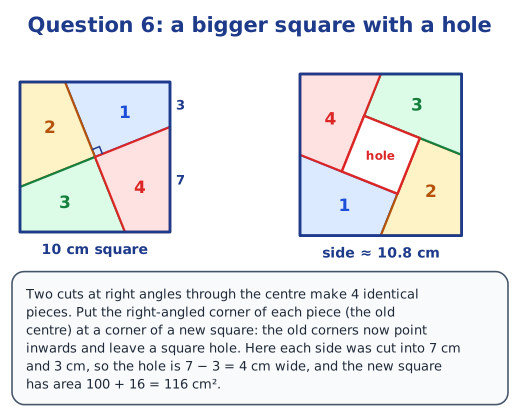
6. With both lines through the centre at right angles, the four pieces are identical. Turn each piece so that its right-angled corner at the centre becomes a corner of a new, larger square. The old corners of the square now point inwards, and a square hole is left in the middle. Its side is the difference between the two parts into which a cut divides a side, and the new square’s area minus the hole equals the old square’s area.
Triangles (pages 153–157)
∆XDC or ∆YDC? ∆XDC or ∆YBC? All of them have equal areas. Dropping the height from X (or Y) splits the rectangle into two rectangles, and the triangle is half of each, so every triangle is half of ABCD.
Area of ∆XDC (Fig. 7.1). ½ × 5 × 4 = 10 square units.
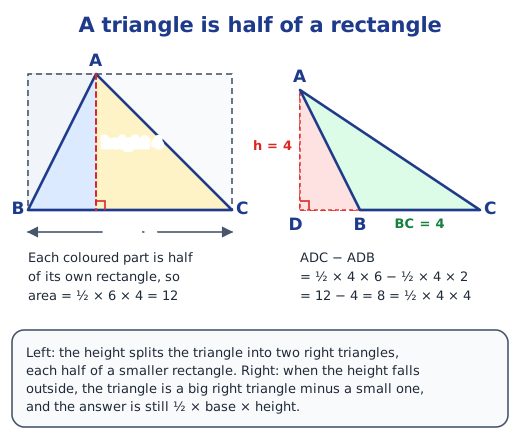
How do we get the outer rectangle? Draw the line l through A parallel to BC, and the perpendiculars to BC at B and C, meeting l at E and D. BCDE is a rectangle: the angles at B and C are right angles by construction, and since l ∥ BC, the angles at D and E are right angles too. In the same way BXAE is a rectangle, so the rectangle’s height equals the triangle’s height AX.
Triangles on base BC with their top corner on l ∥ BC. (i) All of them have the same area, ½ × BC × (the distance between l and BC), so none is largest or smallest. (ii) There is no largest perimeter: the sides grow without limit as the top corner moves away. The smallest perimeter comes when the top corner lies on the perpendicular bisector of BC.
Does A lie on the perpendicular bisector of BC? Yes. B and C′ are equally far from l on opposite sides, because C′ is the mirror image of C and BC ∥ l. Drop perpendiculars BX and C′Y to l. Triangles AXB and AYC′ have a right angle, equal sides BX = C′Y and equal vertically opposite angles at A, so they are congruent and XA = AY. As XY = BC, A is right above the midpoint of BC.
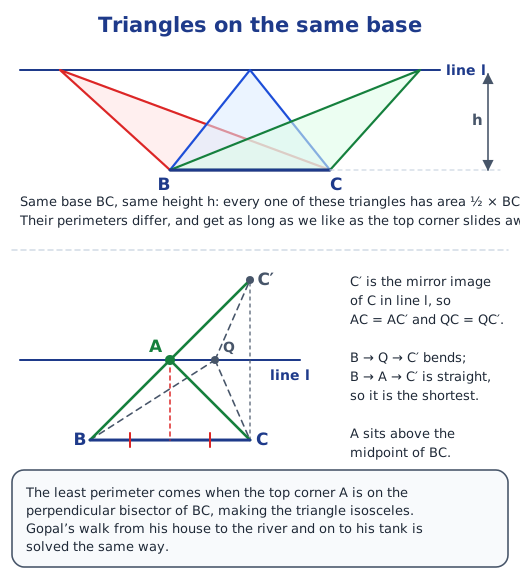
Figure it Out (pages 157–159)
1. (i) ½ × 4 × 3 = 6 cm². (ii) ½ × 5 × 3.2 = 8 cm². (iii) ½ × 3 × 4 = 6 cm².
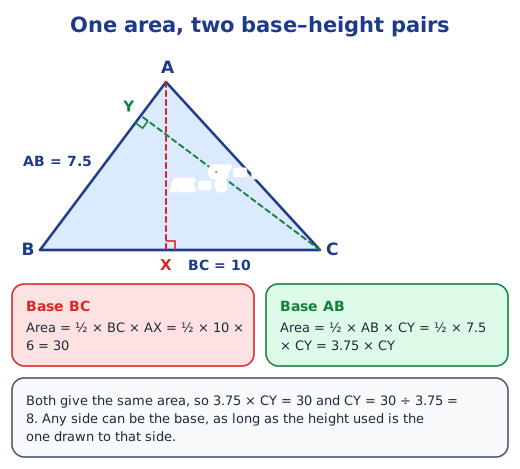
2. Area = ½ × BC × AX = ½ × 6 × 4 = 12 square units. Also area = ½ × AC × BY = ½ × 8 × BY = 4 × BY. So 4 × BY = 12 and BY = 3 units.
3. In isosceles ∆SUB with SU = SB, the perpendicular SE meets UB at its midpoint (∆SEU ≅ ∆SEB by RHS). So ∆SEU also has area 24, and area of ∆SUB = 24 + 24 = 48 square units.
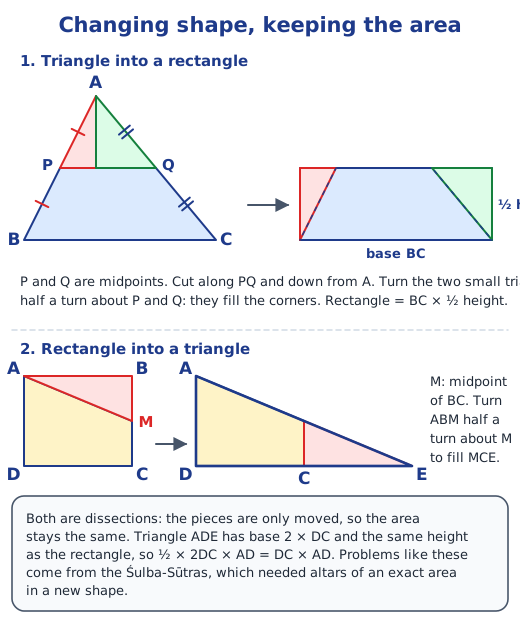
4. Let ABCD be the rectangle and M the midpoint of BC. Join AM and extend it to meet DC extended at E. Triangles ABM and ECM are congruent (BM = CM, right angles at B and C, vertically opposite angles at M). Cut off ∆ABM and turn it about M to fill ∆ECM. The rectangle becomes ∆ADE, with base 2 × DC and the same height, so ½ × 2DC × AD = DC × AD.
5. Let P and Q be the midpoints of AB and AC, using the longest side BC as the base. Cut along PQ, and cut from A straight down to PQ at X. Turn ∆APX half a turn about P and ∆AQX half a turn about Q: they fill the two corners above B and C. The result is a rectangle with base BC and half the triangle’s height, whose area is ½ × BC × height.
6. Let each square have side s. The red region is triangle DCH, with base DC = s and height CH = 2s, so its area is ½ × s × 2s = s², exactly one square. The line DH crosses AB at its midpoint, so the blue triangle has sides s and ½s around a right angle, and area ¼s². (i) Red = 49, so s² = 49 and blue = 49 ÷ 4 = 12.25 square units. (ii) Blue + red = ¼s² + s² = 5/4 s² = 180, so s² = 144 square units for each square.
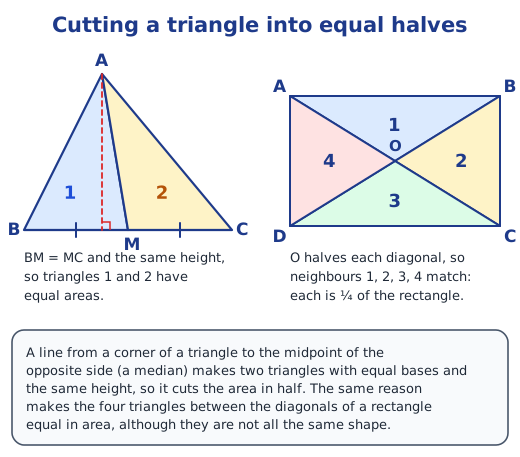
7. Join NY. YN is a median of ∆XYZ, so ∆XNY is half of ∆XYZ. In ∆XNY, NM joins N to the midpoint of XY, so ∆XMN is half of ∆XNY. Therefore ∆XMN is ¼ of ∆XYZ.
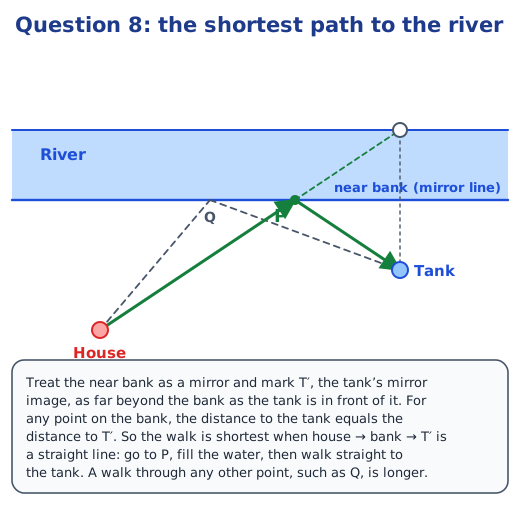
8. Treat the near bank of the river as a mirror. Mark the tank’s image T′ on the other side of the bank, as far from it as the tank. Any point on the bank is as far from T′ as from the tank, so the walk house → bank → tank is as long as house → bank → T′, which is shortest when it is straight. Join the house to T′; where this line meets the bank is the place to collect water, and from there Gopal walks straight to the tank.
Area of any polygon (page 159)
This quadrilateral. Join BD to make two triangles. We need BD and the perpendicular heights to it from A and from C; then area = ½ × BD × (sum of the two heights).
This pentagon. Join one corner to the two corners that are not next to it. This makes three triangles; find the base and height of each and add the areas.
Can any polygon be divided into triangles? Yes. A polygon whose corners all point outwards can be cut into triangles from one corner, an n-sided polygon into n − 2 triangles. Other polygons can also be cut into triangles, with a little more care.
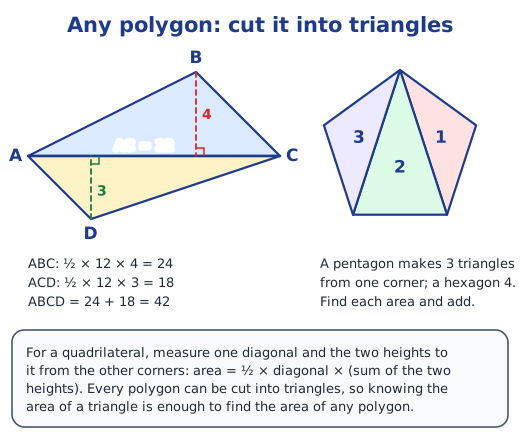
Figure it Out (page 160)
1. Area = ½ × 22 × 3 + ½ × 22 × 3 = 33 + 33 = 66 cm².
2. Rectangle ABCD = 18 × 10 = 180 cm². The white ∆AEF = ½ × 10 × 6 = 30 cm² and the white ∆EBC = ½ × 8 × 10 = 40 cm². Shaded region = 180 − 30 − 40 = 110 cm².
3. Lines from the centre to the six corners cut a regular hexagon into six identical equilateral triangles. So we need the side and the perpendicular distance from the centre to a side; then area = 6 × ½ × side × distance. (Another way: the side and the distance between two opposite sides, using a rectangle and two triangles.)
4. One half. The two blue triangles stand on the top and bottom sides of the rectangle, each of full length, and meet at one point inside. Their heights add up to the width of the rectangle, so together they cover ½ × length × width.
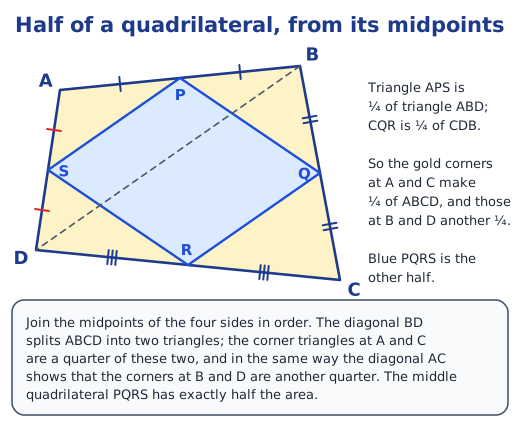
5. Join the midpoints of the four sides in order. The diagonal BD splits ABCD into two triangles, and by Question 7 the corner triangles at A and C are a quarter of these; the diagonal AC shows the same for the corners at B and D. The four corners make half of ABCD, so the middle quadrilateral has half the area.
Parallelogram (pages 161–162)
Converting a parallelogram into a rectangle. Draw AX ⟂ CD, cut off ∆AXD and move it to the other end. The fourth angle: the angles of a quadrilateral add up to 360°, so with three right angles the fourth is 360° − 270° = 90°. XY and DC: DX = CY, so adding XC to both gives XY = DC. Another side as base: yes; cutting along CZ and moving that triangle also makes a rectangle, so area = AD × CZ as well.
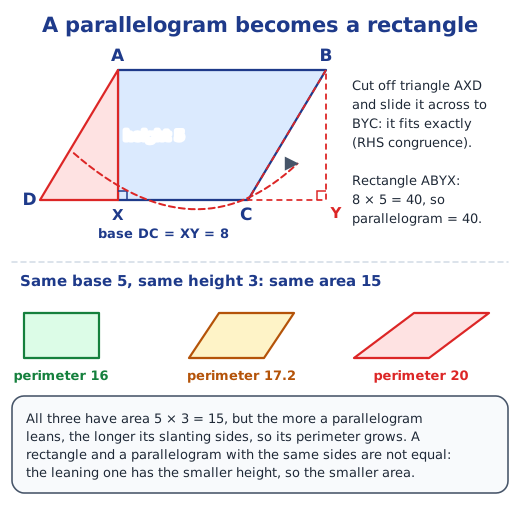
Figure it Out (pages 162–164)
1. (i) Each parallelogram has a base of 5 grid units and a height of 3, so all of them have the same area, 15 square units. (ii) Their perimeters are different: the more a parallelogram leans, the longer its slanting sides. (g) leans the most, so it appears to have the largest perimeter, and (a), which is almost a rectangle, the smallest.
2. (i) 7 × 4 = 28 cm². (ii) 5 × 3 = 15 cm² (the diagonal does not matter). (iii) 5 × 4.8 = 24 cm². (iv) 2 × 4.4 = 8.8 cm².
3. Area = SR × QM = 12 × 6 = 72 cm². Also area = PS × QN = 7.6 × QN. So QN = 72 ÷ 7.6 ≈ 9.47 cm (exactly 180/19 cm).
4. The rectangle. Its area is 5 × 4 = 20 cm². On the same 5 cm base, the parallelogram’s 4 cm side leans, so its height is less than 4 cm (the slanting side is the longest side of a right triangle with the height as one side), and its area 5 × height is less than 20 cm².
5. Some methods: (a) draw the rectangle around the triangle, with the base BC and the triangle’s height, using perpendiculars at B and C and the line through A parallel to BC: the triangle is half of it. (b) Turn a copy of the triangle half a turn about the midpoint of a side to make a parallelogram, then cut and slide it into a rectangle. (c) Draw any rectangle whose sides are the base and the height. Each has area base × height = 2 × the triangle.
6. Cut the triangle along PQ, the line joining the midpoints of AB and AC. Turn ∆APQ half a turn about Q, so that A lands on C: the pieces now form a parallelogram with base BC and half the height. Cut off a right triangle from one end and slide it to the other to get a rectangle with base BC and half the height, the same area as the triangle. (Question 5 of the triangles set gives another way.)
7. Cut along the altitude AD. ∆ADB and ∆ADC are congruent (RHS: AB = AC, AD common), and each is half of a rectangle with sides AD and BD. Turn ∆ADC over and place its side AC against AB, with the right angles at opposite corners: together they make a rectangle AD × BD, whose area AD × ½BC equals the triangle’s area.
8. Cut the rectangle along a diagonal into two identical right triangles. Turn one over and place the two side by side so that one pair of equal sides lies together and the other sides form a straight line. The result is an isosceles triangle. A 6 cm × 4 cm rectangle, for example, gives a triangle with base 12 cm and height 4 cm (area 24 cm²), or base 8 cm and height 6 cm.
9. The square has the greater area in both cases. In an equilateral triangle of side s, the height is shorter than s, because it is one side of a right triangle whose longest side is s. So the triangle’s area ½ × s × height is less than ½s², and two such triangles make s × height, still less than the square’s s². By the Baudhāyana–Pythagoras theorem (Part 2 Chapter 2), the height is about 0.87s.
Rhombus (pages 164–166)
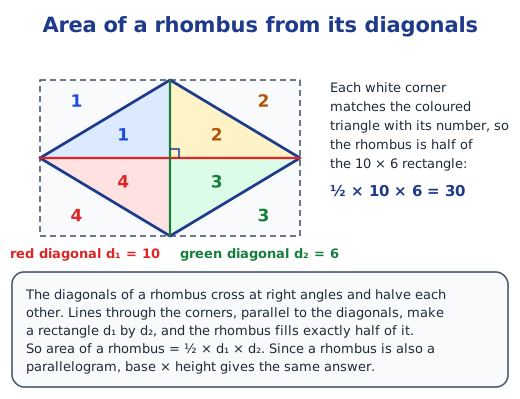
Sides of the rectangle WXYZ. XW is the diagonal AC and WZ is half the other diagonal BD, so the area is AC × ½BD.
From ∆ADB and ∆CDB. ½ × AO × BD + ½ × CO × BD = ½ × BD × (AO + CO) = ½ × BD × AC, the same formula.
Trapezium (pages 166–169)
The three trapeziums on the grid (counting grid squares). ABCD: rectangle 4 × 4 = 16 plus a triangle ½ × 2 × 4 = 4, so 20. PQRS: rectangle 6 × 3 = 18 plus two triangles of ½ × 2 × 3 = 3, so 24. WXYZ: rectangle 5 × 4 = 20 plus two triangles of ½ × 2 × 4 = 4, so 28 square units.
Is WXNM a rectangle? Yes: WM and XN are perpendicular to ZY, and since WX ∥ ZY, the angles at W and X are right angles too.
A trapezium that leans over. Approach 1: ABEF is a rectangle a × h, so ABED = ah − ½ × FD × h. ∆BEC has base EC = b − a + FD. Adding, ah − ½FD·h + ½(b − a + FD)h = ah + ½(b − a)h = ½h(a + b). Approach 2: ABGD is a parallelogram with area a × h, and ∆BGC has base b − a, so the total is ah + ½(b − a)h = ½h(a + b). Does Approach 2 always work? Yes, if the parallel line is drawn from an end of the shorter parallel side: then G lands on the longer side, because DG = a is less than b.
Two copies of the trapezium. The joined figure is a parallelogram with base a + b and height h, so the trapezium is ½h(a + b).
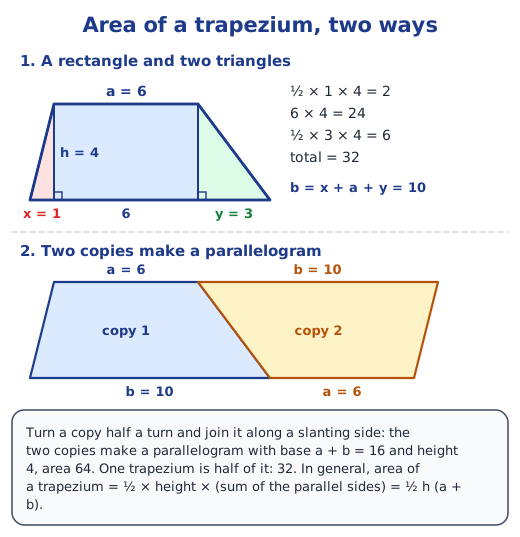
Figure it Out (pages 169–170)
1. ½ × 20 × 15 = 150 cm².
2. Take a rectangle of length l and width w. Cut it across the middle into two strips l × ½w, and cut each strip along a diagonal. The four right triangles have sides l and ½w around the right angle. Put them together with their right angles meeting at one point: they form a rhombus with diagonals 2l and w, and area ½ × 2l × w = l × w. For example, an 8 cm × 6 cm rectangle becomes a rhombus with diagonals 16 cm and 6 cm, area 48 cm².
3. (i) ½ × 16 × (10 + 7) = 136 ft². (ii) ½ × 14 × (24 + 36) = 420 m². (iii) ½ × 10 × (14 + 6) = 100 in². (iv) ½ × 8 × (12 + 18) = 120 ft².
4. Drop perpendiculars from the two ends of the shorter parallel side. Cut off the right triangle at one end, turn it over and fit it against the slanting side at the other end; it fits because an isosceles trapezium has equal slanting sides. The pieces form a rectangle with the trapezium’s height and a length of ½(a + b).
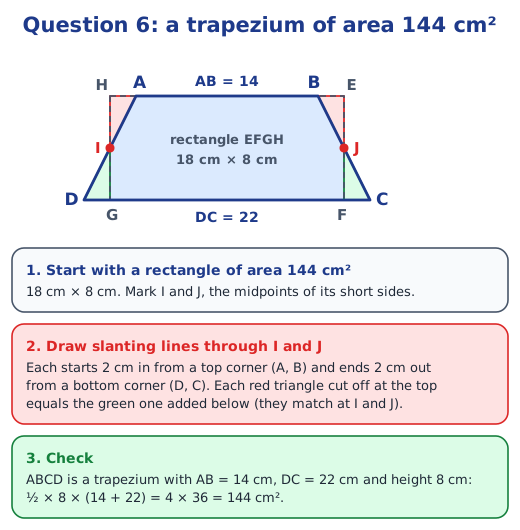
5. Mark I and J, the midpoints of the slanting sides AD and BC. Through I and J draw lines perpendicular to DC; they meet DC at G and F and the line AB at H and E. Then ∆AHI ≅ ∆DGI (AI = DI, vertically opposite angles at I, right angles at H and G), and in the same way ∆BEJ ≅ ∆CFJ. So the rectangle EFGH gains at each top corner exactly what it loses at the bottom, and it has the same area as ABCD.
6. Start with a rectangle of area 144 cm², say 18 cm × 8 cm, and work Question 5 backwards. Through the midpoints of its short sides, draw slanting lines that start 2 cm inside the top corners and end 2 cm outside the bottom corners. The triangles cut off at the top equal those added at the bottom, giving a trapezium with parallel sides 14 cm and 22 cm and height 8 cm: ½ × 8 × (14 + 22) = 144 cm².
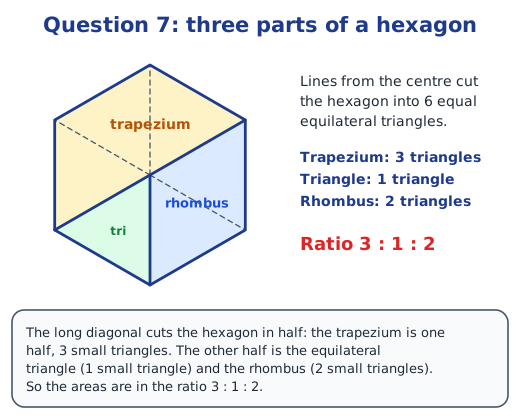
7. Lines from the centre cut the regular hexagon into 6 identical equilateral triangles. The trapezium holds 3 of them, the equilateral triangle 1 and the rhombus 2, so the ratio is 3 : 1 : 2.
8. Triangles ZYA and BXA are congruent: AY = AX, the angles at A are vertically opposite, and ∠YZA = ∠XBA as alternate angles (ZY ∥ WB). The trapezium is quadrilateral ZAXW plus ∆ZYA, and ∆ZWB is ZAXW plus ∆BXA. The added triangles are equal, so the trapezium and ∆ZWB have equal areas.
Areas in real life (pages 170–171)
A4 sheet. 21 × 29.7 = 623.7 cm². Your tabletop: for example, a table 120 cm × 60 cm has area 7200 cm², room for about 7200 ÷ 623.7 ≈ 11 A4 sheets.
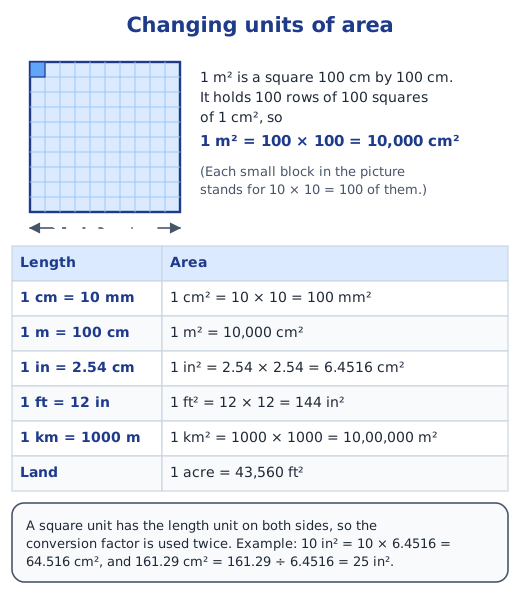
In centimetres. (i) 5 in = 5 × 2.54 = 12.7 cm. (ii) 7.4 in = 18.796 cm.
In inches. (i) 5.08 cm = 5.08 ÷ 2.54 = 2 in. (ii) 11.43 cm = 4.5 in.
161.29 cm² in in². 161.29 ÷ 6.4516 = 25 in².
1 ft² in in². 12 × 12 = 144 in².
1 km² in m². 1000 × 1000 = 10,00,000 m².
Classroom, school, village or town. Measure or pace out the length and width and multiply; a classroom 9 m × 6 m, for example, is 54 m². To compare your town with your school, write both areas in the same unit and divide. For a town or city, official figures depend on where its boundary is drawn, so check the municipal or census records.
Local units. Bigha, gaj, katha, dhur, cent and ankanam are some local units. Extra: a gaj usually means a square yard (about 0.84 m²) and a cent is 1/100 acre (435.6 ft²), while a bigha differs from region to region.
Largest and smallest cities. This is a project: the answer depends on whether only the city’s official limits or the whole built-up area is counted, so note your source with each answer.
Practice
-
A triangle has area 42 cm² and base 14 cm. Its height is:
Show answer
Answer: (b) 6 cm
-
A trapezium has area 90 cm², height 6 cm and one parallel side 12 cm. The other parallel side is:
Show answer
Answer: (b) 18 cm
-
How many cm² is 1 m²?
Show answer
Answer: (c) 10,000
-
A rhombus has side 13 cm and one diagonal 24 cm. The other diagonal is 10 cm. Find its area.
Show answer
Answer: Area = ½ × 24 × 10 = 120 cm². (Half-diagonals 12 and 5 with side 13 fit the right angle at the centre: 12² + 5² = 13².)
-
A square park of side 40 m has a path 2.5 m wide along the inside of its boundary. Find the area of the path.
Show answer
Answer: The inner square is 40 − 5 = 35 m wide. Path = 40 × 40 − 35 × 35 = 1600 − 1225 = 375 m².
Stuck on a question?
Take a photo and Lagnever AI explains it step by step. Try it for 7 days for ₹2.
Get it on Google Play Open in browser
For parents: after the trial, the plan renews monthly by UPI or card autopay. You can cancel anytime in the app.