
Class 8 Maths Part 2 Chapter 7: Area Notes
This chapter in five lines
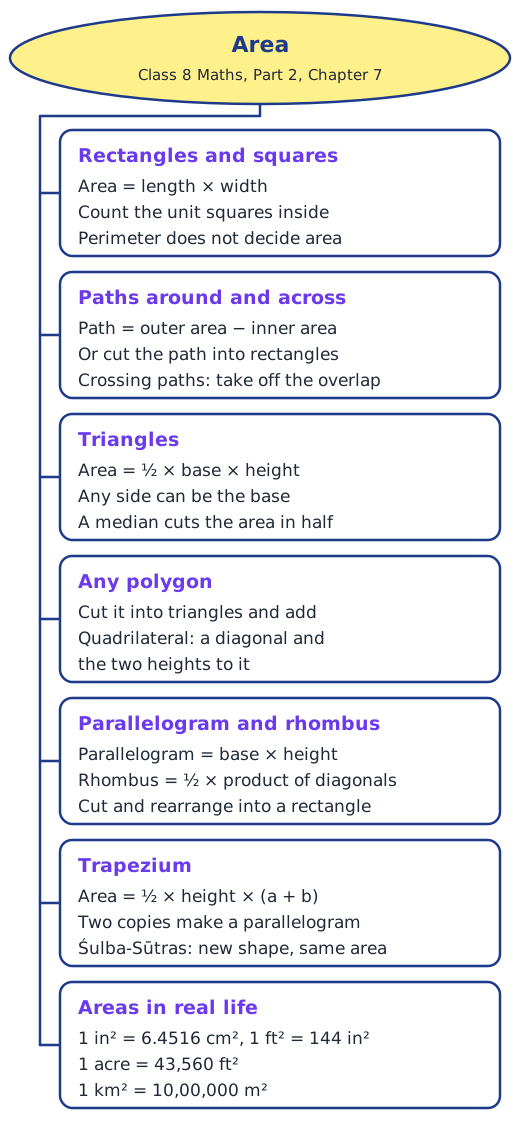
Area counts how many unit squares cover a region, and perimeter cannot replace it. A rectangle is length × width, and a triangle is half of a rectangle: ½ × base × height. Any polygon can be cut into triangles. Cutting and rearranging gives the parallelogram, rhombus and trapezium formulas, and real areas are measured in cm², in², ft², m², acres and km².
What is this chapter about?
Area tells us how much surface a region covers. This chapter starts from the rectangle, builds the formula for a triangle, and then uses triangles and clever cutting to find the area of any polygon. It ends with the units we use for paper, rooms, land and whole cities.
Rectangles, paths and perimeter
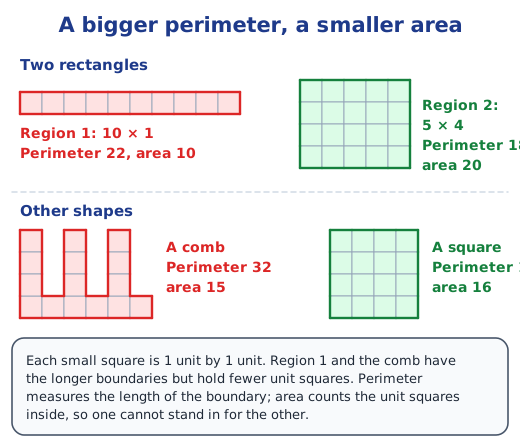
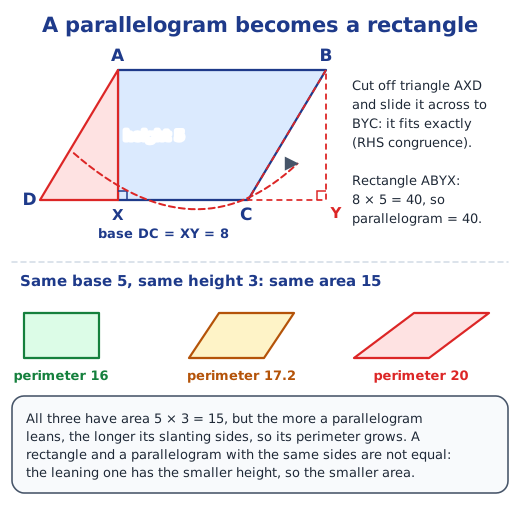
We measure area by counting unit squares, and a rectangle of length l and width w holds l × w of them. Perimeter is not a substitute: a 10 cm by 1 cm strip has a longer boundary than a 5 cm by 4 cm card but only half its area. The area of a path around a park is the outer rectangle minus the park, and where two paths cross, the shared square must be counted once. Read rectangles, paths and units of area.
Triangles
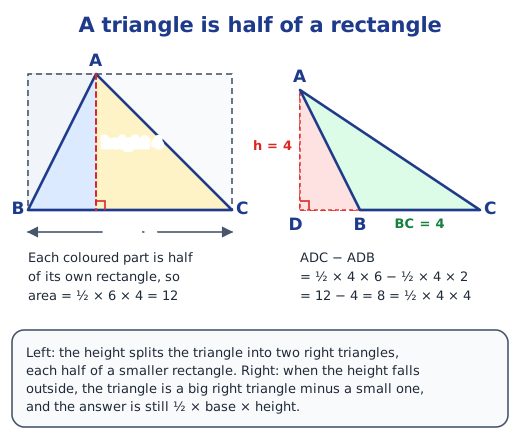
A triangle fits inside a rectangle with the same base and height, and it fills exactly half of it, so its area is ½ × base × height. The formula works for every triangle, even when the height falls outside the base. Because any side can be the base, two base–height pairs give the same area, which helps find a missing height. A median cuts a triangle into two equal halves. Read area of triangles.
Any polygon
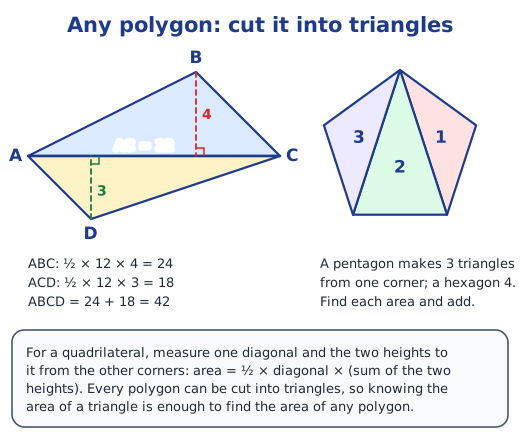
Every polygon can be cut into triangles. For a quadrilateral, one diagonal makes two triangles, so we need the diagonal and the two heights to it: area = ½ × diagonal × (sum of the heights). A pentagon makes three triangles from one corner. Read area of quadrilaterals.
Parallelogram and rhombus
Cut a right triangle off one end of a parallelogram and slide it to the other end: you get a rectangle, so a parallelogram’s area is base × height. Any side can be the base, as long as the height is drawn to that side. A rhombus is half of the rectangle formed around its diagonals, so its area is ½ × d₁ × d₂.
Trapezium
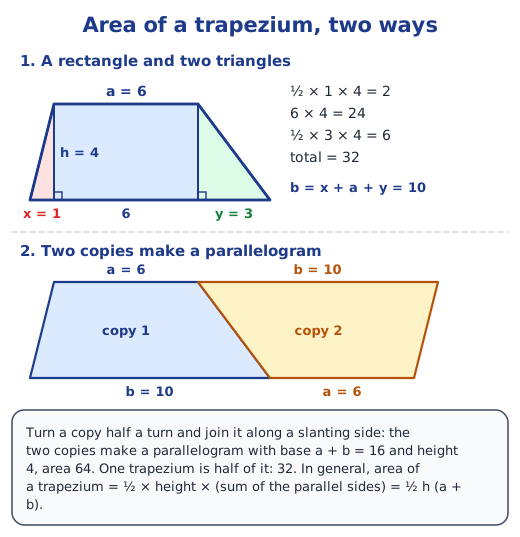
A trapezium with parallel sides a and b and height h splits into a rectangle and two triangles, or doubles up with a turned copy into a parallelogram of base a + b. Either way, its area is ½ × h × (a + b).
Changing the shape, keeping the area
The Śulba-Sūtras, ancient Indian texts on building altars, ask how to turn one shape into another of the same area. Cutting a triangle along the line joining the midpoints of two sides and moving two small pieces makes a rectangle; cutting a rectangle from a corner to the midpoint of a side makes a triangle. Euclid’s Elements solves problems of the same kind.
Areas in real life
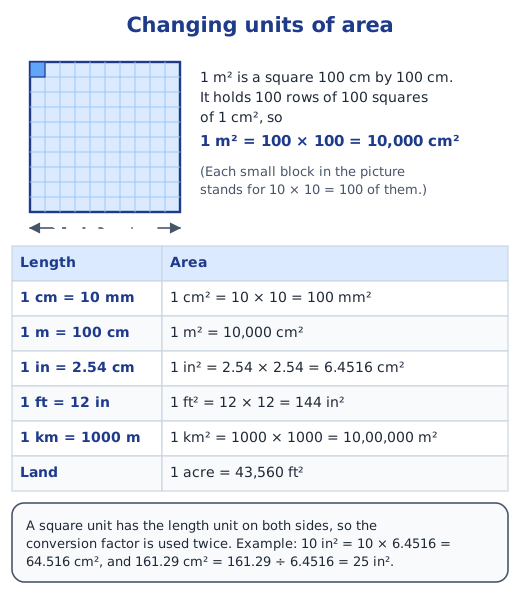
An A4 sheet is 21 cm by 29.7 cm, so its area is 623.7 cm². Furniture is often measured in inches and feet, rooms in ft² or m², land in acres and cities in km². To change a unit of area, use the length factor twice: 1 in = 2.54 cm gives 1 in² = 6.4516 cm². Many regions of India also use local units such as bigha, gaj, katha, dhur, cent and ankanam.
Before we move on
Almost every area problem comes back to two ideas: count unit squares with length × width, and cut shapes into triangles or rearrange them into rectangles. Answers to every question are in the NCERT solutions for Part 2 Chapter 7.
Key terms
| Term | Meaning |
|---|---|
| Area | The number of unit squares, whole or in parts, that exactly cover a region. |
| Unit square | A square with sides of 1 unit, such as 1 cm by 1 cm; its area is 1 square unit (1 cm²). |
| Perimeter | The length of the boundary of a region. Two regions with the same perimeter can have different areas. |
| Base and height of a triangle | Any side can be the base; the height is the perpendicular distance from the opposite corner to the line of that base. |
| Median | A line from a corner of a triangle to the midpoint of the opposite side. It cuts the triangle into two halves of equal area. |
| Diagonal | A line joining two corners of a polygon that are not next to each other. |
| Parallelogram | A quadrilateral whose opposite sides are parallel. Area = base × height. |
| Rhombus | A parallelogram with all four sides equal. Its diagonals cross at right angles; area = ½ × product of the diagonals. |
| Trapezium | A quadrilateral with one pair of parallel sides. Area = ½ × height × (sum of the parallel sides). |
| Dissection | Moving the pieces of a cut-up shape to build a new shape; the area stays the same. |
| Śulba-Sūtras | Ancient Indian texts on building altars, with many problems on turning one shape into another of equal area. |
| Acre | A unit for land: 1 acre = 43,560 ft². Larger areas are measured in km². |
Topics in this chapter
Practice
-
A triangle has base 9 cm and height 4 cm. Its area is:
Show answer
Answer: (b) 18 cm²
-
Which of these always has the larger area?
Show answer
Answer: (b) The shape that holds more unit squares
-
A parallelogram has base 12 m and height 5 m. Its area is:
Show answer
Answer: (c) 60 m²
-
The diagonals of a rhombus are 14 cm and 10 cm. Its area is:
Show answer
Answer: (b) 70 cm²
-
A trapezium has parallel sides 9 cm and 5 cm and height 6 cm. Its area is:
Show answer
Answer: (a) 42 cm²
-
How many square inches make 1 square foot?
Show answer
Answer: (d) 144
Questions students ask
What are the main topics of Class 8 Maths Part 2 Chapter 7?
Areas of rectangles and paths, why perimeter cannot measure area, the area of a triangle and its uses, the area of any polygon, special formulas for the parallelogram, rhombus and trapezium, problems from the Śulba-Sūtras, and units of area used in real life.
Is Area in the new NCERT Class 8 Maths book?
Yes. It is Chapter 7 of Ganita Prakash, Grade 8 Part 2, on pages 148 to 171 of the first edition (December 2025). It is the last chapter of Part 2.
Why is the area of a triangle half of base × height?
Draw a rectangle around the triangle with the same base and height. The height splits the triangle into two right triangles, and each is half of one part of the rectangle, so the triangle is half of the whole rectangle.
Do I need to learn a new formula for every shape?
Not really. Every formula in the chapter comes from the rectangle and the triangle, by cutting a shape into triangles or by moving pieces to make a rectangle. If you forget a formula, you can rebuild it that way.
Stuck on a question?
Take a photo and Lagnever AI explains it step by step. Try it for 7 days for ₹2.
Get it on Google Play Open in browser
For parents: after the trial, the plan renews monthly by UPI or card autopay. You can cancel anytime in the app.