
Area of triangles
Answer in short
The area of a triangle is ½ × base × height, because every triangle fills exactly half of a rectangle with the same base and height. Any side can be the base if the height is drawn to that side, so two base–height pairs give the same area. A median cuts a triangle into two halves of equal area.
Stuck on a question? Take a photo and Lagnever AI explains it step by step. Try it for 7 days for ₹2. Get it on Google Play
Why is a triangle half of a rectangle?
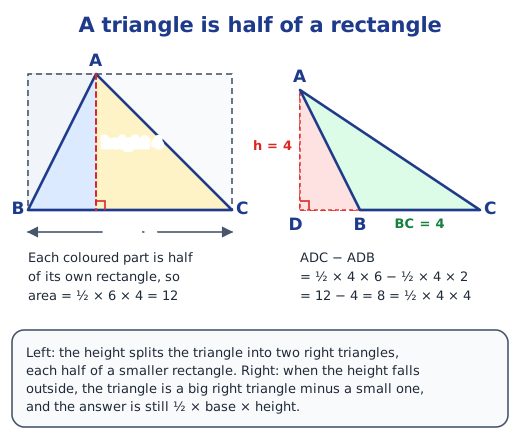
Take triangle ABC with base BC. Draw a line through A parallel to BC, and draw lines at B and C perpendicular to BC. They make a rectangle with the same base and the same height as the triangle. Now drop the height from A to BC. It splits the rectangle into two smaller rectangles, and it splits the triangle into two right triangles. Each right triangle is cut off by the diagonal of one small rectangle, so it is exactly half of that rectangle. Adding the two halves, the triangle is half of the whole rectangle:
Area of a triangle = ½ × base × height.
A triangle with base 6 cm and height 4 cm therefore has area ½ × 6 × 4 = 12 cm², half of the 24 cm² rectangle around it.
What if the height falls outside the triangle?
In an obtuse triangle, the height from A may land on the line of BC extended, at a point D beyond B. We cannot draw a rectangle on BC around such a triangle, but we can still find its area. Triangle ABC is the big right triangle ADC with the small right triangle ADB taken away. Each of those is half of a rectangle, so with height h:
Area = ½ × h × DC − ½ × h × DB = ½ × h × (DC − DB) = ½ × h × BC.
The same formula holds for every triangle.
Can any side be the base?
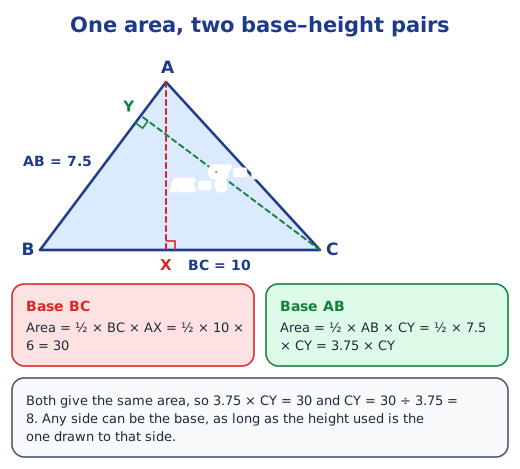
Yes. A triangle has three sides and three heights, one drawn to each side. Every base–height pair gives the same area, and this is a neat way to find a length that is hard to measure. In the diagram, BC = 10 and the height AX = 6, so the area is ½ × 10 × 6 = 30. If AB = 7.5, the height CY to AB must satisfy ½ × 7.5 × CY = 30, so CY = 8.
How does a median cut a triangle?
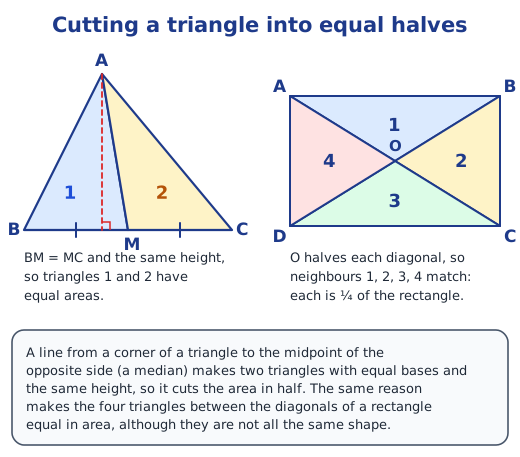
A median joins a corner to the midpoint of the opposite side. The two triangles it makes have equal bases (the two halves of that side) and the same height (from the same corner). So a median always cuts a triangle into two parts of equal area, even though the parts usually have different shapes. The same reasoning shows that the two diagonals of a rectangle make four triangles of equal area: the diagonals halve each other, so any two neighbouring triangles have equal bases and the same height.
Triangles on the same base
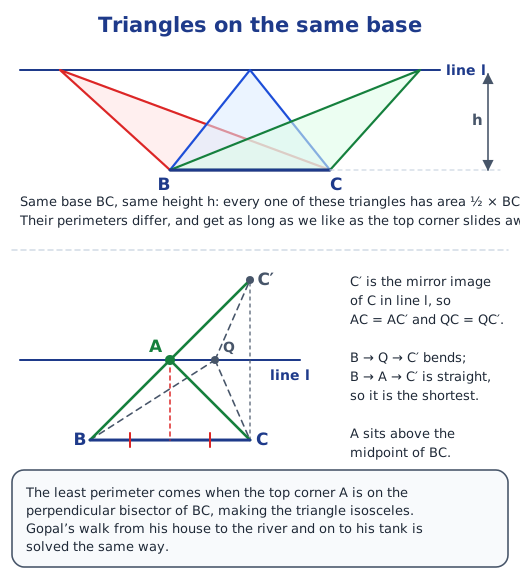
Fix a base BC and draw a line l parallel to it. Every triangle with base BC and its top corner on l has the same height, the gap between the two lines, so all of them have the same area. Their perimeters, however, are different, and they keep growing as the top corner slides further away. The least perimeter comes when the top corner sits right above the midpoint of BC. To see why, treat l as a mirror and reflect C to C′. The distance from any point A on l to C equals its distance to C′, and the path B → A → C′ is shortest when it is straight.
How can a triangle become a rectangle?
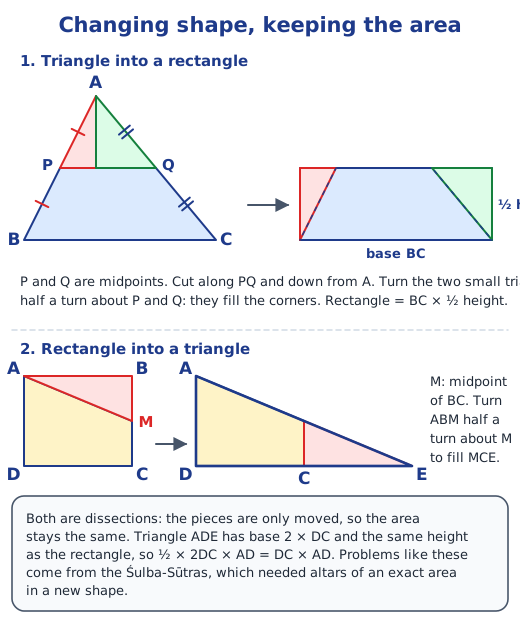
The Śulba-Sūtras, ancient Indian texts on building fire altars, needed shapes changed without changing their area. Join the midpoints P and Q of two sides of a triangle, cut along PQ, and cut down from the top corner to PQ. Turning the two small pieces half a turn about P and Q fills the corners below, and the triangle becomes a rectangle with the same base and half the height. Going the other way, a rectangle becomes a triangle with twice the base when we cut from a corner to the midpoint of a side and swing that piece round.
Read next: area of quadrilaterals, rectangles, paths and units of area, the chapter notes and NCERT solutions.
Practice
-
A triangle has base 12 cm and height 5 cm. Its area is:
Show answer
Answer: (b) 30 cm²
-
A triangle of area 24 cm² has a side of 8 cm. The height to that side is:
Show answer
Answer: (c) 6 cm
-
A median divides a triangle of area 50 cm² into two triangles of area:
Show answer
Answer: (a) 25 cm² each
-
Triangle PQR has QR = 15 cm, the height from P to QR is 8 cm and PQ = 12 cm. Find the height from R to PQ.
Show answer
Answer: Area = ½ × 15 × 8 = 60 cm². Also area = ½ × 12 × height, so 6 × height = 60 and the height is 10 cm.
-
M and N are the midpoints of sides XY and XZ of a triangle of area 64 cm². What is the area of triangle XMN?
Show answer
Answer: Joining NY makes a median of triangle XYZ, so XNY is 32 cm². NM is a median of triangle XNY, so XMN is half of that: 16 cm², a quarter of the whole.
Questions students ask
How do you find the area of a triangle?
Area = ½ × base × height. The base can be any side, and the height is the perpendicular distance from the opposite corner to the line of that side.
Does the formula work for an obtuse triangle?
Yes. When the height falls outside the base, the triangle is a big right triangle minus a small one. Working it out gives ½ × height × (the difference of the two bases), which is again ½ × base × height.
How do you find the height of a triangle from its area?
Height = 2 × area ÷ base. If the area is known from one base–height pair, the same area gives the height to any other side.
Stuck on a question?
Take a photo and Lagnever AI explains it step by step. Try it for 7 days for ₹2.
Get it on Google Play Open in browser
For parents: after the trial, the plan renews monthly by UPI or card autopay. You can cancel anytime in the app.