
Area of quadrilaterals
Answer in short
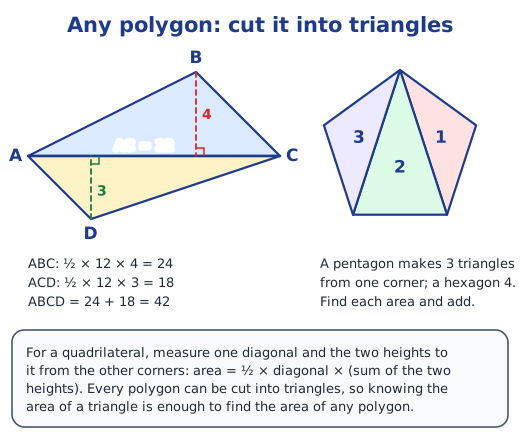
Any quadrilateral can be cut by a diagonal into two triangles, so its area is ½ × diagonal × (sum of the two heights to it). Special shapes have shortcuts: a parallelogram is base × height, a rhombus is ½ × product of the diagonals, and a trapezium is ½ × height × (sum of the parallel sides).
Stuck on a question? Take a photo and Lagnever AI explains it step by step. Try it for 7 days for ₹2. Get it on Google Play
How do you find the area of any polygon?
Every polygon can be cut into triangles, and we already know how to find the area of a triangle. For a quadrilateral ABCD, the diagonal AC makes triangles ABC and ACD. Measure AC and the two heights to it, one from B and one from D. With AC = 12 cm and heights 4 cm and 3 cm, the area is ½ × 12 × 4 + ½ × 12 × 3 = 24 + 18 = 42 cm². In one step: ½ × diagonal × (sum of the two heights). A pentagon cut from one corner gives three triangles, a hexagon four, and so on.
For the special quadrilaterals below there are shorter formulas, and each one comes from cutting and rearranging.
Why is a parallelogram base × height?
Draw a height AX from corner A to the base DC. Cut off triangle AXD and slide it across to the other end. It fits exactly into the gap BYC, because the two right triangles have equal hypotenuses (AD = BC) and equal heights, so they are congruent by RHS. The parallelogram has become a rectangle ABYX. Its width XY equals DC, since DX = CY, so
Area of a parallelogram = base × height.
A parallelogram with base 8 cm and height 5 cm has area 40 cm². Any side can be the base if we use the height drawn to that side.
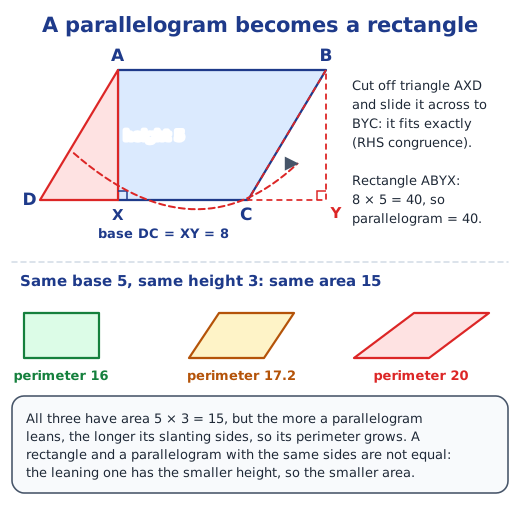
So parallelograms with the same base and the same height all have equal areas, however much they lean. Their perimeters are not equal: the more they lean, the longer the slanting sides. And a rectangle with sides 5 cm and 4 cm has a larger area than a parallelogram with the same sides, because the leaning side is longer than the parallelogram’s height.
How do you find the area of a rhombus?
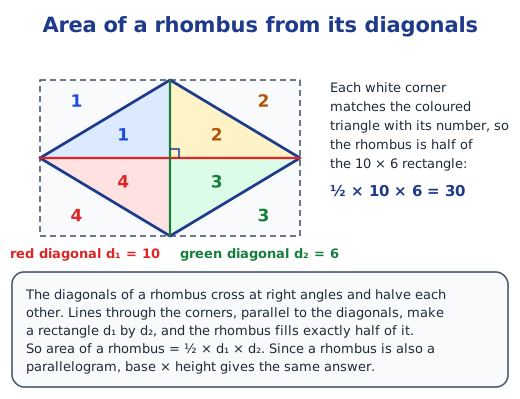
A rhombus is a parallelogram, so base × height works. Its diagonals give a second way. They cross at right angles and halve each other. Draw lines through the four corners parallel to the diagonals: they make a rectangle whose sides are the two diagonals. Each corner triangle outside the rhombus matches a triangle inside it, so the rhombus is exactly half the rectangle:
Area of a rhombus = ½ × d₁ × d₂.
With diagonals 10 cm and 6 cm, the area is ½ × 10 × 6 = 30 cm². The Śulba-Sūtras describe another way: split the rhombus along a diagonal into two isosceles triangles, turn each into a rectangle, and join them into one rectangle with sides AC and ½ BD.
What is the formula for a trapezium?
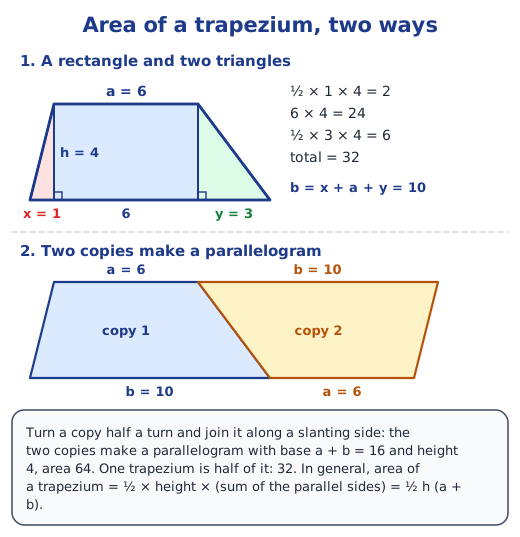
A trapezium has one pair of parallel sides, a and b, and a height h between them. Drop heights from the ends of the shorter side. They cut the trapezium into a rectangle a × h and two right triangles with bases x and y, where x + a + y = b. Adding the three areas, ½hx + ha + ½hy = ½h(x + y + 2a) = ½h(a + b).
Two copies give a quicker proof. Turn one copy half a turn and join it to the other along a slanting side. The angles along each joined side add up to 180°, so the result is a parallelogram with base a + b and height h. One trapezium is half of it:
Area of a trapezium = ½ × height × (sum of the parallel sides).
With a = 6, b = 10 and h = 4, the area is ½ × 4 × 16 = 32 square units.
Which formula should I use?
- Any quadrilateral: one diagonal and the two heights to it.
- Parallelogram: base × height, with the height drawn to that base.
- Rhombus: ½ × product of the diagonals, or base × height.
- Trapezium: ½ × height × (sum of the parallel sides).
- A rectangle and a square are parallelograms too, so length × width still fits.
Read next: area of triangles, rectangles, paths and units of area, the chapter notes and NCERT solutions.
Practice
-
A parallelogram has base 9 cm and height 7 cm. Its area is:
Show answer
Answer: (b) 63 cm²
-
A rhombus has diagonals 16 cm and 12 cm. Its area is:
Show answer
Answer: (b) 96 cm²
-
A trapezium has parallel sides 11 m and 7 m and height 4 m. Its area is:
Show answer
Answer: (a) 36 m²
-
A quadrilateral has a diagonal of 15 cm, and the heights to it from the other two corners are 6 cm and 4 cm. Find its area.
Show answer
Answer: Area = ½ × 15 × 6 + ½ × 15 × 4 = 45 + 30 = 75 cm², or ½ × 15 × (6 + 4) = 75 cm².
-
A parallelogram has sides 10 cm and 6 cm, and the height to the 10 cm side is 4.8 cm. What is the height to the 6 cm side?
Show answer
Answer: Area = 10 × 4.8 = 48 cm². Then 6 × height = 48, so the height to the 6 cm side is 8 cm.
Questions students ask
How do you find the area of any quadrilateral?
Draw one diagonal to cut it into two triangles. Measure the diagonal and the perpendiculars to it from the other two corners, find each triangle’s area and add them.
Why is the area of a parallelogram base × height?
Cut off the right triangle between one slanting side and a height, and slide it to the other end. The pieces make a rectangle with the same base and height, so the areas are equal.
What is the formula for the area of a trapezium?
Area = ½ × height × (sum of the parallel sides). Two copies of a trapezium, one turned round, make a parallelogram with base a + b, and the trapezium is half of it.
Stuck on a question?
Take a photo and Lagnever AI explains it step by step. Try it for 7 days for ₹2.
Get it on Google Play Open in browser
For parents: after the trial, the plan renews monthly by UPI or card autopay. You can cancel anytime in the app.