
Dividing fractions
Answer in short
To divide by a fraction, multiply by its reciprocal: a/b ÷ c/d = a/b × d/c = (a × d)/(b × c). This works because division asks what number times the divisor gives the dividend. Dividing by a number between 0 and 1 makes the quotient larger than the dividend.
Stuck on a question? Take a photo and Lagnever AI explains it step by step. Try it for 7 days for ₹2. Get it on Google Play
Division as multiplication
We already know that 12 ÷ 4 = 3. The same fact can be asked the other way round: what number times 4 gives 12? Writing every division as a missing-number multiplication is the trick that makes dividing fractions easy. In 12 ÷ 4 = 3, 12 is the dividend, 4 the divisor and 3 the quotient.
The reciprocal
What is 1 ÷ 2/3? Rewrite it as 2/3 × ? = 1. If the 2 and the 3 could cancel each other we would be left with 1, and 2/3 × 3/2 does exactly that. So 1 ÷ 2/3 = 3/2. The fraction 3/2, with numerator and denominator swapped, is the reciprocal of 2/3, and any fraction multiplied by its reciprocal gives 1. Now 3 ÷ 2/3 asks for 3 times as much: 2/3 × 3/2 × 3 = 3, so 3 ÷ 2/3 = 9/2. In the same way, 1/5 ÷ 1/2 = 2 × 1/5 = 2/5.
The rule
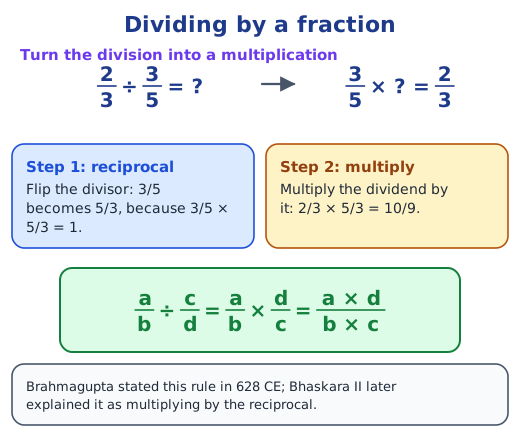
Look at 2/3 ÷ 3/5, that is, 3/5 × ? = 2/3. The reciprocal of the divisor, 5/3, turns 3/5 into 1, and multiplying by 2/3 then gives 2/3, so the quotient is 5/3 × 2/3 = 10/9. Every division follows the same two steps: find the reciprocal of the divisor, then multiply it by the dividend.
a/b ÷ c/d = a/b × d/c = (a × d)/(b × c).
Brahmagupta first stated this rule in general form in his Brahmasphutasiddhanta (628 CE), and Bhaskara II later described it as multiplying by the reciprocal.
Is the quotient bigger?
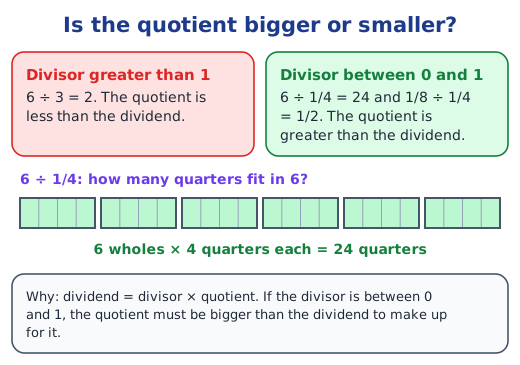
6 ÷ 3 = 2 is smaller than 6, but 6 ÷ 1/4 = 24 is much bigger: six wholes contain 24 quarters. Likewise 1/8 ÷ 1/4 = 1/2, bigger than 1/8. Since dividend = divisor × quotient, the multiplication rules settle it: a divisor between 0 and 1 makes the quotient larger than the dividend, and a divisor above 1 makes it smaller. Comparing the dividend with the divisor tells us about the quotient too: it is more than 1 exactly when the dividend is bigger than the divisor.
Using division in problems
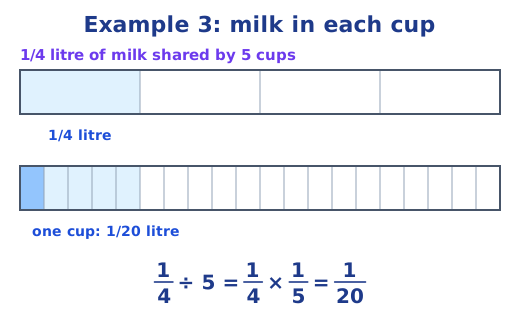
Leena makes 5 cups of tea with 1/4 litre of milk. Each cup has 1/4 ÷ 5 of a litre: the reciprocal of 5 is 1/5, so each cup gets 1/4 × 1/5 = 1/20 litre. Other problems follow the same pattern: 8 m of lace used 1/4 m at a time decorates 8 ÷ 1/4 = 32 bags; 1/2 m of ribbon shared by 8 badges gives 1/2 ÷ 8 = 1/16 m each; and 5 kg of flour at 1/6 kg a loaf makes 5 ÷ 1/6 = 30 loaves. The key step is deciding which quantity is being shared or measured, and which is doing the dividing.
Why it matters
Division of fractions answers ‘how many fit?’ and ‘how much each?’ questions in cooking, sharing, measuring and building. How multiplication works is in multiplying fractions, and old Indian puzzles that use division, such as Baudhayana’s bricks and the four fountains, are in fraction problems from Indian mathematics. Answers to every question are in the NCERT solutions for Chapter 8; see also the full Chapter 8 notes.
Practice
-
What is the reciprocal of 7/4?
Show answer
Answer: (b) 4/7
-
What is 3 ÷ 2/3?
Show answer
Answer: (b) 9/2
-
1/4 litre of milk is shared equally among 5 cups. How much milk is in each cup?
Show answer
Answer: (c) 1/20 litre
-
Maria has 8 m of lace and uses 1/4 m for each bag. How many bags can she decorate?
Show answer
Answer: 8 ÷ 1/4 = 8 × 4 = 32 bags.
-
Is 5 ÷ 3/7 more or less than 5? Explain without calculating.
Show answer
Answer: More, because the divisor 3/7 is between 0 and 1, and dividing by such a number gives a quotient greater than the dividend. In fact 5 ÷ 3/7 = 35/3.
Questions students ask
What is the reciprocal of a fraction?
It is the fraction you get by swapping the numerator and the denominator: the reciprocal of 3/5 is 5/3, and of 5 (that is, 5/1) is 1/5. A number multiplied by its reciprocal always gives 1, which is why the reciprocal is the key to division.
Why do we multiply by the reciprocal when dividing fractions?
Division asks what times the divisor gives the dividend. For 2/3 ÷ 3/5 we want 3/5 × ? = 2/3. Multiplying 3/5 by its reciprocal 5/3 gives 1, and then multiplying by 2/3 gives 2/3, so the answer is 5/3 × 2/3 = 10/9.
Who first gave the rule for dividing fractions?
Brahmagupta stated the general rule in his Brahmasphutasiddhanta in 628 CE: swap the numerator and denominator of the divisor, then multiply. Bhaskara II, in the Lilavati (1150 CE), described it as multiplying by the divisor turned upside down, that is, by its reciprocal.
Stuck on a question?
Take a photo and Lagnever AI explains it step by step. Try it for 7 days for ₹2.
Get it on Google Play Open in browser
For parents: after the trial, the plan renews monthly by UPI or card autopay. You can cancel anytime in the app.