
NCERT Solutions Class 7 Maths Chapter 8: Working with Fractions
Answers to every question in Chapter 8, Working with Fractions, of Ganita Prakash, the Class 7 Maths textbook Part 1 (Reprint 2026-27): the questions in the text, the Math Talk and Try This questions, all four Figure it Out sets, the problems from Indian mathematics and the chess puzzle. Page numbers follow the book (pages 173–199). Short notes: Chapter 8 notes.
8.1 Multiplication of Fractions (pages 173–175)
Aaron in 5 hours: 5 × 3 = 15 km. The tortoise in 3 hours: 3 × 1/4 = 3/4 km. Aaron in 1/5 of an hour: 3 km cut into 5 equal parts, 3/5 km. Aaron in 2/5 of an hour: twice that, 2 × 3/5 = 6/5 km.
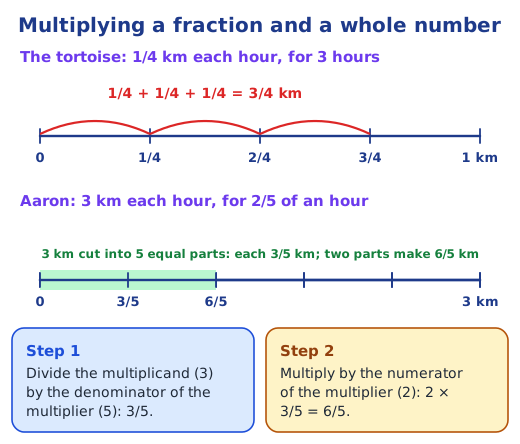
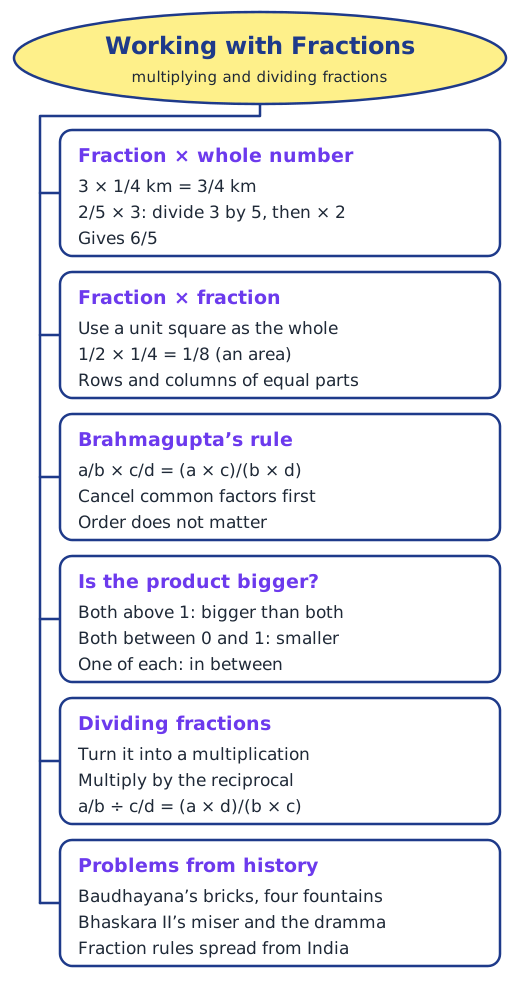
Figure it Out (pages 176–177)
1. In a week: 7 × 1/2 = 7/2 = 3 1/2 glasses. In January (31 days): 31 × 1/2 = 31/2 = 15 1/2 glasses.
2. In one day: 1/8 km. In a 5-day week: 5 × 1/8 = 5/8 km.
3. Each family each week: 5 ÷ 3 = 5/3 = 1 2/3 litres. In 4 weeks: 4 × 5/3 = 20/3 = 6 2/3 litres.
4. Thursday is 3 days after Monday, so the Moon sets 3 × 5/6 = 5/2 = 2 1/2 hours after 10 pm, at 12:30 am (just after midnight).
5. (a) 7 × 3/5 = 21/5 = 4 1/5. (b) 4 × 1/3 = 4/3 = 1 1/3. (c) 9/7 × 6 = 54/7 = 7 5/7. (d) 13/11 × 6 = 78/11 = 7 1/11.
Multiplying Two Fractions (pages 177–179)
The tortoise in half an hour: half of 1/4 km. Splitting the shaded quarter of a unit square into 2 makes 8 equal parts of the whole, so 1/8 of the whole is shaded and the tortoise walks 1/8 km.
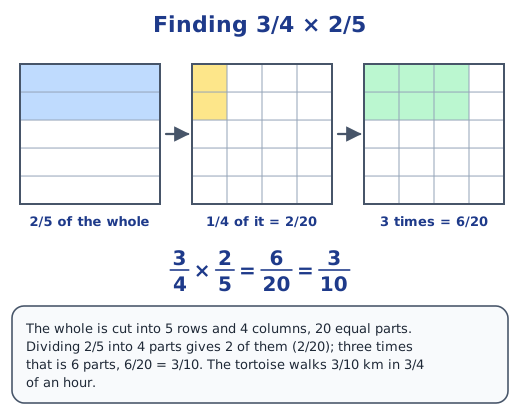
A faster tortoise, 2/5 km an hour, for 3/4 of an hour: 3/4 × 2/5. With the square in 5 rows and 4 columns, a quarter of 2/5 is 2/20, and three quarters is 6/20 = 3/10 km.
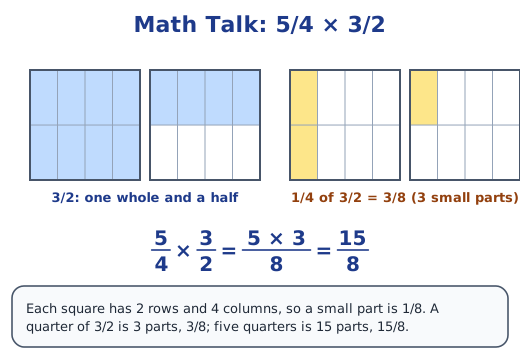
Math Talk: 5/4 × 3/2. Draw 3/2 as one and a half unit squares, each in 2 rows and 4 columns. A quarter of 3/2 is 3 small parts, 3/8, and five quarters is 15/8.
Area and Fraction Multiplication (page 180)
The shaded rectangle is 1/2 unit by 1/4 unit, and eight of them fill the unit square, so its area is 1/8 square unit. That equals 1/2 × 1/4: the area of a rectangle with fractional sides is the product of its sides.
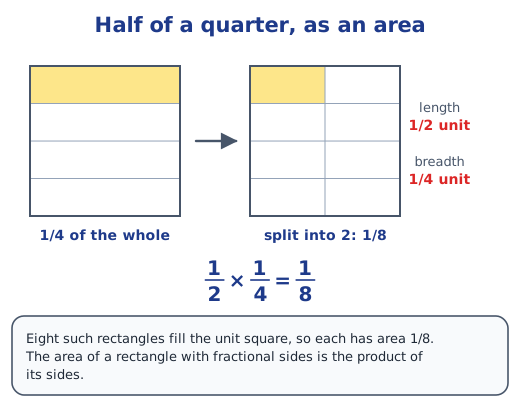
Figure it Out (pages 180–181)
1. (a) 1/3 × 1/5 = 1/15 (b) 1/4 × 1/3 = 1/12 (c) 1/5 × 1/2 = 1/10 (d) 1/6 × 1/5 = 1/30. In each, the square is cut into rows and columns and one small part is shaded. 1/12 × 1/18 = 1/216, since 18 rows and 12 columns make 216 parts.
2. (a) 2/3 × 4/5 = 8/15 (b) 1/4 × 2/3 = 2/12 = 1/6 (c) 3/5 × 1/2 = 3/10 (d) 4/6 × 3/5 = 12/30 = 2/5. In (a), for example, cut the square into 5 rows and 3 columns: 4/5 is four rows, a third of it is 4 parts, and two thirds is 8 parts out of 15.
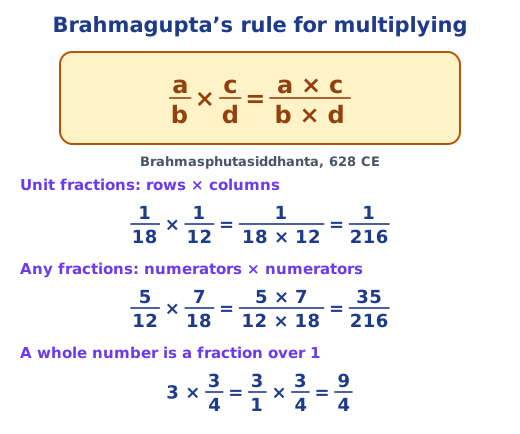
Now find 5/12 × 7/18 (page 181). With 18 rows and 12 columns, 7/18 split into 12 parts gives 7/216, and five of those give 35/216. (The book’s next line prints 5/12 × 7/8 by mistake; it should read 7/18.)
Lowest Form (pages 182–183)
12/7 × 5/24: cancel 12 with 24 to get (1 × 5)/(7 × 2) = 5/14. 14/15 × 25/42: cancel 14 with 42 (leaving 1 and 3) and 25 with 15 (leaving 5 and 3) to get 5/9.
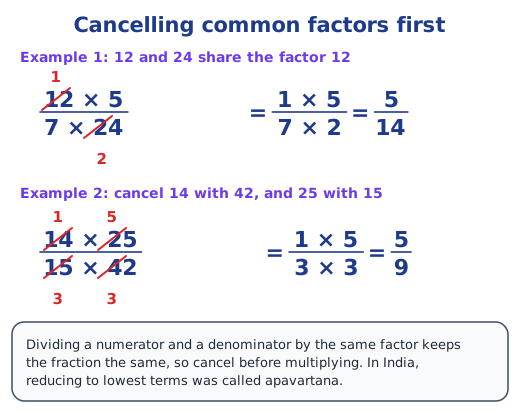
Figure it Out (pages 183–184)
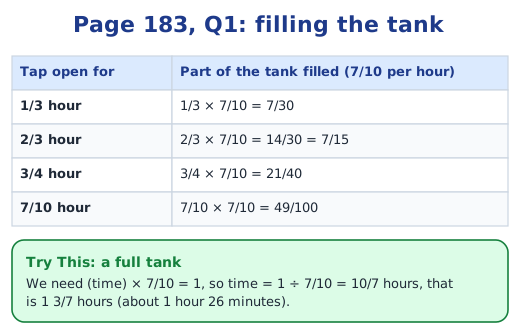
1. (a) 1/3 × 7/10 = 7/30 (b) 2/3 × 7/10 = 14/30 = 7/15 (c) 3/4 × 7/10 = 21/40 (d) 7/10 × 7/10 = 49/100. (e) Try This: we need (time) × 7/10 = 1, so the tap must run 1 ÷ 7/10 = 10/7 = 1 3/7 hours.
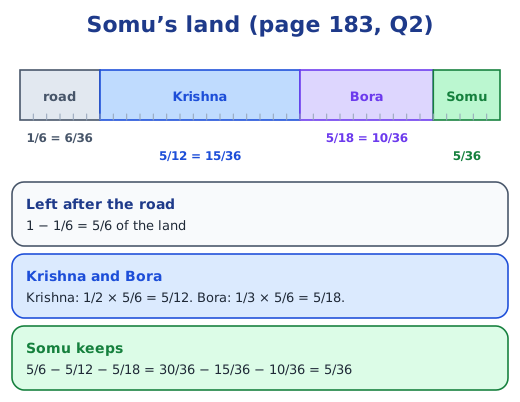
2. Somu keeps 1 − 1/6 = 5/6 after the road. (a) Krishna: 1/2 × 5/6 = 5/12. (b) Bora: 1/3 × 5/6 = 5/18. (c) Somu: 5/6 − 5/12 − 5/18 = 30/36 − 15/36 − 10/36 = 5/36.
3. 3 3/4 × 9 3/5 = 15/4 × 48/5 = (3 × 12)/(1 × 1) after cancelling = 36 square feet.
4. Four saplings in a row have 3 gaps, so the distance is 3 × 3/4 = 9/4 = 2 1/4 m.
5. 12/15 of 500 g = 4/5 × 500 = 400 g; 3/20 of 4 kg = 3/20 × 4000 = 600 g. 3/20 of 4 kg is heavier.
Is the Product Always Greater? (pages 184–185)
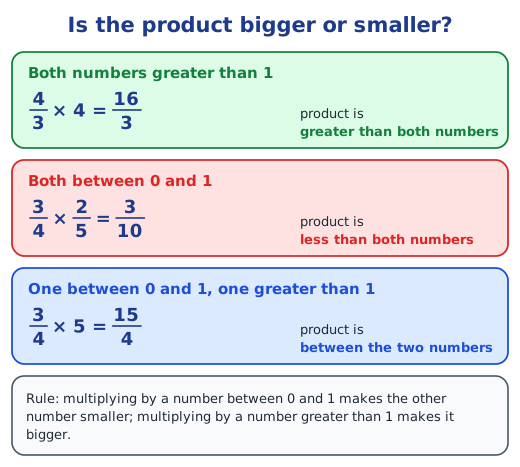
The product is greater than both numbers when both are greater than 1 (4/3 × 4 = 16/3), less than both when both are between 0 and 1 (3/4 × 2/5 = 3/10), and in between when one is between 0 and 1 and the other greater than 1 (3/4 × 5 = 15/4). More examples: 5/2 × 3 = 15/2; 1/2 × 1/3 = 1/6; 2/3 × 6 = 4.
The blanks: if one number lies between 0 and 1, the product is less than the other; if one number is above 1, the product is greater than the other.
8.2 Division of Fractions (pages 186–189)
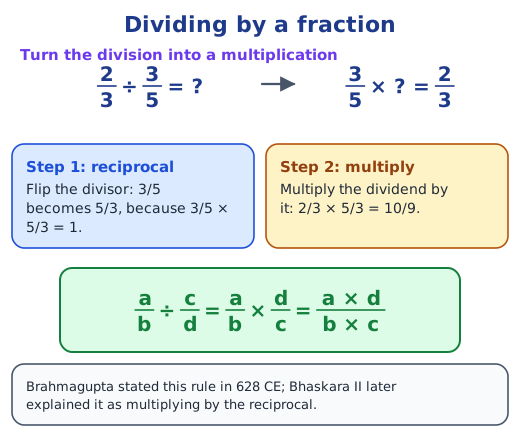
12 ÷ 4 = 3 because 4 × 3 = 12. 1 ÷ 2/3 = 3/2, since 2/3 × 3/2 = 1. 3 ÷ 2/3 = 9/2, since 2/3 × 9/2 = 3. 1/5 ÷ 1/2 = 2/5, since 1/2 × 2/5 = 1/5. 2/3 ÷ 3/5 = 10/9, since 3/5 × 10/9 = 2/3. The rule: multiply the dividend by the reciprocal of the divisor, a/b ÷ c/d = (a × d)/(b × c).
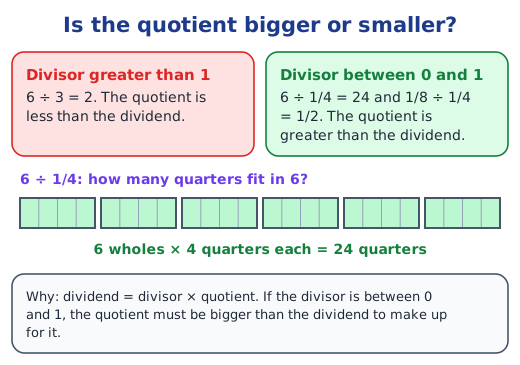
When is the quotient less or greater than the dividend? Since dividend = divisor × quotient, a divisor between 0 and 1 makes the quotient greater than the dividend (6 ÷ 1/4 = 24, 1/8 ÷ 1/4 = 1/2), and a divisor above 1 makes it less (6 ÷ 3 = 2). Divisor and quotient: reading divisor × quotient = dividend the same way, the quotient is greater than 1 when the dividend is bigger than the divisor, and between 0 and 1 when the dividend is smaller than the divisor.
8.3 Some Problems Involving Fractions (pages 190–191)
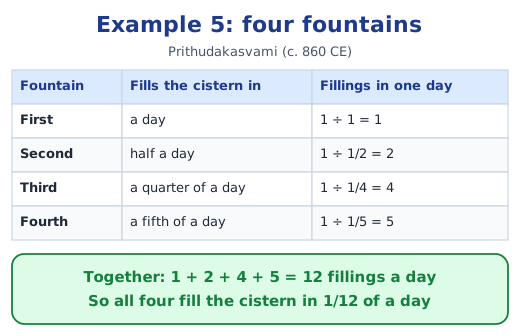
Example 3: 1/4 ÷ 5 = 1/4 × 1/5 = 1/20 litre of milk per cup. Example 4: 15/2 ÷ 1/25 = 375/2 bricks. Example 5 (fountains): 1 ÷ 1/2 = 2, 1 ÷ 1/4 = 4, 1 ÷ 1/5 = 5; 1 + 2 + 4 + 5 = 12 fillings a day, so together they take 1/12 of a day.
Fractional Relations (pages 192–193)
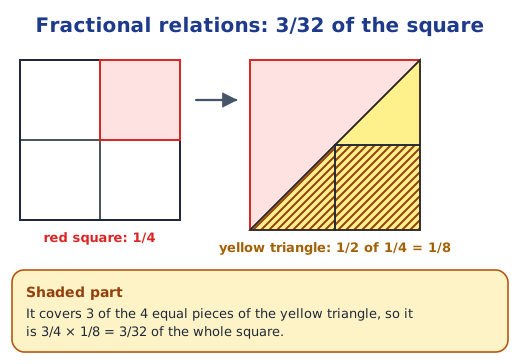
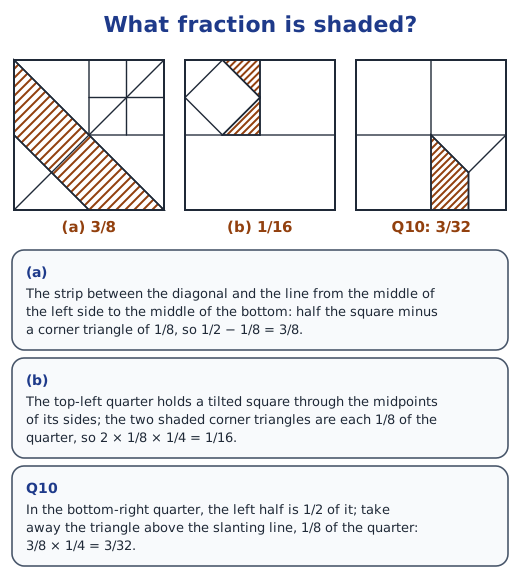
Math Talk: the worked square. The red square is 1/4 of the whole, the yellow triangle is half of it, 1/8, and the shaded part is 3 of the triangle’s 4 equal pieces, so 3/4 × 1/8 = 3/32.
The two figures: (a) the shaded strip lies between the diagonal and the line joining the midpoints of the left and bottom sides: half the square minus a corner triangle of 1/8, so 3/8. (b) In the top-left quarter, a tilted square joins the midpoints of its sides; the two shaded corner triangles are each 1/8 of the quarter, so 2 × 1/8 × 1/4 = 1/16.
A Dramma-tic Donation (pages 193–194)
1/2 × 2/3 × 3/4 × 1/5 × 1/16 × 1/4 = 6/7680 = 1/1280 of a dramma, which is one cowrie shell. The blanks: 1 cowrie shell = 1/30 copper pana, and 1 cowrie shell = 1/30 × 1/48 = 1/1440 gold dinar.
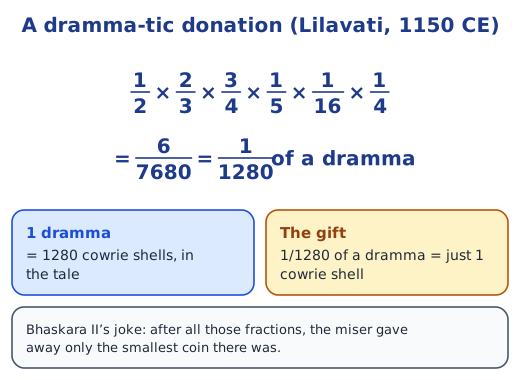
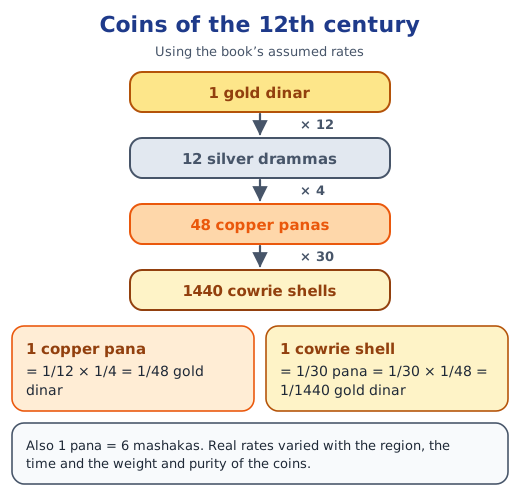
Figure it Out (pages 196–198)
1.
- 3 ÷ 7/9 = 3 × 9/7 = 27/7
- 14/4 ÷ 2 = 14/8 = 7/4
- 2/3 ÷ 2/3 = 1
- 14/6 ÷ 7/3 = 14/6 × 3/7 = 1
- 4/3 ÷ 3/4 = 16/9
- 7/4 ÷ 1/7 = 49/4
- 8/2 ÷ 4/15 = 4 × 15/4 = 15
- 1/5 ÷ 1/9 = 9/5
- 1/6 ÷ 11/12 = 12/66 = 2/11
- 3 2/3 ÷ 1 3/8 = 11/3 × 8/11 = 8/3 = 2 2/3
2. (a) (iii) 8 ÷ 1/4 = 32 bags. (b) (iv) 1/2 ÷ 8 = 1/16 m for each badge. (c) (iii) 5 ÷ 1/6 = 30 loaves; option (iv), 5 × 6, gives the same number because dividing by 1/6 is multiplying by its reciprocal, 6, but (iii) is the expression that describes the sharing.
3. 6 rotis are half of 12, so 1/2 × 1/4 = 1/8 kg of flour.
4. Each 1 ÷ 1/n is n, so the sum is 6 + 10 + 13 + 9 + 2 = 40.
5. Read: 1/5 × 400 = 80 pages and 3/10 × 400 = 120 pages, 200 in all. Left: 200 pages.
6. 2 3/4 × 16 = 11/4 × 16 = 44 km.
7. 5 1/6 − 1/2 = 31/6 − 3/6 = 28/6 = 4 2/3 hours saved.
8. The friends share 1 − 4/5 = 1/5 of the cake, so each gets 1/5 ÷ 3 = 1/15 of the cake.
9. Both 565/465 and 707/676 are greater than 1, so the product is greater than each of them and greater than 1: (a), (c) and (e).
10. In the bottom-right quarter, the shaded region is the left half (1/2 of the quarter) minus the triangle above the slanting line (1/8 of the quarter), that is 3/8 of the quarter: 3/8 × 1/4 = 3/32 of the whole square.
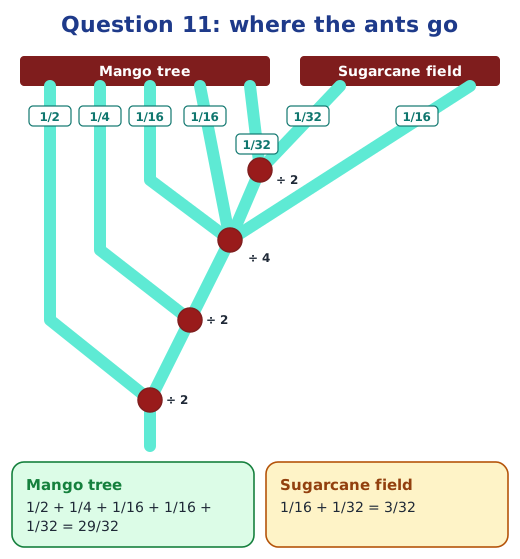
11. At the first point half go to the mango tree; at the second, half of the rest; at the third the group splits four ways (two paths to the mango tree, one to the sugarcane field, one on); at the fourth it splits in two. Mango tree: 1/2 + 1/4 + 1/16 + 1/16 + 1/32 = 29/32. Sugarcane field: 1/16 + 1/32 = 3/32. Together they make 1.
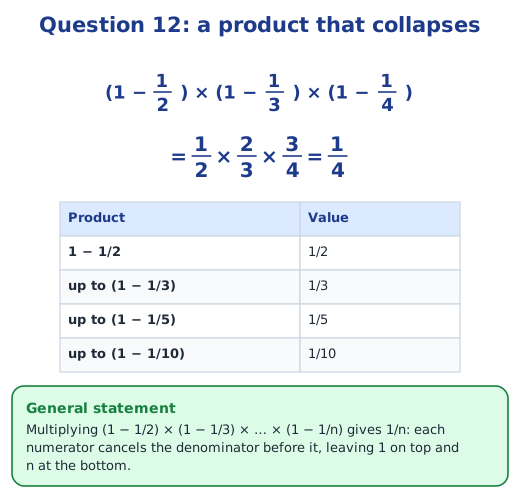
12. 1 − 1/2 = 1/2; (1 − 1/2) × (1 − 1/3) = 1/2 × 2/3 = 1/3; up to (1 − 1/5): 1/5; up to (1 − 1/10): 1/10. General statement: (1 − 1/2) × (1 − 1/3) × … × (1 − 1/n) = 1/n, because the product is 1/2 × 2/3 × 3/4 × … × (n − 1)/n and each numerator cancels the denominator before it.
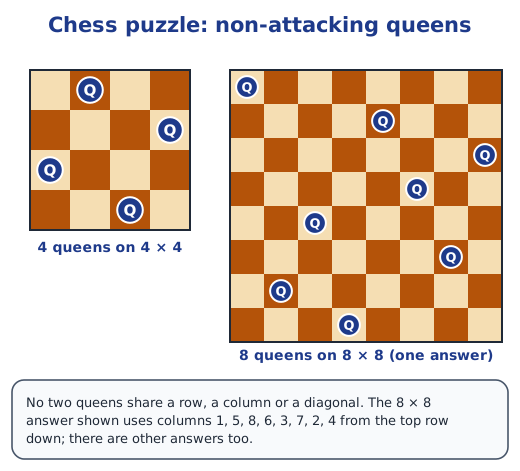
Chess Puzzle: Non-attacking Queens (page 199)
4 queens on a 4 × 4 board: put them in columns 2, 4, 1 and 3 of rows 1 to 4. 8 queens on the 8 × 8 board: one answer uses columns 1, 5, 8, 6, 3, 7, 2 and 4 of rows 1 to 8. In both, no two queens share a row, a column or a diagonal; the 8-queens puzzle has other answers too.
Short notes and more practice are on the topic pages: multiplying fractions, dividing fractions and fraction problems from Indian mathematics.
Practice
-
What is 14/15 × 25/42 in lowest form?
Show answer
Answer: (a) 5/9
-
What is 3 2/3 ÷ 1 3/8?
Show answer
Answer: (a) 2 2/3
-
A car runs 16 km on 1 litre of petrol. How far does it go on 2 3/4 litres?
Show answer
Answer: (c) 44 km
-
What is (1 − 1/2) × (1 − 1/3) × (1 − 1/4) × (1 − 1/5)?
Show answer
Answer: 1/2 × 2/3 × 3/4 × 4/5 = 1/5, since each numerator cancels the previous denominator.
-
Which is heavier, 12/15 of 500 g or 3/20 of 4 kg?
Show answer
Answer: 12/15 of 500 g is 400 g, and 3/20 of 4000 g is 600 g, so 3/20 of 4 kg is heavier.
Stuck on a question?
Take a photo and Lagnever AI explains it step by step. Try it for 7 days for ₹2.
Get it on Google Play Open in browser
For parents: after the trial, the plan renews monthly by UPI or card autopay. You can cancel anytime in the app.