
Class 7 Maths Chapter 8: Working with Fractions Notes
This chapter in five lines
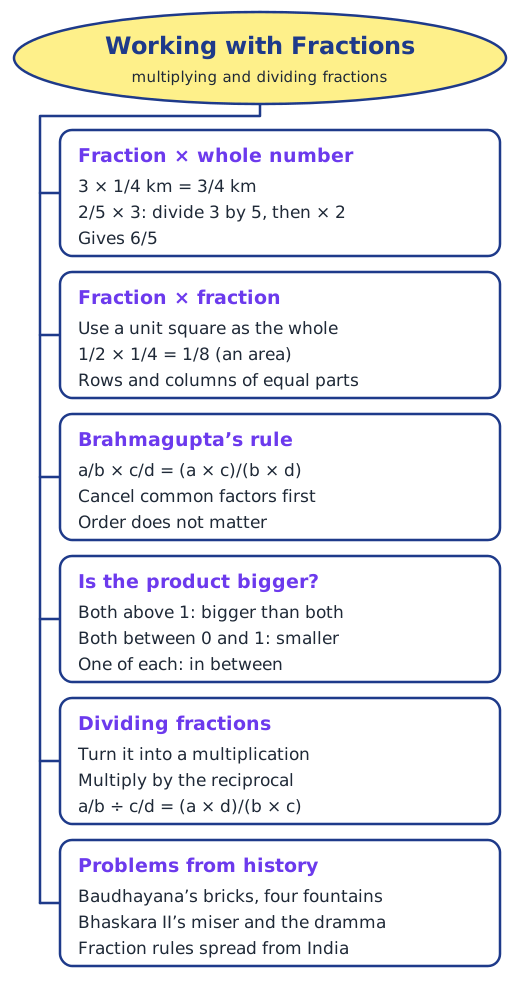
Working with Fractions explains how to multiply and divide fractions. A fraction times a whole number is found by dividing and then multiplying; a fraction times a fraction is the area of a rectangle in a unit square, which gives Brahmagupta’s rule a/b × c/d = (a × c)/(b × d). Dividing by a fraction means multiplying by its reciprocal. Old Indian problems put these rules to work.
What is this chapter about?
Aaron walks 3 km in an hour, so in 5 hours he walks 5 × 3 = 15 km. His pet tortoise is slower, managing only 1/4 km an hour. Questions about how far the tortoise goes, or how far Aaron goes in part of an hour, need multiplication with fractions. The chapter builds the rules for multiplying and dividing fractions step by step, checks them with pictures, and ends with problems from Indian mathematicians who first wrote these rules down.
Multiplying a fraction and a whole number
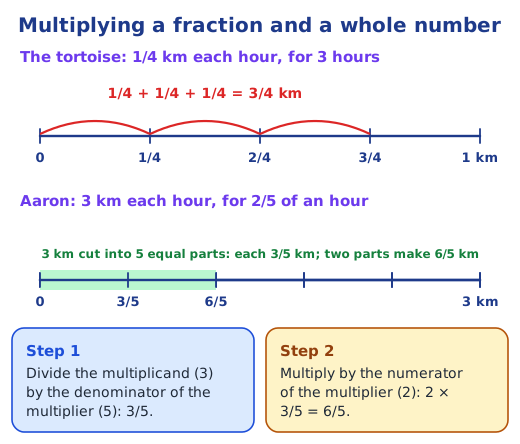
In 3 hours the tortoise walks 3 × 1/4 = 1/4 + 1/4 + 1/4 = 3/4 km. In 2/5 of an hour, Aaron walks 2/5 × 3 km. Cut the 3 km into 5 equal parts to get 3/5 km, the distance in 1/5 of an hour, and double it: 2 × 3/5 = 6/5 km. So to find 2/5 × 3, divide the multiplicand by the denominator of the multiplier, then multiply by its numerator. The same idea gives 1 1/4 hours of internet at ₹8 an hour as 5/4 × 8 = ₹10. Read multiplying fractions.
Multiplying two fractions
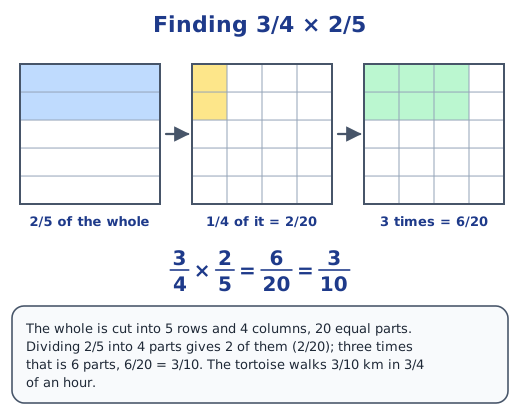
How far does the tortoise walk in half an hour? Half of 1/4 km. Take a unit square as the whole, shade 1/4 of it, and split that quarter into 2: the piece is 1/8 of the square, so 1/2 × 1/4 = 1/8. For 3/4 × 2/5, cut the square into 5 rows and 4 columns; 2/5 is two rows, a quarter of it is 2 of the 20 parts, and three quarters is 6 parts, so the product is 6/20 = 3/10. The small rectangles show a useful fact: the area of a rectangle with fractional sides is the product of its sides.
Brahmagupta’s rule and cancelling
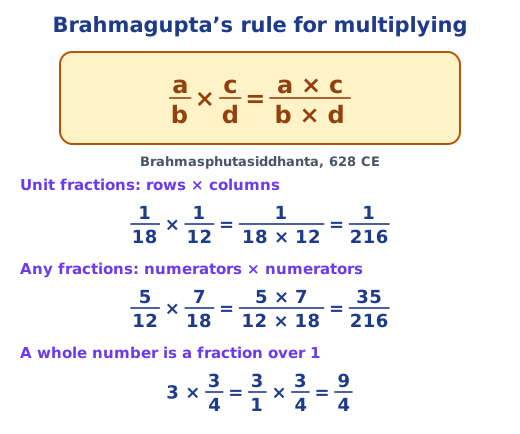
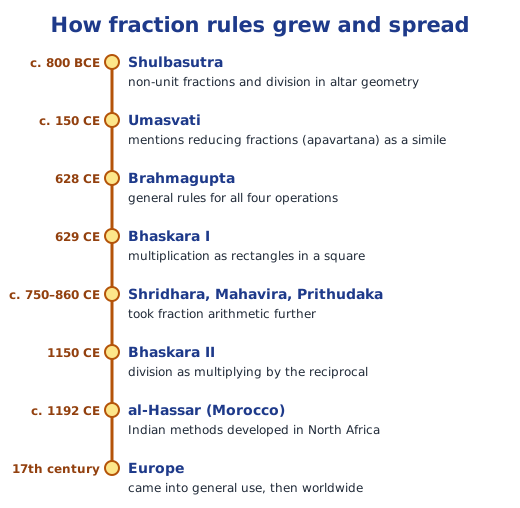
The pictures suggest a shortcut. For 1/18 × 1/12, the square has 18 × 12 = 216 parts, so the product is 1/216; for 5/12 × 7/18 it is 35/216. In general, a/b × c/d = (a × c)/(b × d), a rule Brahmagupta first gave in general form in his Brahmasphutasiddhanta (628 CE). A whole number can be written over 1, so 3 × 3/4 = 9/4. Before multiplying, we can cancel common factors: in 12/7 × 5/24, 12 and 24 share 12, giving 5/14. The order of multiplying does not matter, just as a rectangle keeps its area when turned around.
Is the product always bigger?
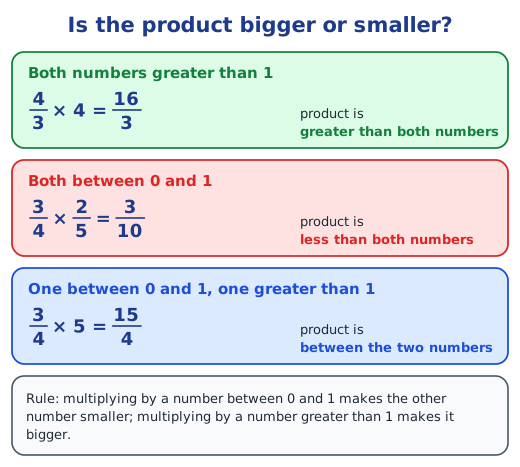
With counting numbers, 3 × 5 = 15 is bigger than both. With fractions it depends. If both numbers are greater than 1, the product is greater than both, as in 4/3 × 4 = 16/3. If both lie between 0 and 1, the product is less than both, as in 3/4 × 2/5 = 3/10. If one is between 0 and 1 and the other greater than 1, the product lies between them, as in 3/4 × 5 = 15/4. In short, multiplying by a number between 0 and 1 shrinks the other number, and multiplying by a number greater than 1 enlarges it.
Dividing fractions
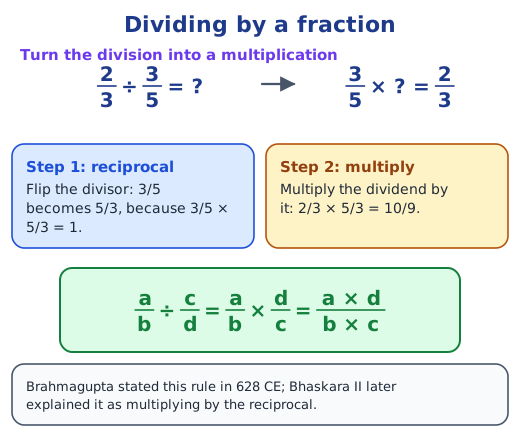
Any division can be read as a multiplication: 12 ÷ 4 asks what times 4 gives 12. So 1 ÷ 2/3 asks what times 2/3 gives 1, and the answer is 3/2, because 2/3 × 3/2 = 1. The fraction 3/2 is the reciprocal of 2/3. To divide by any fraction, multiply by its reciprocal: 2/3 ÷ 3/5 = 2/3 × 5/3 = 10/9. In symbols, a/b ÷ c/d = (a × d)/(b × c), again first stated in general form by Brahmagupta. Dividing by a number between 0 and 1 makes the answer bigger than the dividend (6 ÷ 1/4 = 24), while dividing by a number greater than 1 makes it smaller. Read dividing fractions.
Problems from Indian mathematics
Fractions have a long history in India. The Shulbasutra, geometry texts from about 800 BCE, already divided fractions: Baudhayana asks how many square bricks of side 1/5 unit cover 7 1/2 square units (375/2 of them). Prithudakasvami’s four fountains fill a cistern together in 1/12 of a day, and in Bhaskara II’s Lilavati a miser’s gift of fractions of fractions of a coin turns out to be a single cowrie shell. These methods spread to North Africa and the Arab world and reached general use in Europe only around the 17th century. Read fraction problems from Indian mathematics.
In a nutshell
Multiply fractions by multiplying numerators and denominators, cancelling first where you can; divide by multiplying with the reciprocal; and use the size of the numbers to check whether an answer should be bigger or smaller. The chapter closes with a chess puzzle about placing queens that cannot attack each other. Answers to every question are in the NCERT solutions for Chapter 8.
Key terms
| Term | Meaning |
|---|---|
| Multiplier and multiplicand | In 2/5 × 3, the first number, 2/5, is the multiplier and the second, 3, is the multiplicand: we find 2/5 of 3. |
| Unit square | A square of side 1 unit used as the ‘whole’; cutting it into rows and columns shows the product of two fractions as an area. |
| Product | The result of a multiplication; for fractions it can be bigger, smaller or in between the numbers multiplied. |
| Brahmagupta’s rule | a/b × c/d = (a × c)/(b × d): multiply the numerators and multiply the denominators, stated in general form in 628 CE. |
| Cancelling common factors | Dividing a numerator and a denominator by a common factor before multiplying, so the product comes out in lowest terms. |
| Apavartana | The old Indian name for reducing a fraction to its lowest terms, mentioned even by the Jaina scholar Umasvati. |
| Reciprocal | The fraction b/a obtained by swapping the numerator and denominator of a/b; a fraction times its reciprocal is 1. |
| Dividend, divisor and quotient | In 12 ÷ 4 = 3, 12 is the dividend, 4 the divisor and 3 the quotient; division asks what times the divisor gives the dividend. |
| Mixed fraction | A whole number with a proper fraction, such as 1 1/4, which equals the improper fraction 5/4. |
| Shulbasutra | Ancient Indian geometry texts, going back to about 800 BCE, about building fire altars; they already used non-unit fractions. |
| Lowest form | A fraction whose numerator and denominator have no common factor other than 1, such as 5/14. |
| Dramma | A silver coin of medieval India; in Bhaskara II’s puzzle one dramma was worth 1280 cowrie shells. |
Topics in this chapter
Practice
-
What is 2/5 × 3?
Show answer
Answer: (b) 6/5
-
What is 3/4 × 2/5?
Show answer
Answer: (c) 3/10
-
What is the reciprocal of 3/5?
Show answer
Answer: (b) 5/3
-
What is 2/3 ÷ 3/5?
Show answer
Answer: (b) 10/9
-
Which product is less than both numbers multiplied?
Show answer
Answer: (c) 3/4 × 2/5
-
6 ÷ 1/4 equals:
Show answer
Answer: (b) 24
Questions students ask
What are the main topics of Class 7 Maths Chapter 8?
Multiplying a fraction and a whole number; multiplying two fractions with a unit square and the area of a rectangle; Brahmagupta’s rule and cancelling common factors; whether a product is bigger or smaller than the numbers multiplied; dividing fractions with reciprocals; word problems; and fraction problems from Indian mathematics, from the Shulbasutra to Bhaskara II.
Is Working with Fractions in the new NCERT Class 7 Maths book?
Yes. It is Chapter 8 of Ganita Prakash, the Class 7 Maths textbook Part 1 (Reprint 2026-27), on pages 173 to 199. It follows A Tale of Three Intersecting Lines and is the last chapter of Part 1.
How do you multiply two fractions?
Multiply the numerators together and the denominators together: a/b × c/d = (a × c)/(b × d). For example, 3/4 × 2/5 = 6/20 = 3/10. Cancelling common factors first keeps the numbers small. This rule was stated in general form by Brahmagupta in 628 CE.
How do you divide one fraction by another?
Find the reciprocal of the divisor by swapping its numerator and denominator, then multiply the dividend by it. For example, 2/3 ÷ 3/5 = 2/3 × 5/3 = 10/9. This works because 3/5 × 10/9 gives back 2/3.
Stuck on a question?
Take a photo and Lagnever AI explains it step by step. Try it for 7 days for ₹2.
Get it on Google Play Open in browser
For parents: after the trial, the plan renews monthly by UPI or card autopay. You can cancel anytime in the app.