
Fraction problems from Indian mathematics
Answer in short
Indian mathematicians used and developed fractions for nearly two thousand years. The Shulbasutra (c. 800 BCE) divided fractions to count bricks, Brahmagupta (628 CE) gave general rules for all four operations, and Bhaskara II’s Lilavati (1150 CE) told of a miser whose gift of fractions came to one cowrie shell. These methods spread to Africa and Europe.
Stuck on a question? Take a photo and Lagnever AI explains it step by step. Try it for 7 days for ₹2. Get it on Google Play
Fractions in the oldest geometry
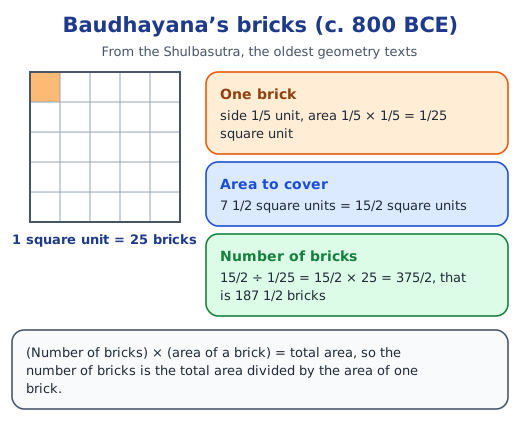
Some of the oldest work with non-unit fractions appears in the Shulbasutra, geometry texts about building fire altars. Baudhayana’s Shulbasutra (c. 800 BCE) asks: how many square bricks of side 1/5 unit are needed to cover 7 1/2 square units? Each brick has area 1/5 × 1/5 = 1/25 square unit, and the number of bricks times the area of one brick must equal the total area. So the number of bricks is 15/2 ÷ 1/25 = 15/2 × 25 = 375/2, that is, 187 1/2 bricks.
The four fountains
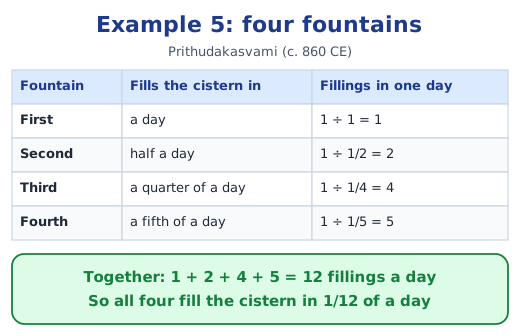
Chaturveda Prithudakasvami (c. 860 CE), who wrote a commentary on Brahmagupta’s work, set this puzzle. Four fountains fill a cistern: the first in a day, the second in half a day, the third in a quarter of a day and the fourth in a fifth of a day. How long do they take together? Count how many times each fills the cistern in one day: 1 ÷ 1 = 1, 1 ÷ 1/2 = 2, 1 ÷ 1/4 = 4 and 1 ÷ 1/5 = 5. Together they fill it 12 times a day, so they need only 1/12 of a day.
A miser’s gift
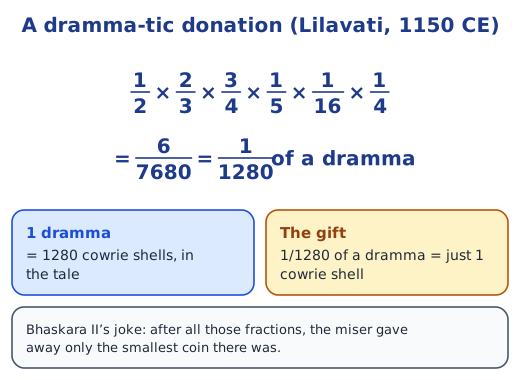
In the Lilavati, written in 1150 CE, Bhaskara II teases the reader: a miser gave a beggar 1/5 of 1/16 of 1/4 of 1/2 of 2/3 of 3/4 of a dramma, a silver coin. ‘Of’ means multiply, so the gift is 1/2 × 2/3 × 3/4 × 1/5 × 1/16 × 1/4 = 6/7680 = 1/1280 of a dramma. In the tale a dramma was worth 1280 cowrie shells, so the beggar received exactly one cowrie, the coin of least value.
Coins and fractions
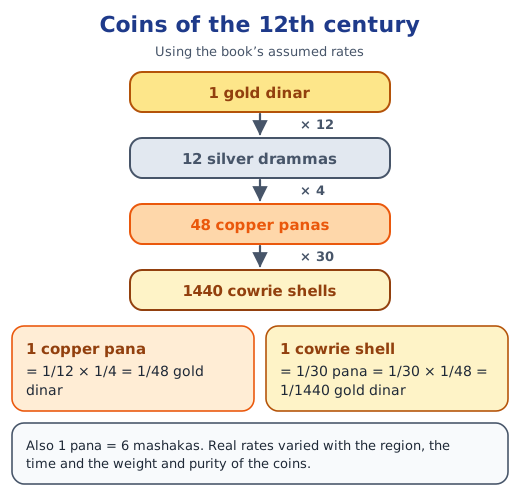
Around the 12th century many coins were in use: gold dinars or gadyanas and hunas for large payments and saving, silver drammas or tankas for daily trade, copper kasus or panas and mashakas for small purchases, and cowrie shells as change. Exchange rates varied by region and by the weight and purity of the coins. Using the book’s assumed rates, 1 gold dinar = 12 drammas, 1 dramma = 4 panas and 1 pana = 30 cowries, so 1 pana = 1/12 × 1/4 = 1/48 dinar and 1 cowrie = 1/30 pana = 1/1440 dinar.
Who wrote the rules
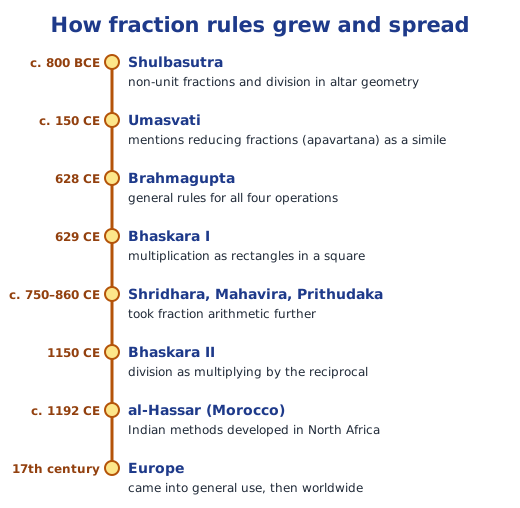
Fractions entered everyday Indian culture early: the Jaina scholar Umasvati (c. 150 CE) used the reduction of fractions to lowest terms as a simile in a work of philosophy. Brahmagupta, in his Brahmasphutasiddhanta (628 CE), first codified general rules for adding, subtracting, multiplying and dividing fractions, almost exactly as we use them today. Bhaskara I (629 CE), commenting on Aryabhata, explained multiplication as rectangles inside a square; Shridharacharya (c. 750 CE), whose Patiganita asks for the sum 1 ÷ 1/6 + 1 ÷ 1/10 + 1 ÷ 1/13 + 1 ÷ 1/9 + 1 ÷ 1/2 (it is 40), Mahaviracharya (c. 850 CE), Prithudakasvami and Bhaskara II developed the subject further. Mathematicians in the Arab world and North Africa, such as al-Hassar of Morocco (c. 1192 CE), carried it on, and it reached general use in Europe around the 17th century.
Why it matters
These problems show that fraction arithmetic grew out of real tasks, such as building altars, filling tanks and counting coins, and that much of it was first worked out in India. The rules themselves are in multiplying fractions and dividing fractions. Answers to every question are in the NCERT solutions for Chapter 8; see also the full Chapter 8 notes.
Practice
-
How many bricks of side 1/5 unit cover 7 1/2 square units?
Show answer
Answer: (b) 375/2
-
Four fountains fill a cistern 1, 2, 4 and 5 times a day. How long do they take together?
Show answer
Answer: (b) 1/12 day
-
In the Lilavati puzzle, what fraction of a dramma did the miser give?
Show answer
Answer: (a) 1/1280
-
With 1 pana = 30 cowrie shells and 1 pana = 1/48 gold dinar, how much of a dinar is 1 cowrie?
Show answer
Answer: 1 cowrie = 1/30 pana = 1/30 × 1/48 = 1/1440 of a gold dinar.
-
Sridharacharya’s Patiganita asks for 1 ÷ 1/6 + 1 ÷ 1/10 + 1 ÷ 1/13 + 1 ÷ 1/9 + 1 ÷ 1/2. What is the sum?
Show answer
Answer: Each 1 ÷ 1/n is n, so the sum is 6 + 10 + 13 + 9 + 2 = 40.
Questions students ask
What is the Shulbasutra and why does it matter for fractions?
The Shulbasutra are ancient Indian geometry texts, going back to about 800 BCE, written to guide the building of fire altars. They used general non-unit fractions freely, including division of fractions, as in Baudhayana’s problem of covering 7 1/2 square units with bricks of side 1/5 unit.
What is the Lilavati miser puzzle?
In the Lilavati (1150 CE), Bhaskara II tells of a miser who gave a beggar 1/5 of 1/16 of 1/4 of 1/2 of 2/3 of 3/4 of a dramma. Multiplying gives 6/7680 = 1/1280 of a dramma, and since a dramma was worth 1280 cowrie shells, the gift was a single cowrie, the smallest coin of all.
How did Indian fraction methods reach the rest of the world?
After Brahmagupta, mathematicians such as Bhaskara I, Shridharacharya, Mahaviracharya, Prithudakasvami and Bhaskara II took the subject further. Mathematicians in the Arab world and North Africa, such as al-Hassar of Morocco (c. 1192 CE), took up the methods, which passed to Europe through the Arabs, and came into general use there around the 17th century.
Stuck on a question?
Take a photo and Lagnever AI explains it step by step. Try it for 7 days for ₹2.
Get it on Google Play Open in browser
For parents: after the trial, the plan renews monthly by UPI or card autopay. You can cancel anytime in the app.