
Multiplying fractions
Answer in short
To multiply two fractions, multiply the numerators and the denominators: a/b × c/d = (a × c)/(b × d), a rule Brahmagupta stated in 628 CE. A unit square shows why: the product is the area of a rectangle with those sides. Cancel common factors first; multiplying by a number below 1 gives a smaller result.
Stuck on a question? Take a photo and Lagnever AI explains it step by step. Try it for 7 days for ₹2. Get it on Google Play
A fraction and a whole number
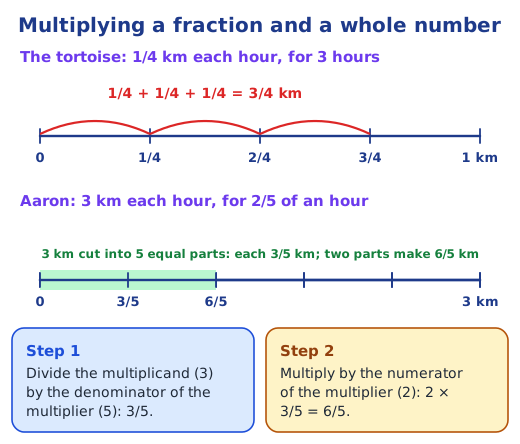
If the tortoise walks 1/4 km in an hour, then in 3 hours it walks 3 × 1/4 = 1/4 + 1/4 + 1/4 = 3/4 km: a fraction in the problem does not change the method. If Aaron walks 3 km in an hour, then in 1/5 of an hour he covers one fifth of 3 km, 3/5 km, and in 2/5 of an hour twice that, 6/5 km. So 2/5 × 3 means: divide 3 (the multiplicand) by 5, the multiplier’s denominator, and then multiply by its numerator, 2. A farmer giving 2/3 acre to each of 5 grandchildren gives 5 × 2/3 = 10/3 acres.
Two fractions on a unit square
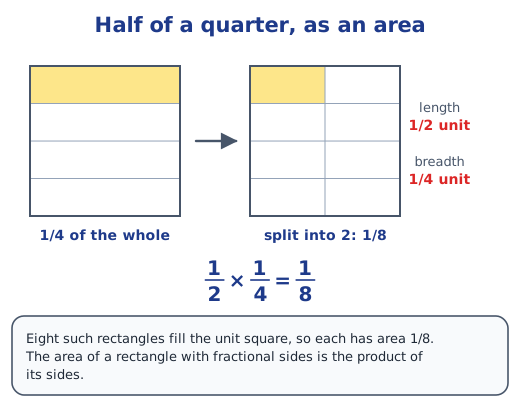
In half an hour the tortoise covers half of 1/4 km. Draw a unit square, shade 1/4 of it, and cut that strip into 2 equal pieces; each is 1/8 of the square, so 1/2 × 1/4 = 1/8. The little rectangle is 1/2 unit long and 1/4 unit wide, and eight of them fill the square, so its area is 1/8: the area of a rectangle with fractional sides is still length × breadth.
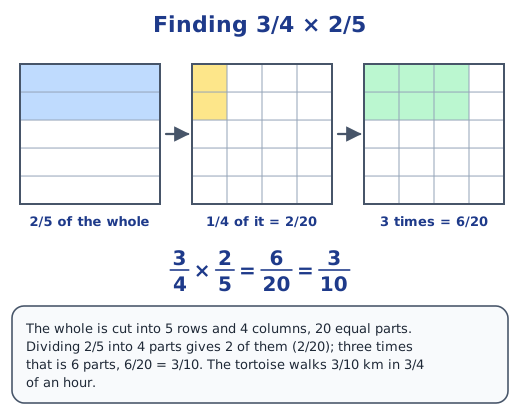
For 3/4 × 2/5, cut the square into 5 rows and 4 columns, 20 equal parts. The fraction 2/5 is two rows; a quarter of it is 2 parts, 2/20, and three quarters is 6 parts, 6/20 = 3/10. The same steps work beyond one whole: 3/2 is one and a half squares, a quarter of it is 3/8, and so 5/4 × 3/2 = 15/8.
Brahmagupta’s rule
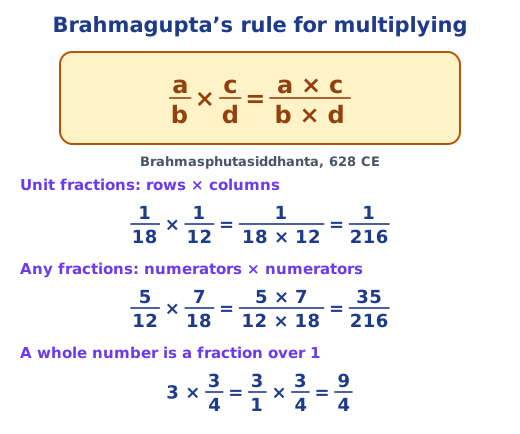
Drawing grids for 1/18 × 1/12 is tiring, but the pattern is clear: the square splits into 18 rows and 12 columns, so the product is 1/216. For 5/12 × 7/18, take 7 of those rows and 5 of the columns: 35 parts out of 216. In general, a/b × c/d = (a × c)/(b × d). Brahmagupta first gave this rule in general form in his Brahmasphutasiddhanta (628 CE). It also covers whole numbers, written over 1: 3 × 3/4 = 3/1 × 3/4 = 9/4, and 3/5 × 4 = 12/5.
Cancelling common factors
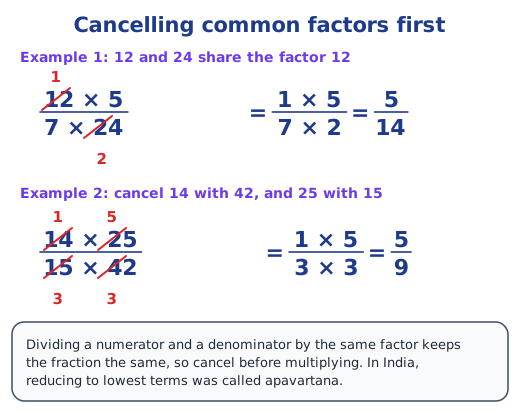
A fraction does not change when its numerator and denominator are divided by the same number. So before multiplying, divide out any factor shared by a numerator and a denominator. In 12/7 × 5/24, 12 and 24 share 12, leaving (1 × 5)/(7 × 2) = 5/14. In 14/15 × 25/42, 14 and 42 share 14, and 25 and 15 share 5, leaving 5/9. In India, reducing a fraction to lowest terms, called apavartana, was so familiar that the Jaina scholar Umasvati used it as a comparison in a work of philosophy.
Bigger or smaller?
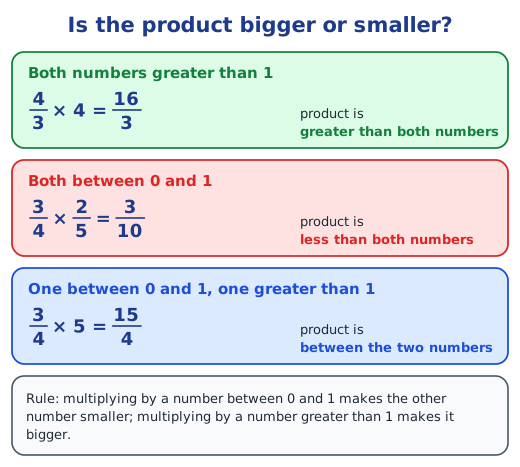
Multiplying counting numbers greater than 1 always gives something bigger, but fractions behave differently. If one of the two numbers lies between 0 and 1, the answer comes out smaller than the other number; if one is above 1, the answer comes out larger. So 1/4 × 8 = 2 is less than 8, 3/4 × 2/5 = 3/10 is less than both, and 4/3 × 4 = 16/3 is more than both. The order of the two numbers never matters: 1/2 × 1/4 and 1/4 × 1/2 are the same rectangle turned around.
Why it matters
Multiplying fractions turns up whenever we take a part of a part: a share of a share of land, the milk in part of a recipe, the distance covered in part of an hour. The reverse operation is in dividing fractions, and the old problems that used these rules are in fraction problems from Indian mathematics. Answers to every question are in the NCERT solutions for Chapter 8; see also the full Chapter 8 notes.
Practice
-
What is 5/4 × 3/2?
Show answer
Answer: (b) 15/8
-
What is 12/7 × 5/24 in lowest form?
Show answer
Answer: (b) 5/14
-
A rectangle measures 1/2 unit by 1/4 unit. Find its area.
Show answer
Answer: (c) 1/8 sq unit
-
Find 3 × 3/4 using Brahmagupta’s rule.
Show answer
Answer: Write 3 as 3/1: 3/1 × 3/4 = (3 × 3)/(1 × 4) = 9/4, that is 2 1/4.
-
Without working it out, is 3/4 × 5 more or less than 5? Why?
Show answer
Answer: Less, because 3/4 is between 0 and 1, and multiplying by a number between 0 and 1 makes the other number smaller. In fact 3/4 × 5 = 15/4.
Questions students ask
How do you multiply a fraction by a whole number?
Divide the whole number by the denominator, then multiply by the numerator. For 2/5 × 3, divide 3 by 5 to get 3/5, then double it to get 6/5. Writing the whole number over 1 and using a/b × c/d = (a × c)/(b × d) gives the same answer.
Why does a unit square help in multiplying fractions?
A unit square of side 1 has area 1. Cutting it into b rows and d columns makes b × d equal parts, and a rectangle a parts tall and c parts wide covers a × c of them, so its area is (a × c)/(b × d). That area is exactly the product a/b × c/d.
Is the product of two fractions always smaller?
No. Two fractions below 1 give a product smaller than either; two numbers above 1 give one larger than either; and if one is below 1 and the other above, the product lies between them. For example, 4/3 × 4 = 16/3 is greater than both.
Stuck on a question?
Take a photo and Lagnever AI explains it step by step. Try it for 7 days for ₹2.
Get it on Google Play Open in browser
For parents: after the trial, the plan renews monthly by UPI or card autopay. You can cancel anytime in the app.