
Congruent figures and triangles
Answer in short
Two figures are congruent when they have the same shape and size, so one fits exactly over the other, even after turning or flipping. Two triangles are congruent when they match by SSS, SAS, ASA, AAS or RHS. Their corresponding sides and angles are then equal, and the order of letters in ΔABC ≅ ΔXYZ shows which parts match.
Stuck on a question? Take a photo and Lagnever AI explains it step by step. Try it for 7 days for ₹2. Get it on Google Play
What congruent means
Two figures are congruent when they have the same shape and the same size. The test is to superimpose them: trace one, or cut it out, and place it on the other. If it fits exactly, the figures are congruent. You may turn the tracing round or flip it over like a page before placing it, because neither changes the shape or the size.
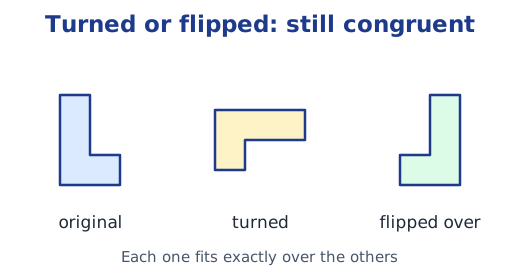
For big figures, tracing is hard, so we measure instead. A circle is fixed by its radius, and a rectangle by its length and breadth. For a figure made of two arms, the two lengths are not enough; the angle between the arms is needed too.
Same three sides: SSS
Suppose a triangle has sides 4 cm, 6 cm and 8 cm. Draw AB = 6 cm. The third vertex must be 4 cm from A and 8 cm from B, so it lies on a circle of radius 4 cm around A and on a circle of radius 8 cm around B. The circles cross at two points, E above AB and F below it.
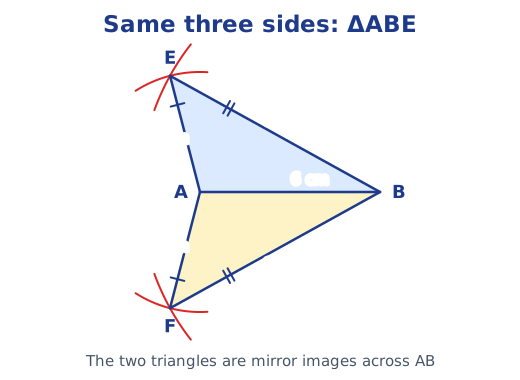
ΔABE and ΔABF are mirror images across AB, so a cut-out of one fits on the other after a flip. Every triangle with these three sides is a copy of the same triangle. This is the SSS condition: if three sides of one triangle are equal to three sides of another, the triangles are congruent.
Writing a congruence in the right order
When two congruent triangles are superimposed, the parts that fall on each other are corresponding parts. If A falls on X, B on Y and C on Z, we write ΔABC ≅ ΔXYZ. The order is the message:
| Corresponding | Pairs |
|---|---|
| vertices | A and X, B and Y, C and Z |
| sides | AB and XY, BC and YZ, CA and ZX |
| angles | ∠A and ∠X, ∠B and ∠Y, ∠C and ∠Z |
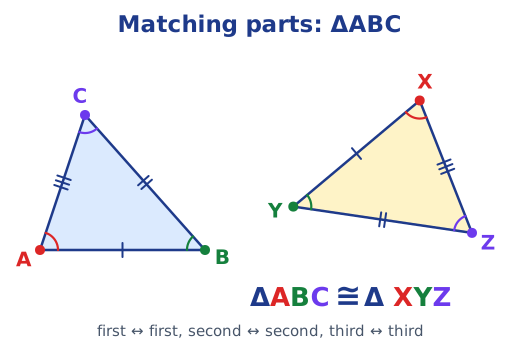
You may start from any vertex, as long as both names move together: ΔBCA ≅ ΔYZX and ΔACB ≅ ΔXZY are also correct, but ΔACB ≅ ΔXYZ is not. To find the correct order, look at the equal sides. In rectangle ABCD with diagonal BD, AB = CD, AD = CB and BD is common. AB must lie on CD, so the congruence is ΔABD ≅ ΔCDB.
The other conditions: SAS, ASA, AAS and RHS
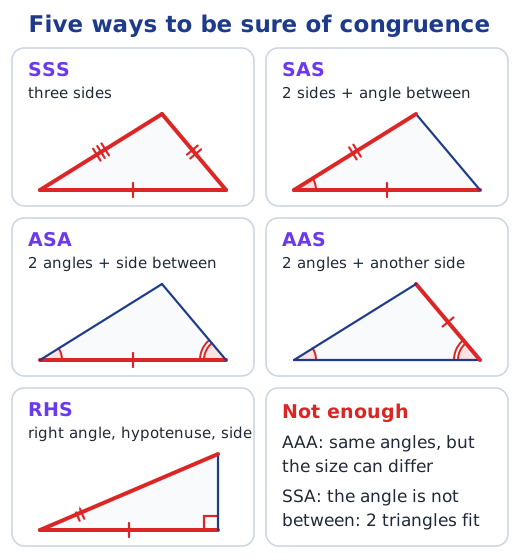
- SAS: two sides and the angle between them. AB = XY = 6 cm, AC = XZ = 5 cm and ∠A = ∠X = 30° give only one triangle, so ΔABC ≅ ΔXYZ.
- ASA: two angles and the side between them, such as BC = YZ = 5 cm, ∠B = ∠Y = 50° and ∠C = ∠Z = 30°.
- AAS: two angles and a side that is not between them. The third angles are equal (all three add up to 180°), so it becomes ASA.
- RHS: for right-angled triangles, the right angle, the hypotenuse and one more side, such as ∠B = ∠Y = 90°, BC = YZ = 4 cm and AC = XZ = 5 cm.
AAA and SSA are not enough
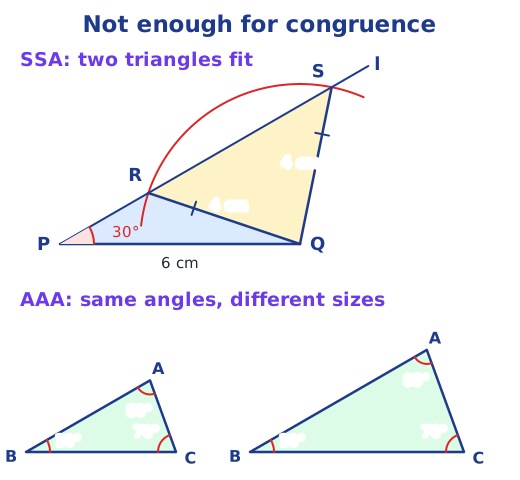
Triangles with the angles 30°, 70° and 80° can be drawn in many sizes, so equal angles do not make triangles congruent. Two sides with an angle that is not between them can also fail: with PQ = 6 cm, ∠P = 30° and QR = 4 cm, the 4 cm arc from Q cuts the 30° line at two points, giving two different triangles.
Why it matters
Once two triangles are known to be congruent, every pair of corresponding parts is equal, so you can prove that two lengths or two angles are equal without measuring. The next step is angles of isosceles and equilateral triangles. Answers to the textbook questions are in the NCERT solutions for Part 2 Chapter 1; see all of Part 2 Chapter 1 notes.
Practice
-
Two triangles have sides 5 cm, 6 cm and 7 cm each. They are:
Show answer
Answer: (a) congruent by SSS
-
ΔDOG ≅ ΔCAT. Which angle is equal to ∠G?
Show answer
Answer: (c) ∠T G is the third letter of DOG and T is the third letter of CAT.
-
AB = PQ, ∠A = ∠P and AC = PR. Which condition shows that ΔABC ≅ ΔPQR?
Show answer
Answer: (b) SAS ∠A lies between AB and AC, and ∠P lies between PQ and PR, so the equal angle is the included angle.
-
Why are three equal angles not enough to show that two triangles are congruent?
Show answer
Answer: Many triangles have the same three angles, for example 30°, 70° and 80°, but they can be small or large. They have the same shape but not always the same size.
-
In two triangles, ∠A = ∠X = 40°, ∠B = ∠Y = 60° and BC = YZ. Are they congruent? Give the condition.
Show answer
Answer: Yes. The third angles are equal too: ∠C = ∠Z = 180° − 100° = 80°. BC lies between ∠B and ∠C, and YZ between ∠Y and ∠Z, so ASA applies (the given facts are AAS).
Questions students ask
What are congruent figures?
Figures that have exactly the same shape and size. A tracing or cut-out of one fits exactly over the other, and it may be turned or flipped over to fit.
What are the conditions for congruence of triangles in Class 7?
SSS (three sides), SAS (two sides and the angle between them), ASA (two angles and the side between them), AAS (two angles and a side not between them) and RHS (in right-angled triangles, the hypotenuse and one side).
Why is SSA not a congruence condition?
With two sides and an angle that is not between them, the arc for the third vertex can cut the line at two points. That gives two different triangles with the same measurements, so they need not be congruent.
What does the order of letters in ΔABC ≅ ΔXYZ mean?
The first, second and third letters match: A with X, B with Y and C with Z. So AB = XY, BC = YZ, CA = ZX, and the matching angles are equal.
Stuck on a question?
Take a photo and Lagnever AI explains it step by step. Try it for 7 days for ₹2.
Get it on Google Play Open in browser
For parents: after the trial, the plan renews monthly by UPI or card autopay. You can cancel anytime in the app.