
Class 7 Maths Part 2 Chapter 1: Geometric Twins Notes
This chapter in five lines
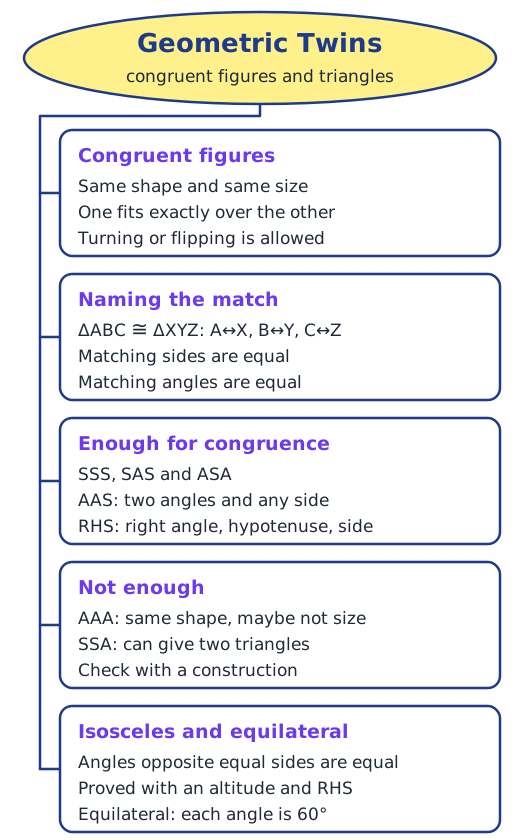
Geometric Twins is about congruence: figures with the same shape and size, so that one fits exactly over the other, even after turning or flipping. Two triangles are congruent if they match by SSS, SAS, ASA, AAS or, in right triangles, RHS; equal angles alone are not enough. Congruence also shows that angles opposite equal sides are equal, so each angle of an equilateral triangle is 60°.
What is this chapter about?
Geometric Twins is about congruence: when are two figures exact copies of each other, and which measurements are enough to make or check a copy? The chapter starts with a symbol on a signboard, moves on to triangles, finds five sets of measurements that fix a triangle completely, and shows two sets that do not. At the end it uses congruence to discover the angles of isosceles and equilateral triangles.
Congruent figures
A symbol on a signboard, made of two straight arms AB and BC, has to be copied onto another board. Tracing works for small figures, but for a big board it is easier to take measurements. The two arm lengths are not enough. With AB = 4 cm and BC = 8 cm, the arms can open to many different angles, and each angle gives a different shape. Fixing ∠ABC as well, say at 80°, leaves only one shape.
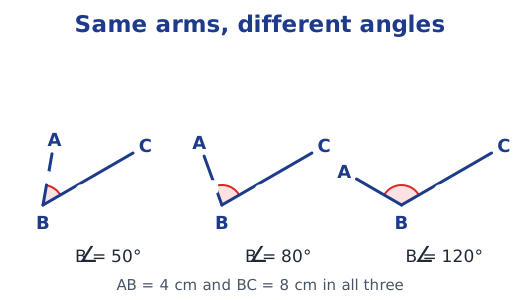
Figures with the same shape and size are congruent. A tracing of one fits exactly over the other, and you may turn the tracing or flip it over to make it fit. To copy a circle you need only its radius; to copy a rectangle, its length and breadth. So two circles with equal radii are congruent, and so are two rectangles with the same length and the same breadth.
Congruent triangles: the SSS condition
Meera and Rabia must make a cardboard copy of a triangular frame that is too big to trace. They measure its sides: 40 cm, 60 cm and 80 cm. Meera says the angles are not needed. To test this on paper with 4 cm, 6 cm and 8 cm, Rabia draws AB = 6 cm and circles of radius 4 cm around A and 8 cm around B. The circles cross at two points, E and F, so there are two triangles, ΔABE and ΔABF. They are mirror images of each other across AB, so they are congruent, and Meera was right.
This is the SSS (Side Side Side) condition: if two triangles have the same three side lengths, they are congruent. See the steps and the picture in congruent figures and triangles.
Writing a congruence
If ΔABC fits on ΔXYZ with A on X, B on Y and C on Z, these are the corresponding vertices. Then AB and XY, BC and YZ, and CA and ZX are corresponding sides, and ∠A = ∠X, ∠B = ∠Y and ∠C = ∠Z. We write ΔABC ≅ ΔXYZ, and the order of the letters shows which vertex matches which. ΔACB ≅ ΔXZY says the same thing, but ΔACB ≅ ΔXYZ is wrong, because it pairs C with Y.
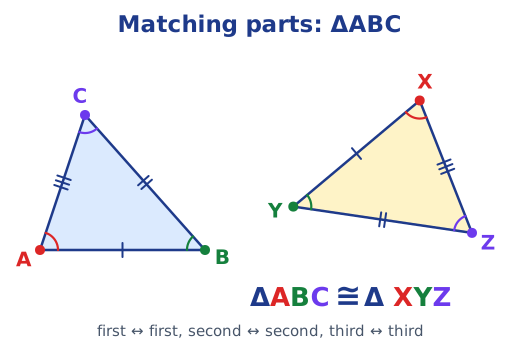
For example, the diagonal BD cuts rectangle ABCD into ΔABD and ΔCDB. AB = CD and AD = CB, because they are opposite sides of the rectangle, and BD is common to both, so the triangles are congruent by SSS. AB has to sit on CD, so A matches C, B matches D and D matches B: ΔABD ≅ ΔCDB.
Five conditions for congruent triangles
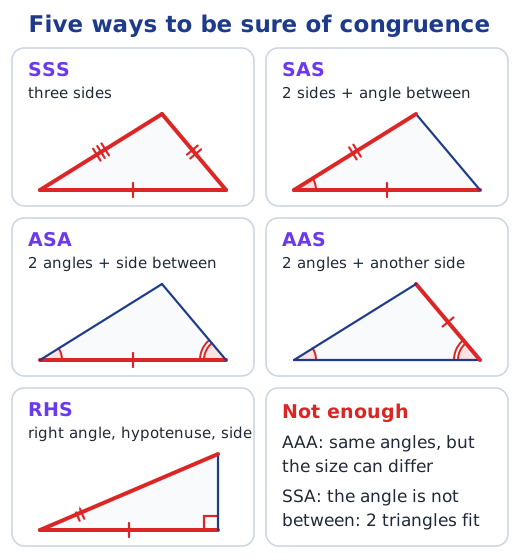
- SSS: all three sides are equal.
- SAS: two sides and the included angle, the angle between them. If AB = XY = 6 cm, AC = XZ = 5 cm and ∠A = ∠X = 30°, everyone who constructs the triangle gets the same one, so ΔABC ≅ ΔXYZ.
- ASA: two angles and the included side. BC = YZ = 5 cm, ∠B = ∠Y = 50° and ∠C = ∠Z = 30° fix the triangle.
- AAS: two angles and a side that is not between them. Since the angles of a triangle add up to 180°, the third angles are equal too, and ASA applies. If ∠A = ∠X = 35°, ∠C = ∠Z = 75° and BC = YZ = 4 cm, then ∠B = ∠Y = 180° − 110° = 70°.
- RHS: in two right-angled triangles, the hypotenuse (the side opposite the right angle) and one more side. With BC = YZ = 4 cm, ∠B = ∠Y = 90° and AC = XZ = 5 cm, the construction gives one triangle above the base and its mirror image below it, and the two are congruent.
Measurements that are not enough
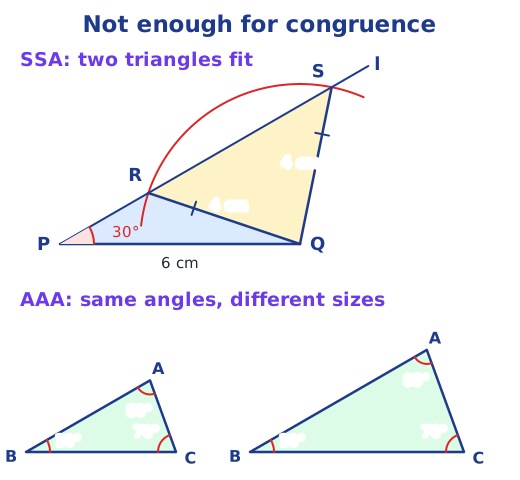
Three angles are not enough. Triangles with angles 30°, 70° and 80° have the same shape but can be any size, so two such triangles need not be congruent.
Two sides and a non-included angle (SSA) are not enough. Take PQ = 6 cm, ∠P = 30° and QR = 4 cm. Draw PQ and a line l from P at 30°. An arc of radius 4 cm from Q cuts l at two points, R and S, so ΔPQR and ΔPQS both fit the measurements but are clearly different. RHS is a special case of SSA that does work, because the angle there is a right angle.
Using congruence
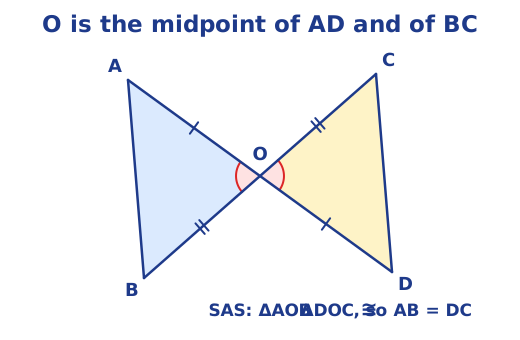
Congruence proves that lengths or angles are equal without measuring them. If O is the midpoint of AD and of BC, then AO = OD and BO = OC, and ∠AOB = ∠DOC because they are vertically opposite angles. By SAS, ΔAOB ≅ ΔDOC, with A matching D, O matching O and B matching C. So AB and DC are corresponding sides, and AB = DC.
Isosceles and equilateral triangles
In ΔABC, let AB = AC and ∠A = 80°. Draw the altitude AD from A to BC. The triangles ADB and ADC have a right angle at D, equal hypotenuses AB and AC, and the common side AD, so ΔADB ≅ ΔADC by RHS. Hence ∠B = ∠C, and each is (180° − 80°) ÷ 2 = 50°. In every triangle, angles opposite equal sides are equal.
In an equilateral triangle all three sides are equal, so all three angles are equal. They add up to 180°, so each angle is 60°. The full reasoning, with more examples, is in angles of isosceles and equilateral triangles.
Congruent triangles around us
Congruent triangles appear in buildings and designs, from ancient times to today. Look for them in the glass pyramid at the Louvre Museum in Paris, the Great Pyramid of Giza in Egypt, dome frames, rangoli patterns and the steel frame of Rabindra Setu (Howrah Bridge) in Kolkata. Answers to every question of the chapter are in the NCERT solutions for Part 2 Chapter 1.
Key terms
| Term | Meaning |
|---|---|
| Congruent | Having exactly the same shape and size, so that one figure fits exactly over the other. The sign ≅ means “is congruent to”. |
| Superimpose | To place one figure exactly on top of another, for example a tracing or a paper cut-out, to see whether they match. |
| Corresponding parts | The vertices, sides and angles that fall on each other when two congruent figures are superimposed. Corresponding parts are equal. |
| Included angle | The angle between two given sides. In ΔABC, ∠A is the included angle of the sides AB and AC. |
| Included side | The side between two given angles. In ΔABC, BC is the included side of ∠B and ∠C. |
| Hypotenuse | The side opposite the right angle in a right-angled triangle. It is the longest side of the triangle. |
| SSS condition | If the three sides of one triangle are equal to the three sides of another, the triangles are congruent. |
| SAS condition | If two sides and the included angle of one triangle are equal to those of another, the triangles are congruent. |
| ASA condition | If two angles and the included side of one triangle are equal to those of another, the triangles are congruent. |
| AAS condition | If two angles and a side that is not between them are equal to the matching parts of another triangle, the triangles are congruent. |
| RHS condition | If two right-angled triangles have equal hypotenuses and one more pair of equal sides, they are congruent. |
| Isosceles triangle | A triangle with two equal sides. The angles opposite the equal sides are also equal. |
| Equilateral triangle | A triangle with all three sides equal. All its angles are equal too, and each one is 60°. |
Topics in this chapter
Practice
-
Which set of measurements does not always fix a triangle?
Show answer
Answer: (c) Two sides and an angle that is not between them This is SSA. With PQ = 6 cm, ∠P = 30° and QR = 4 cm, the arc from Q can cut the line at two points, giving two different triangles.
-
ΔPQR ≅ ΔLMN. Which side is equal to QR?
Show answer
Answer: (b) MN Q matches M and R matches N, so QR matches MN.
-
In ΔABC, AB = AC and ∠A = 40°. What is ∠B?
Show answer
Answer: (b) 70° ∠B = ∠C because they are opposite the equal sides, and ∠B + ∠C = 180° − 40° = 140°, so each is 70°.
-
Two right-angled triangles have equal hypotenuses and one more pair of equal sides. They are congruent by:
Show answer
Answer: (c) RHS
-
Each angle of an equilateral triangle measures:
Show answer
Answer: (b) 60°
-
Which pair of figures is always congruent?
Show answer
Answer: (a) Two circles of radius 3 cm A circle is fixed by its radius alone. The other pairs can still differ in size or shape.
Questions students ask
What are the main topics of Class 7 Maths Part 2 Chapter 1?
Congruent figures and how to check them; congruence of triangles with the SSS, SAS, ASA, AAS and RHS conditions; why equal angles (AAA) or SSA are not enough; how to write a congruence with its corresponding parts; and the angles of isosceles and equilateral triangles.
Is Geometric Twins in the new Ganita Prakash book?
Yes. Geometric Twins is Chapter 1 of Ganita Prakash Grade 7 Part 2, the second Class 7 Maths book used in the 2026-27 session. It comes after the eight chapters of Part 1.
What does congruent mean in Class 7 Maths?
Two figures are congruent when they have exactly the same shape and size. A tracing or cut-out of one fits exactly over the other, and you may turn it or flip it over to make it fit. The sign ≅ is read as “is congruent to”.
Stuck on a question?
Take a photo and Lagnever AI explains it step by step. Try it for 7 days for ₹2.
Get it on Google Play Open in browser
For parents: after the trial, the plan renews monthly by UPI or card autopay. You can cancel anytime in the app.