
Angles of isosceles and equilateral triangles
Answer in short
In an isosceles triangle, the angles opposite the equal sides are equal. The altitude from the vertex between the equal sides makes two right-angled triangles that are congruent by RHS, so the two base angles match. In an equilateral triangle all sides are equal, so all angles are equal, and each is 180° ÷ 3 = 60°.
Stuck on a question? Take a photo and Lagnever AI explains it step by step. Try it for 7 days for ₹2. Get it on Google Play
Isosceles and equilateral triangles
A triangle with two equal sides is isosceles. In ΔABC with AB = AC, the angle at A lies between the equal sides, and BC is the third side, often called the base. A triangle with all three sides equal is equilateral. In a drawing, equal sides carry the same mark, such as a small dash across each.
Congruence can tell us something about the angles of these triangles, even before we measure them.
Why the base angles are equal
Take ΔABC with AB = AC and ∠A = 80°. Draw the altitude from A, the line AD that meets BC at a right angle.
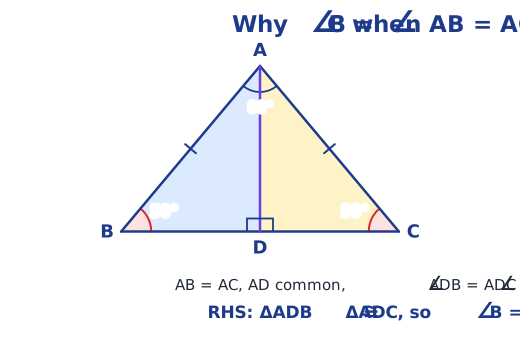
Now compare ΔADB and ΔADC:
- ∠ADB = ∠ADC = 90°, because AD is an altitude,
- AB = AC, the hypotenuses, as given, and
- AD is a side of both triangles.
So ΔADB ≅ ΔADC by RHS. Corresponding parts of congruent triangles are equal, so ∠B = ∠C. The same argument works for every isosceles triangle, which gives the rule: in a triangle, angles opposite equal sides are equal.
Here, ∠B + ∠C = 180° − 80° = 100°, so each of them is 50°.
Finding missing angles
Two shortcuts follow from the rule and the angle sum of 180°:
| What you know | What you get |
|---|---|
| the angle between the equal sides | each base angle = (180° − that angle) ÷ 2 |
| one base angle | the other base angle is the same; the third = 180° − 2 × base angle |
For example, if the angle between the equal sides is 40°, each base angle is (180° − 40°) ÷ 2 = 70°. If a base angle is 65°, the angle between the equal sides is 180° − 130° = 50°.
Angles of an equilateral triangle
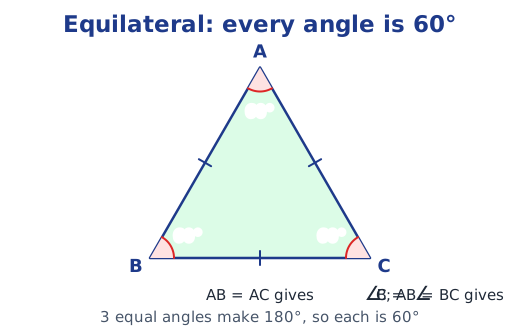
In an equilateral triangle ABC, AB = AC, so ∠B = ∠C (the angles opposite these sides). Also AB = BC, so ∠C = ∠A. All three angles are equal, just like the sides. They add up to 180°, so each one is 180° ÷ 3 = 60°. You can check this by constructing an equilateral triangle with a compass and measuring its angles with a protractor.
Circles make isosceles triangles
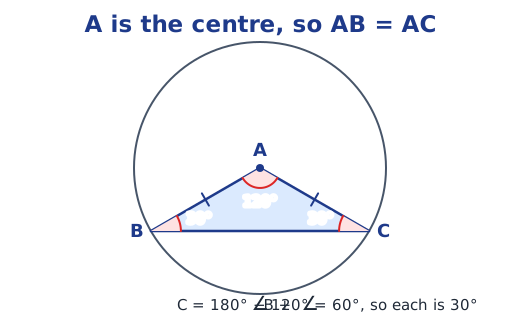
Every two radii of a circle are equal, so a triangle with its top at the centre and the other two vertices on the circle is isosceles. If A is the centre, B and C are on the circle and ∠BAC = 120°, then ∠B = ∠C = (180° − 120°) ÷ 2 = 30°.
Why it matters
This rule turns one known angle into all three, and it is used again and again in geometry problems. It also shows how useful congruence is: a fact about angles came from a fact about two congruent halves. Revise the conditions in congruent figures and triangles. Answers to the textbook questions are in the NCERT solutions for Part 2 Chapter 1; see all of Part 2 Chapter 1 notes.
Practice
-
In ΔPQR, PQ = PR and ∠P = 50°. What is ∠Q?
Show answer
Answer: (b) 65° ∠Q = ∠R and ∠Q + ∠R = 180° − 50° = 130°, so each is 65°.
-
Each base angle of an isosceles triangle is 70°. The third angle is:
Show answer
Answer: (b) 40° 180° − 70° − 70° = 40°.
-
Which statement is true for every equilateral triangle?
Show answer
Answer: (b) Each angle is 60°
-
In ΔABC, AB = AC and ∠B = 35°. Find ∠C and ∠A.
Show answer
Answer: ∠C = ∠B = 35°, because they are opposite the equal sides AC and AB. Then ∠A = 180° − 35° − 35° = 110°.
-
A is the centre of a circle, and B and C are points on it with ∠BAC = 90°. Find ∠ABC.
Show answer
Answer: AB and AC are radii, so AB = AC and ∠ABC = ∠ACB. Together they make 180° − 90° = 90°, so ∠ABC = 45°.
Questions students ask
Why are the base angles of an isosceles triangle equal?
Draw the altitude AD from the vertex A between the equal sides. Triangles ADB and ADC have right angles at D, equal hypotenuses AB and AC, and the common side AD, so they are congruent by RHS. Their corresponding angles B and C are therefore equal.
What is each angle of an equilateral triangle?
60°. All three sides are equal, so all three angles are equal. Three equal angles that add up to 180° must each be 180° ÷ 3 = 60°.
How do I find the angles of an isosceles triangle if one angle is given?
If the given angle is between the equal sides, each other angle is (180° − given angle) ÷ 2. If it is a base angle, the other base angle is the same and the third angle is 180° − 2 × base angle.
Stuck on a question?
Take a photo and Lagnever AI explains it step by step. Try it for 7 days for ₹2.
Get it on Google Play Open in browser
For parents: after the trial, the plan renews monthly by UPI or card autopay. You can cancel anytime in the app.