
NCERT Solutions Class 7 Maths Part 2 Chapter 1: Geometric Twins
Answers to every “Figure it Out” question in Chapter 1, Geometric Twins, of Ganita Prakash Grade 7 Part 2 (2026-27), with the in-text questions that go with them. The page numbers match the Part 2 book. In the answers, “≅” means “is congruent to”. Short notes: Part 2 Chapter 1 notes.
Recreating the signboard symbol (pages 1–3)
How can the symbol be recreated on another board? Tracing works for a small symbol, but for a big one it is easier to take measurements and draw the copy from them.
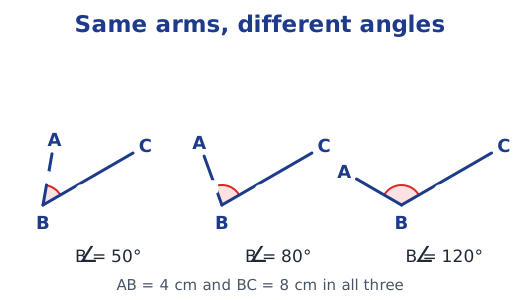
Are the arm lengths AB and BC enough to recreate the figure exactly? No. With AB = 4 cm and BC = 8 cm, the arms can meet at many different angles, and each angle gives a different shape.
Would any other measurement help? Yes, the angle between the arms, ∠ABC. The two arm lengths and this angle fix the shape and the size.
Draw the symbol with AB = 4 cm, BC = 8 cm and ∠ABC = 80°.
- Draw BC = 8 cm.
- Place the protractor at B and mark 80° from BC. Draw a ray from B through the mark.
- Mark A on the ray, 4 cm from B. The arms AB and BC form the symbol.
If two symbols have the same arm lengths, are they congruent? Not always, because the angles between the arms can differ. If the arm lengths and the angle are both equal, the symbols are congruent.
Figure it Out (pages 3–4)
1. Check if the two figures are congruent. They are not congruent. Their arms are nearly equal in length, but the angle between the arms is close to 90° in the first figure and close to 70° in the second. Trace one and place it on the other: the arms do not fit together.
2. Circle the pairs that appear congruent. The two drops appear congruent (one is a turned copy of the other), and so do the two pairs of leaves (one is a flipped copy). The clouds are not congruent, because one is bigger and their outlines differ, and the star bursts are not congruent, because one is clearly larger.
3. What measurements would you take to create a figure congruent to a given (a) circle, (b) rectangle? How would you check if two (a) circles, (b) rectangles are congruent?
- (a) A circle needs only its radius (or its diameter). Two circles are congruent if their radii are equal.
- (b) A rectangle needs its length and breadth, since all its angles are 90°. Two rectangles are congruent if their lengths are equal and their breadths are equal.
4. How would we check if two figures like the one shown (a long segment with a shorter segment meeting it) are congruent? Measure four things in each figure: the length of the long segment, the length of the short segment, how far along the long segment the short one meets it, and the angle between them. If all four match, the figures are congruent. In the book’s pairs, these four measurements come out the same for both figures of each pair, so each pair is congruent: one figure is the other moved to a new place.
Congruence of triangles (pages 4–6)
What can Meera and Rabia do? Take measurements of the frame, such as its side lengths, and construct a triangle with the same measurements on cardboard.
Do you agree with Meera that the three sides are enough? Yes. A triangle with given side lengths can be drawn in only one shape and size, as the construction below shows.
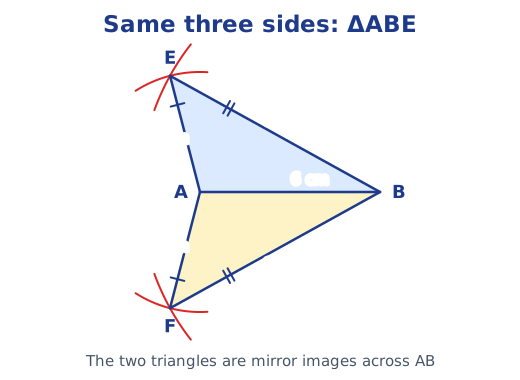
Can you replicate the triangle with sides 4 cm, 6 cm and 8 cm? Yes. Draw AB = 6 cm. With the compass, draw an arc of radius 4 cm from A and an arc of radius 8 cm from B. They meet at E. Join AE and BE.
Are ΔABE and ΔABF congruent? Yes. The circles also meet at F below AB, but ΔABF is the mirror image of ΔABE across AB, built the same way below the line. A cut-out of one fits on the other after flipping it. Both have sides 4 cm, 6 cm and 8 cm, so all such triangles are congruent (the SSS condition).
Conventions to express congruence (pages 6–8)
Which vertices of ΔABC and ΔXYZ should overlap? A over X, B over Y and C over Z, so that the equal sides lie on each other.
Are there other ways of overlapping the vertices? Not for these triangles, because their three sides have different lengths and each side can only lie on the side of the same length. A triangle with two or three equal sides can be overlapped in more than one way (see question 4 on page 21).
Can you identify a pair of congruent triangles in Fig. 1.1 (rectangle ABCD with diagonal BD)? ΔABD and ΔCDB. AB = CD and AD = CB, since they are opposite sides of the rectangle, and BD is common, so they are congruent by SSS.
Can the correspondence be A–C, B–B, D–D? No. That would lay AB of ΔABD on CB of ΔCDB, and these sides need not be equal.
Identify the correct correspondence. AB must lie on CD, AD on CB and BD on DB. So A matches C, B matches D and D matches B: ΔABD ≅ ΔCDB.
Figure it Out (pages 8–9)
1. ΔHEN ≅ ΔBIG. List all the other correct ways of expressing this congruence. H matches B, E matches I and N matches G, so the letters must move in pairs:
- ΔHNE ≅ ΔBGI
- ΔEHN ≅ ΔIBG
- ΔENH ≅ ΔIGB
- ΔNHE ≅ ΔGBI
- ΔNEH ≅ ΔGIB
Each of these can also be written the other way round, such as ΔBIG ≅ ΔHEN.
2. Are triangles RED and JAM congruent? Yes, by SSS: RE = JA = 3.5 cm, ED = AM = 5 cm and RD = JM = 6 cm. R lies between the 3.5 cm and 6 cm sides, and so does J; E lies between the 3.5 cm and 5 cm sides, and so does A. So ΔRED ≅ ΔJAM.
3. AB = AD and CB = CD. Is there a pair of congruent triangles? Does AC divide ∠BAD and ∠BCD into two equal parts? Yes. In ΔABC and ΔADC, AB = AD, CB = CD and AC is common, so ΔABC ≅ ΔADC by SSS. Corresponding angles are equal, so ∠BAC = ∠DAC and ∠BCA = ∠DCA. Hence AC divides both ∠BAD and ∠BCD into two equal parts.
4. DF = DG and FE = GE. Are ΔDFE and ΔGED congruent? The two triangles in the figure, DFE and DGE, are congruent by SSS: DF = DG, FE = GE, and DE is common. The correct statement is ΔDFE ≅ ΔDGE (D with D, F with G, E with E). Writing ΔDFE ≅ ΔGED would be wrong, because it would pair the side DF with GE.
Measuring the angles (pages 9–10)
Can Meera and Rabia recreate the triangle exactly from its three angles? No.
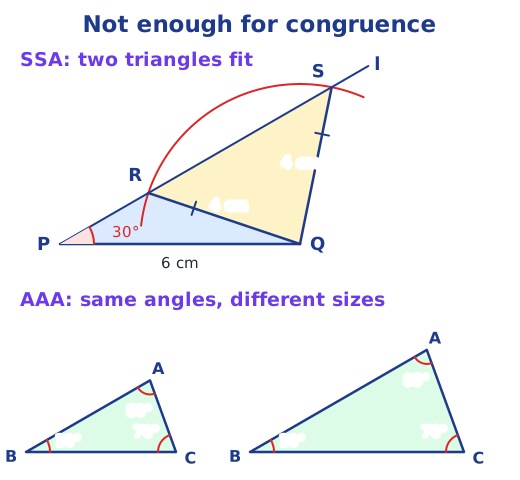
With angles 30°, 70° and 80°, can we make an exact copy? No. Draw any base, make 30° at one end and 70° at the other; the third angle is then 80°. A longer base gives a larger triangle with the same angles. All these triangles have the same shape but not the same size, so they are not all congruent.
Two sides and the included angle (page 10)
Construct a triangle with AB = 6 cm, AC = 5 cm and ∠A = 30°, and compare with your classmates. Draw AB = 6 cm, make an angle of 30° at A, and mark C on the new arm, 5 cm from A. Join BC. Everyone gets the same triangle, because once AB is drawn, the angle fixes the direction of AC and the length fixes C; then BC has only one possible length. So triangles with two equal sides and equal included angles are congruent: the SAS condition.
Two sides and a non-included angle (pages 10–12)
AB = XY = 6 cm, AC = XZ = 4 cm and ∠B = ∠Y = 30°. Are the triangles congruent? Not necessarily. Draw PQ = 6 cm and a line l from P at 30° to PQ. An arc of radius 4 cm from Q cuts l at two points, R and S. Both ΔPQR and ΔPQS have the given measurements, but they are different triangles. So the SSA condition does not make triangles congruent.
Two angles and the included side (pages 12–13)
BC = YZ = 5 cm, ∠B = ∠Y = 50° and ∠C = ∠Z = 30°. Are the triangles congruent? Yes. Draw BC = 5 cm, an angle of 50° at B and an angle of 30° at C. The two arms meet at exactly one point, A, so every triangle with these measurements is the same. This is the ASA condition, and ΔABC ≅ ΔXYZ.
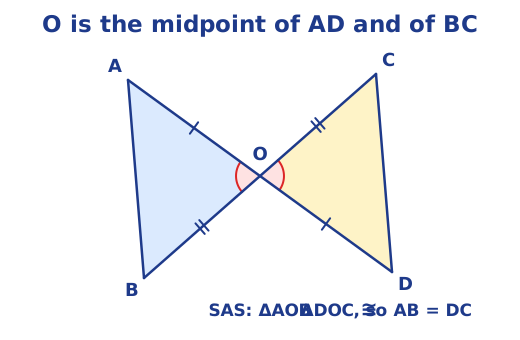
O is the midpoint of AD and BC. What can you say about AB and CD? AO = OD and BO = OC, and ∠AOB = ∠DOC because they are vertically opposite angles. So ΔAOB ≅ ΔDOC by SAS, with A matching D, O matching O and B matching C. AB and DC are corresponding sides, so AB = DC.
Figure it Out (pages 13–14)
1. Are triangles ABC and XYZ congruent? Yes, by SAS. AB = XZ = 7 cm, BC = ZY = 5 cm, and the angles between these sides are equal: ∠B = ∠Z = 47°. B matches Z, A matches X and C matches Y, so ΔABC ≅ ΔXZY.
2. CD and AB are parallel and AB = CD. What are the other equal parts? DB and CA cross at O. DB is a transversal of the parallel lines, so the alternate angles ∠CDO and ∠ABO are equal. CA is also a transversal, so ∠DCO = ∠BAO. With DC = BA between these angles, ΔDOC ≅ ΔBOA by ASA. So OD = OB and OC = OA, which means O is the midpoint of both DB and CA. Also, ∠DOC = ∠BOA (vertically opposite angles).
3. ∠ABC = ∠DBC and ∠ACB = ∠DCB. Show that ∠BAC = ∠BDC. Are the triangles congruent? In ΔABC and ΔDBC, the angles at B are equal, the angles at C are equal, and BC is common, so ΔABC ≅ ΔDBC by ASA. Hence ∠BAC = ∠BDC, as corresponding angles. (The angle sum shows it too: ∠BAC = 180° − ∠ABC − ∠ACB = 180° − ∠DBC − ∠DCB = ∠BDC.)
4. ∠ABD = ∠DCA and ∠ACB = ∠DBC. Identify the equal parts. Add the given angles: ∠ABC = ∠ABD + ∠DBC = ∠DCA + ∠ACB = ∠DCB. In ΔABC and ΔDCB, ∠ABC = ∠DCB, BC is common, and ∠ACB = ∠DBC, so ΔABC ≅ ΔDCB by ASA. The equal parts are AB = DC, AC = DB, ∠BAC = ∠CDB and ∠ABC = ∠DCB, along with the given angles.
Two angles and a non-included side (pages 14–16)
∠A = ∠X = 35°, ∠C = ∠Z = 75° and BC = YZ = 4 cm. Are the triangles congruent? Yes. The angle sum gives ∠B = 180° − 35° − 75° = 70°, and in the same way ∠Y = 70°. Now ∠B = ∠Y, BC = YZ and ∠C = ∠Z, so ΔABC ≅ ΔXYZ by ASA. The given facts are two angles and a side that is not between them: the AAS condition, which is enough for congruence.
Two sides in a right triangle (pages 16–17)
BC = YZ = 4 cm, ∠B = ∠Y = 90° and AC = XZ = 5 cm. Are the triangles congruent? Construct: draw QR = 4 cm, draw the line l perpendicular to QR at Q, and cut l with an arc of radius 5 cm from R. Call the point P and join PR.
Does the arc also meet l below QR? Is that triangle different? Yes, it meets the downward part of l at a second point. That triangle is the mirror image of ΔPQR across QR, so it is congruent to ΔPQR after a flip. All triangles with these measurements are congruent, so ΔABC ≅ ΔXYZ. If you measure, PQ comes out 3 cm in both. This is the RHS condition: right angle, hypotenuse (the side opposite the right angle) and one more side.
Angles of isosceles and equilateral triangles (pages 17–19)
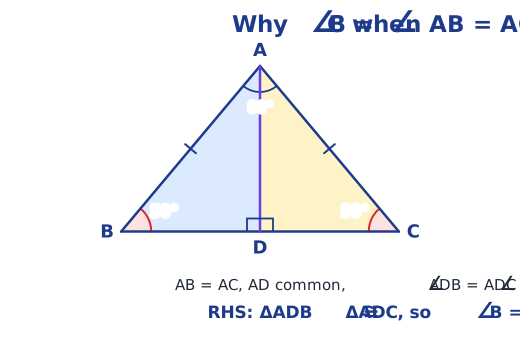
ΔABC is isosceles with AB = AC and ∠A = 80°. What can we say about ∠B and ∠C? Draw the altitude AD. ΔADB ≅ ΔADC by RHS (right angles at D, AB = AC, AD common), so ∠B = ∠C. They add up to 180° − 80° = 100°, so ∠B = ∠C = 50°.
What are the angles of an equilateral triangle? All three are equal, because every pair of sides is equal. Three equal angles that add up to 180° are 60° each.
Verify this by construction. Draw BC = 5 cm. With the compass open to 5 cm, draw arcs from B and from C; they meet at A. Join AB and AC. Measure the three angles with a protractor: each is 60°.
Congruent triangles in real life (pages 19–20)
Describe the congruent triangles you see in each picture.
- Louvre Museum, Paris: the glass pyramid has four sloping faces that are congruent triangles, and its metal frame divides each face into many small pieces of the same shape and size.
- Pyramid of Giza, Egypt: its four sloping faces are congruent triangles standing on a square base.
- Dome design: the frame is made of many small triangles; the triangles in each ring of the dome are congruent.
- Rangoli design: the star in the middle is made of congruent triangles in two colours, arranged round the centre, and the background repeats congruent shapes too.
- Rabindra Setu (Howrah Bridge): the steel frame repeats the same triangles along the bridge, and the two halves of the bridge mirror each other.
Figure it Out (pages 20–21)
1. ΔAIR ≅ ΔFLY. Identify the corresponding vertices, sides and angles.
| Corresponding | Pairs |
|---|---|
| vertices | A and F, I and L, R and Y |
| sides | AI and FL, IR and LY, AR and FY |
| angles | ∠A and ∠F, ∠I and ∠L, ∠R and ∠Y |
2. Which pairs of triangles are congruent?
- (a) AB = DE, BC = EF, CA = DF: congruent by SSS, ΔABC ≅ ΔDEF.
- (b) AB = EF, ∠A = ∠E, AC = ED: ∠A lies between AB and AC, and ∠E between EF and ED, so they are congruent by SAS, ΔABC ≅ ΔEFD.
- (c) AB = DF, ∠B = ∠D = 90°, AC = FE: both are right triangles, AC and FE are the hypotenuses, and AB = DF is one more side, so they are congruent by RHS, ΔABC ≅ ΔFDE.
- (d) ∠A = ∠D, ∠B = ∠E, AC = DF: two angles and a side that is not between them, so they are congruent by AAS, ΔABC ≅ ΔDEF.
- (e) AB = DF, ∠B = ∠F, AC = DE: ∠B is not between AB and AC, so this is SSA. These measurements do not make the triangles congruent; there may be two different triangles.
3. OB = OC and OA = OD. Show that AB is parallel to CD. In ΔAOB and ΔDOC, OA = OD, OB = OC, and ∠AOB = ∠DOC (vertically opposite angles), so ΔAOB ≅ ΔDOC by SAS. Hence ∠OAB = ∠ODC, that is, ∠BAD = ∠CDA. These are alternate angles made by the transversal AD with the lines AB and CD. Since the alternate angles are equal, AB ∥ CD.
4. ABCD is a square. Show that ΔABC ≅ ΔADC. Is ΔABC also congruent to ΔCDA? All sides of a square are equal and AC is common. AB = AD, BC = DC and AC = AC, so ΔABC ≅ ΔADC by SSS. Also AB = CD, BC = DA and AC = CA, so ΔABC ≅ ΔCDA too. This happens because ΔABC has two equal sides, AB = BC, so it can be laid on ΔADC in two ways.
Give more examples of triangles congruent in two ways, and in six ways. Any two congruent isosceles triangles: if PQ = PR and XY = XZ with the same lengths and the same angle at P and X, then ΔPQR ≅ ΔXYZ and also ΔPQR ≅ ΔXZY. Two equilateral triangles with the same side are congruent in six ways: ΔABC ≅ ΔXYZ, ΔXZY, ΔYXZ, ΔYZX, ΔZXY and ΔZYX.
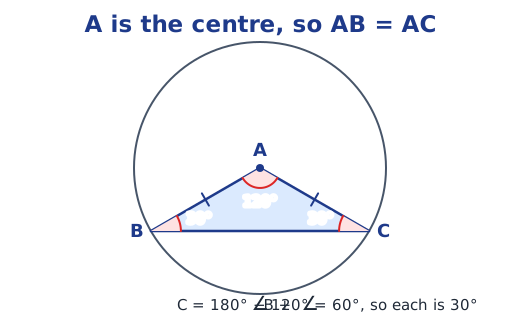
5. Find ∠B and ∠C if A is the centre of the circle. AB and AC are radii, so AB = AC and ∠B = ∠C. Since ∠A = 120°, ∠B + ∠C = 60°, so ∠B = ∠C = 30°.
6. Find the missing angles. The book does not name four inside points, so we call them G, H, O and M as shown. The figure is a rectangle, so its corners are 90°, and angles on a straight line add up to 180°.
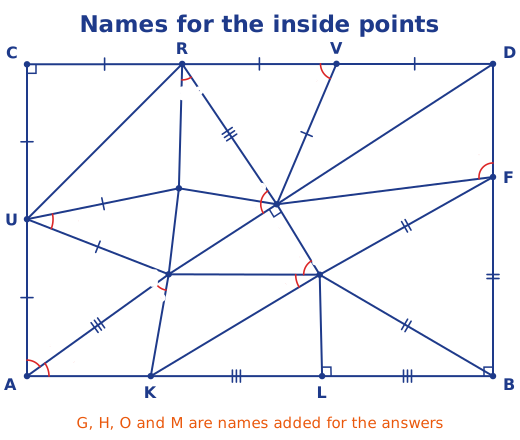
Work through the triangles in this order, each using the ones before it:
| Triangle | Missing angles and reason |
|---|---|
| ΔCRU | CR = CU and ∠C = 90°, so ∠CRU = ∠CUR = 45° |
| ΔRVO | RV = VO and ∠RVO = 68°, so ∠VRO = ∠VOR = 56° |
| ΔVDO | ∠OVD = 180° − 68° = 112°; VO = VD, so ∠VOD = ∠VDO = 34° |
| ΔUHA | UA = UH, so ∠UHA = ∠UAH = 56° and ∠AUH = 68° |
| ΔUGH | UG = UH and ∠GUH = 34°, so ∠UGH = ∠UHG = 73° |
| ΔRGO | ∠RGO = 180° − 34° − 44° = 102° |
| ΔURG | straight line at R: ∠URG = 180° − 45° − 34° − 56° = 45°; straight line at U: ∠RUG = 180° − 45° − 34° − 68° = 33°; so ∠RGU = 102° |
| ΔGOH | angles round G: ∠OGH = 360° − 102° − 102° − 73° = 83°; so ∠GHO = 180° − 46° − 83° = 51° |
| ΔAHK | ∠AKH = 180° − 34° − 44° = 102° |
| ΔHOM | ∠OHM = 180° − 90° − 56° = 34° |
| ΔHKM | angles round H: ∠KHM = 360° − 73° − 51° − 34° − 44° − 56° = 102°; so ∠HKM = 180° − 102° − 30° = 48° |
| ΔKML | straight line at K: ∠MKL = 180° − 102° − 48° = 30°; ∠MLK = 90°, so ∠KML = 60° |
| ΔFMB | MF = FB = BM, so it is equilateral: 60°, 60° and 60° |
| ΔMLB | ∠LBM = 90° − 60° = 30° and ∠MLB = 90°, so ∠LMB = 60° |
| ΔOFM | straight line at F: ∠OFM = 180° − 98° − 60° = 22°; angles round M: ∠OMF = 360° − 56° − 30° − 60° − 60° − 60° = 94°; so ∠MOF = 64° |
| ΔDOF | angles round O: ∠DOF = 360° − 34° − 56° − 44° − 46° − 90° − 64° = 26°; so ∠ODF = 180° − 98° − 26° = 56° |
Two checks: ∠VDO + ∠ODF = 34° + 56° = 90°, the corner D of the rectangle. And the triple-marked sides agree: ΔRGO ≅ ΔAKH by ASA (34°, RO = AH, 44°), and indeed ∠RGO = ∠AKH = 102°.
Puzzle time (page 23)
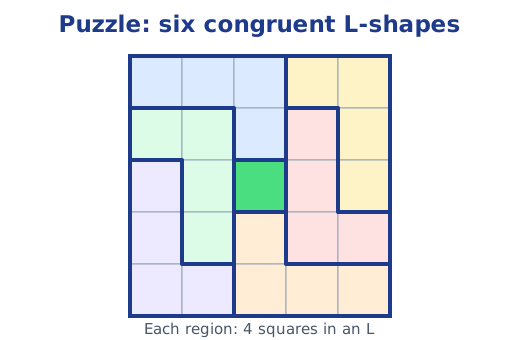
Split the white squares into 6 smaller congruent regions. There are 24 white squares, so each region has 4 squares. Six L-shapes of 4 squares do it, some turned and some flipped:
Practice
-
ΔKLM ≅ ΔPQR. Which angle is equal to ∠M?
Show answer
Answer: (c) ∠R M is the third letter of KLM and R is the third letter of PQR.
-
AB = PQ = 5 cm, ∠A = ∠P = 40° and AC = PR = 7 cm. The triangles ABC and PQR are congruent by:
Show answer
Answer: (b) SAS ∠A is between AB and AC, and ∠P is between PQ and PR.
-
The two equal angles of an isosceles triangle are 65° each. The third angle is:
Show answer
Answer: (a) 50° 180° − 65° − 65° = 50°.
-
In ΔXYZ, XY = XZ and ∠Y = 72°. Find ∠Z and ∠X.
Show answer
Answer: ∠Z = ∠Y = 72°, because they are opposite the equal sides XY and XZ. Then ∠X = 180° − 72° − 72° = 36°.
-
Why can the angles 40°, 60° and 80° alone not be used to make an exact copy of a triangle?
Show answer
Answer: Many triangles have these three angles, some small and some large. They have the same shape but different sizes, so at least one side length is also needed.
Stuck on a question?
Take a photo and Lagnever AI explains it step by step. Try it for 7 days for ₹2.
Get it on Google Play Open in browser
For parents: after the trial, the plan renews monthly by UPI or card autopay. You can cancel anytime in the app.