
NCERT Solutions Class 10 Maths Chapter 2: Polynomials
Answers to the questions inside Chapter 2, Polynomials, all five worked examples, and every question of Exercises 2.1 and 2.2, from Mathematics, the Class 10 NCERT textbook. Page numbers follow the 2026-27 reprint (pages 10–23). The exercise questions are quoted from the book; the examples and in-chapter questions are restated in short and labelled by number and page. The book’s graphs (Fig. 2.9 and Fig. 2.10) are described in words, not redrawn, and every graph on this page is plotted from its own polynomial. Every zero, sum and product below was checked by computing it again. Short notes: Chapter 2 notes.
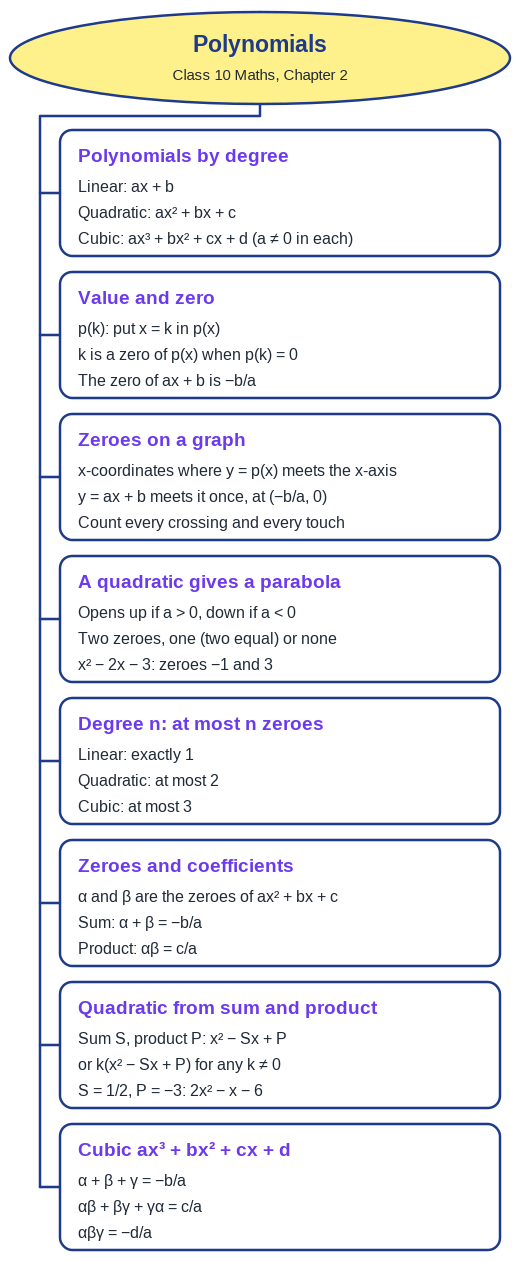
Questions inside the chapter (pages 11–17)
Page 11: x² − 3x − 4 when x = −1, and why −1 and 4 are special. p(−1) = (−1)² − 3 × (−1) − 4 = 1 + 3 − 4 = 0, and p(4) = 16 − 12 − 4 = 0. Both make the polynomial 0, so they are its zeroes. Other values are not 0: p(2) = 4 − 6 − 4 = −6 and p(0) = −4.
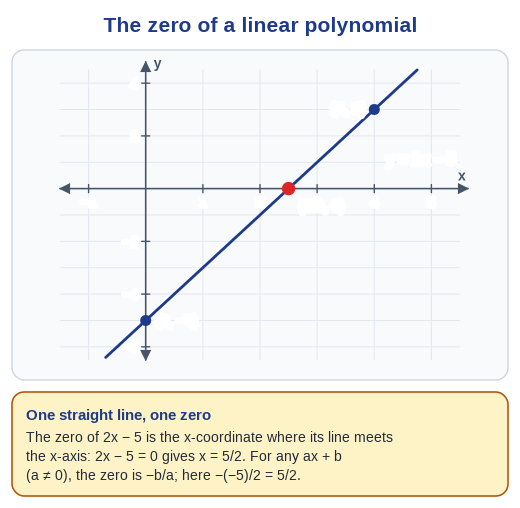
Page 11: the zero of a linear polynomial, and whether the zeroes of a quadratic depend on its coefficients. For 2x + 3, 2k + 3 = 0 gives k = −3/2. In general ax + b has the zero −b/a, that is, −(constant term)/(coefficient of x). The zeroes of a quadratic are linked to its coefficients too: Section 2.3 shows that their sum is −b/a and their product c/a.
Page 12: the line y = 2x + 3. Check the two points: 2 × (−2) + 3 = −1 and 2 × 2 + 3 = 7, so (−2, −1) and (2, 7) lie on the line. It meets the x-axis where 2x + 3 = 0, at (−3/2, 0), halfway between x = −2 and x = −1. The zero of 2x + 3 is the x-coordinate of that point.
Page 13: the values of x² − 3x − 4 in Table 2.1. Working them out again for x = −2, −1, 0, 1, 2, 3, 4 and 5 gives 6, 0, −4, −6, −6, −4, 0 and 6, as in the table. The value is 0 at x = −1 and x = 4, and these are exactly the x-coordinates where the parabola meets the x-axis.
Page 15: what the zeroes of a cubic mean on a graph. The same as for linear and quadratic polynomials: they are the x-values at which the graph meets the x-axis. For x³ − 4x, the values at x = −2, −1, 0, 1 and 2 are 0, 3, 0, −3 and 0 (Table 2.2). Since x³ − 4x = x(x − 2)(x + 2), its only zeroes are −2, 0 and 2.
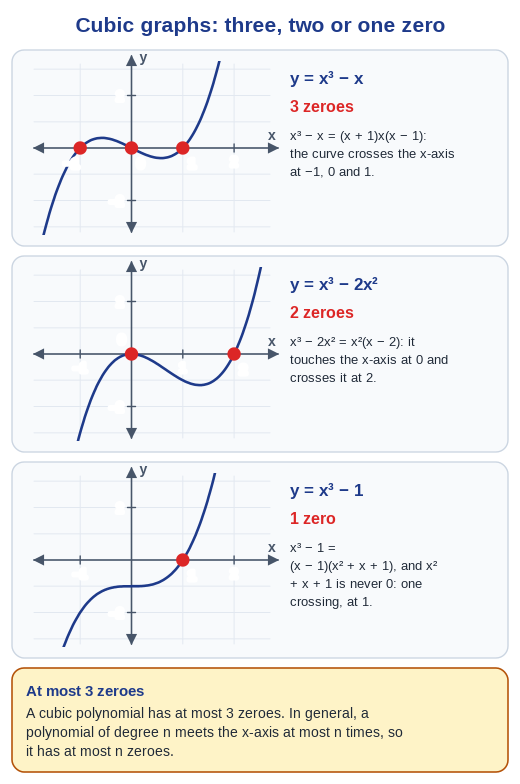
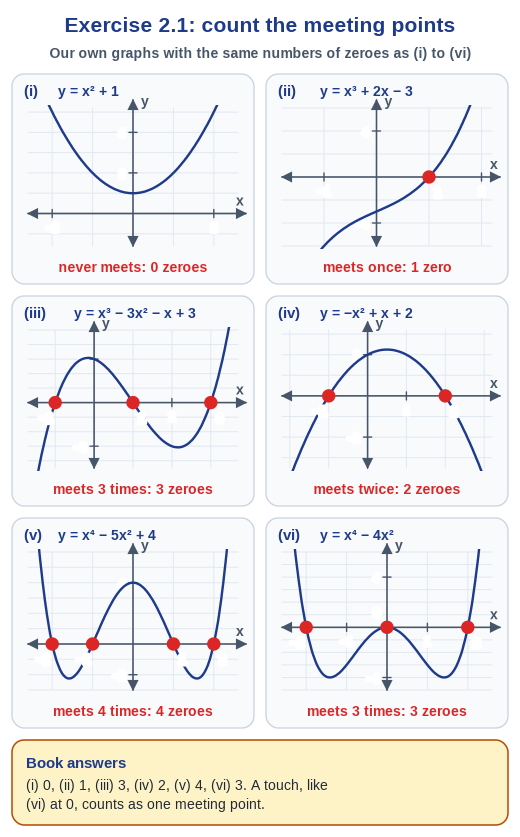
Pages 16–17: the cubics x³ and x³ − x². x³ = 0 only when x = 0, so 0 is its only zero. x³ − x² = x²(x − 1) is 0 only when x = 0 or x = 1, so it has the two zeroes 0 and 1; at 0 its graph touches the x-axis instead of crossing it. Our own graphs of three cubics show the same patterns:
Example 1 (pages 17–18)
Example 1 (page 17): six graphs of y = p(x) in Fig. 2.9; how many zeroes does each p(x) have? Count the points where each graph meets the x-axis.
(i) The curve crosses the x-axis only once, to the left of the origin, and its wavy part stays above the axis: 1 zero.
(ii) The curve, a parabola opening downwards, cuts the x-axis at two points: 2 zeroes.
(iii) Why 3? The curve cuts the x-axis at three different points, so p(x) has 3 zeroes.
(iv) Why 1? The graph is a straight line that is not parallel to the x-axis, so it crosses the axis at exactly one point: 1 zero.
(v) Why 1? The parabola only touches the x-axis, at its lowest point, so the graph meets the axis at one point: 1 zero (two equal zeroes).
(vi) Why 4? The curve meets the x-axis at four different points: 4 zeroes.
Exercise 2.1 (page 18)
1. “The graphs of y = p(x) are given in Fig. 2.10 below, for some polynomials p(x). Find the number of zeroes of p(x), in each case.”
The number of zeroes is the number of points where the graph meets the x-axis. (Fig. 2.10 is not reproduced here; each graph is described in words.)
(i) The graph is a straight line parallel to the x-axis, lying above it. It never meets the x-axis, so p(x) has no zeroes.
(ii) The curve meets the x-axis at exactly one point, to the right of the y-axis: 1 zero.
(iii) The curve meets the x-axis at three points, one to the left of the y-axis and two to the right: 3 zeroes.
(iv) The U-shaped curve, to the left of the y-axis, cuts the x-axis at two points: 2 zeroes.
(v) The wave-shaped curve cuts the x-axis at four points: 4 zeroes.
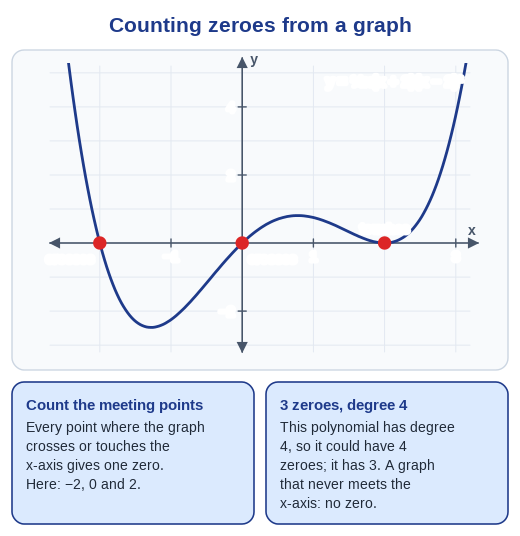
(vi) The curve crosses the x-axis once on the left, then comes down to touch it at two more points. That is three meeting points: 3 zeroes.
These match the book’s answers: 0, 1, 3, 2, 4 and 3. Our own polynomials below have the same numbers of zeroes.
Answer: (i) 0 (no zeroes) (ii) 1 (iii) 3 (iv) 2 (v) 4 (vi) 3
The two quadratics in Section 2.3 (pages 18–19)
Pages 18–19: the zeroes of 2x² − 8x + 6 and their link with the coefficients. Split −8x into two terms whose product is 2x² × 6 = 12x²: −6x and −2x.
2x² − 8x + 6 = 2x² − 6x − 2x + 6 = 2x(x − 3) − 2(x − 3) = (2x − 2)(x − 3) = 2(x − 1)(x − 3)
The zeroes are 1 and 3. Sum: 1 + 3 = 4 = −(−8)/2. Product: 1 × 3 = 3 = 6/2.
Page 19: the zeroes of 3x² + 5x − 2. Split 5x into 6x and −x, whose product −6x² equals 3x² × (−2).
3x² + 5x − 2 = 3x² + 6x − x − 2 = 3x(x + 2) − 1(x + 2) = (3x − 1)(x + 2)
The zeroes are 1/3 and −2. Sum: 1/3 + (−2) = −5/3 = −5/3. Product: 1/3 × (−2) = −2/3 = −2/3.
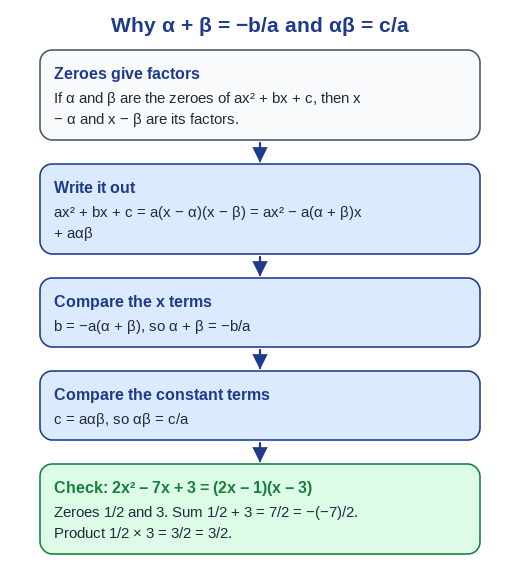
Pages 19–20: the general rule. If α and β are the zeroes of ax² + bx + c, then ax² + bx + c = a(x − α)(x − β) = ax² − a(α + β)x + aαβ. Comparing coefficients gives α + β = −b/a and αβ = c/a.
Examples 2 to 4 (pages 20–21)
Example 2 (page 20): zeroes of x² + 7x + 10, and the check. Two numbers with product 10 and sum 7 are 2 and 5, so x² + 7x + 10 = (x + 2)(x + 5).
Zeroes: −2 and −5. Here a = 1, b = 7, c = 10.
Sum = −2 + (−5) = −7 = −7/1 = −b/a
Product = (−2) × (−5) = 10 = 10/1 = c/a
Example 3 (page 20): zeroes of x² − 3, and the check. By a² − b² = (a − b)(a + b), x² − 3 = (x − √3)(x + √3).
Zeroes: √3 and −√3. Here a = 1, b = 0, c = −3.
Sum = √3 + (−√3) = 0 = −0/1 = −b/a
Product = √3 × (−√3) = −3 = −3/1 = c/a
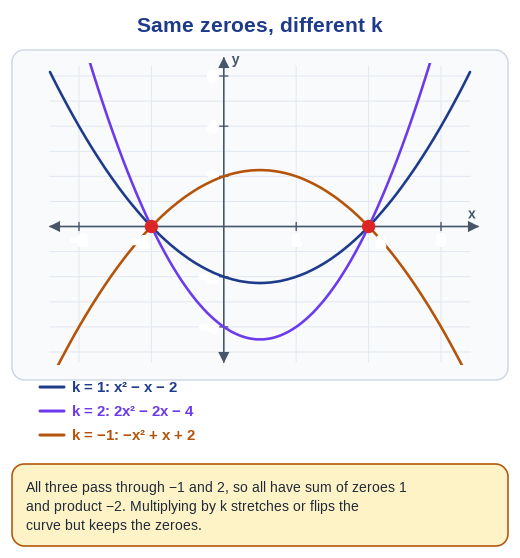
Example 4 (page 21): a quadratic whose zeroes have sum −3 and product 2. Let it be ax² + bx + c. Then −b/a = −3 and c/a = 2. Taking a = 1 gives b = 3 and c = 2, so one answer is x² + 3x + 2. Check: x² + 3x + 2 = (x + 1)(x + 2), with zeroes −1 and −2; their sum is −3 and their product 2.
Page 21: why every other answer is k(x² + 3x + 2). For any answer ax² + bx + c, −b/a = −3 gives b = 3a, and c/a = 2 gives c = 2a. So ax² + bx + c = ax² + 3ax + 2a = a(x² + 3x + 2): a multiple of x² + 3x + 2, with k = a. Multiplying by k does not move the zeroes, as our own example shows:
Cubic polynomials (pages 21–22)
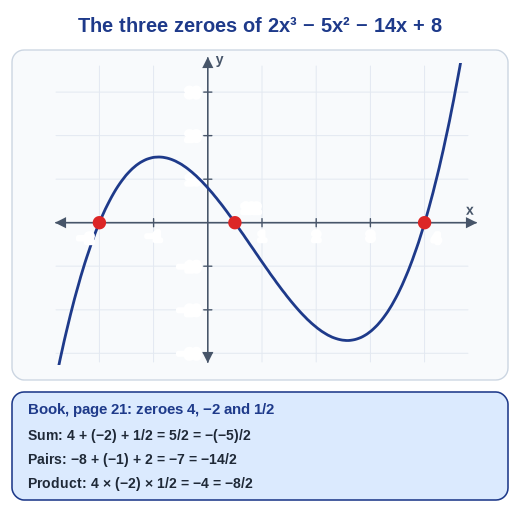
Page 21: is there a similar relation for a cubic? Check that 4, −2 and 1/2 are zeroes of 2x³ − 5x² − 14x + 8.
p(4) = 2 × 64 − 5 × 16 − 14 × 4 + 8 = 128 − 80 − 56 + 8 = 0
p(−2) = 2 × (−8) − 5 × 4 − 14 × (−2) + 8 = −16 − 20 + 28 + 8 = 0
p(1/2) = 2 × 1/8 − 5 × 1/4 − 14 × 1/2 + 8 = 1/4 − 5/4 − 7 + 8 = 0
A cubic has at most three zeroes, so these are all of them. Here a = 2, b = −5, c = −14, d = 8, and there are three relations:
Sum = 4 + (−2) + 1/2 = 5/2 = −(−5)/2 = −b/a
Sum of products in pairs = 4 × (−2) + (−2) × 1/2 + 1/2 × 4 = −8 − 1 + 2 = −7 = −14/2 = c/a
Product = 4 × (−2) × 1/2 = −4 = −8/2 = −d/a
Example 5 (page 22): check that 3, −1 and −1/3 are zeroes of 3x³ − 5x² − 11x − 3, then verify the relations. Here a = 3, b = −5, c = −11, d = −3.
p(3) = 81 − 45 − 33 − 3 = 0
p(−1) = −3 − 5 + 11 − 3 = 0
p(−1/3) = 3 × (−1/27) − 5 × 1/9 + 11/3 − 3 = −1/9 − 5/9 + 33/9 − 27/9 = 0
Take α = 3, β = −1, γ = −1/3.
α + β + γ = 3 − 1 − 1/3 = 5/3 = −(−5)/3 = −b/a
αβ + βγ + γα = −3 + 1/3 − 1 = −11/3 = c/a
αβγ = 3 × (−1) × (−1/3) = 1 = −(−3)/3 = −d/a
The book marks Example 5 “not from the examination point of view”; the three relations themselves are in the chapter summary.
Exercise 2.2 (page 23)
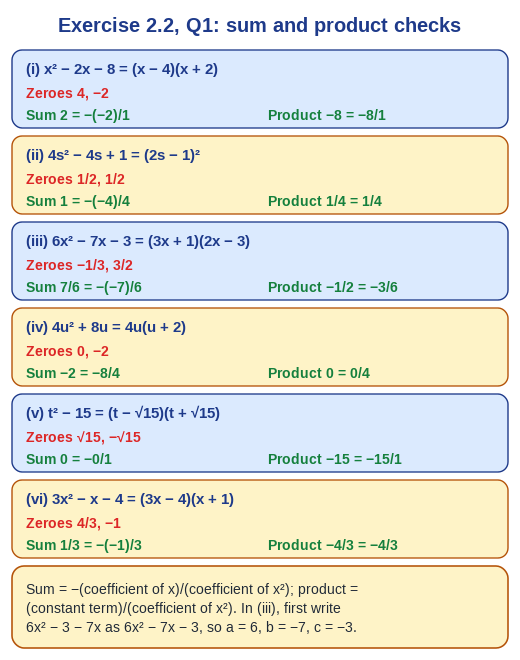
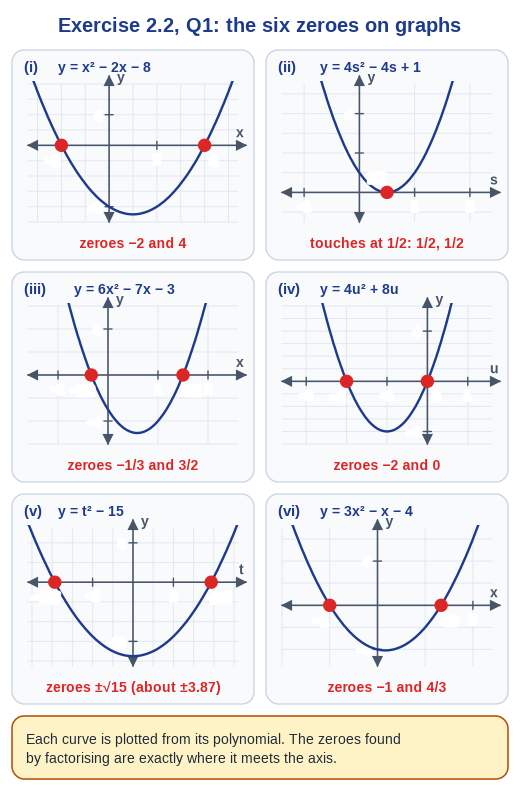
1. “Find the zeroes of the following quadratic polynomials and verify the relationship between the zeroes and the coefficients. (i) x² − 2x − 8 (ii) 4s² − 4s + 1 (iii) 6x² − 3 − 7x (iv) 4u² + 8u (v) t² − 15 (vi) 3x² − x − 4”
In each part, find the zeroes, then check that their sum is −b/a and their product c/a.
(i) Two numbers with product −8 and sum −2 are −4 and 2.
x² − 2x − 8 = x² − 4x + 2x − 8 = x(x − 4) + 2(x − 4) = (x − 4)(x + 2)
Zeroes: 4 and −2. Here a = 1, b = −2, c = −8.
Sum = 4 + (−2) = 2 = −(−2)/1 = −b/a
Product = 4 × (−2) = −8 = −8/1 = c/a. Verified.
(ii) 4s² − 4s + 1 = (2s)² − 2 × 2s × 1 + 1² = (2s − 1)²
Zeroes: 1/2 and 1/2 (two equal zeroes). Here a = 4, b = −4, c = 1.
Sum = 1/2 + 1/2 = 1 = −(−4)/4 = −b/a
Product = 1/2 × 1/2 = 1/4 = c/a. Verified.
(iii) First write it in standard form: 6x² − 3 − 7x = 6x² − 7x − 3, so a = 6, b = −7, c = −3. Two numbers with product 6 × (−3) = −18 and sum −7 are −9 and 2.
6x² − 7x − 3 = 6x² − 9x + 2x − 3 = 3x(2x − 3) + 1(2x − 3) = (3x + 1)(2x − 3)
Zeroes: −1/3 and 3/2.
Sum = −1/3 + 3/2 = −2/6 + 9/6 = 7/6 = −(−7)/6 = −b/a
Product = (−1/3) × 3/2 = −1/2 = −3/6 = c/a. Verified.
(iv) 4u² + 8u = 4u(u + 2)
Zeroes: 0 and −2. Here a = 4, b = 8, c = 0.
Sum = 0 + (−2) = −2 = −8/4 = −b/a
Product = 0 × (−2) = 0 = 0/4 = c/a. Verified.
(v) t² − 15 = t² − (√15)² = (t − √15)(t + √15)
Zeroes: √15 and −√15. Here a = 1, b = 0, c = −15.
Sum = √15 + (−√15) = 0 = −0/1 = −b/a
Product = √15 × (−√15) = −15 = −15/1 = c/a. Verified.
(vi) Two numbers with product 3 × (−4) = −12 and sum −1 are −4 and 3.
3x² − x − 4 = 3x² − 4x + 3x − 4 = x(3x − 4) + 1(3x − 4) = (x + 1)(3x − 4)
Zeroes: −1 and 4/3. Here a = 3, b = −1, c = −4.
Sum = −1 + 4/3 = 1/3 = −(−1)/3 = −b/a
Product = (−1) × 4/3 = −4/3 = c/a. Verified.
Answer: (i) 4, −2 (ii) 1/2, 1/2 (iii) −1/3, 3/2 (iv) 0, −2 (v) √15, −√15 (vi) −1, 4/3
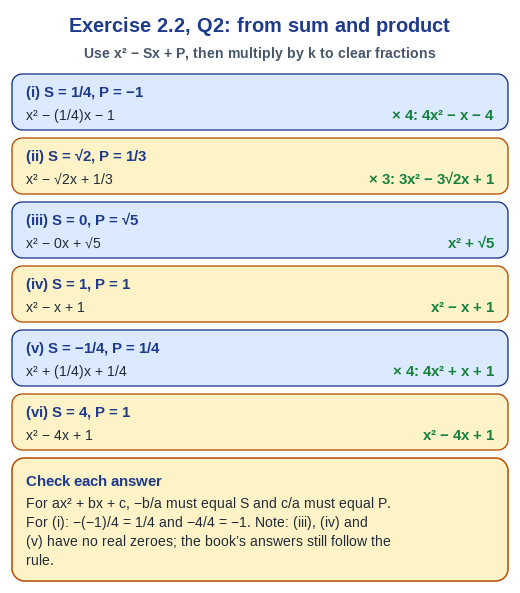
2. “Find a quadratic polynomial each with the given numbers as the sum and product of its zeroes respectively. (i) 1/4, −1 (ii) √2, 1/3 (iii) 0, √5 (iv) 1, 1 (v) −1/4, 1/4 (vi) 4, 1”
If the zeroes have sum S and product P, then x² − Sx + P is one such polynomial, and so is k(x² − Sx + P) for any k ≠ 0. Choose k to clear fractions.
(i) S = 1/4, P = −1: x² − (1/4)x − 1. Multiplying by 4: 4x² − x − 4. Check: −b/a = −(−1)/4 = 1/4 and c/a = −4/4 = −1.
(ii) S = √2, P = 1/3: x² − √2x + 1/3. Multiplying by 3: 3x² − 3√2x + 1. Check: −b/a = 3√2/3 = √2 and c/a = 1/3.
(iii) S = 0, P = √5: x² − 0 × x + √5 = x² + √5. Check: −b/a = 0 and c/a = √5.
(iv) S = 1, P = 1: x² − x + 1. Check: −b/a = −(−1)/1 = 1 and c/a = 1.
(v) S = −1/4, P = 1/4: x² + (1/4)x + 1/4. Multiplying by 4: 4x² + x + 1. Check: −b/a = −1/4 and c/a = 1/4.
(vi) S = 4, P = 1: x² − 4x + 1. Check: −b/a = 4 and c/a = 1. Its zeroes are 2 + √3 and 2 − √3: their sum is 4 and their product 4 − 3 = 1.
Answer: (i) 4x² − x − 4 (ii) 3x² − 3√2x + 1 (iii) x² + √5 (iv) x² − x + 1 (v) 4x² + x + 1 (vi) x² − 4x + 1
Any non-zero multiple of each answer is also correct (for example, 8x² − 2x − 8 for part (i)); the answers above match the book’s key.
A note on (iii), (iv) and (v): these polynomials have no real zeroes. x² + √5 is never less than √5, x² − x + 1 = (x − 1/2)² + 3/4 is never less than 3/4, and 4x² + x + 1 = 4(x + 1/8)² + 15/16 is never less than 15/16, so no real numbers have those sums and products. The answers still follow the rule and match the book’s key. (Extra: in higher classes these zeroes appear as complex numbers.)
Practice
-
If 2 is a zero of x² − 6x + k, then k is:
Show answer
Answer: (a) 8
-
A quadratic polynomial whose zeroes are 3 and −5 is:
Show answer
Answer: (a) x² + 2x − 15
-
How many zeroes does x² + 4 have?
Show answer
Answer: (a) 0
-
Find the zeroes of 4x² − 4x − 3 and check that their sum and product agree with the coefficients.
Show answer
Answer: 4x² − 4x − 3 = 4x² − 6x + 2x − 3 = 2x(2x − 3) + 1(2x − 3) = (2x + 1)(2x − 3), so the zeroes are −1/2 and 3/2. Sum: −1/2 + 3/2 = 1 = −(−4)/4. Product: (−1/2) × (3/2) = −3/4 = −3/4.
-
Find a quadratic polynomial whose zeroes have sum 3/2 and product −1, and then find its zeroes.
Show answer
Answer: x² − (3/2)x − 1; multiplying by 2 gives 2x² − 3x − 2. Splitting the middle term, 2x² − 4x + x − 2 = (2x + 1)(x − 2), so the zeroes are −1/2 and 2. Check: sum 3/2, product −1.
Stuck on a question?
Take a photo and Lagnever AI explains it step by step. Try it for 7 days for ₹2.
Get it on Google Play Open in browser
For parents: after the trial, the plan renews monthly by UPI or card autopay. You can cancel anytime in the app.