
Class 10 Maths Chapter 2: Polynomials Notes
This chapter in five lines
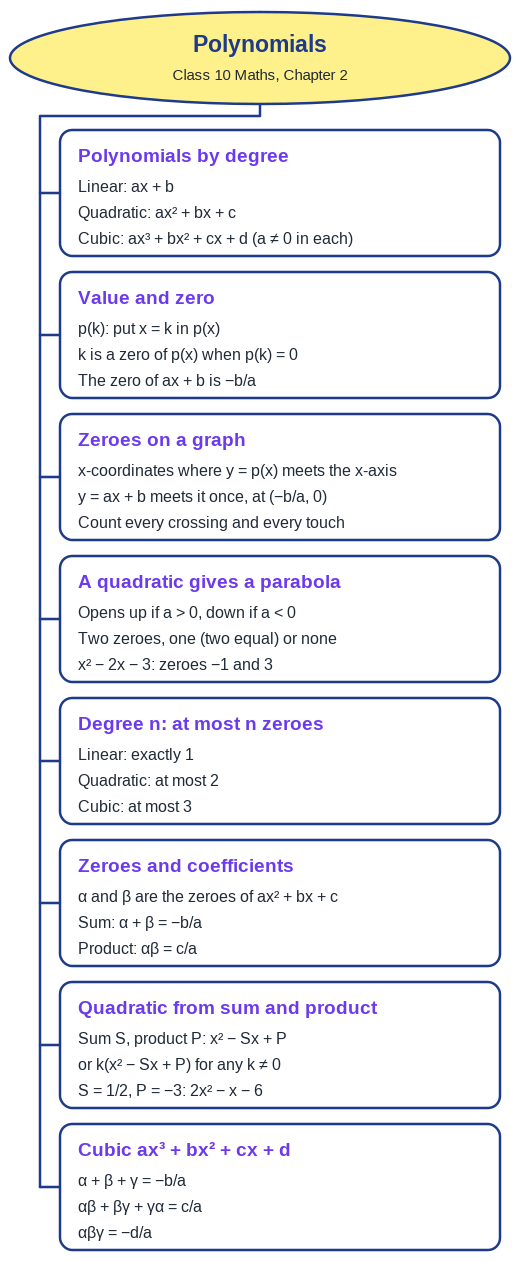
A number k is a zero of p(x) when putting x = k gives 0, that is, p(k) = 0. On the graph of y = p(x), the zeroes are where the curve meets the x-axis, so a linear polynomial has one zero, a quadratic at most two and a cubic at most three. The zeroes of ax² + bx + c satisfy α + β = −b/a and αβ = c/a, which also builds a quadratic from the sum and product of its zeroes.
What is this chapter about?
In Class 9 you learnt what a polynomial is, how to find its degree and how to find the zero of a linear polynomial. This 14-page chapter asks two new questions. What do the zeroes of a polynomial look like on a graph? And are the zeroes of a quadratic polynomial connected to its coefficients, the way the zero of ax + b is −b/a?
What are linear, quadratic and cubic polynomials?
The degree of a polynomial p(x) is the largest power of x that appears in it. A polynomial of degree 1 is linear (ax + b), of degree 2 quadratic (ax² + bx + c) and of degree 3 cubic (ax³ + bx² + cx + d). In each, a, b, c and d are real numbers and a ≠ 0. So 2x − 5 is linear, x² − 2x − 3 is quadratic and x³ − x is cubic. Expressions such as 1/x or √x are not polynomials.
What is a zero of a polynomial?
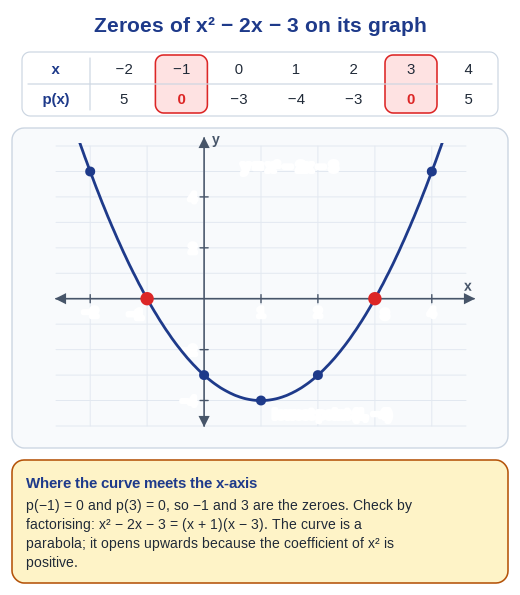
Putting x = k into p(x) gives the value p(k). If p(k) = 0, then k is a zero of p(x). For p(x) = x² − 2x − 3, p(−1) = 1 + 2 − 3 = 0 and p(3) = 9 − 6 − 3 = 0, so −1 and 3 are its zeroes. For a linear polynomial, ak + b = 0 gives the zero k = −b/a. Read more on the zeroes of a polynomial.
What do the zeroes look like on a graph?
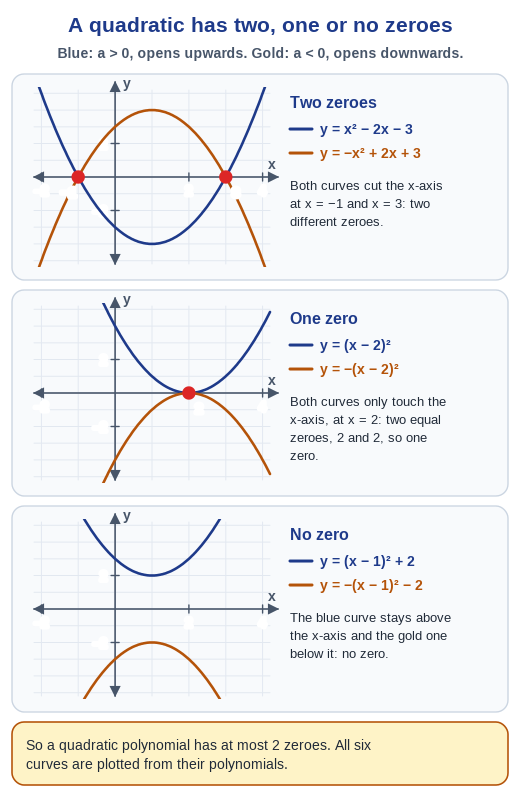
Drawn on a graph, y = ax + b gives a straight line that crosses the x-axis once, at (−b/a, 0). The graph of y = ax² + bx + c is a parabola, opening upwards if a > 0 and downwards if a < 0. In every case, the zeroes of p(x) are the x-values at which the graph of y = p(x) meets the x-axis.
A parabola can cut the x-axis at two points, only touch it at one point (two equal zeroes) or miss it completely. So a quadratic has two zeroes, one zero or none.
How many zeroes can a polynomial have?
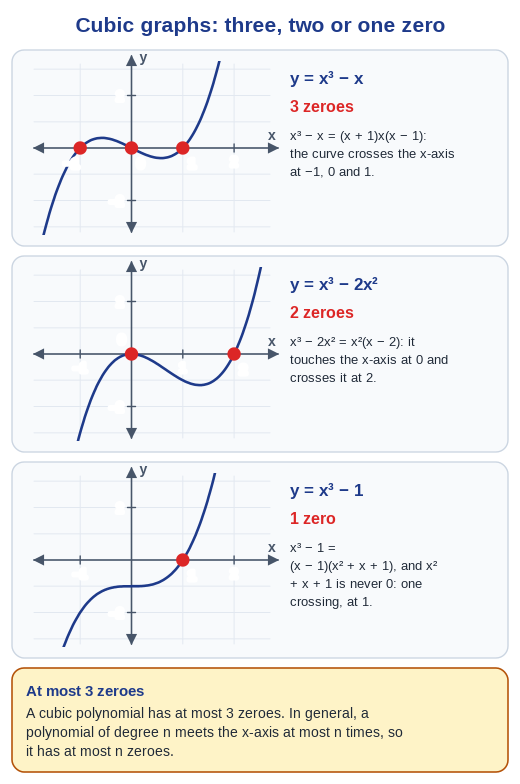
A cubic graph can meet the x-axis three, two or one time: x³ − x has the zeroes −1, 0 and 1, x³ − 2x² has 0 and 2, and x³ − 1 has only 1. The book’s Remark gives the rule: a polynomial of degree n can have no more than n zeroes. To count zeroes from a graph, count every point where it crosses or touches the x-axis. The book also notes that students are not expected to plot graphs of quadratic or cubic polynomials themselves.
How are the zeroes related to the coefficients?
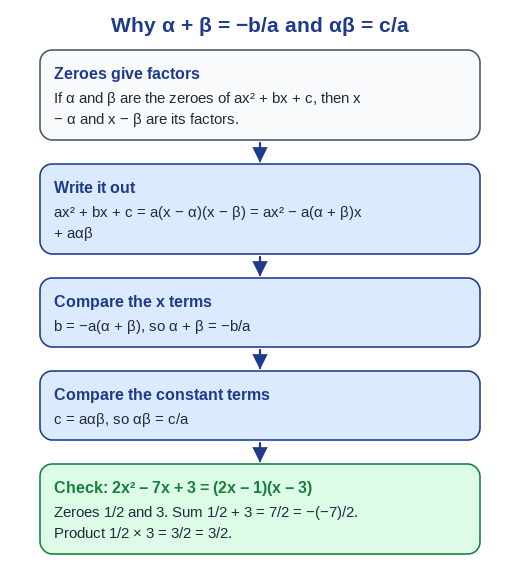
If α and β are the zeroes of ax² + bx + c, then x − α and x − β are its factors, so ax² + bx + c = a(x − α)(x − β). Expanding and comparing coefficients gives
α + β = −b/a and αβ = c/a
In words: the sum of the zeroes is −(coefficient of x)/(coefficient of x²), and the product is (constant term)/(coefficient of x²). For 2x² − 7x + 3 = (2x − 1)(x − 3), the zeroes 1/2 and 3 have sum 7/2 = −(−7)/2 and product 3/2. Read more on zeroes and coefficients.
How do you find a quadratic from the sum and product of its zeroes?
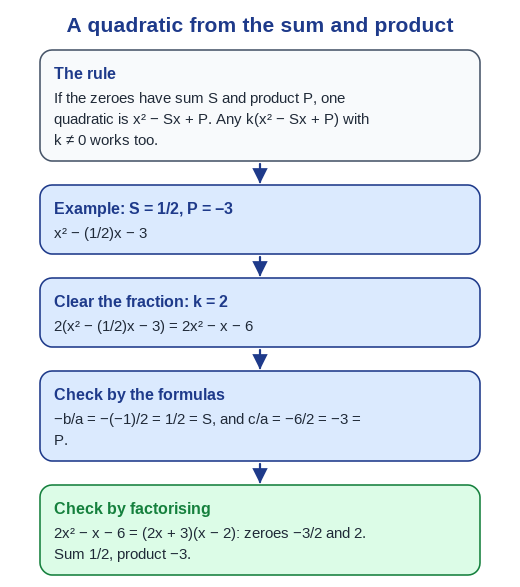
If the zeroes have sum S and product P, then x² − Sx + P is a quadratic with those zeroes, and so is k(x² − Sx + P) for any k ≠ 0. For S = 1/2 and P = −3, multiplying x² − (1/2)x − 3 by 2 gives 2x² − x − 6 = (2x + 3)(x − 2).
What about a cubic polynomial?
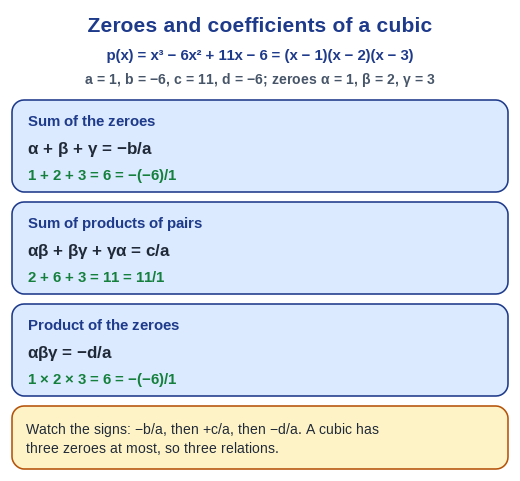
A cubic ax³ + bx² + cx + d with zeroes α, β and γ has three relations: α + β + γ = −b/a, αβ + βγ + γα = c/a and αβγ = −d/a. For x³ − 6x² + 11x − 6, with zeroes 1, 2 and 3: 1 + 2 + 3 = 6, 2 + 6 + 3 = 11 and 1 × 2 × 3 = 6, as the rules predict.
Before we move on
This chapter uses factorising by splitting the middle term and identities such as a² − b² = (a − b)(a + b), which build on squares of sums and differences from Class 8. The introduction still says the chapter will cover the division algorithm for polynomials; the current book has no such section, so older guides that include it go beyond this edition. Every example and both exercises are answered in the NCERT solutions for Chapter 2. The previous chapter is Real Numbers.
Key terms
| Term | Meaning |
|---|---|
| Polynomial in x | A sum of terms, each a real number times a whole-number power of x, such as 4x + 2 or 2x³ − 5x² − 14x + 8. 1/x and √x are not polynomials. |
| Degree | The largest power of x that appears in p(x). 7x − 3x⁴ + x² has degree 4. |
| Linear polynomial | Degree 1: ax + b with a ≠ 0, such as 2x − 5. |
| Quadratic polynomial | Degree 2: ax² + bx + c with a ≠ 0, such as x² − 2x − 3. |
| Cubic polynomial | Degree 3: ax³ + bx² + cx + d with a ≠ 0, such as x³ − x. |
| Value p(k) | What you get by putting x = k in p(x). For p(x) = x² − 2x − 3, p(2) = −3. |
| Zero of a polynomial | A real number k with p(k) = 0. The zeroes of x² − 2x − 3 are −1 and 3. |
| Parabola | The U-shaped graph of a quadratic polynomial. It opens upwards if a > 0 and downwards if a < 0. |
| Coefficient | The number multiplying a power of x. In 2x² − 7x + 3 the coefficient of x² is 2, the coefficient of x is −7 and the constant term is 3. |
| α, β, γ | The Greek letters alpha, beta and gamma, used as names for the zeroes. |
| Sum and product of zeroes | For ax² + bx + c: α + β = −b/a and αβ = c/a. |
| Relations for a cubic | For ax³ + bx² + cx + d: α + β + γ = −b/a, αβ + βγ + γα = c/a and αβγ = −d/a. |
Topics in this chapter
Practice
-
The degree of 7x − 3x⁴ + x² is:
Show answer
Answer: (a) 4
-
If p(x) = x² − 4x + 3, then p(3) is:
Show answer
Answer: (a) 0
-
The graph of y = p(x) crosses the x-axis at two points and touches it at one more. The number of zeroes of p(x) is:
Show answer
Answer: (a) 3
-
The zeroes of x² − 9 are:
Show answer
Answer: (a) 3 and −3
-
The sum of the zeroes of 3x² − 6x + 1 is:
Show answer
Answer: (a) 2
Questions students ask
What are the main topics of Class 10 Maths Chapter 2?
The meaning of the zeroes of a polynomial on a graph (for linear, quadratic and cubic polynomials), how the zeroes of a quadratic polynomial are linked to its coefficients, finding a quadratic from the sum and product of its zeroes, and the three relations for a cubic.
Is the division algorithm for polynomials in the 2026-27 book?
No. In the rationalised book (revised October 2022, marked Reprint 2026-27) the chapter has an introduction, the geometrical meaning of the zeroes, the relationship between zeroes and coefficients, and a summary. The introduction still says the division algorithm will be studied, but this edition has no such section.
How many exercises does Chapter 2 have?
Two. Exercise 2.1 has one question with six graphs, and Exercise 2.2 has two questions with six parts each. Every part, and every example in the chapter, is worked out on the NCERT solutions page.
What should I practise most from this chapter?
Finding the zeroes of a quadratic by splitting the middle term and verifying α + β = −b/a and αβ = c/a; building a quadratic from a given sum and product; and counting zeroes from a graph. Learn the three cubic relations as well, because the summary states them.
Stuck on a question?
Take a photo and Lagnever AI explains it step by step. Try it for 7 days for ₹2.
Get it on Google Play Open in browser
For parents: after the trial, the plan renews monthly by UPI or card autopay. You can cancel anytime in the app.