
What are the zeroes of a polynomial?
Answer in short
A zero of a polynomial p(x) is a real number k with p(k) = 0. On a graph, the zeroes are the x-values at which the graph of y = p(x) meets the x-axis. A linear polynomial has exactly one zero, a quadratic has two, one or none, and a cubic has at most three.
Stuck on a question? Take a photo and Lagnever AI explains it step by step. Try it for 7 days for ₹2. Get it on Google Play
What is the value of a polynomial at a number?
To work out p(x) for x = k, replace x by k and simplify. The answer is written p(k). Take p(x) = x² − 2x − 3:
p(2) = 2² − 2 × 2 − 3 = 4 − 4 − 3 = −3
p(−1) = (−1)² − 2 × (−1) − 3 = 1 + 2 − 3 = 0
p(3) = 3² − 2 × 3 − 3 = 9 − 6 − 3 = 0
The numbers −1 and 3 are special: they make the polynomial equal to 0. A real number k is called a zero of p(x) if p(k) = 0. So −1 and 3 are the zeroes of x² − 2x − 3.
How do you find the zero of a linear polynomial?
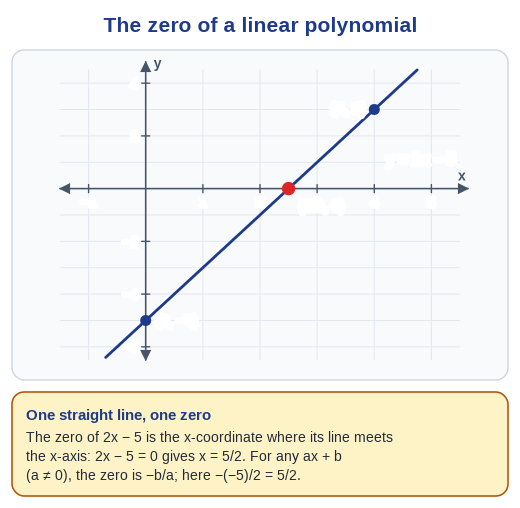
A linear polynomial has degree 1: ax + b with a ≠ 0. Its zero k must satisfy ak + b = 0, so k = −b/a. For 2x − 5, the zero is −(−5)/2 = 5/2. Check: 2 × 5/2 − 5 = 0.
The graph of y = 2x − 5 is a straight line. It passes through (0, −5) and (4, 3), and it crosses the x-axis at exactly one point, (5/2, 0). The x-coordinate of that point is the zero. Because a ≠ 0, the line is never parallel to the x-axis, so every linear polynomial has exactly one zero.
What does the graph of a quadratic polynomial look like?
A quadratic polynomial has degree 2: ax² + bx + c with a ≠ 0. Work out the values of x² − 2x − 3 for x = −2, −1, 0, 1, 2, 3 and 4, plot the points and join them smoothly. You get a U-shaped curve called a parabola, with its lowest point at (1, −4). It meets the x-axis at x = −1 and x = 3, exactly the zeroes we found.
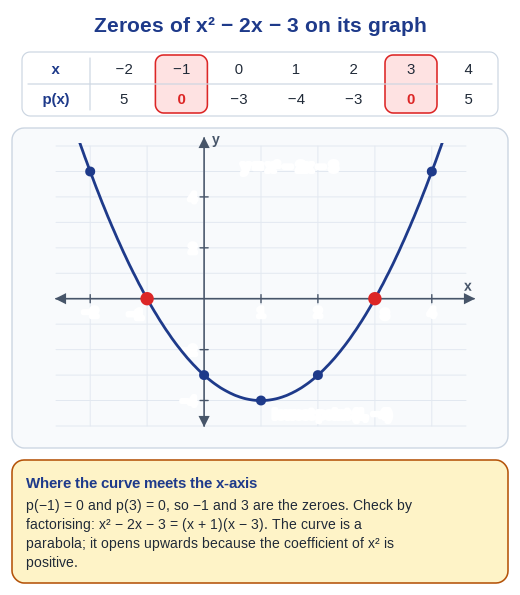
This is true for every polynomial: the zeroes of p(x) are the x-values at which the graph of y = p(x) meets the x-axis. For a quadratic, the parabola opens upwards when a > 0 and downwards when a < 0.
Can a quadratic polynomial have one zero or no zero?
Yes. A parabola can meet the x-axis in three ways:
- It cuts the axis at two points: two different zeroes. x² − 2x − 3 has −1 and 3.
- It only touches the axis at one point: the two zeroes are equal. (x − 2)² touches at 2, so its zeroes are 2 and 2.
- It stays completely above or below the axis: no zero. (x − 1)² + 2 is never less than 2.
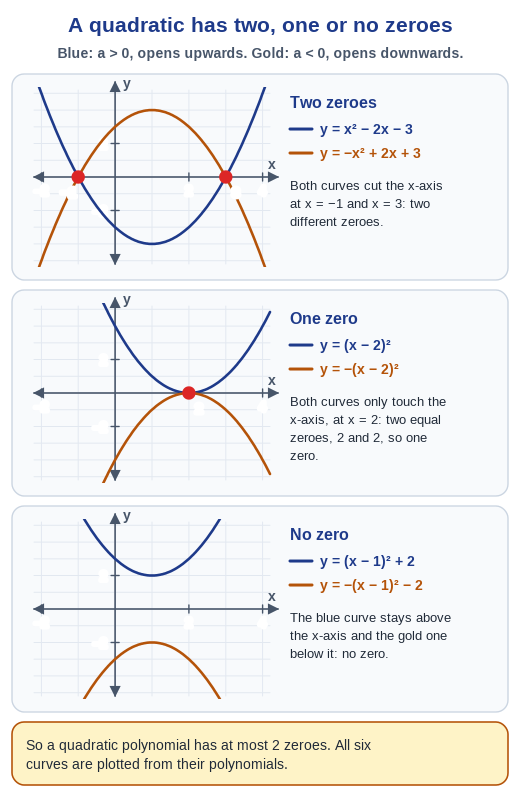
So a quadratic polynomial has at most two zeroes.
How many zeroes can a cubic polynomial have?
A cubic polynomial has degree 3: ax³ + bx² + cx + d with a ≠ 0. Its graph can cross the x-axis three times, as x³ − x = (x + 1)x(x − 1) does at −1, 0 and 1. It can touch at one point and cross at another, as x³ − 2x² = x²(x − 2) does at 0 and 2. Or it can cross just once, as x³ − 1 does at 1.
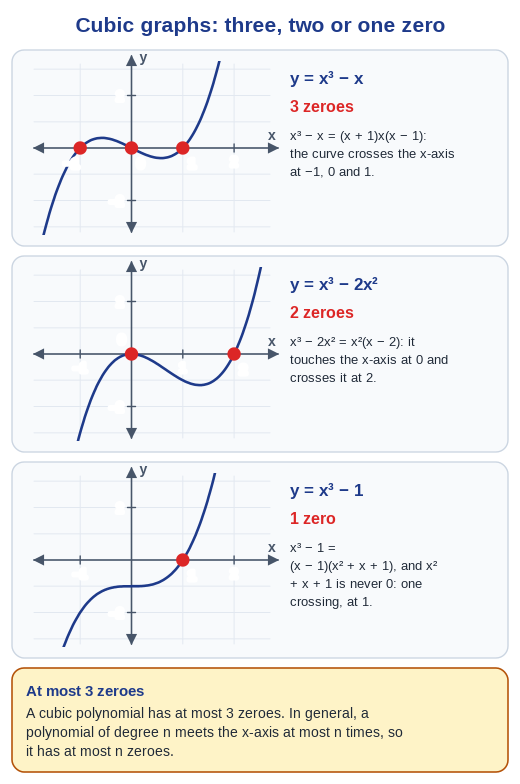
So a cubic has at most three zeroes. The book states the general rule as a Remark: the graph of a polynomial of degree n meets the x-axis at most n times, so the polynomial has at most n zeroes.
How do you count the zeroes from a graph?
Count the points where the graph meets the x-axis. A crossing counts as one zero, and so does a point where the graph only touches the axis. A graph that never meets the x-axis, such as a horizontal line above it, means no zero. The curve below has degree 4 but meets the axis at only three points, so it has 3 zeroes.
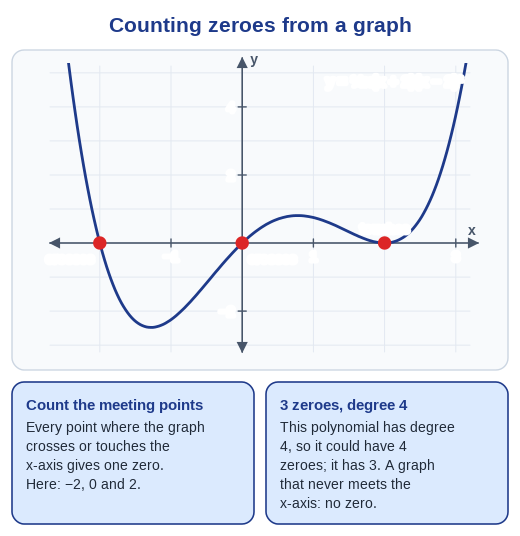
You do not have to plot quadratic or cubic graphs yourself: a footnote on page 12 of the book says students are not expected to, and this is not evaluated. Reading a given graph, as in Example 1 and Exercise 2.1, is what matters. Try them in the NCERT solutions.
Read next: how the zeroes are related to the coefficients, and the chapter notes. The line graphs page from Class 8 is a quick refresher on reading points from a graph.
Practice
-
The zero of the polynomial 3x + 12 is:
Show answer
Answer: (a) −4
-
The graph of y = p(x) meets the x-axis at (−3, 0), (1, 0) and (4, 0) only. The zeroes of p(x) are:
Show answer
Answer: (a) −3, 1 and 4
-
Which statement is true for every quadratic polynomial?
Show answer
Answer: (a) It has at most 2 zeroes
-
Is 2 a zero of p(x) = x² − 5x + 6? Is 1?
Show answer
Answer: p(2) = 4 − 10 + 6 = 0, so 2 is a zero. p(1) = 1 − 5 + 6 = 2, which is not 0, so 1 is not a zero. (The other zero is 3: p(3) = 9 − 15 + 6 = 0.)
-
The graph of a cubic polynomial crosses the x-axis at one point and touches it at another. How many zeroes does it have? Could a cubic's graph meet the x-axis at four points?
Show answer
Answer: It has 2 zeroes, one for each meeting point. A cubic cannot meet the x-axis at four points, because a polynomial of degree 3 has at most 3 zeroes.
Questions students ask
What is the difference between a zero of a polynomial and a root of an equation?
They are the same numbers seen in two ways. If p(k) = 0, then k is a zero of p(x) and also a root (solution) of the equation p(x) = 0. The zeroes of x² − 2x − 3, namely −1 and 3, are the roots of x² − 2x − 3 = 0. Chapter 4 of the book, Quadratic Equations, works with roots.
Can a polynomial have no zero at all?
Yes. x² + 1 is at least 1 for every real x, so it is never 0, and its graph stays above the x-axis. A quadratic or cubic can have fewer zeroes than its degree. A linear polynomial ax + b with a ≠ 0, however, always has exactly one zero.
Do I have to draw graphs of quadratic or cubic polynomials?
No. A footnote in the book (page 12) says students are not expected to plot quadratic or cubic graphs themselves, and such plotting is not assessed. You should be able to read a given graph and count its zeroes, as in Example 1 and Exercise 2.1.
Why can a quadratic polynomial have at most two zeroes?
Its graph is a parabola, which can meet a horizontal line such as the x-axis at most twice. The book's Remark on page 17 gives the general rule: a polynomial of degree n can have no more than n zeroes.
Stuck on a question?
Take a photo and Lagnever AI explains it step by step. Try it for 7 days for ₹2.
Get it on Google Play Open in browser
For parents: after the trial, the plan renews monthly by UPI or card autopay. You can cancel anytime in the app.