
How are the zeroes of a polynomial related to its coefficients?
Answer in short
If α and β are the zeroes of ax² + bx + c, then α + β = −b/a and αβ = c/a. These rules check zeroes without a graph and build a quadratic from the sum S and product P of its zeroes: x² − Sx + P. A cubic ax³ + bx² + cx + d has three such rules.
Stuck on a question? Take a photo and Lagnever AI explains it step by step. Try it for 7 days for ₹2. Get it on Google Play
What do the zeroes have to do with the coefficients?
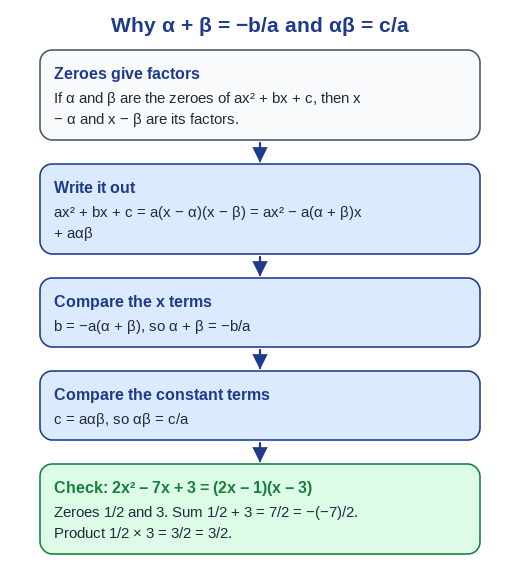
The coefficients of ax² + bx + c are the numbers a, b and c. Take 2x² − 7x + 3. Splitting the middle term, 2x² − 7x + 3 = 2x² − 6x − x + 3 = 2x(x − 3) − 1(x − 3) = (2x − 1)(x − 3), so the zeroes are 1/2 and 3. Now look:
- Sum of the zeroes: 1/2 + 3 = 7/2, and −(coefficient of x)/(coefficient of x²) = −(−7)/2 = 7/2.
- Product of the zeroes: 1/2 × 3 = 3/2, and (constant term)/(coefficient of x²) = 3/2.
This is no accident. You already know the linear case: the zero of ax + b is −b/a. The chapter shows that the zeroes of a quadratic are tied to its coefficients in a similar way.
Why is α + β = −b/a and αβ = c/a?
Let α (alpha) and β (beta) be the zeroes of ax² + bx + c, with a ≠ 0. Since p(α) = 0 and p(β) = 0, x − α and x − β are factors, and so
ax² + bx + c = a(x − α)(x − β) = ax² − a(α + β)x + aαβ
The two sides are the same polynomial, so their coefficients match. The x terms give b = −a(α + β), and the constant terms give c = aαβ. Dividing by a:
α + β = −b/a and αβ = c/a
How do you verify the relationship?
The book’s exercises ask you to find the zeroes and then “verify the relationship”. Work in four steps:
- Write the polynomial as ax² + bx + c and read a, b and c with their signs.
- Factorise, by splitting the middle term or with an identity such as a² − b² = (a − b)(a + b).
- Read off the zeroes.
- Check that their sum equals −b/a and their product equals c/a.
For x² − 5, the identity gives (x − √5)(x + √5), so the zeroes are √5 and −√5. Their sum is 0 = −0/1, because the x term is missing (b = 0), and their product is −5 = −5/1.
How do you find a quadratic from the sum and product of its zeroes?
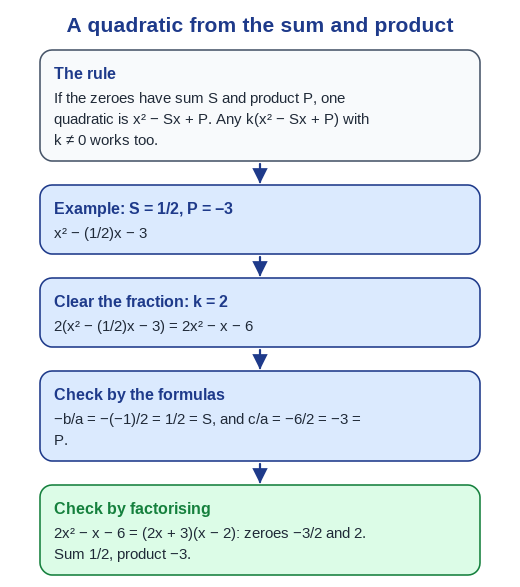
Turn the rules around. If the zeroes have sum S and product P, then
(x − α)(x − β) = x² − (α + β)x + αβ = x² − Sx + P
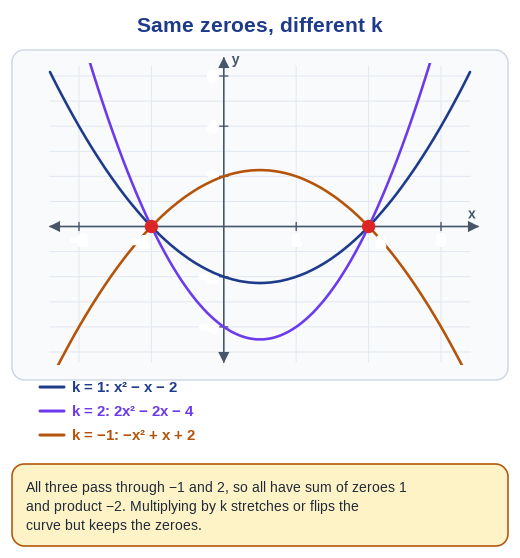
Multiplying by any non-zero number k keeps the same zeroes, so k(x² − Sx + P) works too. Use k to clear fractions. For S = 1/2 and P = −3, x² − (1/2)x − 3 times 2 gives 2x² − x − 6. Check: −(−1)/2 = 1/2 and −6/2 = −3. Factorising, 2x² − x − 6 = (2x + 3)(x − 2), with zeroes −3/2 and 2.
The graphs show why any k works: x² − x − 2, 2x² − 2x − 4 and −x² + x + 2 all meet the x-axis at −1 and 2. Multiplying by k stretches or flips the curve, but the meeting points stay.
One caution: not every S and P belongs to real zeroes. S = 1 and P = 1 give x² − x + 1, which is never 0, because x² − x + 1 = (x − 1/2)² + 3/4. The book still accepts x² − x + 1 as the answer to Exercise 2.2, Question 2(iv), since it follows the rule.
Does a similar rule work for a cubic polynomial?
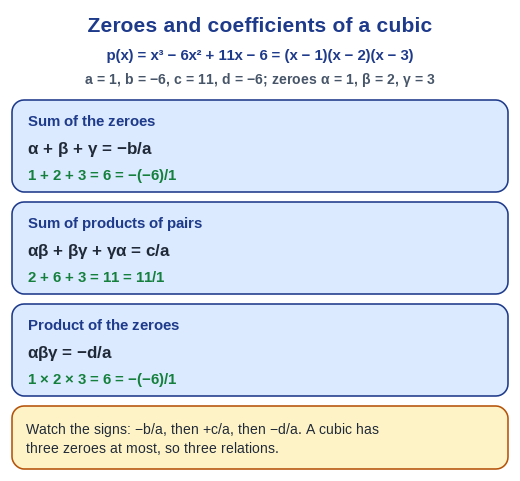
Yes, with three relations. Call the zeroes of the cubic ax³ + bx² + cx + d α, β and γ (gamma). Then
- α + β + γ = −b/a
- αβ + βγ + γα = c/a
- αβγ = −d/a
Check with x³ − 6x² + 11x − 6 = (x − 1)(x − 2)(x − 3). The zeroes 1, 2 and 3 add up to 6 = −(−6)/1, the products in pairs give 2 + 6 + 3 = 11 = 11/1, and the product is 6 = −(−6)/1. The signs alternate: minus, plus, minus.
The book checks the same relations for 2x³ − 5x² − 14x + 8, whose zeroes are 4, −2 and 1/2, and for 3x³ − 5x² − 11x − 3 in Example 5, which it marks as not for the examination.
Read next: what the zeroes mean on a graph, the chapter notes and the NCERT solutions, where every part of Exercise 2.2 is worked out. The identities used for factorising are on the Class 8 page on squares of sums and differences.
Practice
-
The sum and the product of the zeroes of 2x² + 5x − 3 are:
Show answer
Answer: (a) −5/2 and −3/2
-
A quadratic polynomial whose zeroes have sum −2 and product −15 is:
Show answer
Answer: (a) x² + 2x − 15
-
The product of the zeroes of the cubic polynomial x³ − 2x² − x + 2 is:
Show answer
Answer: (a) −2
-
Find the zeroes of x² + x − 12 and check that their sum and product agree with the coefficients.
Show answer
Answer: x² + x − 12 = (x + 4)(x − 3), so the zeroes are −4 and 3. Sum: −4 + 3 = −1 = −(1)/1 = −b/a. Product: −4 × 3 = −12 = −12/1 = c/a.
-
α and β are the zeroes of x² − 5x + 6. Find α² + β² without finding α and β.
Show answer
Answer: α + β = −(−5)/1 = 5 and αβ = 6/1 = 6. So α² + β² = (α + β)² − 2αβ = 25 − 12 = 13. Check: the zeroes are 2 and 3, and 4 + 9 = 13.
Questions students ask
Why is the sum of the zeroes −b/a and not b/a?
Because (x − α)(x − β) = x² − (α + β)x + αβ: the sum of the zeroes comes with a minus sign in the x term. Matching a(x − α)(x − β) with ax² + bx + c gives b = −a(α + β), so α + β = −b/a.
Is there only one quadratic polynomial with a given sum and product of zeroes?
No. x² − Sx + P is one, and k(x² − Sx + P) has the same zeroes for every real k ≠ 0. The book's answers choose k to clear fractions, for example 4x² − x − 4 for sum 1/4 and product −1.
Do these rules work when the zeroes are irrational?
Yes. x² − 5 = (x − √5)(x + √5) has zeroes √5 and −√5. Their sum is 0 = −0/1 and their product is −5 = −5/1, exactly as the rules say.
Is the cubic relationship needed for the exam?
The three rules for a cubic are stated in the chapter and in its summary, so learn them. The book marks Example 5, which verifies them for one cubic, “not from the examination point of view”, and Exercise 2.2 asks only about quadratic polynomials.
Stuck on a question?
Take a photo and Lagnever AI explains it step by step. Try it for 7 days for ₹2.
Get it on Google Play Open in browser
For parents: after the trial, the plan renews monthly by UPI or card autopay. You can cancel anytime in the app.