
Squares of sums and differences: (a + b)², (a − b)² and a² − b²
Answer in short
(a + b)² = a² + 2ab + b², (a − b)² = a² − 2ab + b² and (a + b)(a − b) = a² − b². All three come from the distributive property, and each has a picture made of squares and rectangles. They make squares quick: 99² = 9801 and 98 × 102 = 9996.
Stuck on a question? Take a photo and Lagnever AI explains it step by step. Try it for 7 days for ₹2. Get it on Google Play
What is (a + b)²?
(a + b)² means (a + b) × (a + b). Multiplying out term by term gives a² + ab + ba + b². Since ba = ab, the two middle terms are like terms, so
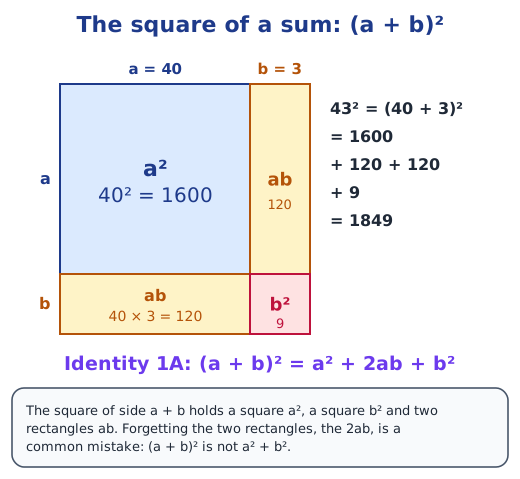
(a + b)² = a² + 2ab + b² (Identity 1A).
The picture makes it easy to remember. A square of side a + b holds a square of side a, a square of side b and two rectangles a by b. For 43² = (40 + 3)², the pieces are 1600, 120, 120 and 9, which add up to 1849.
Is (a + b)² always bigger than a² + b²?
The difference is 2ab. So (a + b)² is bigger when a and b have the same sign, equal when one of them is 0, and smaller when one is positive and the other negative. For a = 3 and b = −2, (a + b)² = 1 but a² + b² = 13.
What is (a − b)²?
Write a − b as a + (−b) and use Identity 1A with −b in place of b:
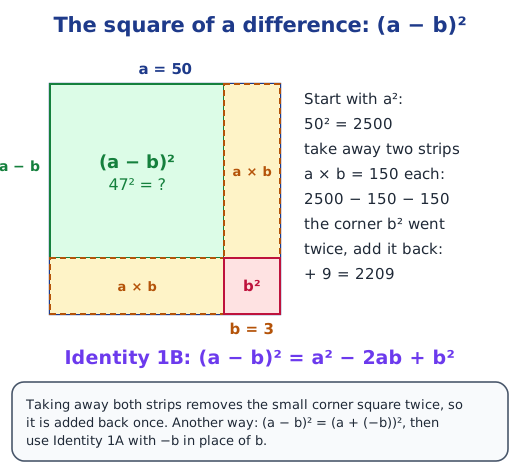
(a − b)² = a² − 2ab + b² (Identity 1B).
In a picture, start with the big square a² and cut away two strips, each a by b. The small corner square b² sits in both strips, so it has been cut away twice; adding it back once leaves (a − b)². For 47² = (50 − 3)²: 2500 − 150 − 150 + 9 = 2209.
What is (a + b)(a − b)?
Multiply out: a² − ab + ba − b². The middle terms cancel, so
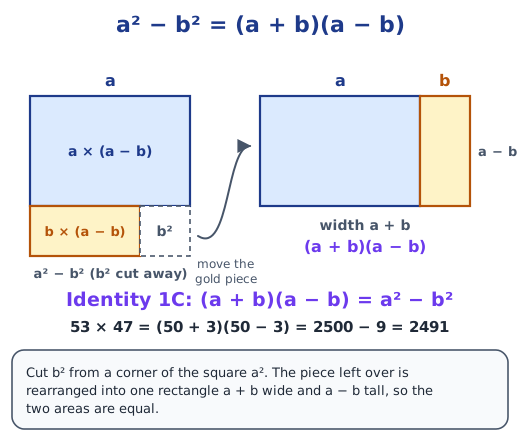
(a + b)(a − b) = a² − b² (Identity 1C).
The picture: cut a small square b² from a corner of a². The L-shape left over can be cut into two rectangles and rearranged into one long rectangle, a + b wide and a − b tall. So 53 × 47 = (50 + 3)(50 − 3) = 2500 − 9 = 2491.
How do the identities make squares quick?
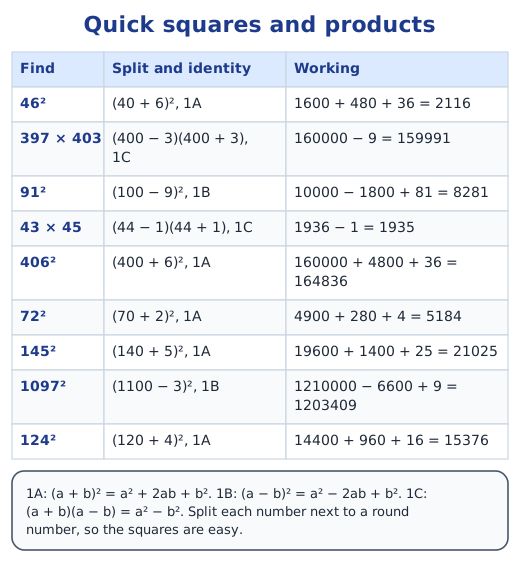
Split the number next to a round number. 61² = (60 + 1)² = 3600 + 120 + 1 = 3721. 89² = (90 − 1)² = 8100 − 180 + 1 = 7921. For a product of two numbers the same distance from a round number, use 1C: 51 × 49 = 50² − 1² = 2499.
Sridharacharya (750 CE) used 1C in another form: a² = (a + b)(a − b) + b². Choose b so that one factor is round. For 48², take b = 2: 50 × 46 + 4 = 2304. For 103², take b = 3: 106 × 100 + 9 = 10609.
What are Patterns 1 and 2?
Pattern 1: twice a sum of two squares is again a sum of two squares, 2(a² + b²) = (a + b)² + (a − b)². Add Identities 1A and 1B and the 2ab terms cancel. For example, 2(7² + 4²) = 130 = 11² + 3².
Pattern 2: a² − b² = (a + b)(a − b), which is Identity 1C. For example, 9² − 5² = 56 = 14 × 4.
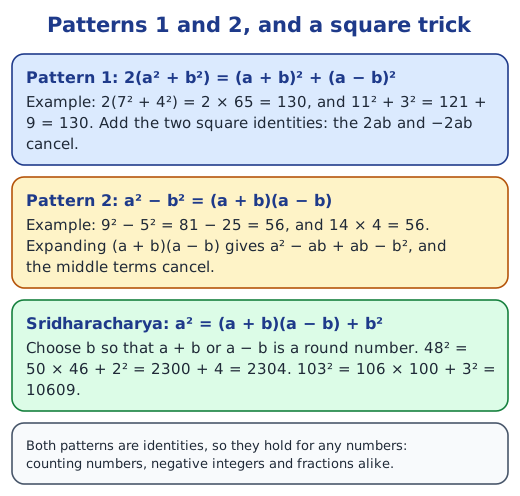
Both are identities, so they hold for negative integers and fractions as well as counting numbers.
Read next: the chapter notes, the distributive property, one pattern, many expressions and NCERT solutions.
Practice
-
(x + 4)² equals:
Show answer
Answer: (b) x² + 8x + 16
-
51 × 49 equals:
Show answer
Answer: (a) 2499
-
(3a − 2b)² equals:
Show answer
Answer: (b) 9a² − 12ab + 4b²
-
Find 63² and 97² using the identities.
Show answer
Answer: 63² = (60 + 3)² = 3600 + 360 + 9 = 3969. 97² = (100 − 3)² = 10000 − 600 + 9 = 9409.
-
Write 15 as a difference of two squares in two ways.
Show answer
Answer: 15 = (a + b)(a − b). Take 15 × 1: a = 8, b = 7, so 64 − 49 = 15. Take 5 × 3: a = 4, b = 1, so 16 − 1 = 15.
Questions students ask
What is the formula for (a + b)²?
(a + b)² = a² + 2ab + b². Multiply (a + b)(a + b) term by term: a² + ab + ba + b², and ab + ba = 2ab. For example, 43² = 1600 + 240 + 9 = 1849.
What is the difference between (a − b)² and a² − b²?
(a − b)² is the square of a difference and equals a² − 2ab + b². a² − b² is a difference of two squares and equals (a + b)(a − b). With a = 5, b = 3: (a − b)² = 4, but a² − b² = 16.
How did Sridharacharya square numbers quickly?
He used a² = (a + b)(a − b) + b², choosing b to make one factor a round number. For 48², take b = 2: 50 × 46 + 4 = 2300 + 4 = 2304.
Is (a − b)² the same as (b − a)²?
Yes. b − a is the negative of a − b, and a number and its negative have the same square. Both expand to a² − 2ab + b².
Stuck on a question?
Take a photo and Lagnever AI explains it step by step. Try it for 7 days for ₹2.
Get it on Google Play Open in browser
For parents: after the trial, the plan renews monthly by UPI or card autopay. You can cancel anytime in the app.