
Class 8 Maths Chapter 6: We Distribute, Yet Things Multiply Notes
This chapter in five lines
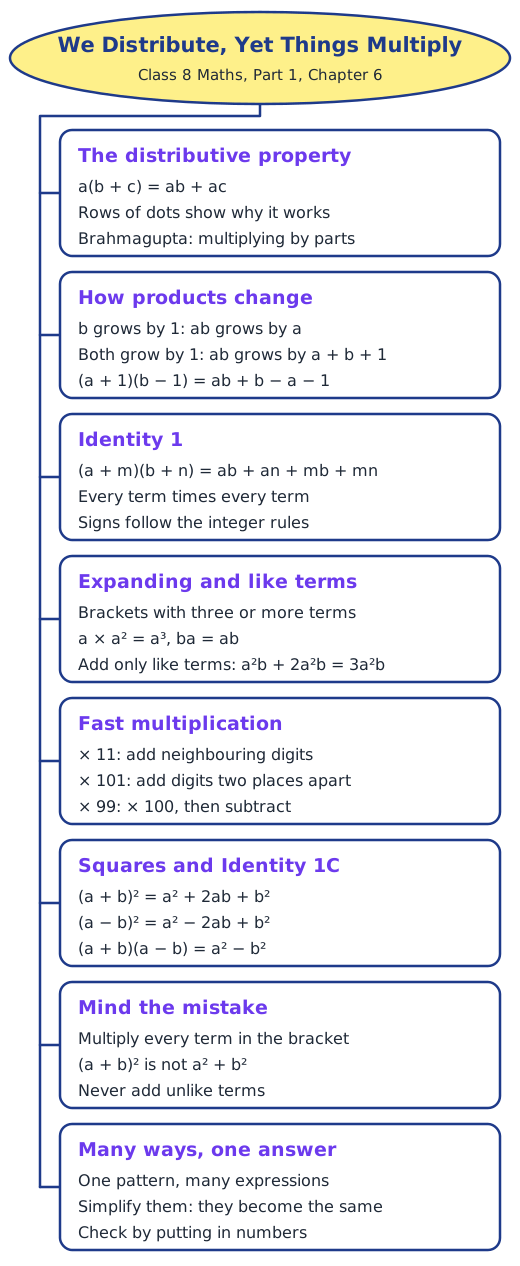
This chapter is about the distributive property, a(b + c) = ab + ac, and what grows out of it. It shows how a product changes when its numbers change, gives Identity 1, (a + m)(b + n) = ab + an + mb + mn, and its special cases (a + b)², (a − b)² and (a + b)(a − b). It ends with quick multiplication, common mistakes and patterns seen in many ways.
What is this chapter about?
This is the sixth chapter of Ganita Prakash, Grade 8 Part 1. Earlier chapters used algebra to write patterns and rules in a short form. Here algebra is used to prove things, and the main tool is the distributive property, which links multiplication and addition. The chapter has four parts: properties of multiplication, special cases of the distributive property, a page of mistakes to mend, and patterns that can be seen in more than one way.
The distributive property
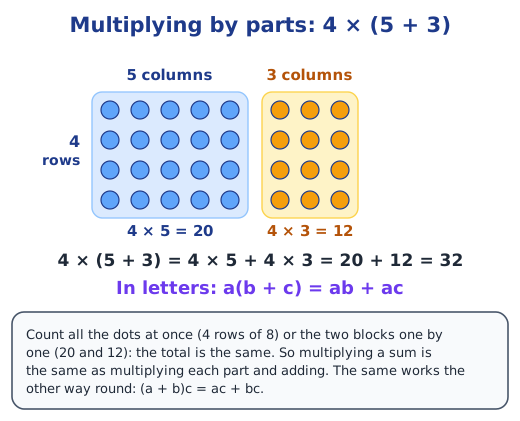
To multiply a sum, multiply each part and add: a(b + c) = ab + ac. Rows of dots make it clear. Four rows of 8 dots can be split into a block of 4 × 5 and a block of 4 × 3, so 4 × 8 = 20 + 12. Because multiplication is commutative, the rule also works from the other side: (a + b)c = ac + bc. Read more in the distributive property.
How does a product change?
If one number of a product ab grows by 1, the product grows by the other number: a(b + 1) = ab + a. If both grow by 1, the product grows by a + b + 1. If a grows by 1 and b shrinks by 1, the new product is ab + b − a − 1, which can be bigger or smaller than ab. These rules hold for negative integers too.
Identity 1 and like terms
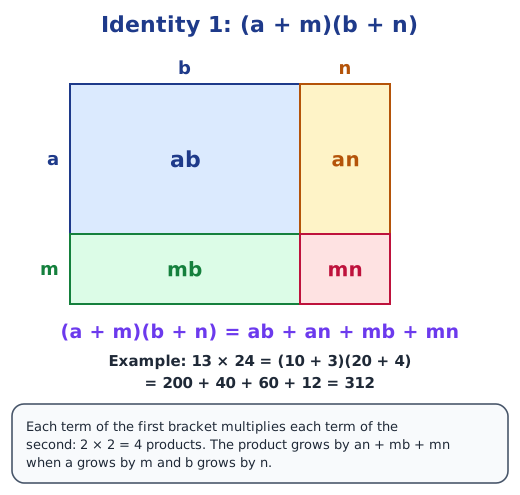
When the numbers grow by m and n, (a + m)(b + n) = ab + an + mb + mn. Each term of the first bracket multiplies each term of the second. A minus sign is handled by the integer rules, so the same identity covers (a + u)(b − v) and (a − u)(b − v).
Brackets can hold three or more terms, and the rule is the same. After multiplying, like terms, the ones with exactly the same letter-numbers, are added: ba + ab = 2ab, and a²b + 2a²b = 3a²b. Terms such as 3a² and 3a are not like terms, so they stay apart. This is how the chapter finds (a + b)(a² + 2ab + b²) = a³ + 3a²b + 3ab² + b³.
A little history
Mathematicians in Egypt, Mesopotamia, Greece, China and India used this property long before it had a name. Euclid used it in geometric form and Aryabhata in algebraic form. Brahmagupta stated it plainly in his Brāhmasphuṭasiddhānta (verse 12.55) and called it khaṇḍa-guṇanam, which means multiplying in parts: break the multiplier into parts, multiply by each part, then add.
Quick multiplication
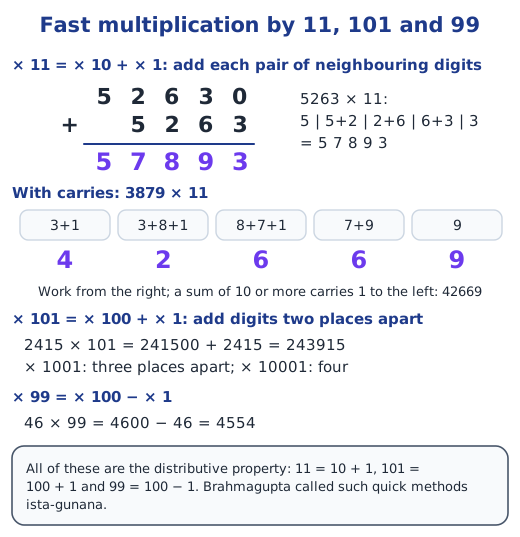
Since 11 = 10 + 1, multiplying by 11 adds a number to ten times itself. So each digit of the answer is the sum of two neighbouring digits: 5263 × 11 = 57893. In the same way, × 101 adds digits two places apart, and × 99 is × 100 minus the number. Brahmagupta called such tricks iṣṭa-guṇana, and Sridharacharya and Bhaskaracharya wrote about them too.
Squares of sums and differences
Three special cases of Identity 1 are worth knowing by heart:
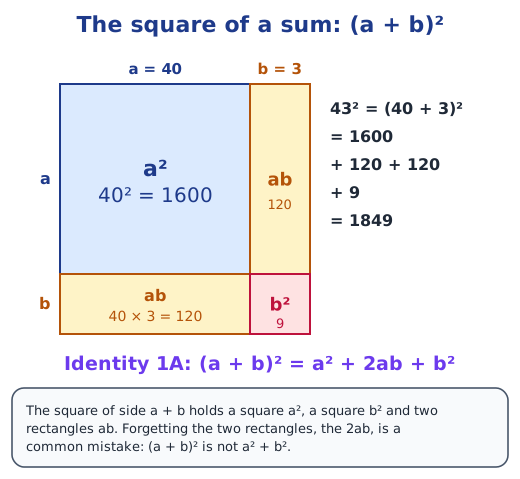
- Identity 1A: (a + b)² = a² + 2ab + b², so 43² = 1600 + 240 + 9 = 1849.
- Identity 1B: (a − b)² = a² − 2ab + b², so 99² = 10000 − 200 + 1 = 9801.
- Identity 1C: (a + b)(a − b) = a² − b², so 98 × 102 = 10000 − 4 = 9996.
Each one has a picture made of squares and rectangles. Sridharacharya (750 CE) turned 1C into a quick way to square numbers: a² = (a + b)(a − b) + b². Read squares of sums and differences.
Mind the mistake
The chapter gives twelve worked simplifications to check. Most of the wrong ones make the same few slips: multiplying only one term of a bracket, writing (a + b)² as a² + b², or adding unlike terms such as 5w² + 6w. Four of the twelve are already right. The full list with corrections is in the NCERT solutions.
This way or that way
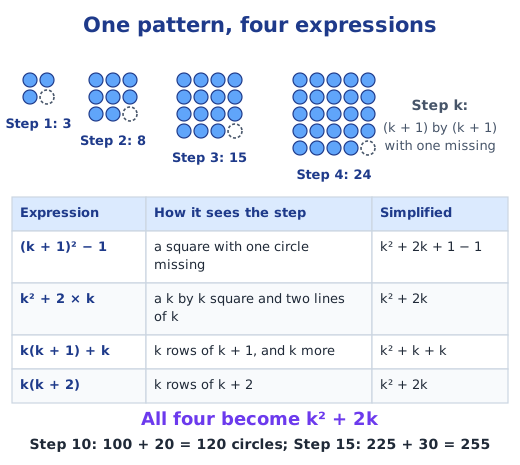
A pattern of circles can be counted as a square with one circle missing, (k + 1)² − 1, or as k rows of k + 2, k(k + 2), and in other ways too. Simplified correctly, every expression becomes k² + 2k. The chapter does the same with areas of shapes made from equal rectangles. Read one pattern, many expressions.
Puzzle Time: Coin Conjoin
Ten coins sit in a triangle. The task is to flip it so that it points the other way, sliding single coins and using as few moves as possible. Three moves are enough for 10 coins, and five for 15.
Before we move on
This chapter builds on letter-numbers and simplifying expressions from Class 7, the properties of integer multiplication, and square numbers from Chapter 1. More algebra puzzles come in Part 2, Chapter 6: Algebra Play. Answers to every question in this chapter, all three Figure it Out sets and the puzzle are in the NCERT solutions for Chapter 6.
Key terms
| Term | Meaning |
|---|---|
| Distributive property | Multiplying a sum is the same as multiplying each part and adding: a(b + c) = ab + ac, and (a + b)c = ac + bc. |
| Expand | To multiply out the brackets and write a product as a sum of terms, such as (x + 2)(x + 5) = x² + 7x + 10. |
| Term | One part of an expression, joined to the others by + or −, such as 3a², −2ab or 5. |
| Like terms | Terms with exactly the same letter-numbers, such as a²b and 2a²b. Only like terms can be added into one term. |
| Identity | A statement that two expressions are equal for every value of the letters, such as a(b + 8) = ab + 8a. |
| Identity 1 | (a + m)(b + n) = ab + an + mb + mn: every term of one bracket times every term of the other. |
| Identity 1A | The square of a sum: (a + b)² = a² + 2ab + b². |
| Identity 1B | The square of a difference: (a − b)² = a² − 2ab + b². |
| Identity 1C | A sum times a difference: (a + b)(a − b) = a² − b². |
| Exponent notation | A short way to write repeated multiplication: a × a = a², and a × a² = a × a × a = a³. |
| Khaṇḍa-guṇanam | Brahmagupta’s name for the distributive property: multiplication by parts. |
| Iṣṭa-guṇana | Brahmagupta’s name for quick ways of multiplying that use the distributive property. |
Topics in this chapter
Practice
-
(x + 3)(x + 5) expands to:
Show answer
Answer: (a) x² + 8x + 15
-
Both numbers in a product ab are increased by 1. The product increases by:
Show answer
Answer: (b) a + b + 1
-
Using (a + b)², 52² equals:
Show answer
Answer: (c) 2704
-
Using (a + b)(a − b), 48 × 52 equals:
Show answer
Answer: (a) 2496
-
Which two terms are like terms?
Show answer
Answer: (a) 3a²b and −5a²b
-
(2x − 3)² equals:
Show answer
Answer: (b) 4x² − 12x + 9
Questions students ask
What are the main topics of Class 8 Maths Chapter 6?
The distributive property and how products change, Identity 1 for (a + m)(b + n), expanding expressions with like terms, quick multiplication by 11, 101 and 99, the identities for (a + b)², (a − b)² and (a + b)(a − b), common mistakes, and patterns described in many ways.
Is We Distribute, Yet Things Multiply in the new NCERT Class 8 Maths book?
Yes. It is Chapter 6 of Ganita Prakash, Grade 8 Part 1, on pages 136 to 158 of the book marked Reprint 2026-27. It ends with a coin puzzle, Coin Conjoin.
What is the distributive property in simple words?
To multiply a sum, you can multiply each part of it and add the answers. For example, 4 × (5 + 3) = 4 × 5 + 4 × 3 = 20 + 12 = 32. In letters, a(b + c) = ab + ac.
What are Identities 1A, 1B and 1C?
1A is (a + b)² = a² + 2ab + b², 1B is (a − b)² = a² − 2ab + b², and 1C is (a + b)(a − b) = a² − b². All three come from Identity 1 by choosing the numbers in the brackets.
Stuck on a question?
Take a photo and Lagnever AI explains it step by step. Try it for 7 days for ₹2.
Get it on Google Play Open in browser
For parents: after the trial, the plan renews monthly by UPI or card autopay. You can cancel anytime in the app.