
Class 8 Maths Part 2 Chapter 6: Algebra Play Notes
This chapter in five lines
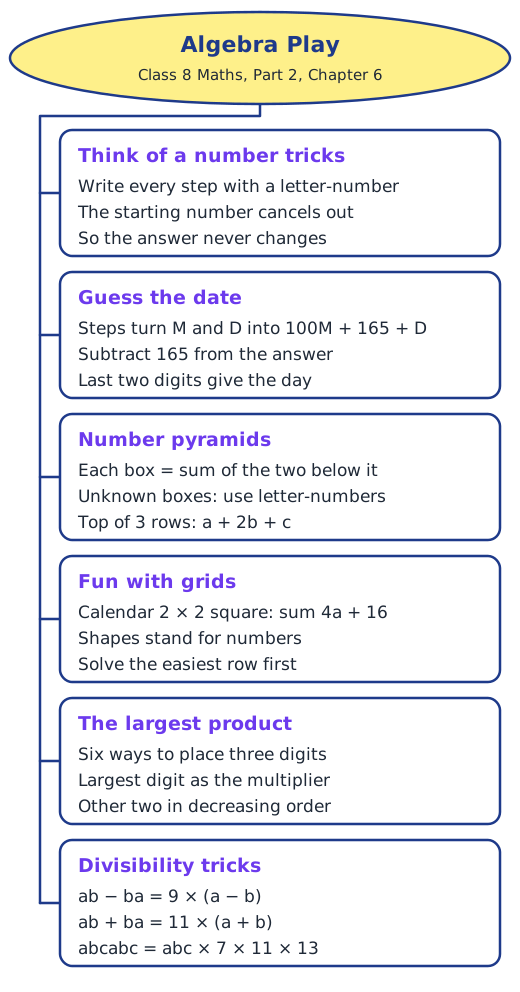
Algebra Play uses letter-numbers to explain tricks and puzzles. Writing each step with x shows why a think of a number trick always ends at the same value and how a date can be decoded. The same idea fills number pyramids and calendar grids, finds the largest product of three digits, and proves divisibility tricks for 9, 11, 37 and 1001.
What is this chapter about?
So far algebra has helped us describe situations and solve equations. In this chapter it becomes a game. We look at number tricks and puzzles, use letter-numbers to find out why they work, and then use the same reasoning to invent tricks of our own.
Think of a number tricks
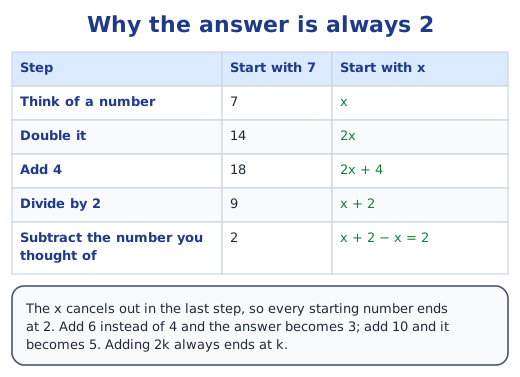
Ask a friend to pick any number, double it, add 4, halve the result and take away the number they started with: the answer is 2. Writing the starting number as x gives 2x, then 2x + 4, then x + 2 and finally 2, so x disappears and every start ends at 2. Adding 6 instead of 4 makes the answer 3. Read think of a number tricks.
Guessing a date
In a longer trick, a friend multiplies the month by 5, adds 6, multiplies by 4, adds 9, multiplies by 5 and adds the day. Algebra turns all this into 100M + 165 + D, so taking 165 away from the answer leaves the month followed by a two-digit day. An answer of 980 leaves 815, which means 15 August.
Number pyramids
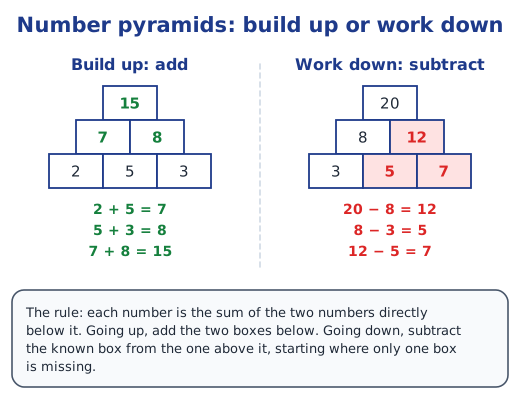
In a number pyramid every box holds the sum of the two boxes below it. Missing numbers can often be found by subtracting; when no box has just one unknown neighbour, call the empty boxes a, b and c and solve the equations. The top of a three-row pyramid is a + 2b + c, and the top of a four-row pyramid is a + 3b + 3c + d. Read number pyramids and grid puzzles.
Fun with grids
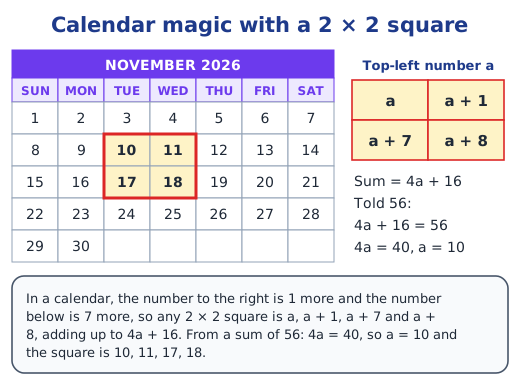
On a calendar, the date to the right is 1 more and the date below is 7 more. So a 2 × 2 square of dates is a, a + 1, a + 7 and a + 8, and its sum is 4a + 16: told that the sum is 56, we get a = 10. In an algebra grid, shapes stand for numbers and each row ends with its sum; a row with only one kind of shape is the place to start.
The largest product
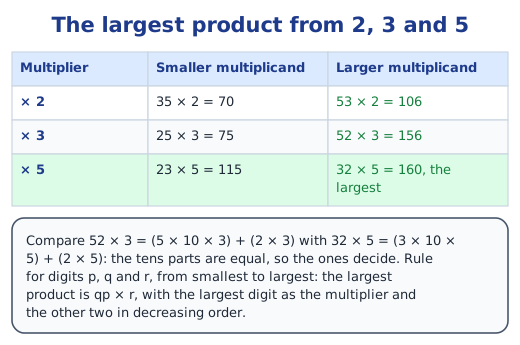
Placing 2, 3 and 5 in two boxes times one box gives six products. Grouping them by the multiplier and comparing tens and ones shows that 32 × 5 = 160 is the largest. Algebra proves the rule for any three digits: the biggest digit goes in the one-digit box, and the remaining two make the two-digit number, larger digit first. Read divisibility tricks and the largest product.
Divisibility tricks
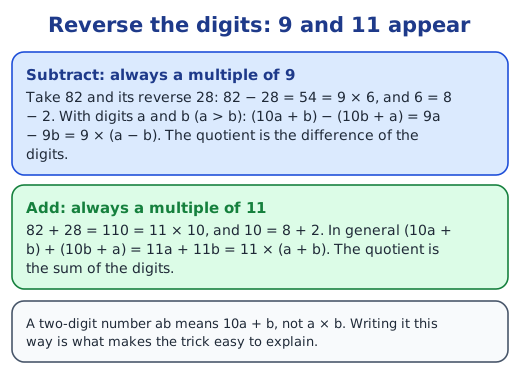
A two-digit number ab means 10a + b. The difference between it and its reverse is 9(a − b), so it always divides by 9, and their sum is 11(a + b), so it always divides by 11. In the same way, abc + bca + cab divides by 37, and abcabc divides by 7, 11 and 13.
Before we move on
A trick, a pyramid or a grid becomes clear once its steps are written with letter-numbers, and the same method solves the chapter’s puzzles about flowers, animals, ages, cows, a dosa cart and a genie. Answers to every question are in the NCERT solutions for Part 2 Chapter 6.
Key terms
| Term | Meaning |
|---|---|
| Letter-number | A letter such as x or a that stands for a number we do not know yet, or for any number at all. |
| Algebraic expression | Letter-numbers and numbers joined by operations, such as 2x + 4 or 100M + 165 + D. |
| Think of a number trick | A set of steps that ends at an answer the trickster can predict, whatever number is chosen. |
| Equation | A statement that two expressions are equal, such as 4a + 16 = 56, which can be solved to find the letter-number. |
| Number pyramid | Rows of boxes in which every box holds the total of the two boxes just beneath it. |
| Algebra grid | A grid in which shapes stand for numbers and the last box of each row gives the sum of that row. |
| Multiplicand and multiplier | In 32 × 5, 32 is the multiplicand, the number being multiplied, and 5 is the multiplier. |
| Two-digit number ab | A number with tens digit a and ones digit b; its value is 10a + b, not a × b. |
| Divisible | One number is divisible by another when the division leaves no remainder, as 54 is by 9. |
| Virahānka–Fibonacci numbers | The sequence 1, 2, 3, 5, 8, 13, … in which every term is found by adding the two terms before it. |
Topics in this chapter
Practice
-
Think of x, double it, add 6, divide by 2 and subtract x. The answer is:
Show answer
Answer: (b) 3
-
The date trick gives 980. The date is:
Show answer
Answer: (b) 15 August
-
The top of a number pyramid with bottom row 2, 6, 5 is:
Show answer
Answer: (b) 19
-
A 2 × 2 square of dates adds up to 56. Its top-left date is:
Show answer
Answer: (a) 10
-
Using 4, 6 and 8 once each, the largest product of a two-digit and a one-digit number is:
Show answer
Answer: (c) 64 × 8
-
The difference between a two-digit number and its reverse is always divisible by:
Show answer
Answer: (b) 9
Questions students ask
What are the main topics of Class 8 Maths Part 2 Chapter 6?
Think of a number tricks and the date trick, number pyramids, calendar magic and algebra grids, the largest product from three digits, and divisibility tricks, all explained with algebra, followed by puzzles about flowers, animals, ages, cows, a dosa cart and a genie.
Is Algebra Play in the new NCERT Class 8 Maths book?
Yes. It is Chapter 6 of Ganita Prakash, Grade 8 Part 2, on pages 135 to 147 of the first edition (December 2025).
Why do we use algebra to explain tricks?
Trying a trick with a few numbers only shows that it worked for those numbers. Writing the steps with a letter-number covers every number at once, so it proves the trick always works and shows how to change it.
What is a number pyramid?
A stack of boxes where each box holds the total of the pair right beneath it. Missing boxes are found by adding, by subtracting or, when that is not enough, by naming them with letter-numbers and solving.
Stuck on a question?
Take a photo and Lagnever AI explains it step by step. Try it for 7 days for ₹2.
Get it on Google Play Open in browser
For parents: after the trial, the plan renews monthly by UPI or card autopay. You can cancel anytime in the app.