
Divisibility tricks and the largest product
Answer in short
Writing a two-digit number ab as 10a + b explains its tricks: ab minus its reverse is 9(a − b), and ab plus its reverse is 11(a + b). Similarly abc + bca + cab = 111(a + b + c). For the largest product from three digits, make the largest digit the multiplier.
Stuck on a question? Take a photo and Lagnever AI explains it step by step. Try it for 7 days for ₹2. Get it on Google Play
The largest product
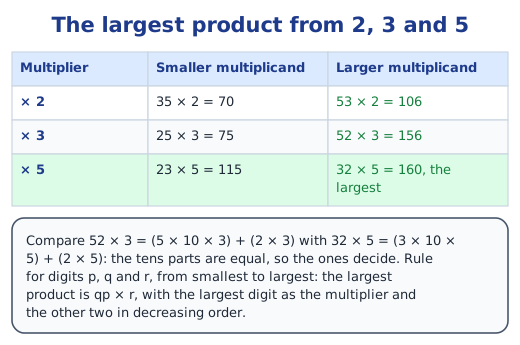
Suppose the digits 2, 3 and 5 must fill a two-digit number times a one-digit number, each used once. The first box can take any of the three digits and the second either of the two left, so there are 3 × 2 = 6 products. Sorted by the multiplier, they are 32 × 5 and 23 × 5, 52 × 3 and 25 × 3, and 53 × 2 and 35 × 2. With the same multiplier, the bigger two-digit number wins, so only 53 × 2, 52 × 3 and 32 × 5 remain. Next, 52 × 3 beats 53 × 2, since it multiplies almost the same number by a bigger digit. To compare 52 × 3 with 32 × 5, split off the tens: 52 × 3 = 150 + 6 and 32 × 5 = 150 + 10. The tens parts are equal, so 32 × 5 = 160 is the largest.
The rule for any three digits
Let the digits be p, q and r, with p the smallest and r the largest. For each multiplier the larger two-digit number wins, which leaves rq × p, rp × q and qp × r. Because q is bigger than p, rp × q is bigger than rq × p. Expanding the other two gives qp × r = 10qr + pr and rp × q = 10rq + pq. The tens parts match, and pr is bigger than pq because r is bigger than q. So the largest product is qp × r: the largest digit is the multiplier, and the other two digits form the two-digit number in decreasing order. For 4, 6 and 8 this gives 64 × 8 = 512.
Reverse the digits and subtract
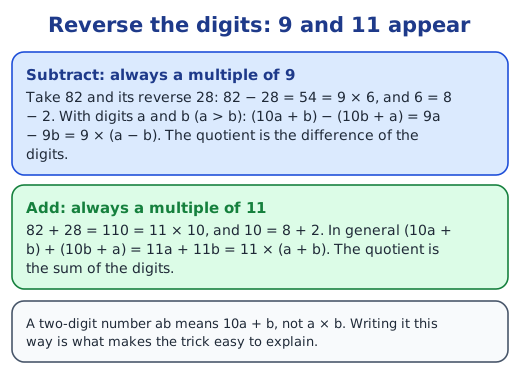
Pick a two-digit number with two different digits, reverse it, take the smaller number from the larger and divide by 9: there is never a remainder. For 82, 82 − 28 = 54 = 9 × 6. Algebra explains why. A two-digit number ab is worth 10a + b, and its reverse ba is worth 10b + a. If a is bigger, (10a + b) − (10b + a) = 9a − 9b = 9(a − b); if b is bigger, the difference is 9(b − a). Either way it is 9 times the gap between the digits, and that gap is the quotient: 8 − 2 = 6.
Reverse the digits and add
Adding instead of subtracting brings out 11: 82 + 28 = 110, 31 + 13 = 44 and 47 + 74 = 121. In general (10a + b) + (10b + a) = 11a + 11b = 11(a + b), so the sum is always 11 times the sum of the digits.
Two three-digit tricks
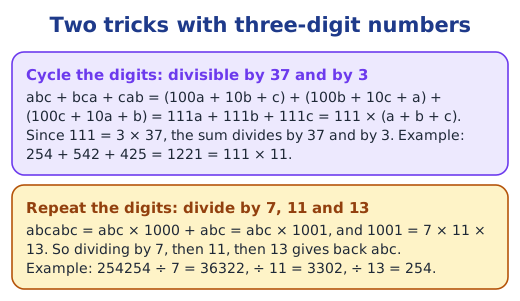
Take a three-digit number abc, worth 100a + 10b + c, and move its digits round to get bca and cab. Adding the three gives 111a + 111b + 111c = 111(a + b + c). Since 111 = 3 × 37, the total always divides by 37 and by 3: 254 + 542 + 425 = 1221 = 111 × 11.
Now repeat the digits to make a six-digit number abcabc. It equals abc × 1000 + abc = abc × 1001, and 1001 = 7 × 11 × 13. So dividing abcabc by 7, then by 11, then by 13 always gives back abc: 254254 ÷ 7 = 36322, 36322 ÷ 11 = 3302 and 3302 ÷ 13 = 254.
Why these tricks work
Each trick looks like magic only while the digits are hidden inside the number. Writing out the place values, 10a + b or 100a + 10b + c, turns the trick into a short calculation in which a factor such as 9, 11, 111 or 1001 appears in plain sight. The same habit of writing numbers by place value helps with many other puzzles about digits.
Read next: think of a number tricks, number pyramids and grid puzzles, the chapter notes and NCERT solutions.
Practice
-
(93 − 39) ÷ 9 is:
Show answer
Answer: (b) 6
-
The sum of a two-digit number and its reverse is always divisible by:
Show answer
Answer: (c) 11
-
Using 1, 4 and 6 once each, the largest product of a two-digit and a one-digit number is:
Show answer
Answer: (c) 41 × 6
-
Why is 637637 divisible by 13?
Show answer
Answer: Because 637637 = 637 × 1001, and 1001 = 7 × 11 × 13.
-
Show that 123 + 231 + 312 is divisible by 37.
Show answer
Answer: Cycling the digits gives a sum of 111 × (1 + 2 + 3) = 666, and 666 = 3 × 37 × 6.
Questions students ask
Why is the difference between a number and its reverse divisible by 9?
Written as 10a + b and 10b + a, the difference is 9a − 9b = 9 × (a − b). The quotient is simply the difference between the two digits.
What happens if we add a number and its reverse?
The sum is (10a + b) + (10b + a) = 11a + 11b = 11 × (a + b), so it always divides by 11, and the quotient is the sum of the digits, as in 28 + 82 = 110 = 11 × 10.
How do you find the largest product from three digits?
Make the largest digit the multiplier and arrange the other two in decreasing order as the two-digit number. With 2, 3 and 5 that gives 32 × 5 = 160.
Stuck on a question?
Take a photo and Lagnever AI explains it step by step. Try it for 7 days for ₹2.
Get it on Google Play Open in browser
For parents: after the trial, the plan renews monthly by UPI or card autopay. You can cancel anytime in the app.