
NCERT Solutions Class 8 Maths Part 2 Chapter 6: Algebra Play
Answers to the questions inside the chapter and to the three Figure it Out sets in Chapter 6, Algebra Play, of Ganita Prakash, Grade 8 Part 2. Page numbers follow the book (pages 135–147). Short notes: Part 2 Chapter 6 notes.
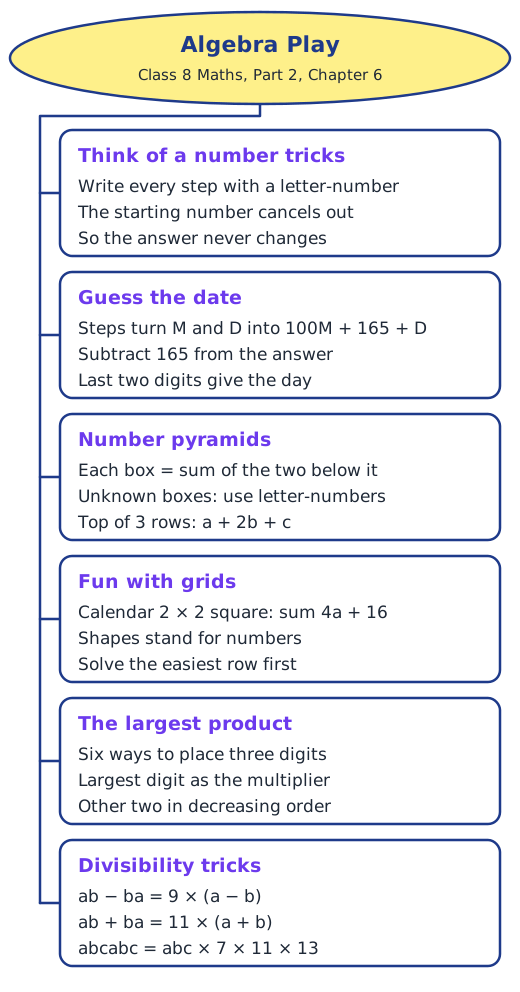
Think of a number tricks (pages 135–137)
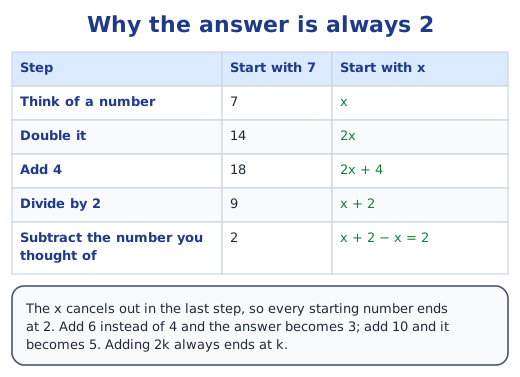
Why do you always get 2? With x the steps give 2x, 2x + 4, x + 2 and then x + 2 − x = 2. The starting number cancels out, so the answer is 2 every time.
Make the final answer 3, or 5. Add 6 instead of 4 and the answer is 3; add 10 and it is 5. In general, adding 2k makes the answer k.
More complicated steps with a fixed answer. For example: think of x, add 3, multiply by 4, subtract 8, divide by 4 and subtract x. The steps give x + 3, 4x + 12, 4x + 4, x + 1 and finally 1.
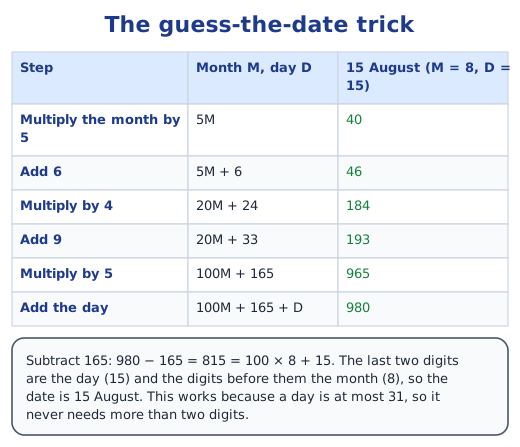
How did Shubham find the date? The steps turn month M and day D into 100M + 165 + D. Subtracting 165 leaves 100M + D, whose last two digits are the day and the rest the month: 291 − 165 = 126, so 26 January.
The answer 1390. 1390 − 165 = 1225, so the date is 25 December.
Find the dates. (i) 1269 − 165 = 1104: 4 November. (ii) 394 − 165 = 229: 29 February, which comes only in a leap year. (iii) 296 − 165 = 131: 31 January.
Change the steps. For example: multiply the month by 5, add 3, multiply by 4, add 7, multiply by 5 and add the day. This gives 100M + 95 + D, so subtract 95 instead of 165.
Your own trick. Any steps that end by removing the starting number will do, such as: think of x, multiply by 5, add 15, divide by 5 and subtract x. The answer is always 3.
Number pyramids (pages 137–140)
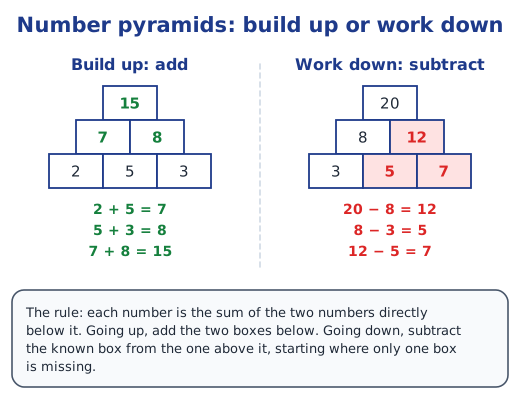
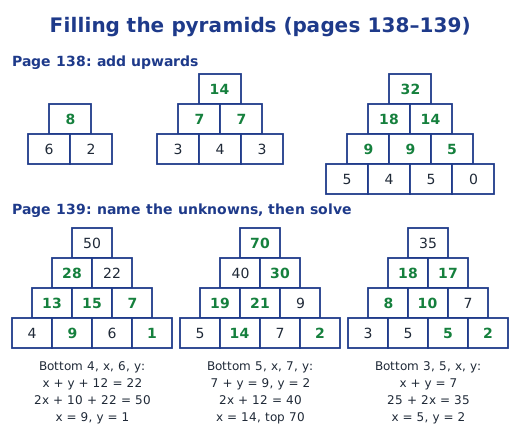
Fill these pyramids (page 138). 6 and 2: top 8. 3, 4, 3: middle row 7, 7 and top 14. 5, 4, 5, 0: rows 9, 9, 5, then 18, 14, and top 32.
The pyramid with 10 at the top. The box beside 4 is 10 − 4 = 6; the box under 4, next to 1, is 4 − 1 = 3; and the last box is 6 − 3 = 3.
The pyramid with 60 at the top. a + b = 60, a = 12 + c and b = c + 8, so 20 + 2c = 60, c = 20, a = 32 and b = 28.
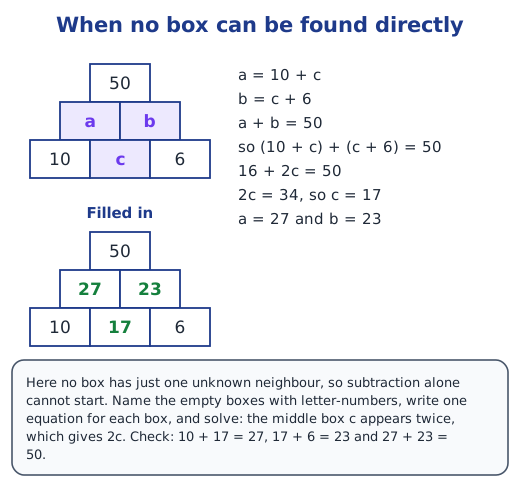
Fill the following pyramids (page 139). Name the missing bottom boxes and use the given boxes to write equations. First: 50; 28, 22; 13, 15, 7; and bottom 4, 9, 6, 1. Second: 70; 40, 30; 19, 21, 9; and bottom 5, 14, 7, 2. Third: 35; 18, 17; 8, 10, 7; and bottom 3, 5, 5, 2.
Bottom row and top number. With two rows the top is a + b; with three rows it is a + 2b + c.
Figure it Out (page 140)
1. The top is a + 2b + c: 4 + 26 + 8 = 38; 7 + 22 + 3 = 32; 10 + 28 + 25 = 63.
2. For the bottom row a, b, c, d the rows above are a + b, b + c, c + d and then a + 2b + c, b + 2c + d, so the top is a + 3b + 3c + d.
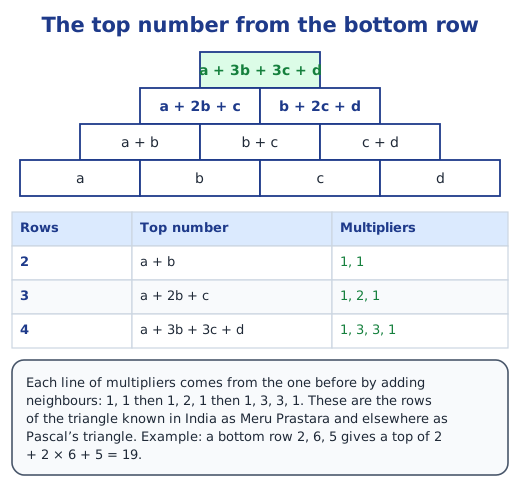
3. The top is a + 3b + 3c + d: 8 + 57 + 63 + 13 = 141; 7 + 54 + 57 + 6 = 124; 9 + 21 + 15 + 11 = 56.
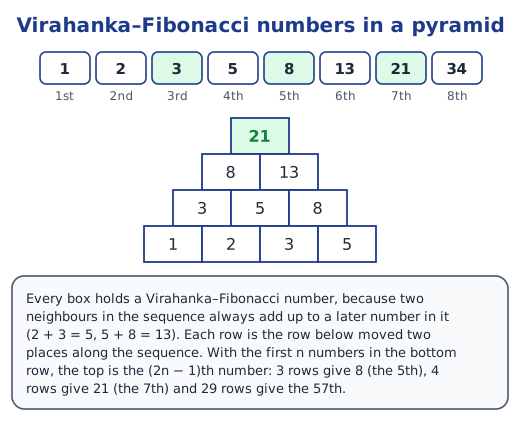
4. Bottom 1, 2, 3; middle 3, 5; top 8. All six numbers, 1, 2, 3, 3, 5 and 8, are Virahānka–Fibonacci numbers, and the top, 8, is the 5th number of the sequence.
5. (i) Bottom 1, 2, 3, 5; then 3, 5, 8; then 8, 13; and 21 at the top. Every number is a Virahānka–Fibonacci number, each row is the row below moved two places along the sequence, and the top, 21, is the 7th number. (ii) Again every number is a Virahānka–Fibonacci number, and the top is the 57th number of the sequence (2 × 29 − 1).
6. All the numbers in the pyramid are Virahānka–Fibonacci numbers, because two neighbours in the sequence add up to the number two places further on. Each row starts two places further along than the row below, so the top of an n-row pyramid is the (2n − 1)th Virahānka–Fibonacci number.
Fun with grids (pages 141–142)
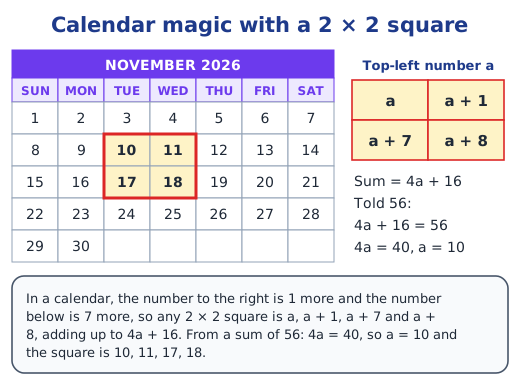
Finding the four numbers from their sum. A 2 × 2 grid of dates is a, a + 1, a + 7 and a + 8, with sum 4a + 16. For 6, 7, 13, 14 the sum is 40 and a = 6. Sum 36: 4a + 16 = 36, so a = 5 and the grid is 5, 6, 12, 13.
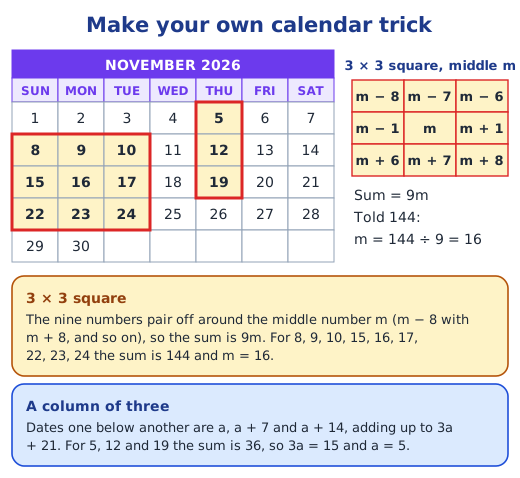
Create your own calendar trick. A 3 × 3 square adds up to 9 times its middle date; a column of three dates adds up to 3a + 21; and on the number grid where the number below is 10 more, a 2 × 2 square adds up to 4a + 22.
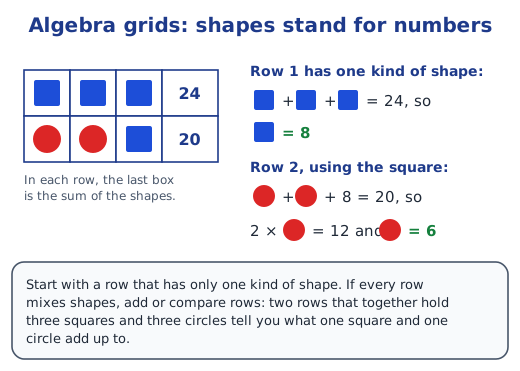
The algebra grid example. Three squares make 27, so a square is 9; two circles and a square make 19, so each circle is 5.
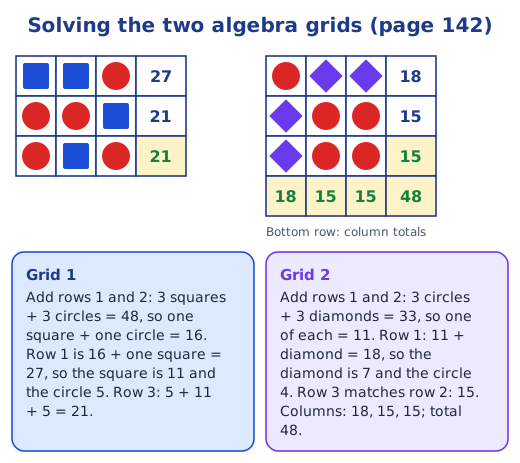
The two grids on page 142. First grid: the square is 11 and the circle 5, so the third row adds up to 5 + 11 + 5 = 21. Second grid: the circle is 4 and the diamond 7, so the third row adds up to 15, and the bottom row of column totals reads 18, 15, 15 and 48.
The largest product (pages 142–144)
2, 3 and 5. The six products are 115, 75, 160, 70, 156 and 106, so 32 × 5 = 160 is the largest.
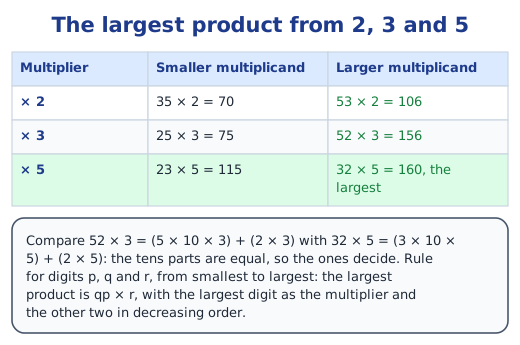
Figure it Out (page 144)
1. 31 × 7 = 217, with the largest digit as the multiplier and 3 and 1 in decreasing order. It beats 71 × 3 = 213 and 73 × 1 = 73.
2. 53 × 9 = 477, which is more than 93 × 5 = 465 and 95 × 3 = 285.
Decoding divisibility tricks (pages 144–147)
Is there never a remainder? Yes, never. If b > a, (10b + a) − (10a + b) = 9(b − a). If a > b, the difference is (10a + b) − (10b + a) = 9a − 9b = 9(a − b), again a multiple of 9.
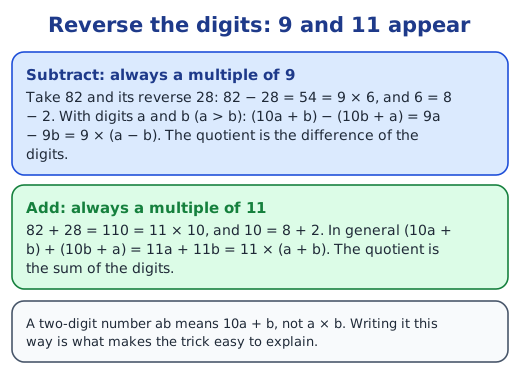
Figure it Out (pages 145–147)
1. The quotient is the difference between the two digits: for 47 and 74, 27 ÷ 9 = 3 = 7 − 4.
2. Yes, always. (10a + b) + (10b + a) = 11a + 11b = 11(a + b), so the sum divides by 11 and the quotient is the sum of the digits: 31 + 13 = 44 = 11 × 4.
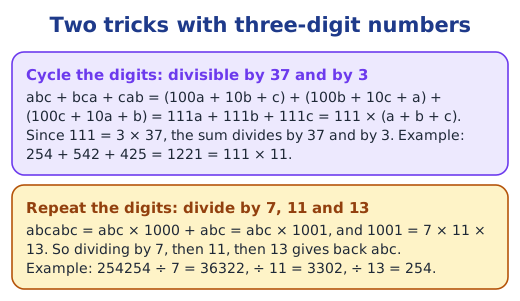
3. abc + bca + cab = (100a + 10b + c) + (100b + 10c + a) + (100c + 10a + b) = 111(a + b + c). Since 111 = 3 × 37, the sum always divides by 37, and by 3 as well.
4. Dividing by 7, then 11, then 13 gives back abc, because abcabc = abc × 1000 + abc = abc × 1001 and 7 × 11 × 13 = 1001. For example, 254254 gives 36322, then 3302, then 254.
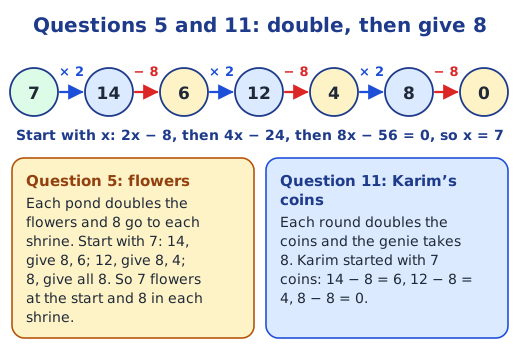
5. Let the person start with x flowers and place k in each shrine. After the first pond and shrine there are 2x − k flowers; after the second, 4x − 3k; after the third pond, 8x − 6k, and all of these go to shrine 3, so 8x − 6k = k and 8x = 7k. The smallest answer is x = 7 and k = 8: 7 flowers at the start and 8 in each shrine. Any multiple, such as 14 and 16, also works.
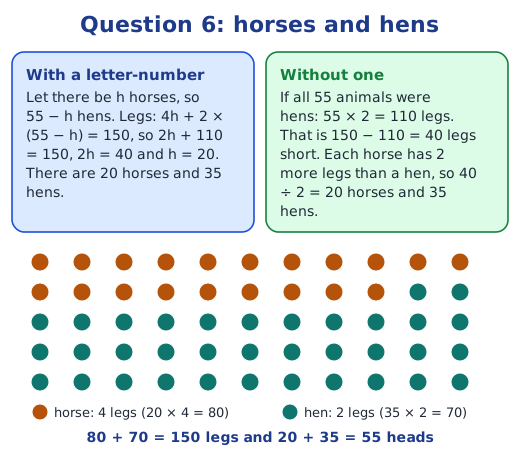
6. With h horses and 55 − h hens, 4h + 2(55 − h) = 150, so h = 20. Without letter-numbers: 55 hens would have 110 legs, 40 fewer than 150, and each horse has 2 more legs than a hen, so there are 20 horses and 35 hens.
7. Let the daughter be d years old, so the mother is 5d. In 6 years, 5d + 6 = 3(d + 6), so 5d + 6 = 3d + 18, 2d = 12 and d = 6. The daughter is 6 now and the mother 30.
8. Gauri has g cows and Naina 2g. After Naina gives 3, 2g − 3 = g + 3, so g = 6. Gauri has 6 cows and Naina 12; after the exchange each has 9.
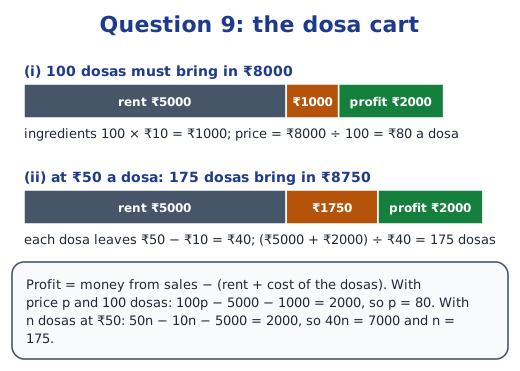
9. Profit = money from sales − (rent + cost of the dosas). (i) 100p − 5000 − 1000 = 2000, so 100p = 8000 and the price is ₹80 a dosa. (ii) 50n − 10n − 5000 = 2000, so 40n = 7000 and n = 175 dosas a day.
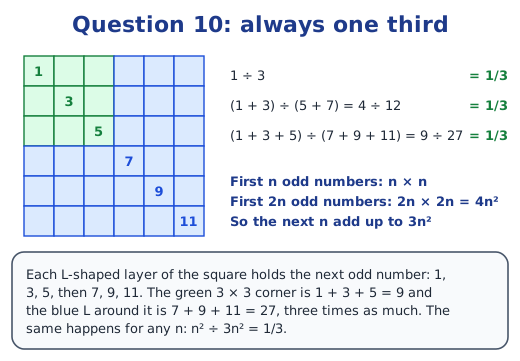
10. 1/3, 4/12 = 1/3 and 9/27 = 1/3: every fraction equals one third. The first n odd numbers add up to n², and the first 2n odd numbers to (2n)² = 4n², so the next n odd numbers add up to 4n² − n² = 3n². Each fraction is n² ÷ 3n² = 1/3.
11. (i) Let Karim start with x coins. After one round there are 2x − 8; after two, 4x − 24; after the third doubling, 8x − 48, which equals 8. So 8x = 56 and x = 7: Karim started with 7 coins (7, 14, 6, 12, 4, 8 and then 0).
(ii) A round turns x coins into 2x − c, which is more than x only when the cost c is less than x. So Karim should agree only if the cost per round is less than the number of coins he starts with; then every round leaves him with more. With 7 coins, any cost below 7 works.
(iii) To take every coin in three rounds, the genie needs 8x − 7c = 0, so c = 8x ÷ 7: 8 coins a round when Karim has 7, or 16 when he has 14. With just one round, the genie would charge 2x; with two rounds, 4x ÷ 3.
Practice
-
Using 2, 7 and 9 once each, the largest product of a two-digit and a one-digit number is:
Show answer
Answer: (c) 72 × 9
-
A pyramid’s bottom row is 6, 1, 4. Its top number is:
Show answer
Answer: (b) 12
-
If the date trick gives 767, the date is:
Show answer
Answer: (a) 2 June
-
A father is 4 times as old as his son. In 5 years he will be 3 times as old. How old is the son?
Show answer
Answer: Let the son be s years old. Then 4s + 5 = 3(s + 5), so 4s + 5 = 3s + 15 and s = 10. The son is 10 and the father 40.
-
Show that 47 + 74 is divisible by 11.
Show answer
Answer: 47 + 74 = 121 = 11 × 11. In general ab + ba = 11(a + b), and here a + b = 11.
Stuck on a question?
Take a photo and Lagnever AI explains it step by step. Try it for 7 days for ₹2.
Get it on Google Play Open in browser
For parents: after the trial, the plan renews monthly by UPI or card autopay. You can cancel anytime in the app.