
Think of a number tricks, explained with algebra
Answer in short
A think of a number trick works because, when each step is written with a letter-number such as x, the starting number cancels out and leaves a fixed answer. In the date trick the steps turn month M and day D into 100M + 165 + D, so subtracting 165 reveals the date.
Stuck on a question? Take a photo and Lagnever AI explains it step by step. Try it for 7 days for ₹2. Get it on Google Play
A trick that always lands on 2
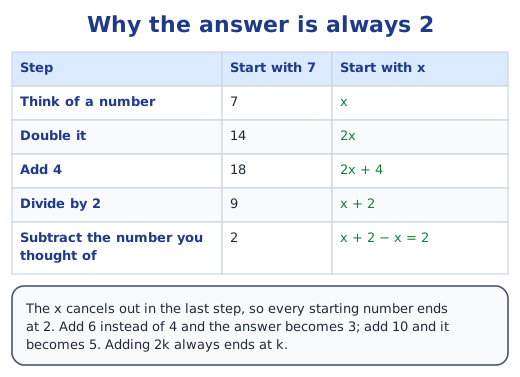
Ask a friend to think of a number, double it, add four, halve the result and then subtract the number they first thought of. Whatever they chose, you can announce that they have 2. Try it with 7: 14, 18, 9, and 9 − 7 = 2. Try it with 50: 100, 104, 52, and 52 − 50 = 2. Testing more numbers builds confidence, but no amount of testing covers every number. Algebra can.
Writing the steps with a letter-number
Let the number be x. Doubling gives 2x, adding four gives 2x + 4, halving gives x + 2, and subtracting the original leaves x + 2 − x = 2. The letter x has vanished. The number was doubled and then halved back, so it came out unchanged and was finally removed; only the 4, halved to 2, survives. So the answer is 2 for every starting number, even a fraction.
Changing the answer
To make the final answer 3, add 6 instead of 4: 2x + 6 halves to x + 3, and removing x leaves 3. To make it 5, add 10. In general, adding 2k makes the trick end at k. Longer tricks work in the same way, as long as the starting number is cancelled at the end. For example, think of x, add 3 to get x + 3, multiply by 4 to get 4x + 12, subtract 8 to get 4x + 4, divide by 4 to get x + 1, and take away x. The answer is always 1.
Guessing a date
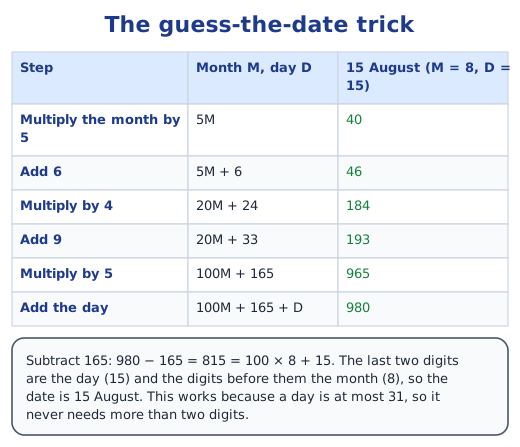
A trick of the same kind can reveal a date. Ask someone to think of a date, multiply the month by 5, add 6, multiply by 4, add 9, multiply by 5, add the day and tell you the result. Call the month M and the day D:
- 5M, then 5M + 6
- 4 × (5M + 6) = 20M + 24, then 20M + 33
- 5 × (20M + 33) = 100M + 165, then 100M + 165 + D
So the answer is always 100M + 165 + D. Subtract 165 and you are left with 100M + D. A day is never more than 31, so it needs only two digits: the last two digits are the day and the digits in front of them are the month. If the answer is 980, then 980 − 165 = 815, so the month is 8 and the day 15: Independence Day, 15 August.
Where does 165 come from?
The 165 is built from the numbers added along the way. The 6 is multiplied by 4 and then by 5, which gives 120, and the 9 is multiplied by 5, which gives 45; together they make 165. Change those additions and the hidden number changes too. If you add 3 instead of 6 and 7 instead of 9, it becomes 3 × 4 × 5 + 7 × 5 = 60 + 35 = 95, and you subtract 95 instead. The multiplications by 5, 4 and 5 should stay, because together they multiply the month by 100 and move it clear of the two places kept for the day.
Make your own trick
- Start with a letter-number, x.
- Mix steps that change x, such as multiplying or dividing, with steps that add or subtract fixed numbers.
- At the end, undo what was done to x, by dividing back or subtracting x, so that only a fixed number is left.
- Check the algebra, then try the trick on friends with a few different numbers.
Tricks like these show why algebra matters: one line with a letter-number proves what no amount of testing can.
Read next: number pyramids and grid puzzles, divisibility tricks and the largest product, the chapter notes and NCERT solutions.
Practice
-
Think of x, multiply by 3, add 9, divide by 3 and subtract x. The answer is:
Show answer
Answer: (a) 3
-
The date trick gives 1167. The date is:
Show answer
Answer: (a) 2 October
-
In ‘double, add, halve, subtract’, what should you add so that the answer is always 7?
Show answer
Answer: (c) 14
-
Why does the date trick never mix up the day and the month?
Show answer
Answer: The steps give 100M + 165 + D. After subtracting 165, the day D is at most 31, so it fills only the last two digits, and the month sits in the places in front of them.
-
Make a trick that always ends at 1.
Show answer
Answer: For example: think of x, add 3 (x + 3), multiply by 4 (4x + 12), subtract 8 (4x + 4), divide by 4 (x + 1) and subtract x. The answer is 1 for every starting number.
Questions students ask
How does a think of a number trick work?
Its steps are chosen so that, written with x, the starting number cancels out. Whatever x is, the expression simplifies to the same number, which the person doing the trick already knows.
How can I change the answer of the trick?
Change the number you add. In ‘double, add, halve, subtract’, adding 2k makes the answer k: add 6 to get 3, or add 10 to get 5.
Why do we subtract 165 in the date trick?
Because the steps add 165 on top of 100 × month + day: the 6 is multiplied by 4 and by 5, giving 120, and the 9 by 5, giving 45. Taking 165 away leaves 100M + D, which shows the month and the day.
Stuck on a question?
Take a photo and Lagnever AI explains it step by step. Try it for 7 days for ₹2.
Get it on Google Play Open in browser
For parents: after the trial, the plan renews monthly by UPI or card autopay. You can cancel anytime in the app.