
Number pyramids and grid puzzles
Answer in short
In a number pyramid every box holds the sum of the two boxes right beneath it. Missing boxes are found by adding or subtracting, or by naming them with letter-numbers and solving. The top of a three-row pyramid is a + 2b + c. In calendar and algebra grids, letter-numbers turn sums into equations that reveal hidden numbers.
Stuck on a question? Take a photo and Lagnever AI explains it step by step. Try it for 7 days for ₹2. Get it on Google Play
The rule of a number pyramid
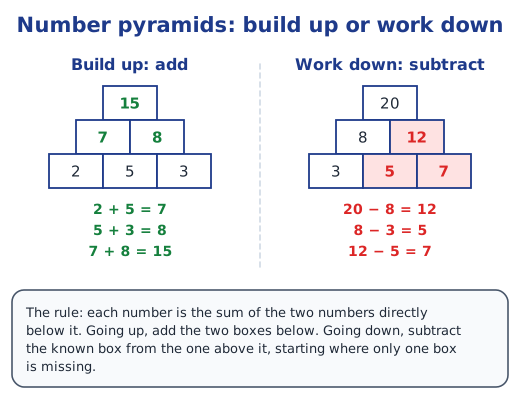
A number pyramid is a stack of boxes. The bottom row can hold any numbers, and every other box holds the sum of the two boxes directly beneath it. With 2, 5 and 3 at the bottom, the row above is 7 and 8, and the top is 15. Going up, we add; going down, we subtract. If the top is 20 with 8 below it on the left, the box beside 8 must be 20 − 8 = 12. If 3 sits under the 8, its neighbour is 8 − 3 = 5, and the last box is 12 − 5 = 7.
When subtraction cannot start
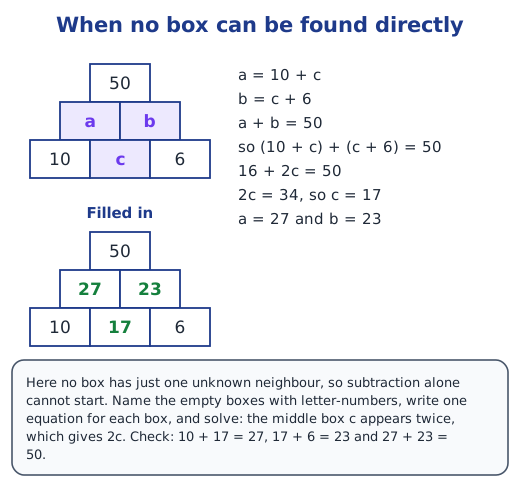
Sometimes no box can be found from its neighbours. Suppose a three-row pyramid has 50 at the top and 10 and 6 at the ends of the bottom row. Call the empty boxes a and b in the middle row and c in the bottom row. The rule gives three equations: a = 10 + c, b = c + 6 and a + b = 50. Putting the first two into the third gives (10 + c) + (c + 6) = 50, so 16 + 2c = 50, 2c = 34 and c = 17. Then a = 27 and b = 23, and indeed 27 + 23 = 50.
The top number from the bottom row
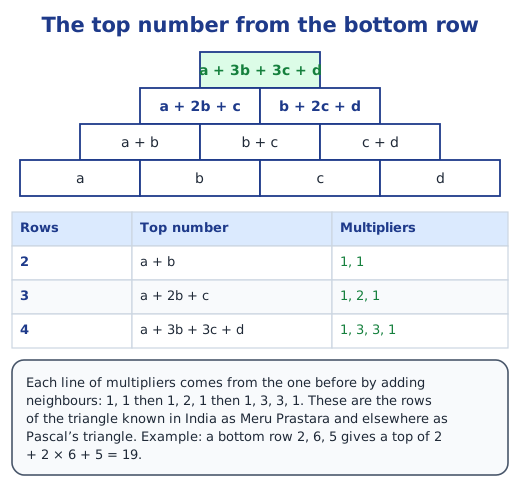
Algebra can also predict the top without building the whole pyramid. With bottom row a, b, the top is a + b. With a, b, c, the middle row is a + b and b + c, so the top is a + 2b + c: the middle number counts twice because it lies under both boxes above it. A four-row pyramid with bottom row a, b, c, d has top a + 3b + 3c + d. The multipliers 1, 1, then 1, 2, 1, then 1, 3, 3, 1 grow by adding neighbours, like the rows of the triangle known in India as Meru Prastara. A bottom row of 2, 6, 5, for example, gives a top of 2 + 12 + 5 = 19.
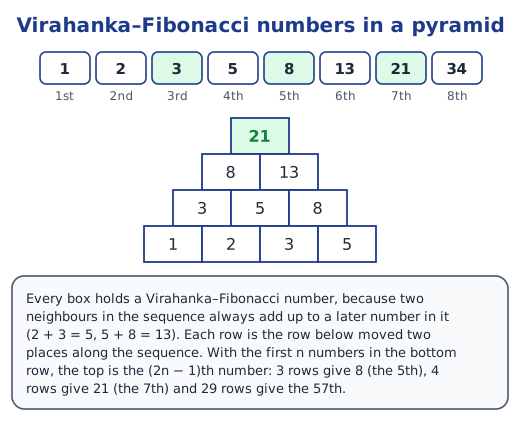
Put the first few Virahānka–Fibonacci numbers in the bottom row and something neat happens: every box holds another number of the sequence, because two neighbours in it always add up to a later one, and each extra row moves the top two places further along the sequence.
Calendar magic
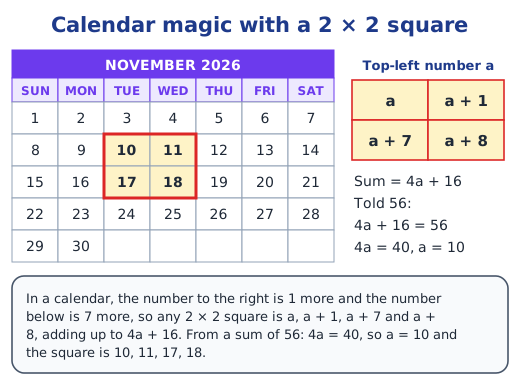
In a monthly calendar the date to the right of any date is 1 more and the date below it is 7 more. So if the top-left date of a 2 × 2 square is a, the square holds a, a + 1, a + 7 and a + 8, and its sum is 4a + 16. If a friend says the sum is 56, then 4a = 40 and a = 10, so the square is 10, 11, 17 and 18.
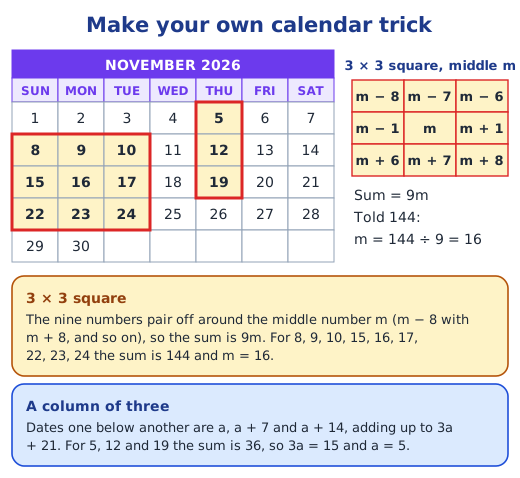
The same idea gives new tricks. A 3 × 3 square adds up to 9 times its middle date, because its nine dates pair off around the middle. Three dates in a column are a, a + 7 and a + 14, which add up to 3a + 21.
Algebra grids
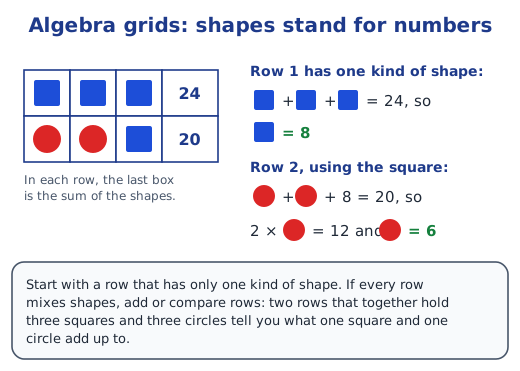
In an algebra grid each shape stands for a number, and the last box of every row gives the sum of that row. If three squares make 24, one square is 8. If two circles and a square make 20, the two circles make 12, so each circle is 6. When every row mixes shapes, adding two rows can give equal numbers of each shape, which tells you what one of each adds up to.
Read next: think of a number tricks, divisibility tricks and the largest product, the chapter notes and NCERT solutions.
Practice
-
The bottom row of a pyramid is 3, 7, 2. The top number is:
Show answer
Answer: (b) 19
-
A 2 × 2 square of dates adds up to 76. Its top-left date is:
Show answer
Answer: (b) 15
-
Three squares add up to 33, and two circles and a square add up to 21. A circle stands for:
Show answer
Answer: (b) 5
-
What is the top of a four-row pyramid whose bottom row is 1, 1, 1, 1?
Show answer
Answer: 1 + 3 + 3 + 1 = 8. Building it confirms this: 2, 2, 2, then 4, 4, then 8.
-
A 3 × 3 square of dates adds up to 117. What is its middle date?
Show answer
Answer: The nine dates add up to 9 times the middle date, so the middle date is 117 ÷ 9 = 13.
Questions students ask
How do you fill a number pyramid from the top?
Look for a missing box whose partner in the same row and the box above them are both known. Subtract to find it, then keep working down, one subtraction at a time.
What if no box can be found by subtraction?
Name the empty boxes with letter-numbers, write an equation for each box and combine them. With 50 at the top and 10 and 6 at the ends of a three-row pyramid, the middle box c gives 16 + 2c = 50, so c = 17.
Why does a 2 × 2 square of dates add up to 4a + 16?
In a calendar the date to the right is 1 more and the date below is 7 more, so the four dates are a, a + 1, a + 7 and a + 8. Their sum is 4a + 16.
Stuck on a question?
Take a photo and Lagnever AI explains it step by step. Try it for 7 days for ₹2.
Get it on Google Play Open in browser
For parents: after the trial, the plan renews monthly by UPI or card autopay. You can cancel anytime in the app.