
Square numbers and square roots
Answer in short
A square number is a number multiplied by itself, like 6 × 6 = 36, written 6². The squares of natural numbers are perfect squares, and they are the only numbers with an odd number of factors. The square root undoes squaring: √36 = 6. Find it by subtracting odd numbers, pairing prime factors or estimating.
Stuck on a question? Take a photo and Lagnever AI explains it step by step. Try it for 7 days for ₹2. Get it on Google Play
Why are they called square numbers?
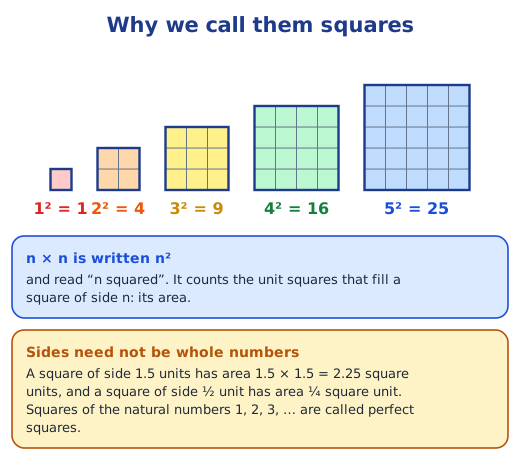
Draw a square whose sides are 4 units long and divide it into unit squares. It holds 4 rows of 4, that is 16 unit squares, so its area is 4 × 4 = 16 square units. This is why 4 × 4 is called the square of 4. We write it as 4², read “4 squared”, and in general n × n = n².
The squares of the natural numbers, 1, 4, 9, 16, 25, 36, …, are called perfect squares. The side does not have to be a whole number: a square of side 1.5 units has area 1.5 × 1.5 = 2.25 square units, and a square of side ½ unit has area ¼.
Which numbers have an odd number of factors?
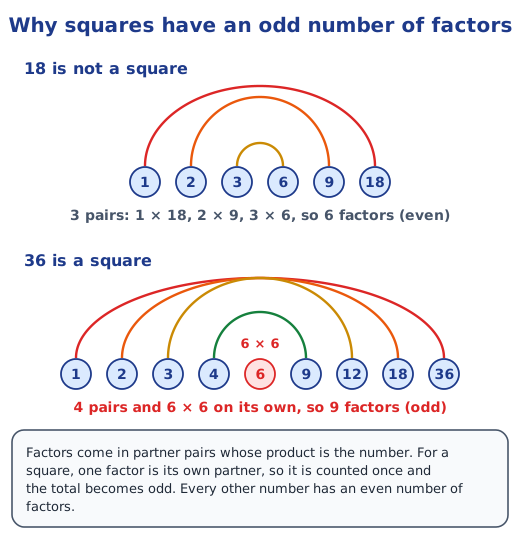
List the factors of 18 in pairs whose product is 18: 1 × 18, 2 × 9 and 3 × 6. That gives 6 factors, an even number. Now try 36: 1 × 36, 2 × 18, 3 × 12, 4 × 9 and 6 × 6. The factor 6 is its own partner, so it is counted only once, and 36 has 9 factors.
Every number has its factors in partner pairs, except that a square has one factor paired with itself. So only squares have an odd number of factors. This is the secret of the chapter’s locker puzzle: a locker is toggled once for each factor of its number, so only the square-numbered lockers end up open.
What is a square root?
The square root goes backwards. If a square has area 81 cm², its side is the number whose square is 81, which is 9 cm. We write √81 = 9. Strictly, (−9) × (−9) is also 81, so 81 has two square roots, +9 and −9, but the sign √ and this chapter use the positive one.
Method 1: subtract odd numbers
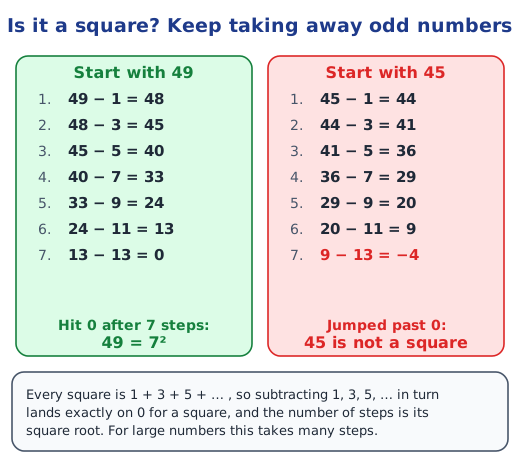
Every square is a sum of odd numbers starting from 1: 1 + 3 + 5 + 7 = 16 = 4². So subtract 1, 3, 5, 7, … from a number in turn. If you land exactly on 0, it is a square, and the number of steps is its square root. If you jump past 0, it is not a square. This is reliable but slow for big numbers: √729 would take 27 steps.
Method 2: pair the prime factors
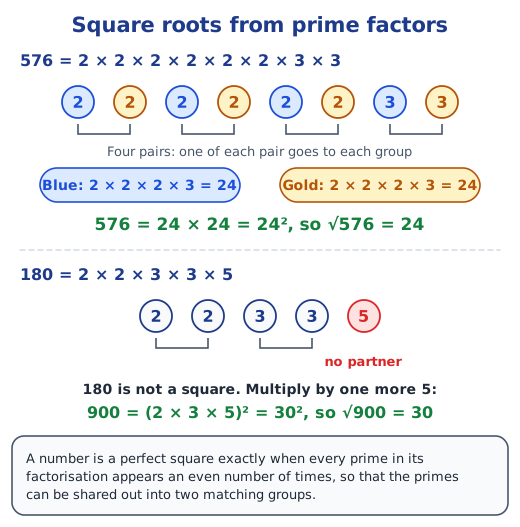
A square is a number times itself, so its prime factors can be shared out into two matching groups. Take 576 = 2 × 2 × 2 × 2 × 2 × 2 × 3 × 3. Send one factor of each pair to each group: both groups are 2 × 2 × 2 × 3 = 24, so 576 = 24² and √576 = 24. For 180 = 2 × 2 × 3 × 3 × 5 the 5 has no partner, so 180 is not a square. Multiplying it by one more 5 fixes that: 900 = 30².
Method 3: narrow it down
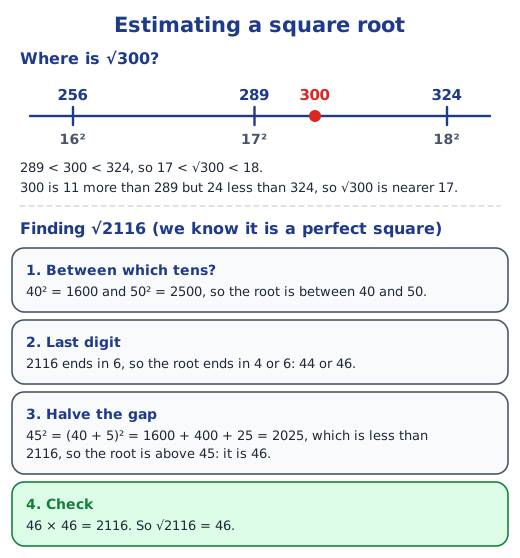
For a perfect square such as 2116, first find the tens: 40² = 1600 and 50² = 2500, so the root is in the 40s. Next, a square ending in 6 comes from a number ending in 4 or 6, so the root is 44 or 46. Finally test the middle: 45² = 2025 is too small, so the answer is 46.
The same idea estimates roots of numbers that are not squares. Since 17² = 289 and 18² = 324, √300 lies between 17 and 18, and it is nearer 17 because 300 is closer to 289. This is useful in real life: from a square cloth of area 300 cm², the largest square handkerchief with a whole-number side has side 17 cm.
Read next: cube numbers and cube roots, patterns in squares and cubes, the chapter notes and NCERT solutions.
Practice
-
Which of these is a perfect square?
Show answer
Answer: (c) 1225
-
Using prime factors, √1296 is:
Show answer
Answer: (b) 36
-
√200 lies between:
Show answer
Answer: (b) 14 and 15
-
Is 2025 a perfect square? Use prime factors.
Show answer
Answer: 2025 = 3 × 3 × 3 × 3 × 5 × 5. The factors split into two groups of 3 × 3 × 5 = 45, so 2025 = 45² and √2025 = 45.
-
A square garden has an area of 160 m². What is the longest whole-number side of a square bed that fits inside it?
Show answer
Answer: 12² = 144 and 13² = 169. 160 lies between them, so the garden’s side is between 12 m and 13 m, and the longest whole-number side is 12 m.
Questions students ask
What is a perfect square?
A perfect square is the square of a natural number, such as 1, 4, 9, 16 or 25. In its prime factorisation, every prime appears an even number of times.
How many square roots does a number have?
A perfect square such as 64 has two: 8 and −8, because (−8) × (−8) is also 64. The sign √ means the positive one, so √64 = 8.
What is the quickest way to find a square root without a calculator?
For a known perfect square, find the two tens it lies between, use the last digit to narrow the answer to two choices, and test the middle (such as 45²) to pick one. Prime factors work for any size.
Stuck on a question?
Take a photo and Lagnever AI explains it step by step. Try it for 7 days for ₹2.
Get it on Google Play Open in browser
For parents: after the trial, the plan renews monthly by UPI or card autopay. You can cancel anytime in the app.