
Class 8 Maths Chapter 1: A Square and A Cube Notes
This chapter in five lines
A square number is a number times itself (n × n = n²), and a cube is a number used three times (n × n × n = n³). Only squares have an odd number of factors, which solves the locker puzzle. Squares and cubes follow patterns in their last digits and in sums of odd numbers. Square roots and cube roots undo them, and prime factorisation finds both.
What is this chapter about?
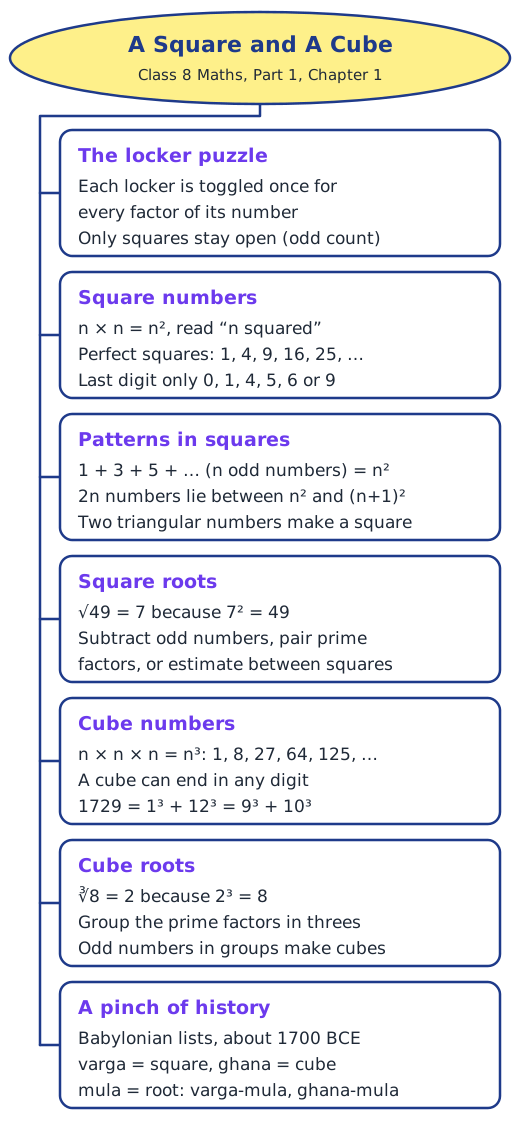
This is the first chapter of Ganita Prakash, Grade 8 Part 1. It starts with a puzzle about lockers, uses it to discover square numbers, and then studies squares and cubes: how to spot them, the patterns they make, and how to undo them with square roots and cube roots. It ends with the history of the words we use and a puzzle on square pairs.
The locker puzzle
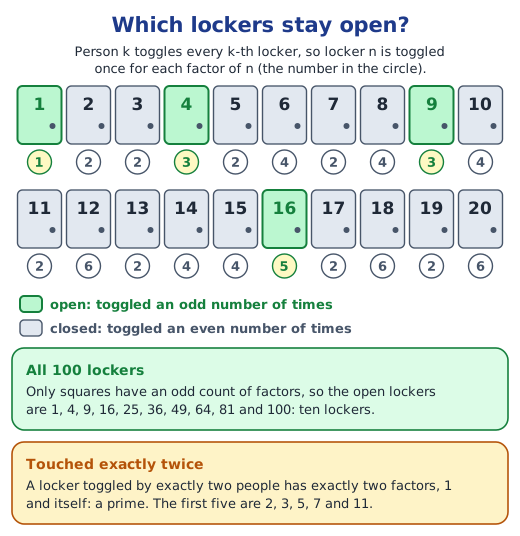
A hundred people take turns with a hundred lockers: person 1 opens every locker, person 2 changes every 2nd locker, person 3 every 3rd, and so on. Locker n is touched once for each factor of n. Factors come in partner pairs, like 2 × 9 for 18, so most numbers have an even number of factors and their lockers end up closed. A square such as 36 has one factor that is its own partner (6 × 6), so its count is odd and its locker stays open. The open lockers are 1, 4, 9, …, 100.
Square numbers
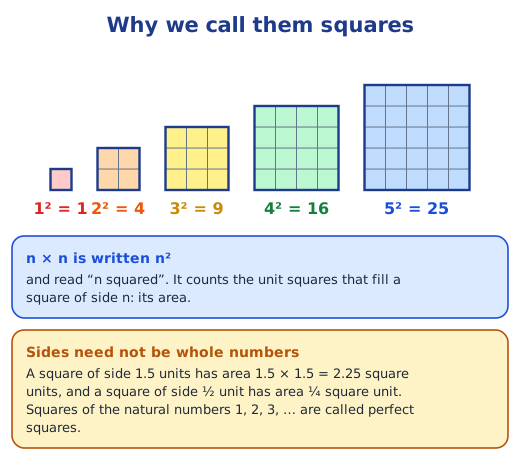
A square of side 5 units holds 5 × 5 = 25 unit squares, so 25 is called the square of 5 and written 5². The squares of the natural numbers, 1, 4, 9, 16, 25, …, are the perfect squares. A side can also be a fraction or a decimal: a square of side 1.5 units has area 2.25 square units. Read square numbers and square roots.
Patterns in squares
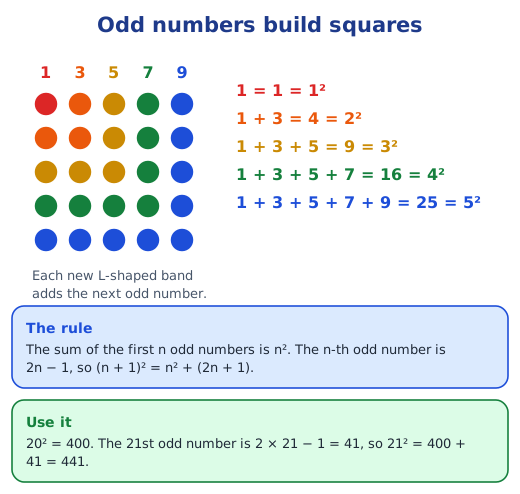
Squares end only in 0, 1, 4, 5, 6 or 9, and always in an even number of zeros. Adding odd numbers from 1 gives the squares in turn: 1 + 3 + 5 + 7 = 16. Between two neighbouring squares n² and (n + 1)² lie 2n numbers, so squares get rarer as numbers grow. Two neighbouring triangular numbers, such as 10 and 15, add up to a square. Read patterns in squares and cubes.
Square roots
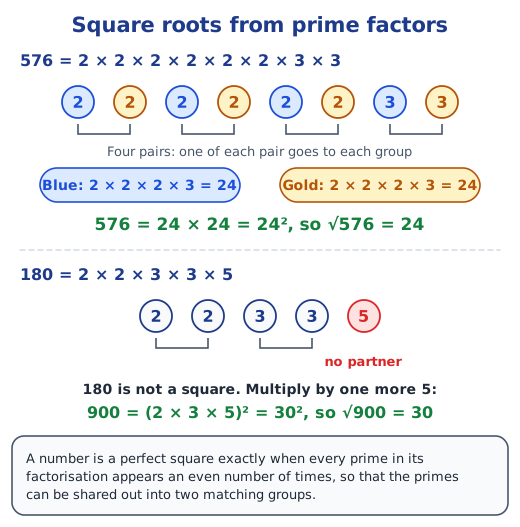
Finding the side of a square from its area undoes squaring. If 7² = 49, then 7 is the square root of 49, written √49 = 7. We can test a number by subtracting 1, 3, 5, … until we reach 0, or by splitting its prime factors into two identical groups. For a number that is not a square, we trap its root between two whole numbers: √300 lies between 17 and 18.
Cube numbers and cube roots
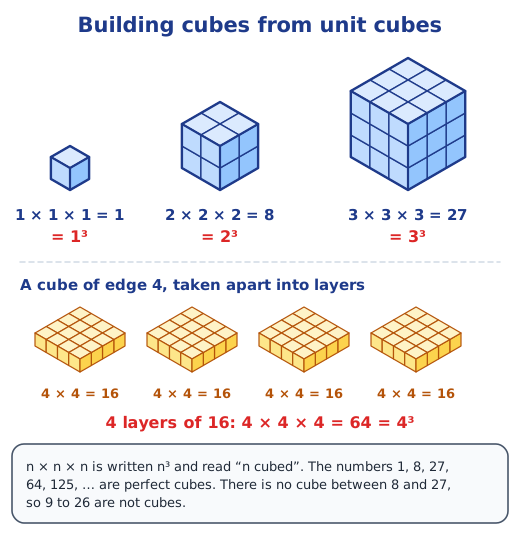
A cube of edge 3 is built from 3 × 3 × 3 = 27 unit cubes, so 27 is 3 cubed, written 3³. The perfect cubes are 1, 8, 27, 64, 125, … A cube can end in any digit, but its zeros at the end come in threes. The cube root undoes cubing: ∛27 = 3. A number is a perfect cube when its prime factors split into three identical groups. Read cube numbers and cube roots.
Taxicab numbers and other patterns in cubes
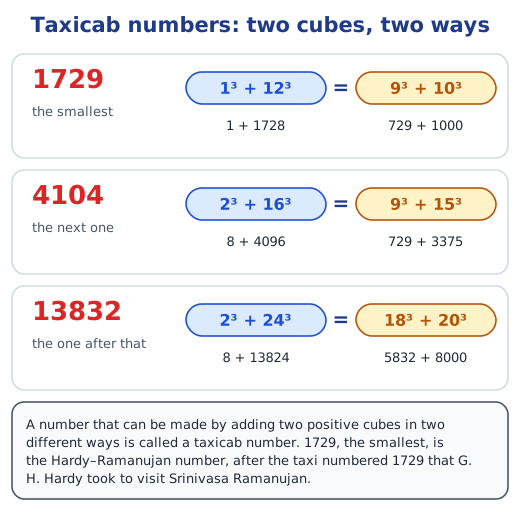
When G. H. Hardy called his taxi number 1729 dull, Srinivasa Ramanujan replied that no smaller number can be written in two ways as a sum of two cubes: 1³ + 12³ and 9³ + 10³. Such numbers are called taxicab numbers. Cubes also come from odd numbers: 3 + 5 = 8 and 7 + 9 + 11 = 27. Their successive differences become equal (all 6) at the third level.
A pinch of history
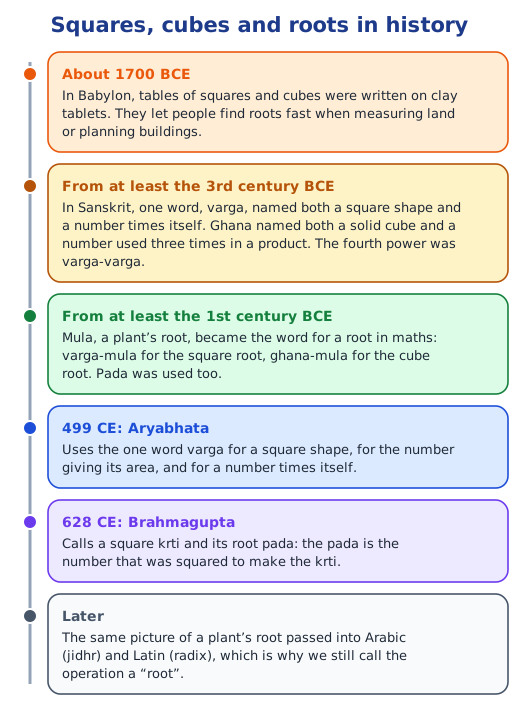
Babylonian clay tablets from about 1700 BCE already list squares and cubes. In India, the Sanskrit words varga (square) and ghana (cube) were in use from at least the third century BCE, and mula, the root of a plant, gave the names varga-mula and ghana-mula for square root and cube root. The same idea travelled into Arabic and Latin, which is why we say “root” today.
Before we move on
Squares first met you in Class 6 as dot patterns (triangular and square numbers), and square roots come back in Part 2 with the square root of 2. Answers to every question in this chapter, both Figure it Out sets and the Square Pairs puzzle are in the NCERT solutions for Chapter 1.
Key terms
| Term | Meaning |
|---|---|
| Square number | A number multiplied by itself, such as 7 × 7 = 49. It is written 7² and read “7 squared”. |
| Perfect square | The square of a natural number: 1, 4, 9, 16, 25, … Its prime factors split into two identical groups. |
| Factor pair | Two factors whose product is the number, such as 4 and 9 for 36. In a square, one factor pairs with itself (6 × 6). |
| Square root (√) | The number that was squared: √49 = 7 because 7² = 49. A perfect square also has a negative root (−7); this chapter uses the positive one. |
| Triangular number | A number of dots that can be arranged in a triangle: 1, 3, 6, 10, 15, … Two neighbouring ones add up to a square. |
| Perfect cube | A number made by using a natural number three times in a product, such as 4 × 4 × 4 = 64 = 4³, read “4 cubed”. |
| Cube root (∛) | The number that was cubed: ∛64 = 4 because 4³ = 64. |
| Prime factorisation | Writing a number as a product of primes, such as 360 = 2 × 2 × 2 × 3 × 3 × 5. It shows at once whether a number is a square or a cube. |
| Parity | Whether a number is even or odd. A number and its square always have the same parity. |
| Taxicab number | A number that can be made by adding two cubes in two different ways. The smallest, 1729 = 1³ + 12³ = 9³ + 10³, is the Hardy–Ramanujan number. |
| Successive differences | Differences between neighbouring terms, then the differences of those, and so on. For squares they become equal at level 2; for cubes at level 3. |
| Varga, ghana, mula | Sanskrit words for square, cube and root. Varga-mula meant square root and ghana-mula cube root. |
Topics in this chapter
Practice
-
Which of these can never be a perfect square?
Show answer
Answer: (c) 1458
-
How many factors does 49 have?
Show answer
Answer: (b) 3
-
√1764 is:
Show answer
Answer: (b) 42
-
Which of these is a perfect cube?
Show answer
Answer: (b) 216
-
How many numbers lie between 20² and 21²?
Show answer
Answer: (c) 40
-
1729 is famous because it is:
Show answer
Answer: (b) the smallest number that is a sum of two cubes in two ways
Questions students ask
What are the main topics of Class 8 Maths Chapter 1?
The locker puzzle and factors, square numbers and their patterns, square roots, cube numbers and their patterns, cube roots, taxicab numbers, and a short history of the words varga, ghana and mula. It ends with the Square Pairs puzzle.
Is A Square and A Cube in the new NCERT Class 8 Maths book?
Yes. It is Chapter 1 of Ganita Prakash, Grade 8 Part 1, on pages 1 to 18 of the book marked Reprint 2026-27. Part 2 of the book numbers its chapters from 1 again.
Why are 1, 4, 9 and 16 called square numbers?
Because they count the unit squares in squares of side 1, 2, 3 and 4. A square of side n holds n × n unit squares, so n × n is called the square of n.
What is the difference between a square root and a cube root?
A square root undoes squaring: √81 = 9 because 9 × 9 = 81. A cube root undoes cubing: ∛125 = 5 because 5 × 5 × 5 = 125.
Stuck on a question?
Take a photo and Lagnever AI explains it step by step. Try it for 7 days for ₹2.
Get it on Google Play Open in browser
For parents: after the trial, the plan renews monthly by UPI or card autopay. You can cancel anytime in the app.