
What are triangular and square numbers?
Answer in short
Triangular numbers, 1, 3, 6, 10, 15, …, are numbers of dots that can be arranged in a triangle; square numbers, 1, 4, 9, 16, 25, …, are numbers of dots that fill a square grid. Adding odd numbers from 1 gives squares, and two consecutive triangular numbers also add up to a square. The number 36 is both triangular and square.
Stuck on a question? Take a photo and Lagnever AI explains it step by step. Try it for 7 days for ₹2. Get it on Google Play
Numbers you can draw
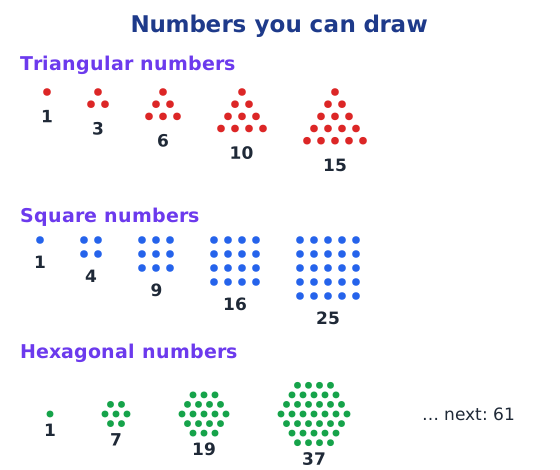
Some numbers get their names from the shapes their dots make. Triangular numbers, 1, 3, 6, 10, 15, …, are numbers of dots that can be arranged in a triangle, with rows of 1, 2, 3, … dots. So each triangular number is 1 + 2 + 3 + … up to some number: 10 = 1 + 2 + 3 + 4. Square numbers, 1, 4, 9, 16, 25, …, are numbers of dots that fill a square grid: 1 × 1, 2 × 2, 3 × 3, and so on.
36: triangle and square
The same number can play different roles. 36 dots can be arranged as a 6 by 6 square, and also as a triangle with rows of 1, 2, 3, 4, 5, 6, 7 and 8 dots, because 1 + 2 + … + 8 = 36. So 36 is both a square number and a triangular number.
Adding odd numbers gives squares
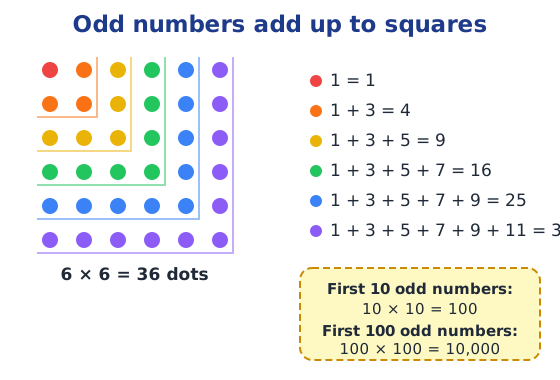
Look at what happens when we add up odd numbers: 1 = 1, 1 + 3 = 4, 1 + 3 + 5 = 9, 1 + 3 + 5 + 7 = 16, 1 + 3 + 5 + 7 + 9 = 25. The answers are the squares. Why does this keep happening? Split a square grid of dots into L-shaped layers: the corner dot, then 3 dots around it, then 5, then 7, and so on. Each new odd number wraps one more L around the square and makes the next bigger square. Since this works for a square of any size, the pattern goes on forever. The first 10 odd numbers add up to 10 × 10 = 100, and the first 100 odd numbers to 100 × 100 = 10,000.
Adding up and down
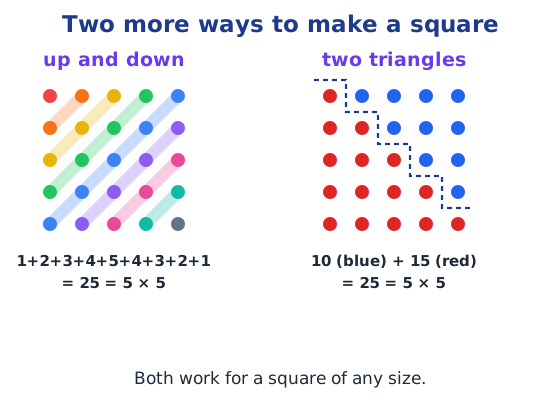
Add the counting numbers up and then back down:
- 1 + 2 + 1 = 4
- 1 + 2 + 3 + 2 + 1 = 9
- 1 + 2 + 3 + 4 + 3 + 2 + 1 = 16
Squares again! The picture explains it: the slanting rows of a 5 by 5 square of dots hold 1, 2, 3, 4, 5, 4, 3, 2 and 1 dots. So 1 + 2 + 3 + … + 99 + 100 + 99 + … + 3 + 2 + 1 = 100 × 100 = 10,000.
Two triangles make a square
Cut a square of dots along a staircase and you get two triangles, one a step smaller than the other. So two consecutive triangular numbers always add up to a square: 1 + 3 = 4, 3 + 6 = 9, 6 + 10 = 16, 10 + 15 = 25.
More links between sequences
| Start with | Do this | You get |
|---|---|---|
| All 1’s | add them up: 1, 1 + 1, 1 + 1 + 1, … | counting numbers |
| Counting numbers | add them up: 1, 1 + 2, 1 + 2 + 3, … | triangular numbers |
| Triangular numbers | multiply by 6 and add 1 | hexagonal numbers 7, 19, 37, 61, … |
| Hexagonal numbers | add them up: 1, 1 + 7, 1 + 7 + 19, … | cubes 1, 8, 27, 64, … |
For patterns made of shapes, read patterns in shapes.
Practice
-
The 7th triangular number is:
Show answer
Answer: (b) 28 1 + 2 + 3 + 4 + 5 + 6 + 7 = 28.
-
The sum of the first 10 odd numbers is:
Show answer
Answer: (c) 100
-
1 + 2 + 3 + 4 + 5 + 6 + 5 + 4 + 3 + 2 + 1 equals:
Show answer
Answer: (b) 36
-
Which two consecutive triangular numbers add up to 49?
Show answer
Answer: 21 and 28: 21 + 28 = 49 = 7 × 7.
-
Show that 36 is both a triangular and a square number.
Show answer
Answer: 36 = 6 × 6, so 36 dots fill a 6 by 6 square. Also 36 = 1 + 2 + 3 + 4 + 5 + 6 + 7 + 8, so 36 dots make a triangle with rows of 1 to 8 dots.
Questions students ask
Why are 1, 3, 6, 10, 15 called triangular numbers?
Because that many dots can be arranged in a triangle: rows of 1, 1 and 2, 1, 2 and 3, and so on. Each triangular number is 1 + 2 + 3 + … up to some number.
Why are 1, 4, 9, 16, 25 called square numbers?
Because that many dots fill a square grid: 1 × 1, 2 × 2, 3 × 3, 4 × 4, 5 × 5.
Why does adding odd numbers give square numbers?
A square grid of dots can be split into L-shaped layers of 1, 3, 5, 7, … dots. Each new odd number adds one more L around the square and makes the next bigger square.
What is the sum of the first 100 odd numbers?
100 × 100 = 10,000, because the first n odd numbers always add up to n × n.
Stuck on a question?
Take a photo and Lagnever AI explains it step by step. Try it for 7 days for ₹2.
Get it on Google Play Open in browser
For parents: after the trial, the plan renews monthly by UPI or card autopay. You can cancel anytime in the app.