
What are number sequences?
Answer in short
A number sequence is a list of numbers that follows a rule, like the odd numbers 1, 3, 5, 7, …. The chapter's ten key sequences include triangular numbers, squares, cubes, Virahānka numbers, where each is the sum of the two before, and powers of 2 and 3. Knowing the rule lets us find the next terms.
Stuck on a question? Take a photo and Lagnever AI explains it step by step. Try it for 7 days for ₹2. Get it on Google Play
Patterns in whole numbers
Among the most basic patterns in mathematics are patterns of whole numbers: 0, 1, 2, 3, 4, …. The branch of mathematics that studies them is called number theory. A number sequence is a list of numbers that follows a rule, and number sequences are among the most fascinating patterns mathematicians study.
The ten key sequences
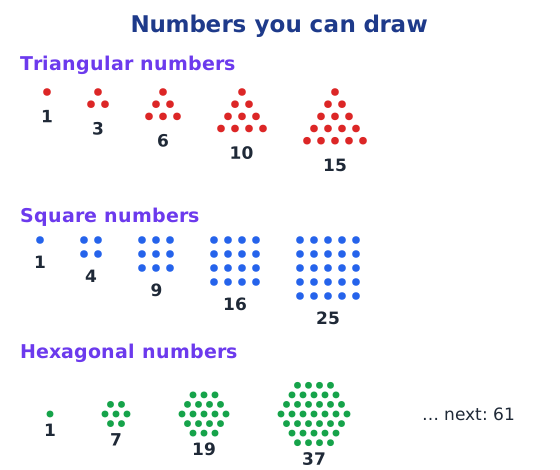
The chapter lists ten important sequences. Here they are with their next three numbers and the rule for each:
| Sequence | Numbers in the book | Next three | Rule |
|---|---|---|---|
| All 1’s | 1, 1, 1, 1, 1, 1, 1 | 1, 1, 1 | every number is 1 |
| Counting numbers | 1, 2, 3, 4, 5, 6, 7 | 8, 9, 10 | add 1 |
| Odd numbers | 1, 3, 5, 7, 9, 11, 13 | 15, 17, 19 | add 2, starting at 1 |
| Even numbers | 2, 4, 6, 8, 10, 12, 14 | 16, 18, 20 | add 2, starting at 2 |
| Triangular numbers | 1, 3, 6, 10, 15, 21, 28 | 36, 45, 55 | add 2, then 3, then 4, … |
| Squares | 1, 4, 9, 16, 25, 36, 49 | 64, 81, 100 | n × n |
| Cubes | 1, 8, 27, 64, 125, 216 | 343, 512, 729 | n × n × n |
| Virahānka numbers | 1, 2, 3, 5, 8, 13, 21 | 34, 55, 89 | add the two numbers before |
| Powers of 2 | 1, 2, 4, 8, 16, 32, 64 | 128, 256, 512 | multiply by 2 |
| Powers of 3 | 1, 3, 9, 27, 81, 243, 729 | 2187, 6561, 19683 | multiply by 3 |
How to find a rule
To spot the rule of a sequence, ask a few questions:
- Is the same number added each time? Odd and even numbers grow by 2 each time.
- Do the gaps themselves grow? Triangular numbers grow by 2, 3, 4, 5, …
- Is each number multiplied? Powers of 2 double; powers of 3 triple.
- Is each number made from earlier ones? Each Virahānka number is the sum of the two before it.
- Is it a number times itself? Squares are 1 × 1, 2 × 2, 3 × 3, …; cubes are 1 × 1 × 1, 2 × 2 × 2, …
Always test your rule on every number you have, not just the first two.
Virahānka numbers
In 1, 2, 3, 5, 8, 13, 21, …, each number is the sum of the two before it: 1 + 2 = 3, 2 + 3 = 5, 3 + 5 = 8, and so on. (Extra: these numbers are also called Fibonacci numbers; Virahānka, an Indian scholar of poetry and rhythm, described them centuries before Fibonacci.)
Powers of 2 and 3
Powers of 2 double at every step: 1, 2, 4, 8, 16, …. The chapter shows a lovely way to picture them: a single point; two points joined by a line; a square with 4 corners; a cube with 8 corners; and two cubes joined to make 16. Powers of 3 triple at every step: 1, 3, 9, 27, 81, …. One way to picture them: a dot, a row of 3 dots, a 3 × 3 square of 9 dots, and 3 such squares stacked into a cube of 27.
Why sequences matter
Number sequences are not just puzzles. They are related to each other in surprising ways, for example, adding up odd numbers gives squares, and they also appear in shapes, like the lines of complete graphs. Pictures often explain why these patterns happen. Read about this in triangular and square numbers.
Practice
-
The next three odd numbers after 13 are:
Show answer
Answer: (b) 15, 17, 19
-
Which sequence is the powers of 3?
Show answer
Answer: (b) 1, 3, 9, 27
-
The next cube after 216 is:
Show answer
Answer: (b) 343 216 = 6 × 6 × 6, so the next cube is 7 × 7 × 7 = 343.
-
Write the rule for 1, 2, 3, 5, 8, 13, 21, … and the next two numbers.
Show answer
Answer: Each number is the sum of the two before it (Virahānka numbers). Next: 13 + 21 = 34 and 21 + 34 = 55.
-
Find the next three powers of 2 after 64.
Show answer
Answer: 128, 256, 512 (each is double the one before).
Questions students ask
What is a number sequence?
A list of numbers in a particular order that follows a rule, such as the even numbers 2, 4, 6, 8, … where each number is 2 more than the one before.
What are Virahānka numbers?
The sequence 1, 2, 3, 5, 8, 13, 21, …, in which each number is the sum of the two before it. (Extra: the same numbers are known elsewhere as Fibonacci numbers; the Indian scholar Virahānka described them centuries earlier.)
What is number theory?
The branch of mathematics that studies patterns in whole numbers, 0, 1, 2, 3, 4, …. Number sequences are among its most basic patterns.
How do you find the rule of a sequence?
Look at how each number is made from the ones before: is something added (and is it the same each time?), is it multiplied, or is it made from two earlier numbers? Then test the rule on all the numbers you have.
Stuck on a question?
Take a photo and Lagnever AI explains it step by step. Try it for 7 days for ₹2.
Get it on Google Play Open in browser
For parents: after the trial, the plan renews monthly by UPI or card autopay. You can cancel anytime in the app.