
Class 6 Maths Chapter 1: Patterns in Mathematics Notes
This chapter in five lines
Mathematics is, in large part, the search for patterns and for why they exist. Number sequences are among the most basic patterns: counting, odd and even numbers, triangular numbers (1, 3, 6, 10, …), squares (1, 4, 9, 16, …), cubes, Virahānka numbers and powers of 2 and 3. Pictures help explain them: adding odd numbers gives squares. Shape sequences, like regular polygons, complete graphs and the Koch snowflake, are linked to number sequences too.
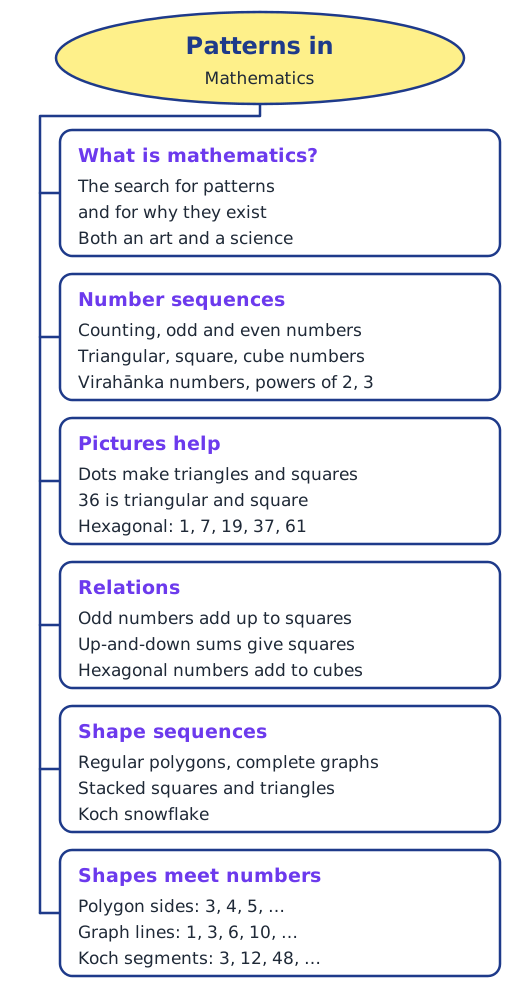
What is mathematics?
Mathematics is, in large part, the search for patterns, and for the explanations of why those patterns exist. Patterns are all around us: in nature, in our homes and schools, in the motion of the sun, moon and stars, and in shopping, cooking, throwing a ball, playing games, the weather and technology. Searching for patterns can be fun and creative, which is why mathematicians see mathematics as both an art and a science. Explaining why a pattern happens matters as much as finding it, because explanations can be used far beyond where they were found: patterns in the motion of stars and planets led to the theory of gravitation and to satellites and rockets to the Moon and Mars, and patterns in genomes help diagnose and cure diseases.
Number sequences
The branch of mathematics that studies patterns in whole numbers, 0, 1, 2, 3, 4, …, is number theory, and number sequences are its most basic patterns.
| Sequence | First numbers | Rule |
|---|---|---|
| All 1’s | 1, 1, 1, 1, … | every number is 1 |
| Counting numbers | 1, 2, 3, 4, … | add 1 |
| Odd numbers | 1, 3, 5, 7, … | add 2, starting at 1 |
| Even numbers | 2, 4, 6, 8, … | add 2, starting at 2 |
| Triangular numbers | 1, 3, 6, 10, 15, … | add 2, then 3, then 4, … |
| Squares | 1, 4, 9, 16, 25, … | n × n |
| Cubes | 1, 8, 27, 64, 125, … | n × n × n |
| Virahānka numbers | 1, 2, 3, 5, 8, 13, … | add the two numbers before |
| Powers of 2 | 1, 2, 4, 8, 16, … | multiply by 2 |
| Powers of 3 | 1, 3, 9, 27, 81, … | multiply by 3 |
Read more in number sequences.
Seeing sequences in pictures
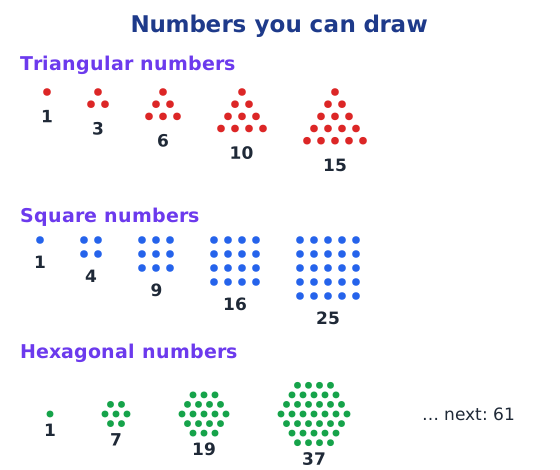
Many sequences can be drawn. Triangular numbers are dots arranged in triangles, squares are dots in square grids, and cubes are little cubes stacked into bigger cubes. The same number can play different roles: 36 can be arranged both as a 6 × 6 square and as a triangle with rows of 1 to 8 dots. Hexagonal numbers, 1, 7, 19, 37, …, make hexagons around a centre dot; the next one is 61. Even powers of 2 can be pictured: a point, two points, a square of 4, a cube of 8, and so on. Read more in triangular and square numbers.
Sequences are related
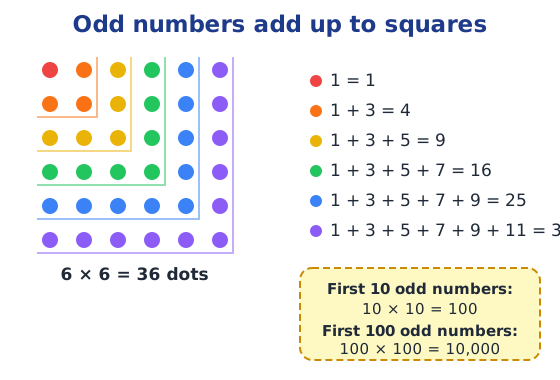
Number sequences can be related in surprising ways. Adding up odd numbers gives squares: 1 = 1, 1 + 3 = 4, 1 + 3 + 5 = 9, 1 + 3 + 5 + 7 = 16. Why? A square grid of dots can be split into L-shaped layers of 1, 3, 5, 7, … dots, and such a picture can be drawn for a square of any size. So the first 10 odd numbers add up to 10 × 10 = 100, and the first 100 to 10,000. Adding counting numbers up and then down gives squares too: 1 + 2 + 3 + 4 + 3 + 2 + 1 = 16.
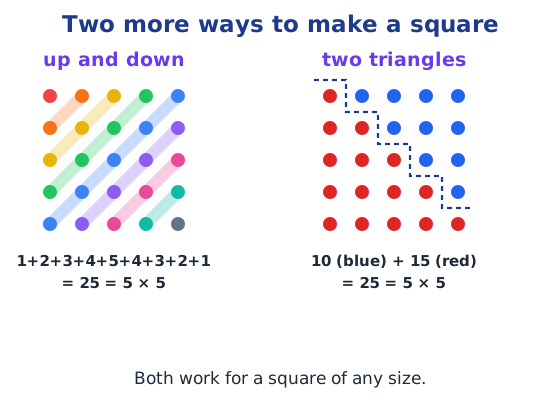
More relations from the chapter: adding up counting numbers gives triangular numbers; two consecutive triangular numbers add up to a square (10 + 15 = 25); 1 + 2 + 4 + 8 = 15, and adding 1 gives 16, the next power of 2; 6 × a triangular number + 1 gives a hexagonal number (6 × 3 + 1 = 19); and adding hexagonal numbers gives cubes (1 + 7 + 19 = 27).
Patterns in shapes
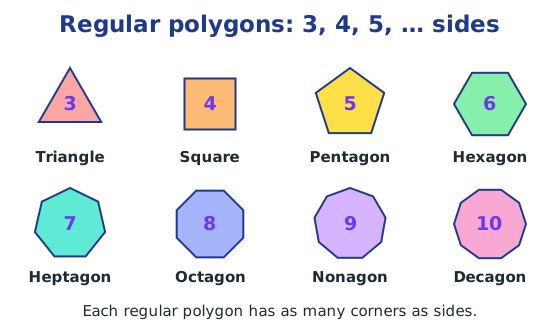
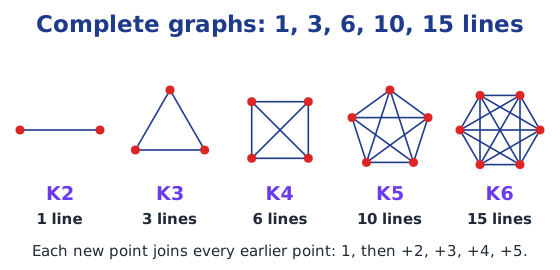
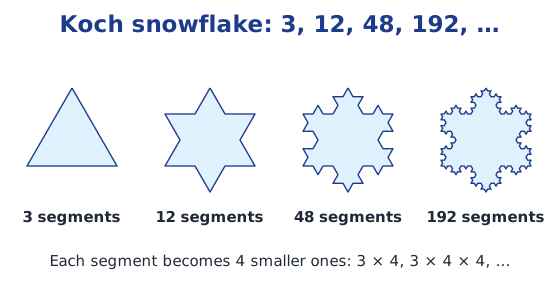
The branch of mathematics that studies patterns in shapes is geometry. Shapes can be in one, two or three dimensions, or even more. The chapter’s shape sequences are regular polygons (triangle, square, pentagon, hexagon, …: equal sides and equal angles), complete graphs (every point joined to every other), stacked squares, stacked triangles and the Koch snowflake. Read more in patterns in shapes.
Shapes meet numbers
| Shape sequence | What we count | Number sequence |
|---|---|---|
| Regular polygons | sides (or corners) | 3, 4, 5, 6, … (counting numbers from 3) |
| Complete graphs | lines | 1, 3, 6, 10, 15, … (triangular numbers) |
| Stacked squares | little squares | 1, 4, 9, 16, … (squares) |
| Stacked triangles | little triangles | 1, 4, 9, 16, … (squares) |
| Koch snowflake | line segments | 3, 12, 48, 192, … (3 × powers of 4) |
Answers to every Figure it Out question are in the NCERT solutions for Chapter 1.
Key terms
| Term | Meaning |
|---|---|
| Pattern | Something that repeats or follows a rule. Mathematics searches for patterns and explains why they exist. |
| Number theory | The branch of mathematics that studies patterns in whole numbers 0, 1, 2, 3, 4, … |
| Number sequence | A list of numbers that follows a rule, like 1, 3, 5, 7, … (odd numbers). |
| Triangular numbers | 1, 3, 6, 10, 15, …: numbers of dots that can be arranged in a triangle. |
| Square numbers (squares) | 1, 4, 9, 16, 25, …: numbers of dots in a square grid, n × n. |
| Cubes | 1, 8, 27, 64, 125, …: numbers of little cubes that make a bigger cube, n × n × n. |
| Virahānka numbers | 1, 2, 3, 5, 8, 13, 21, …: each number is the sum of the two before it. |
| Powers of 2 | 1, 2, 4, 8, 16, …: each number is double the one before. |
| Hexagonal numbers | 1, 7, 19, 37, 61, …: numbers of dots that make a hexagon around a centre dot. |
| Geometry | The branch of mathematics that studies patterns in shapes. |
| Regular polygon | A shape with equal sides and equal angles, like a regular triangle, square, pentagon or hexagon. |
| Complete graph | A set of points in which every point is joined to every other point by a line. |
Topics in this chapter
Practice
-
What is the next triangular number after 1, 3, 6, 10, 15?
Show answer
Answer: (c) 21
-
1 + 3 + 5 + 7 + 9 equals:
Show answer
Answer: (c) 25
-
Which number is both a triangular number and a square number?
Show answer
Answer: (c) 36
-
In the Virahānka numbers 1, 2, 3, 5, 8, 13, 21, the next number is:
Show answer
Answer: (c) 34 Each number is the sum of the two before it: 13 + 21 = 34.
-
How many lines does the complete graph K5 have?
Show answer
Answer: (c) 10
Questions students ask
What are the main topics of Class 6 Maths Chapter 1?
What mathematics is, number sequences such as triangular and square numbers, visualising sequences with pictures, relations among sequences like odd numbers adding up to squares, shape sequences such as regular polygons, complete graphs and the Koch snowflake, and how shape sequences link to number sequences.
Is Patterns in Mathematics in the new Ganita Prakash book?
Yes. Patterns in Mathematics is Chapter 1 of Ganita Prakash, the Class 6 Maths textbook used in the 2026-27 session.
How many Figure it Out questions are there in Chapter 1?
There are 25 Figure it Out questions across sections 1.1 to 1.6, plus two questions in the text about adding odd numbers. Our NCERT solutions page answers all of them.
Stuck on a question?
Take a photo and Lagnever AI explains it step by step. Try it for 7 days for ₹2.
Get it on Google Play Open in browser
For parents: after the trial, the plan renews monthly by UPI or card autopay. You can cancel anytime in the app.