
NCERT Solutions Class 6 Maths Chapter 1: Patterns in Mathematics
Answers to every Figure it Out question in Chapter 1, Patterns in Mathematics, of Ganita Prakash (Reprint 2026-27), with the questions in the text. The page numbers match the book, and the answers have been checked against NCERT’s answer key at the end of the chapter PDF. Short notes: Chapter 1 notes.
Figure it Out: what is mathematics? (page 2)
1. Other examples where mathematics helps in everyday life: paying for fruit and groceries and checking the change; measuring ingredients while cooking; sharing things equally; reading clocks, calendars and timetables; keeping scores in games; finding the area of a room or plot; planning a trip using distances and speeds; patterns and designs in buildings, rangoli and clothes.
2. How mathematics has helped humanity move forward:
- Science: experiments are measured, recorded and checked with numbers; patterns in the motion of planets led to the theory of gravitation and to satellites and rockets.
- Economy and democracy: banking, budgets and prices; counting votes; the census.
- Building: bridges, houses and tall buildings need measurements, angles and calculations of strength.
- Technology: TVs, mobile phones and computers work with numbers and codes; bicycles, trains, cars and planes need calculations of speed, distance and forces.
- Time: calendars and clocks come from patterns in the motion of the sun, moon and stars.
Figure it Out: number sequences (page 3)
1 and 2. The pattern, the next three numbers and the rule for each sequence of Table 1:
| Sequence | Next three | Rule in our own words |
|---|---|---|
| All 1’s | 1, 1, 1 | every number is 1 |
| Counting numbers | 8, 9, 10 | add 1 each time |
| Odd numbers | 15, 17, 19 | start at 1 and add 2 |
| Even numbers | 16, 18, 20 | start at 2 and add 2 |
| Triangular numbers | 36, 45, 55 | add 2, then 3, then 4, …; 1 + 2 + … + n |
| Squares | 64, 81, 100 | 1 × 1, 2 × 2, 3 × 3, … |
| Cubes | 343, 512, 729 | 1 × 1 × 1, 2 × 2 × 2, … |
| Virahānka numbers | 34, 55, 89 | each is the sum of the two before it |
| Powers of 2 | 128, 256, 512 | multiply by 2 each time |
| Powers of 3 | 2187, 6561, 19683 | multiply by 3 each time |
Figure it Out: visualising sequences (page 5)
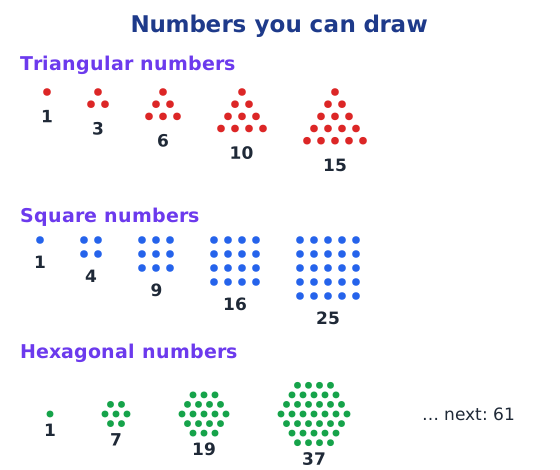
1. The next picture for each sequence of Table 2: all 1’s: one dot; counting numbers: a row of 6 dots; odd numbers: 11 dots in two rows, 5 on top and 6 below; even numbers: two rows of 6 (12 dots); triangular numbers: a triangle with rows of 1 to 6 dots (21); squares: a 6 by 6 grid (36); cubes: a 6 × 6 × 6 stack (216).
2. Why the names? 1, 3, 6, 10, 15, … dots can be arranged as triangles; 1, 4, 9, 16, 25, … dots fill squares; and 1, 8, 27, 64, 125, … little cubes stack into bigger cubes.
3. 36 as a triangle and a square: a 6 by 6 square of dots, and a triangle with rows of 1, 2, 3, 4, 5, 6, 7 and 8 dots (1 + 2 + … + 8 = 36).
4. 1, 7, 19, 37 are the hexagonal numbers. The differences are 6, 12, 18, so the next difference is 24 and the next number is 37 + 24 = 61.
5. Pictures for powers of 2 and 3: powers of 2: a point (1), two points joined (2), a square (4), a cube (8), two cubes joined corner to corner (16), as the chapter shows; or a tree that splits into 2 branches at each level. Powers of 3: a dot (1), a row of 3 dots (3), a 3 × 3 square (9), three such squares stacked into a 3 × 3 × 3 cube (27); or a tree that splits into 3 at each level.
Relations among sequences (pages 6–7)
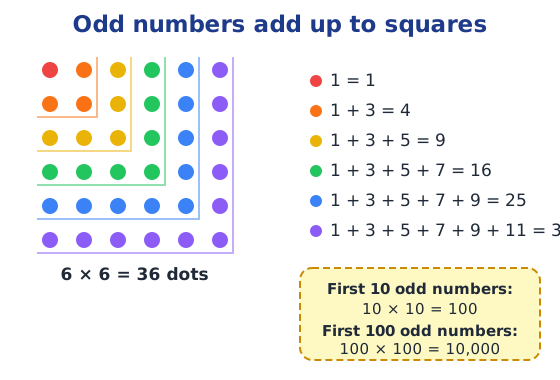
Sum of the first 10 odd numbers: the L-shaped picture for a 10 by 10 square gives 100.
Sum of the first 100 odd numbers: imagining a 100 by 100 square gives 10,000.
Figure it Out: relations among sequences (pages 8–9)
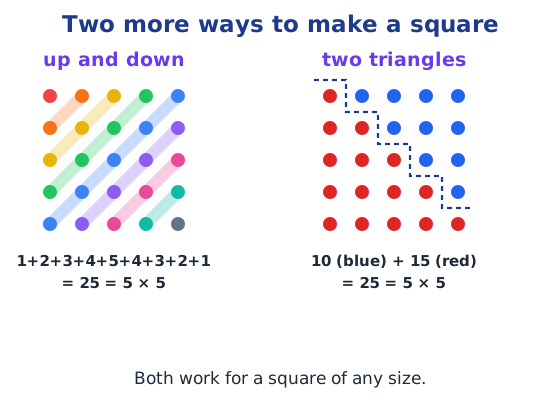
1. In a square grid of dots, the slanting rows hold 1, 2, 3, …, n, …, 3, 2, 1 dots (left picture), so adding counting numbers up and down gives the square n × n.
2. 1 + 2 + 3 + … + 99 + 100 + 99 + … + 3 + 2 + 1 = 100 × 100 = 10,000.
3. Adding the All 1’s sequence up gives 1, 1 + 1, 1 + 1 + 1, … = 1, 2, 3, 4, …: the counting numbers. Adding it up and down gives 1, 1 + 1 + 1, 1 + 1 + 1 + 1 + 1, … = 1, 3, 5, 7, …: the odd numbers.
4. Adding up the counting numbers gives 1, 3, 6, 10, 15, …: the triangular numbers. A smaller picture: a staircase of dots with 1, 2, 3, 4, … dots in its columns.
5. 1 + 3 = 4, 3 + 6 = 9, 6 + 10 = 16, 10 + 15 = 25, …: the squares. A square of dots cut along a staircase gives two triangles, one a step smaller than the other (right picture).
6. 1, 1 + 2, 1 + 2 + 4, 1 + 2 + 4 + 8, … = 1, 3, 7, 15, 31, …. Adding 1 gives 2, 4, 8, 16, 32, …: the powers of 2. Why: adding 1 to 1 + 2 + 4 gives 1 + 1 + 2 + 4 = 2 + 2 + 4 = 4 + 4 = 8; the 1 keeps pairing up and doubling. So each sum is one less than the next power of 2.
7. 6 × 1 + 1 = 7, 6 × 3 + 1 = 19, 6 × 6 + 1 = 37, 6 × 10 + 1 = 61, 6 × 15 + 1 = 91: the hexagonal numbers. Picture: a hexagon of dots is a centre dot with 6 triangles of dots around it, each a triangular number.
8. 1, 1 + 7, 1 + 7 + 19, 1 + 7 + 19 + 37, … = 1, 8, 27, 64, …: the cubes. Picture: look at a cube built from little cubes from one corner; you see a hexagon. Each hexagonal number is the shell of little cubes you see from that corner, and removing it leaves the next smaller cube. So the shells add up to cubes.
9. Some patterns of our own:
- Cubes add up to squares of triangular numbers: 1 = 1 × 1, 1 + 8 = 9 = 3 × 3, 1 + 8 + 27 = 36 = 6 × 6, 1 + 8 + 27 + 64 = 100 = 10 × 10.
- Adding consecutive even numbers from 2 gives numbers that are each a counting number times the next one: 2 = 1 × 2, 2 + 4 = 6 = 2 × 3, 2 + 4 + 6 = 12 = 3 × 4.
- Every third Virahānka number is even: 2, 8, 34, …
Figure it Out: patterns in shapes (page 11)
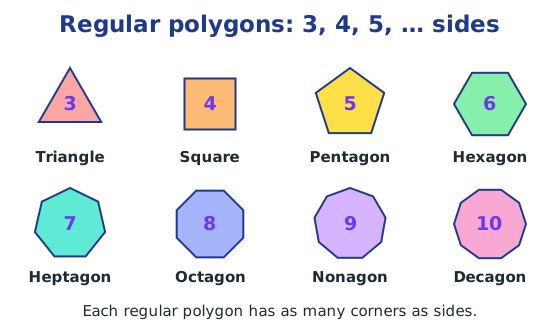
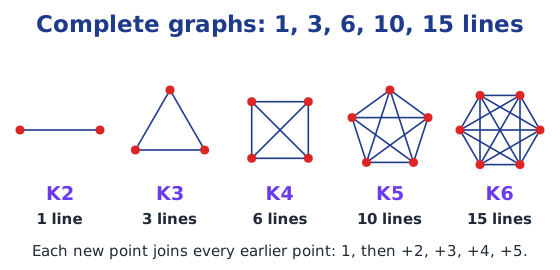
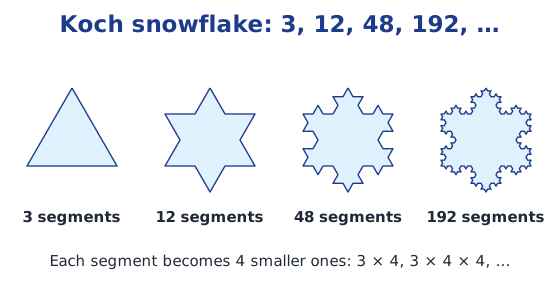
1. The patterns in Table 3: regular polygons: sides 3, 4, 5, …, 10; complete graphs: 1, 3, 6, 10, 15 lines; stacked squares: 1, 4, 9, 16, 25 little squares; stacked triangles: 1, 4, 9, 16, 25 little triangles; Koch snowflake: 3, 12, 48, 192, 768 segments.
2. The next shape in each sequence: a regular polygon with 11 sides; the complete graph K7, with 7 points and 21 lines; a 6 by 6 stack of 36 squares; a stack of triangles with 6 rows, 36 triangles; and the next Koch snowflake, with 3,072 segments. The last is very hard to draw by hand: its segments become too tiny.
Figure it Out: shapes and numbers (pages 11–12)
1. The sides of the regular polygons are 3, 4, 5, 6, 7, 8, 9, 10, …: the counting numbers from 3. The corners give the same sequence, because in a closed shape each side ends at two corners and each corner joins two sides: going round, you meet a side, a corner, a side, a corner, … until you return to the start.
2. The lines in the complete graphs are 1, 3, 6, 10, 15: the triangular numbers. Each new point is joined to all the earlier points, so K3 adds 2 lines to K2, K4 adds 3, K5 adds 4 and K6 adds 5.
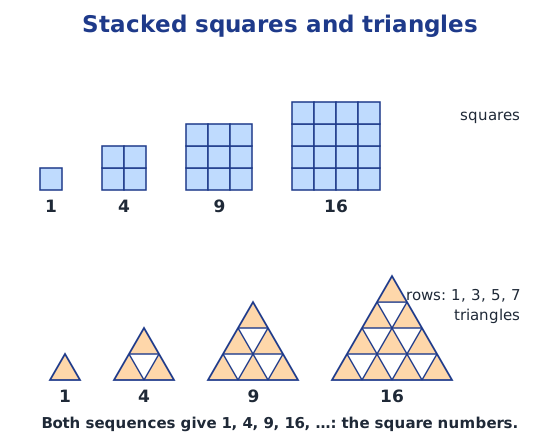
3. The stacked squares have 1, 4, 9, 16, 25 little squares: the squares, because the shape with side n has n rows of n little squares.
4. The stacked triangles have 1, 4, 9, 16, 25 little triangles: the squares again. The rows hold 1, 3, 5, 7, 9 triangles, which are odd numbers, and adding odd numbers gives squares.
5. The Koch snowflake has 3, 12, 48, 192, 768, … segments: each segment is replaced by 4, so the number is multiplied by 4 each time, giving 3 times the powers of 4.
Practice
-
What is 1 + 3 + 5 + … + 19 (the first 10 odd numbers)?
Show answer
Answer: (b) 100
-
The next hexagonal number after 1, 7, 19, 37 is:
Show answer
Answer: (b) 61
-
1 + 2 + 4 + 8 + 16 equals:
Show answer
Answer: (b) 31 It is one less than the next power of 2: 32 − 1 = 31.
-
How many lines does the complete graph K7 have?
Show answer
Answer: 21: the 15 lines of K6 plus 6 new lines from the seventh point.
-
Find 6 × 15 + 1 and name the sequence it belongs to.
Show answer
Answer: 91, a hexagonal number (15 is a triangular number, and 6 × a triangular number + 1 gives hexagonal numbers).
Stuck on a question?
Take a photo and Lagnever AI explains it step by step. Try it for 7 days for ₹2.
Get it on Google Play Open in browser
For parents: after the trial, the plan renews monthly by UPI or card autopay. You can cancel anytime in the app.