
What are patterns in shapes?
Answer in short
Shape sequences are patterns of shapes, studied in geometry. In regular polygons the number of sides goes 3, 4, 5, …; complete graphs have 1, 3, 6, 10, … lines; stacked squares and stacked triangles both have 1, 4, 9, 16, … pieces; and the Koch snowflake has 3, 12, 48, … segments. Shape sequences are often linked to number sequences.
Stuck on a question? Take a photo and Lagnever AI explains it step by step. Try it for 7 days for ₹2. Get it on Google Play
Shape sequences
Besides numbers, the other basic patterns in mathematics are patterns of shapes. The branch of mathematics that studies them is geometry. Shapes may be in one, two or three dimensions (1D, 2D or 3D), or even more. A shape sequence is a list of shapes that follows a rule. The chapter shows five of them, and each one is linked to a number sequence.
Regular polygons
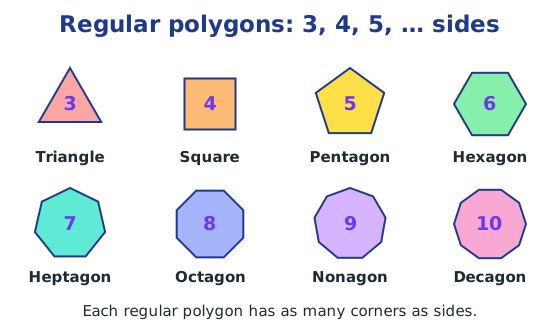
The regular polygons are the regular triangle, quadrilateral (square), pentagon, hexagon, heptagon, octagon, nonagon, decagon, and so on. Their numbers of sides are the counting numbers from 3: 3, 4, 5, 6, 7, 8, 9, 10, …. Regular means the sides have equal lengths and the angles are equal, so all sides and all corners look the same. A polygon has as many corners as sides, because each side ends at two corners and each corner joins two sides.
Complete graphs
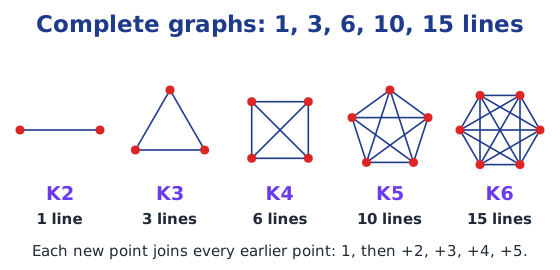
In a complete graph, every point is joined to every other point by a line. K2 has 2 points, K3 has 3 points, and so on up to K6. Their lines number 1, 3, 6, 10, 15: the triangular numbers. Why? Each new point has to be joined to all the earlier points, so going from K2 to K3 adds 2 lines, then 3, then 4, then 5.
Stacked squares and stacked triangles
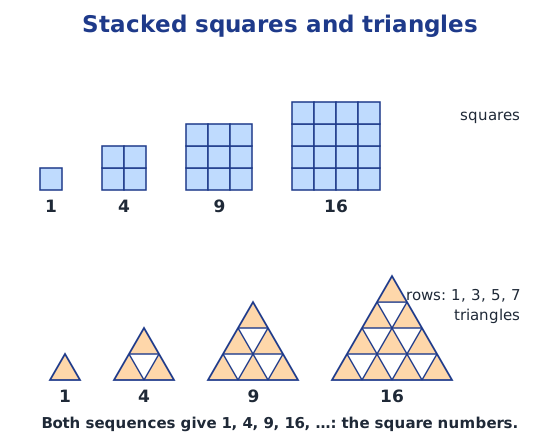
Stacked squares contain 1, 4, 9, 16, 25, … little squares, because a shape with side n has n rows of n squares. Stacked triangles contain the same numbers, 1, 4, 9, 16, 25, …! In each shape, the rows hold 1, 3, 5, 7, … little triangles, pointing up and down in turn, and adding odd numbers gives square numbers.
The Koch snowflake
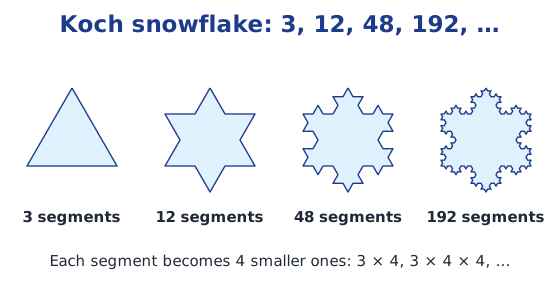
The Koch snowflake starts as a triangle. To get the next shape, each line segment is replaced by a “speed bump” made of 4 smaller segments. Doing this again and again makes the edge more and more crinkly, with tinier and tinier segments. The number of segments goes 3, 12, 48, 192, 768, …, which is 3 times the powers of 4. This sequence is not in the chapter’s Table 1 of number sequences.
Drawing the next shape
Once you know the rule, you can draw the next shape in each sequence. After the decagon comes a regular polygon with 11 sides. After K6 comes K7: seven points, each joined to the other six, making 15 + 6 = 21 lines. The next stacked square is a 6 by 6 square of 36 little squares, and the next stacked triangle has 6 rows and 36 little triangles. The next Koch snowflake is the hard one: its segments become so tiny that it is almost impossible to draw by hand.
Shapes and numbers together
| Shape sequence | Count | Number sequence |
|---|---|---|
| Regular polygons | sides or corners | 3, 4, 5, 6, … |
| Complete graphs | lines | 1, 3, 6, 10, 15, … |
| Stacked squares | little squares | 1, 4, 9, 16, 25, … |
| Stacked triangles | little triangles | 1, 4, 9, 16, 25, … |
| Koch snowflake | line segments | 3, 12, 48, 192, … |
Knowing the number sequence helps us predict the next shape, and the shape helps explain why the number pattern works. For number patterns, read the Chapter 1 notes.
Practice
-
How many sides does a regular octagon have?
Show answer
Answer: (c) 8
-
How many lines does the complete graph K6 have?
Show answer
Answer: (c) 15
-
How many little triangles are in the 4th shape of stacked triangles?
Show answer
Answer: (c) 16 Its rows hold 1, 3, 5 and 7 little triangles: 1 + 3 + 5 + 7 = 16.
-
How many line segments are in the 4th Koch snowflake shape?
Show answer
Answer: 3 × 4 × 4 × 4 = 192.
-
Why does a regular polygon have as many corners as sides?
Show answer
Answer: Each side joins two corners and each corner joins two sides; going round the shape you meet side, corner, side, corner, … alternately until you return to the start, so the two counts are equal.
Questions students ask
What is geometry?
The branch of mathematics that studies patterns in shapes. Shapes can be in one, two or three dimensions, or even more.
What does regular mean in regular polygon?
All its sides are of equal length and all its angles are equal, so the sides look the same and the corners look the same.
Why do complete graphs have 1, 3, 6, 10, … lines?
Each new point is joined to every earlier point. Going from K2 to K3 adds 2 lines, to K4 adds 3, to K5 adds 4, so the totals are 1, 1 + 2, 1 + 2 + 3, …: the triangular numbers.
How is the Koch snowflake made?
Start with a triangle. Replace every line segment with a 'speed bump' of 4 smaller segments, and keep repeating. The number of segments goes 3, 12, 48, 192, …, which is 3 times the powers of 4.
Stuck on a question?
Take a photo and Lagnever AI explains it step by step. Try it for 7 days for ₹2.
Get it on Google Play Open in browser
For parents: after the trial, the plan renews monthly by UPI or card autopay. You can cancel anytime in the app.