
Patterns in squares and cubes
Answer in short
Squares end only in 0, 1, 4, 5, 6 or 9, but cubes can end in any digit. Adding odd numbers from 1 gives the squares, and odd numbers in groups of 1, 2, 3, … give the cubes. Two neighbouring triangular numbers make a square, and 1729 is the smallest sum of two cubes in two ways.
Stuck on a question? Take a photo and Lagnever AI explains it step by step. Try it for 7 days for ₹2. Get it on Google Play
What can the last digit tell you?
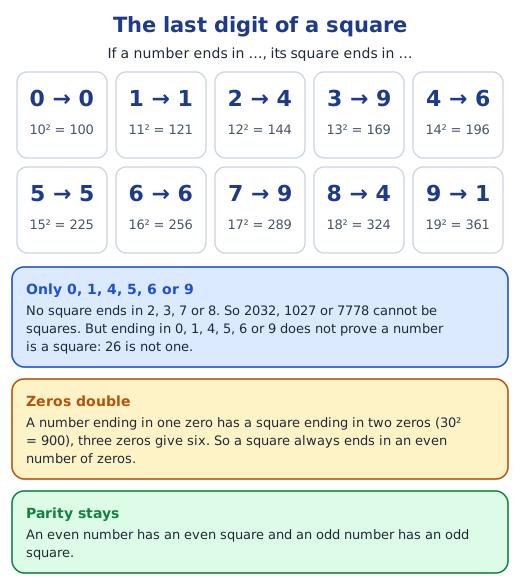
Square the digits 0 to 9 and look only at the last digit of each answer: 0, 1, 4, 9, 6, 5, 6, 9, 4, 1. So every square ends in 0, 1, 4, 5, 6 or 9, and a number ending in 2, 3, 7 or 8, such as 2048 or 1027, cannot be a square. The rule only works one way: 26 ends in 6 but is not a square.
The pairs are worth noticing. A square ends in 1 when the number ends in 1 or 9 (21² = 441, 29² = 841), and in 6 when the number ends in 4 or 6 (24² = 576, 26² = 676). Zeros double when you square: 30² = 900 and 300² = 90,000, so a square always ends in an even number of zeros. Parity stays too: an even number has an even square and an odd number an odd one.
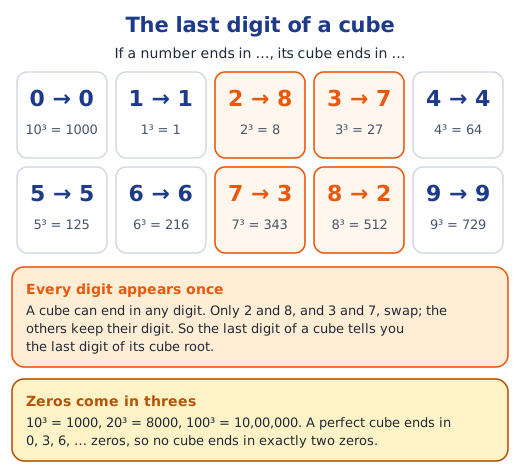
Cubes behave differently. Cubing 0 to 9 gives last digits 0, 1, 8, 7, 4, 5, 6, 3, 2, 9: every digit appears once. So a cube can end in any digit, and the last digit of a cube tells you the last digit of its cube root. Zeros at the end of a cube come in threes (20³ = 8000), so no cube ends in exactly two zeros.
How do odd numbers build squares?
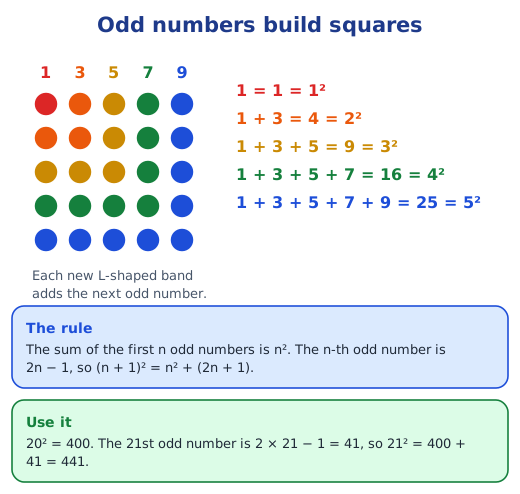
Look at the differences between neighbouring squares: 4 − 1 = 3, 9 − 4 = 5, 16 − 9 = 7, 25 − 16 = 9. They are the odd numbers. Turned around, adding odd numbers from 1 gives the squares: 1 + 3 + 5 + 7 + 9 = 25 = 5². In a dot picture, each new odd number is an L-shaped band that wraps around the last square.
The n-th odd number is 2n − 1, so (n + 1)² = n² + 2n + 1. For example, 20² = 400, so 21² = 400 + 41 = 441.
How many numbers lie between two squares?
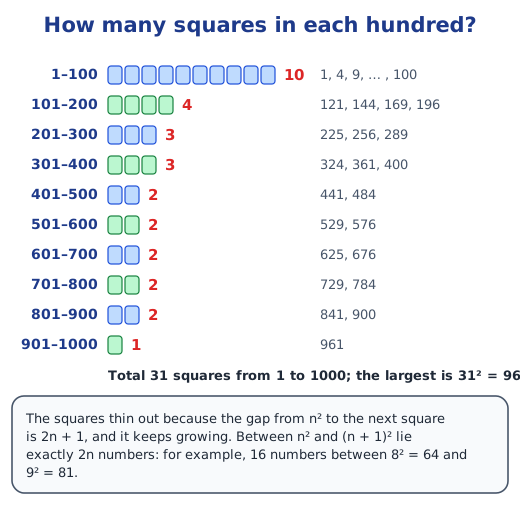
From n² to (n + 1)² the jump is 2n + 1, so exactly 2n numbers lie strictly between them. Between 8² = 64 and 9² = 81 there are 16 numbers, 65 to 80. Because the gaps keep growing, squares become rarer: there are 10 squares from 1 to 100 but only 1 from 901 to 1000, and the largest square below 1000 is 31² = 961.
What do triangular numbers have to do with squares?
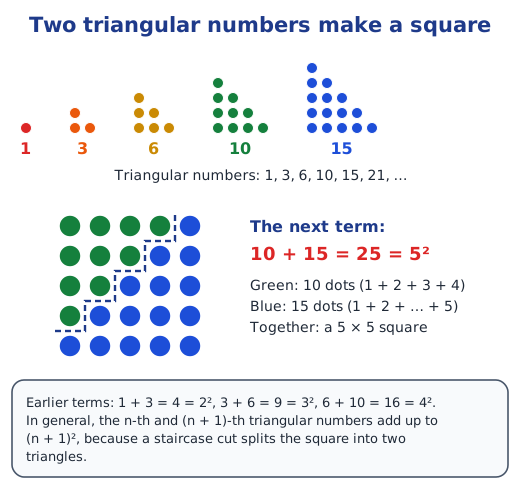
Triangular numbers, 1, 3, 6, 10, 15, 21, …, count dots arranged in a triangle. Add two neighbours and you always get a square: 1 + 3 = 4, 3 + 6 = 9, 6 + 10 = 16, 10 + 15 = 25. In a square of dots, a staircase cut separates the two triangles.
How do odd numbers build cubes?
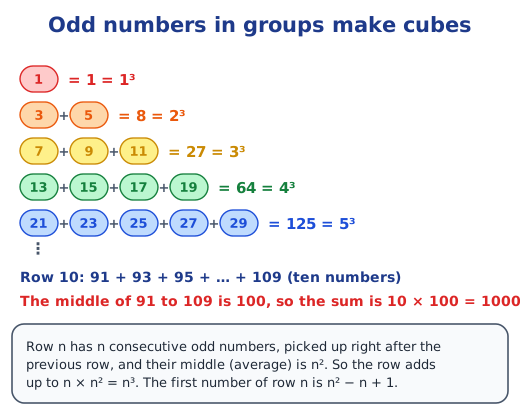
Take the odd numbers in groups of 1, 2, 3, 4, …: 1 = 1³, 3 + 5 = 8 = 2³, 7 + 9 + 11 = 27 = 3³, 13 + 15 + 17 + 19 = 64 = 4³. Group n has n odd numbers whose middle is n², so it adds up to n × n² = n³. The tenth group, 91 + 93 + … + 109, has middle 100, so its sum is 1000 = 10³.
What are successive differences?
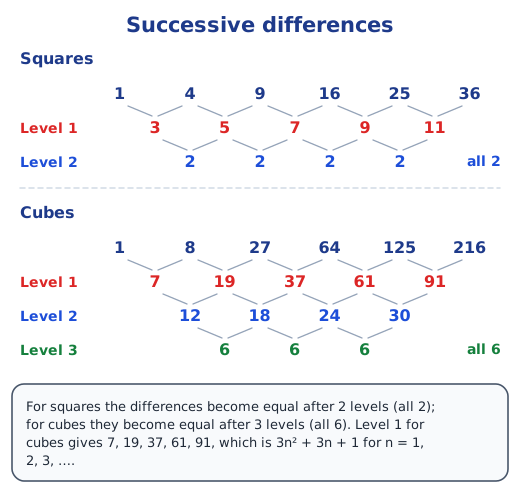
Write the squares, then the differences between neighbours, then the differences of those. For squares, level 1 is 3, 5, 7, 9, … and level 2 is all 2. For cubes it takes one more level: 7, 19, 37, 61, … then 12, 18, 24, … and then 6, 6, 6. Working backwards from the constant level lets you predict the next term.
What is a taxicab number?
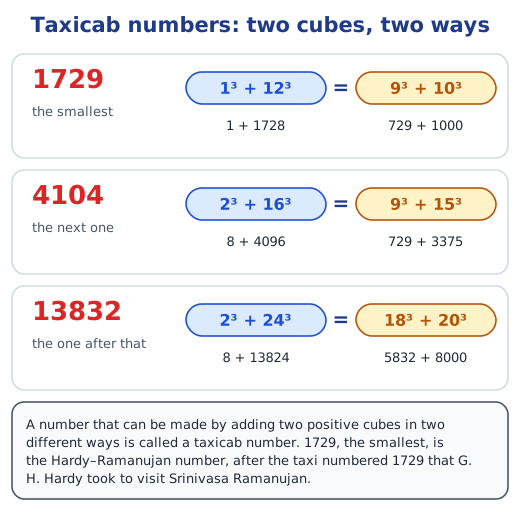
A number that can be made by adding two positive cubes in two different ways is a taxicab number. The smallest is 1729 = 1³ + 12³ = 9³ + 10³, which Ramanujan spotted when Hardy came to see him in taxi number 1729. The next two are 4104 = 2³ + 16³ = 9³ + 15³ and 13832 = 2³ + 24³ = 18³ + 20³.
Read next: square numbers and square roots, cube numbers and cube roots, the chapter notes and NCERT solutions.
Practice
-
Which of these numbers can be a perfect square?
Show answer
Answer: (c) 6561
-
1 + 3 + 5 + … + 29 (all odd numbers up to 29) equals:
Show answer
Answer: (b) 225
-
How many zeros can a perfect cube end with?
Show answer
Answer: (c) 0, 3, 6, …
-
Without adding, find 57 + 59 + 61 + 63 + 65 + 67 + 69.
Show answer
Answer: These are 7 consecutive odd numbers with middle 63. The sum is 7 × 63 = 441 = 21². (They are not the 7th row of the cube pattern, which would start at 43 and add up to 343 = 7³.)
-
Find the next number in 1, 8, 27, 64, 125, 216 using successive differences.
Show answer
Answer: Level 1: 7, 19, 37, 61, 91. Level 2: 12, 18, 24, 30. Level 3: 6, 6, 6. Extend level 3 with 6: level 2 becomes 36, level 1 becomes 127, and the next cube is 216 + 127 = 343 = 7³.
Questions students ask
Why does a square never end in 2, 3, 7 or 8?
The last digit of a square depends only on the last digit of the number. Squaring 0 to 9 gives last digits 0, 1, 4, 9, 6, 5, 6, 9, 4, 1, so 2, 3, 7 and 8 never appear.
Why is 1729 called the Hardy–Ramanujan number?
G. H. Hardy came to visit Srinivasa Ramanujan in a taxi numbered 1729 and called it a dull number. Ramanujan answered that no smaller number can be written in two ways as a sum of two cubes: 1³ + 12³ and 9³ + 10³.
What is the connection between odd numbers and square numbers?
The first n odd numbers add up to n²: 1 + 3 + 5 = 9 = 3². Each new odd number adds an L-shaped band of dots that turns a square into the next square.
Stuck on a question?
Take a photo and Lagnever AI explains it step by step. Try it for 7 days for ₹2.
Get it on Google Play Open in browser
For parents: after the trial, the plan renews monthly by UPI or card autopay. You can cancel anytime in the app.