
NCERT Solutions Class 8 Maths Chapter 1: A Square and A Cube
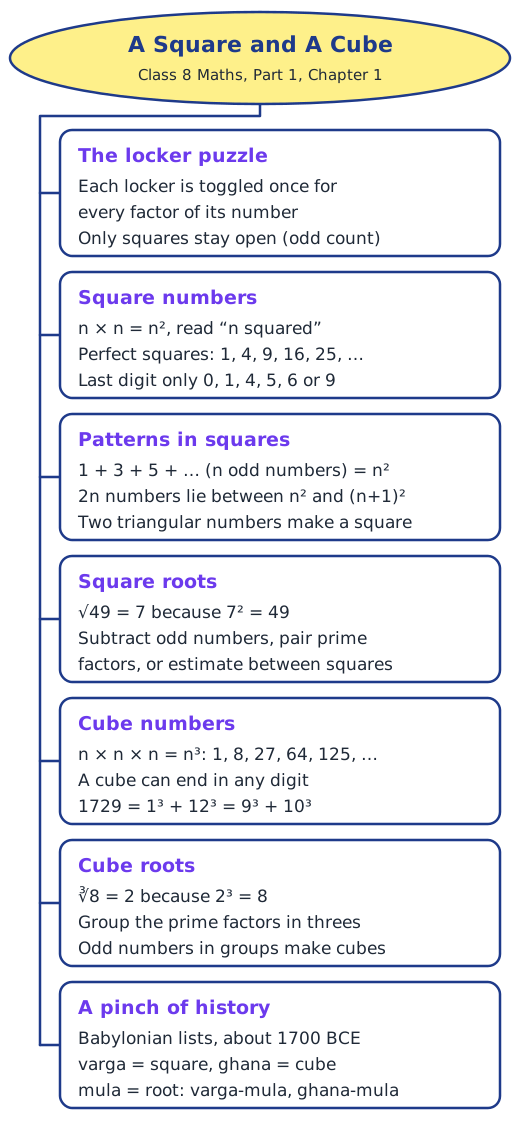
Answers to the questions inside the chapter, both Figure it Out sets and the Square Pairs puzzle in Chapter 1, A Square and A Cube, of Ganita Prakash, Grade 8 Part 1. Page numbers follow the book (pages 1–18). Where a question has many right answers, one is given; the puzzles were also checked by computer search. Short notes: Chapter 1 notes.
The locker puzzle (pages 1–3)
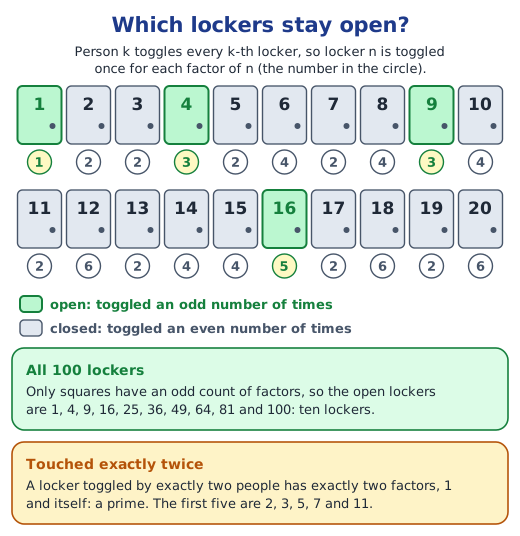
How did Khoisnam know which lockers would be open? Locker n is toggled by person k exactly when k is a factor of n, so it is toggled once for each factor of n. It starts closed, so it ends open if the number of toggles is odd. Khoisnam only had to find which numbers from 1 to 100 have an odd number of factors.
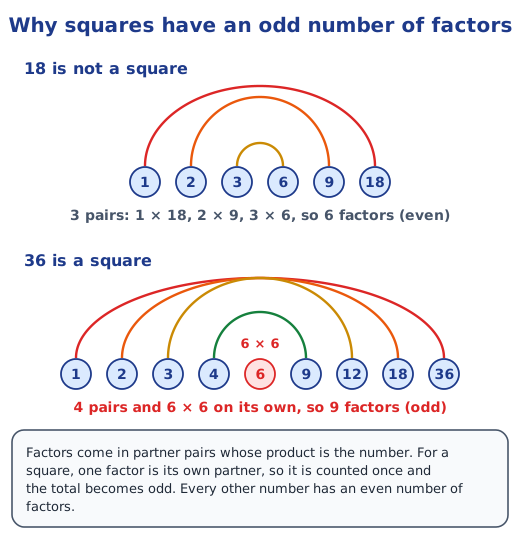
Is the count of factors always even? No. Factors come in partner pairs whose product is the number, but in a square one factor is its own partner (2 × 2 for 4, 3 × 3 for 9). It is counted once, so 1, 4 and 9 have 1, 3 and 3 factors.
Other numbers whose factor count is odd. All squares: 16 (1, 2, 4, 8, 16), 25 (1, 5, 25), 36, 49, 64, 81, 100, …
Does 36 have an odd number of factors? Yes. Its factor pairs are 1 × 36, 2 × 18, 3 × 12 and 4 × 9, with different partners, and 6 × 6. That is 4 × 2 + 1 = 9 factors.
Which lockers stay open? 1, 4, 9, 16, 25, 36, 49, 64, 81 and 100, the ten squares up to 100.
The five lockers touched exactly twice. A number with exactly two factors, 1 and itself, is a prime, so these are 2, 3, 5, 7 and 11.
Square numbers (pages 3–7)
The table of squares from 1 to 30. 1, 4, 9, 16, 25, 36, 49, 64, 81, 100; 11² = 121, 12² = 144, 13² = 169, 14² = 196, 15² = 225, 16² = 256, 17² = 289, 18² = 324, 19² = 361, 20² = 400; 21² = 441, 22² = 484, 23² = 529, 24² = 576, 25² = 625, 26² = 676, 27² = 729, 28² = 784, 29² = 841, 30² = 900.
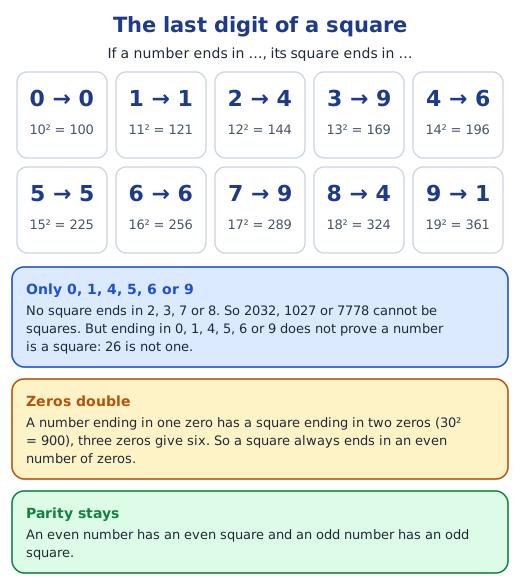
Patterns in the table (Math Talk). Some you may notice: squares end only in 0, 1, 4, 5, 6 or 9; a number and its square are both even or both odd; numbers ending in 5 have squares ending in 25; the differences between neighbouring squares are 3, 5, 7, 9, …; and numbers whose last digits add up to 10 (like 4 and 6, or 3 and 7) have squares with the same last digit.
Five numbers that cannot be squares. Any numbers ending in 2, 3, 7 or 8, for example 52, 403, 1007, 2468 and 9998.
The next two squares ending in 1. After 29², they are 31² = 961 and 39² = 1521.
Which squares end in 6? A square ends in 6 when the number ends in 4 or 6, so (ii) 34² = 1156, (iii) 46² = 2116, (iv) 56² = 3136 and (v) 74² = 5476. The other two end in 4: 38² = 1444 and 82² = 6724.
More patterns like this. Numbers ending in 2 or 8 have squares ending in 4; numbers ending in 3 or 7 have squares ending in 9; numbers ending in 5 have squares ending in 25; numbers ending in 0 have squares ending in 00.
Zeros at the end. A number ending in 3 zeros has a square ending in 6 zeros (1000² = 10,00,000). The square always has twice as many zeros as the number, because (number × 10) × (number × 10) adds two zeros for each one. So yes, this always happens, and a square can only end in an even number of zeros.
Parity of a number and its square. They are the same: even × even is even, and odd × odd is odd.
Does the pattern of differences continue? Yes: 36 − 25 = 11, 49 − 36 = 13, 64 − 49 = 15. The differences are the odd numbers in order.
The pattern from Grade 6. Yes: the dot picture of squares, where each L-shaped band of the next odd number turns one square into the next. The sum of the first n odd numbers is n², and the n-th odd number is 2n − 1, so 36² = 1225 + 71 = 1296.
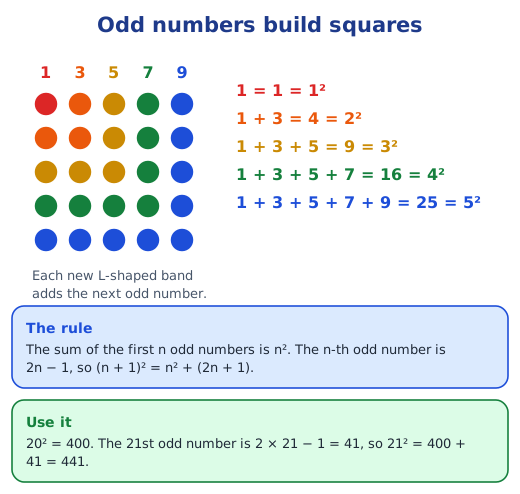
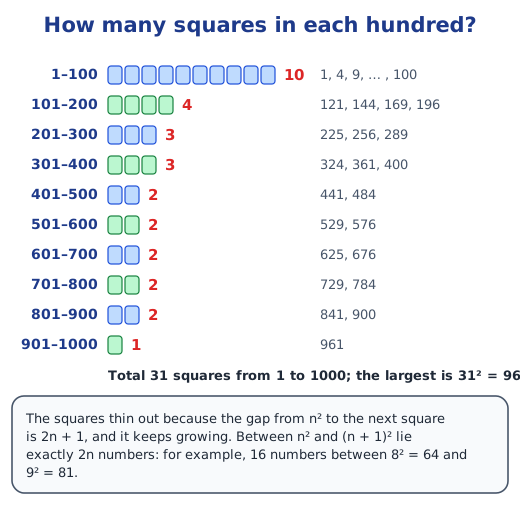
How many numbers lie between two neighbouring squares? Between n² and (n + 1)² there are 2n numbers: 2 between 1 and 4, 4 between 4 and 9, 6 between 9 and 16. The count grows by 2 each time.
Squares in each block of 100. 1–100: 10; 101–200: 4; 201–300: 3; 301–400: 3; 401–500: 2; 501–600: 2; 601–700: 2; 701–800: 2; 801–900: 2; 901–1000: 1. The largest square less than 1000 is 31² = 961.
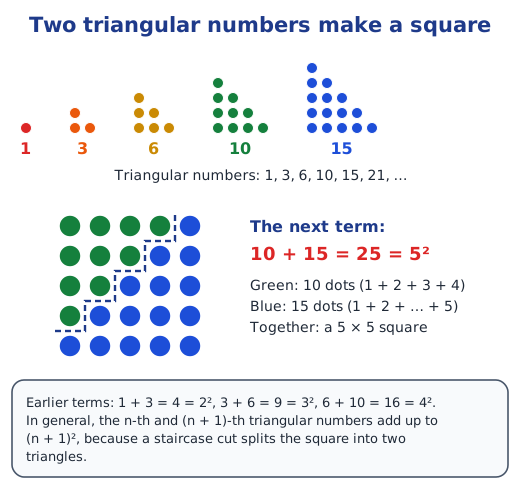
Triangular numbers and squares. Two neighbouring triangular numbers add up to a square. The next term is 10 + 15 = 25 = 5²: a 5 × 5 square of dots, cut along a staircase into a triangle of 10 and a triangle of 15.
Square roots (pages 7–10)
The side of a square of area 49 cm². 7 cm, because 7 × 7 = 49.
Finding √729 by subtracting odd numbers. It works: 729 reaches 0 after subtracting the first 27 odd numbers, so √729 = 27. It takes 27 steps, which is why prime factors are quicker.
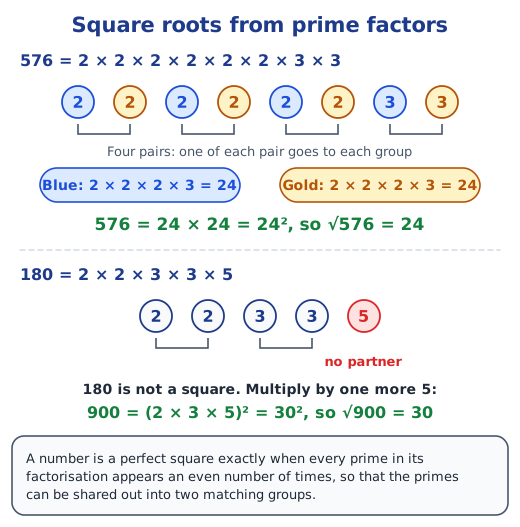
Are 1156 and 2800 perfect squares? 1156 = 2 × 2 × 17 × 17 = (2 × 17) × (2 × 17), so it is a square and √1156 = 34. 2800 = 2 × 2 × 2 × 2 × 5 × 5 × 7: the 7 has no partner, so 2800 is not a perfect square.
Estimating √250 and the handkerchief. 15² = 225 and 16² = 256, so √250 is between 15 and 16, nearer 16. From cloth of area 125 cm², a 15 cm handkerchief (225 cm²) is too big; since 11² = 121 ≤ 125 < 144 = 12², the largest whole-number side is 11 cm.
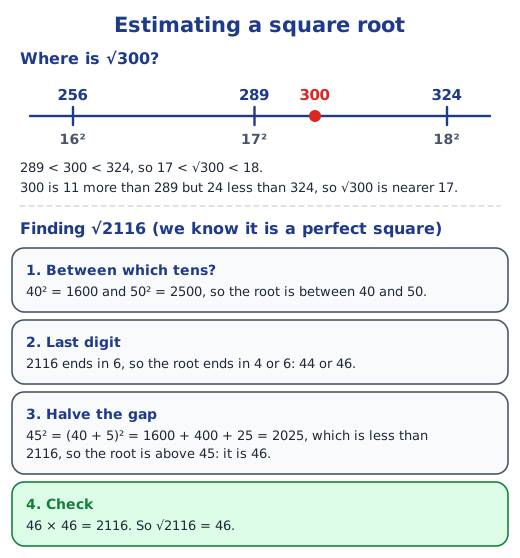
Figure it Out (pages 10–11)
1. (i) 2032, (ii) 2048 and (iii) 1027 are not perfect squares: they end in 2, 8 and 7, which no square does. (iv) 1089 = 33² is a perfect square.
2. Numbers ending in 2 or 8 have squares ending in 4, so 108² = 11664 and 292² = 85264 both end in 4. 64² = 4096 and 36² = 1296 end in 6. (Two of the four end in 4.)
3. (n + 1)² = n² + (2n + 1), and 2 × 125 + 1 = 251. So 126² = 15625 + 251 = 15876: option (iv).
4. 441 = 3 × 3 × 7 × 7 = (3 × 7)², so the side is √441 = 21 m.
5. The number must contain the factors of 4 = 2 × 2, 9 = 3 × 3 and 10 = 2 × 5. Their LCM is 2 × 2 × 3 × 3 × 5 = 180, where the 5 has no partner. Multiply by 5: the smallest such square is 900 = 30².
6. 9408 = 2 × 2 × 2 × 2 × 2 × 2 × 3 × 7 × 7. Only the 3 is unpaired, so multiply by 3. The product is 28224 = (2 × 2 × 2 × 3 × 7)², and its square root is 168.
7. Between n² and (n + 1)² lie 2n numbers. (i) Between 16² = 256 and 17² = 289: 32 numbers. (ii) Between 99² = 9801 and 100² = 10000: 198 numbers.
8. 4² + 5² + 20² = 16 + 25 + 400 = 441 = 21². 9² + 10² + 90² = 81 + 100 + 8100 = 8281 = 91². In each line the third number is the product of the first two, and the answer is one more than that product.
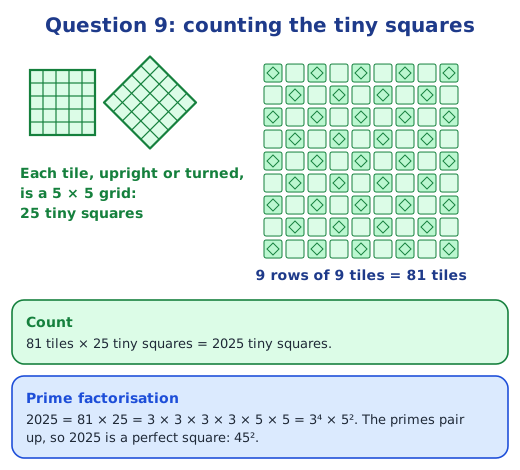
9. Every tile, upright or turned, is a 5 × 5 grid of 25 tiny squares, and the picture has 9 rows of 9 tiles. So there are 81 × 25 = 2025 tiny squares, and 2025 = 3 × 3 × 3 × 3 × 5 × 5 = 3⁴ × 5² (which is 45²).
Cube numbers (pages 11–15)
Small cubes in a cube of side 2 cm and 3 cm. 2 × 2 × 2 = 8 cubes of side 1 cm make a 2 cm cube, and 3 × 3 × 3 = 27 make a 3 cm cube.
Why are 1, 8, 27 called perfect cubes? Each is a whole number used three times in a product, and each counts the unit cubes that fill a cube of edge 1, 2 or 3.
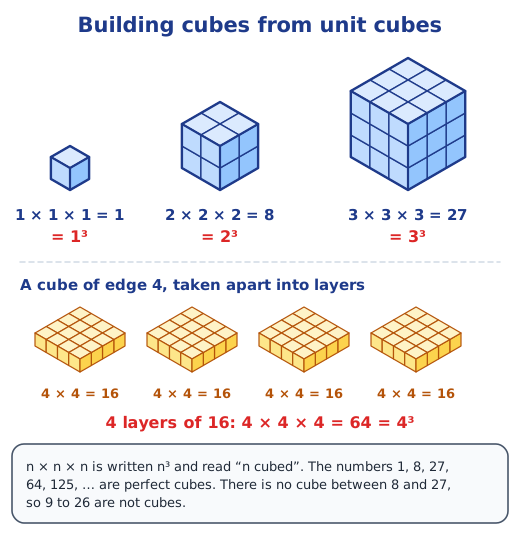
The table of cubes. 6³ = 216, 7³ = 343, 8³ = 512, 9³ = 729, 10³ = 1000, 12³ = 1728, 15³ = 3375, 16³ = 4096, 20³ = 8000.
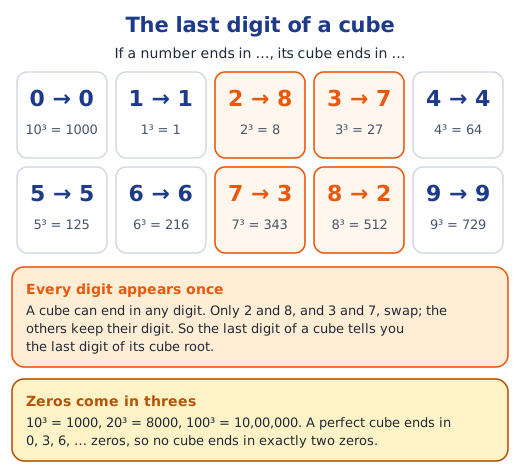
Patterns in the table (Math Talk). Even numbers have even cubes and odd numbers odd cubes; numbers ending in 0, 1, 4, 5, 6 or 9 have cubes ending in the same digit, while 2 and 8, and 3 and 7, swap; 10³ and 20³ end in three zeros; and the cubes grow much faster than the squares.
Possible last digits of cubes. All ten digits, 0 to 9.
Cubes with 1, 2 and 3 digits. One digit: 1 and 8 (2 cubes). Two digits: 27 and 64 (2). Three digits: 125, 216, 343, 512 and 729 (5). For squares the counts are 3, 6 and 22. Cubes are much rarer than squares, and both become more common as the number of digits grows.
Can a cube end with exactly two zeros? No. If a number ends in k zeros, its cube ends in 3k zeros, so the zeros at the end of a cube come in threes: 0, 3, 6, …
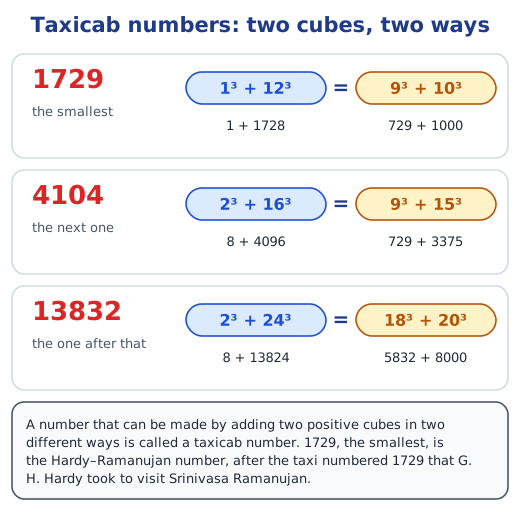
Try This: taxicab numbers. 4104 = 2³ + 16³ = 8 + 4096, and also 9³ + 15³ = 729 + 3375. 13832 = 2³ + 24³ = 8 + 13824, and also 18³ + 20³ = 5832 + 8000.
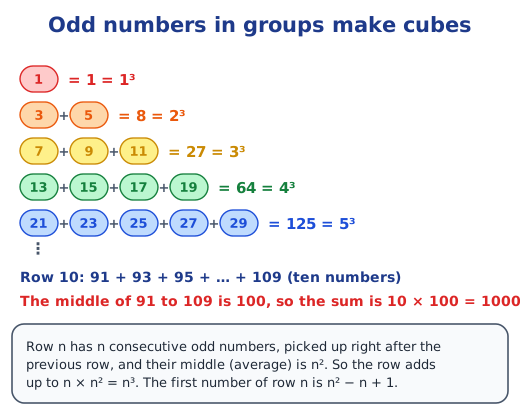
The sum 91 + 93 + … + 109. It has 10 odd numbers and is the 10th row of the pattern, so it equals 10³ = 1000. (Check: the middle of the row is 100, and 10 × 100 = 1000.)
Cube roots of 64, 512 and 729. (i) 64 = 2⁶ = (2 × 2)³, so ∛64 = 4. (ii) 512 = 2⁹ = (2 × 2 × 2)³, so ∛512 = 8. (iii) 729 = 3⁶ = (3 × 3)³, so ∛729 = 9.
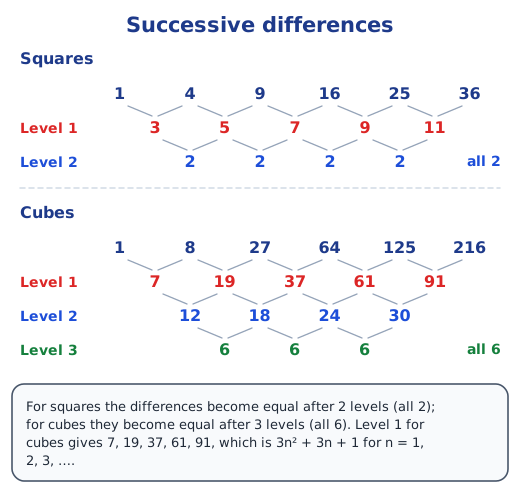
Successive differences of cubes. Level 1: 7, 19, 37, 61, 91. Level 2: 12, 18, 24, 30. Level 3: 6, 6, 6. For cubes the differences become equal after three levels, one more than for squares.
A pinch of history (pages 15–16)
Why is the word root used? In ancient India, mula, the root of a plant, was the word for taking a root: varga-mula for square root and ghana-mula for cube root. Arabic and Latin later did the same with their own words for a plant’s root, jidhr and radix, which is why the operation is still called a root.
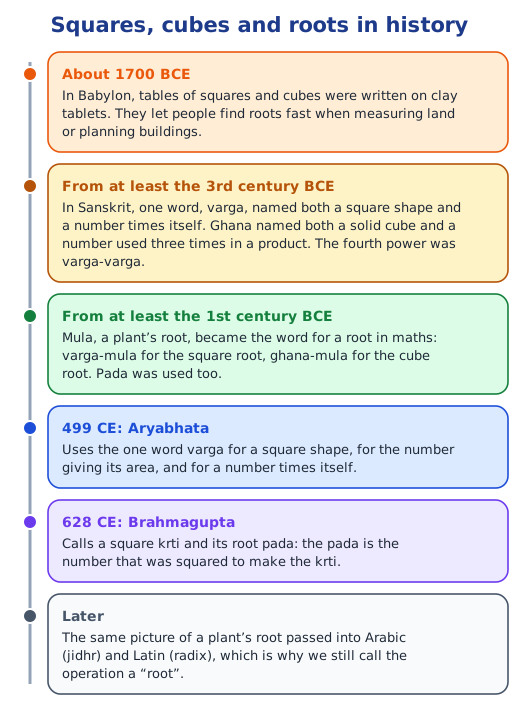
Figure it Out (pages 16–17)
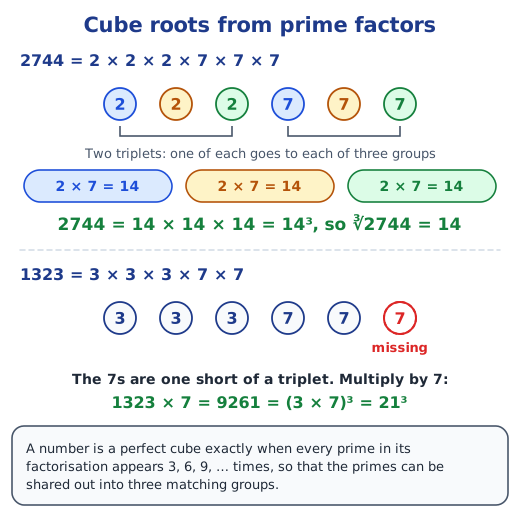
1. 27000 = 27 × 1000 = 3³ × 10³ = 30³, so ∛27000 = 30. 10648 = 2 × 2 × 2 × 11 × 11 × 11 = (2 × 11)³, so ∛10648 = 22.
2. 1323 = 3 × 3 × 3 × 7 × 7. The 3s make a triplet but the 7s are one short, so multiply by 7: 1323 × 7 = 9261 = 21³.
3. (i) False. Odd × odd × odd is odd, for example 3³ = 27. (ii) False. 2³ = 8, 12³ = 1728 and 22³ = 10648 all end in 8; every number ending in 2 has a cube ending in 8. (iii) False. The smallest 2-digit number is 10, and 10³ = 1000 already has 4 digits. (iv) False. The largest 2-digit number is 99, and 99³ = 970299 has only 6 digits; it is less than 100³ = 10,00,000, the smallest 7-digit cube. (v) False. 8 has 4 factors (1, 2, 4, 8) and 27 has 4 (1, 3, 9, 27). Only numbers that are squares as well as cubes, such as 1, 64 and 729, have an odd number of factors.
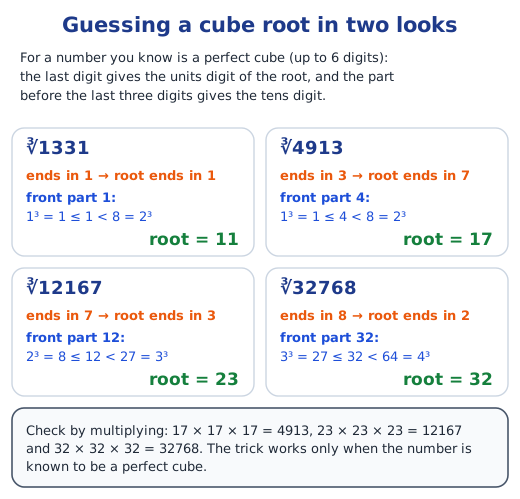
4. 1331 ends in 1, so its root ends in 1, and the part before the last three digits is 1, so the tens digit is 1: ∛1331 = 11. In the same way: 4913 ends in 3, so the root ends in 7, and 1 ≤ 4 < 8 gives tens digit 1: 17. 12167 ends in 7, so the root ends in 3, and 8 ≤ 12 < 27 gives 2: 23. 32768 ends in 8, so the root ends in 2, and 27 ≤ 32 < 64 gives 3: 32.
5. (i) 67³ − 66³ is the greatest. The difference of neighbouring cubes is (n + 1)³ − n³ = 3n² + 3n + 1, while that of neighbouring squares is only 2n + 1, and both grow with n. So (i) = 3 × 66² + 3 × 66 + 1 = 13267, (ii) = 3 × 42² + 3 × 42 + 1 = 5419, (iii) = 2 × 66 + 1 = 133 and (iv) = 2 × 42 + 1 = 85.
Puzzle Time: Square Pairs (page 18)
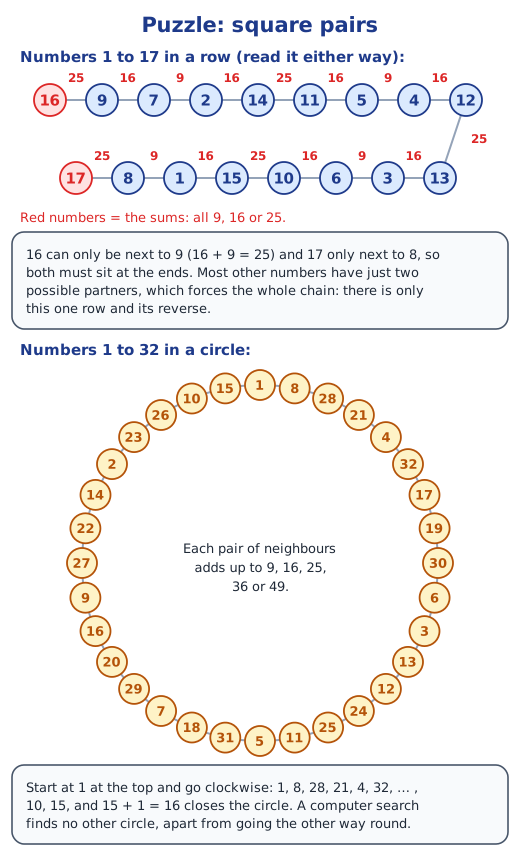
Numbers 1 to 17 in a row. 16, 9, 7, 2, 14, 11, 5, 4, 12, 13, 3, 6, 10, 15, 1, 8, 17. The neighbouring sums are all 9, 16 or 25.
More than one way? No, only this row and the same row read backwards. 16 can only stand next to 9 (16 + 9 = 25) and 17 only next to 8, so they must be the two ends. Starting from 16, each next number is forced: 9, 7, 2, 14, 11, 5, 4, 12, 13, 3. Only at 3 is there a choice, 1 or 6, and only 6 lets the chain use up every number: 6, 10, 15, 1, 8, 17.
Numbers 1 to 32 in a circle. Yes: 1, 8, 28, 21, 4, 32, 17, 19, 30, 6, 3, 13, 12, 24, 25, 11, 5, 31, 18, 7, 29, 20, 16, 9, 27, 22, 14, 2, 23, 26, 10, 15, and back to 1 (15 + 1 = 16). Each neighbouring pair adds up to 9, 16, 25, 36 or 49. A computer search finds no other circle, apart from going round the other way.
Practice
-
How many factors does 100 have?
Show answer
Answer: (c) 9
-
The smallest number by which 2400 must be multiplied to get a perfect square is:
Show answer
Answer: (c) 6
-
∛9261 is:
Show answer
Answer: (b) 21
-
Given 50² = 2500, find 51² using odd numbers.
Show answer
Answer: The 51st odd number is 2 × 51 − 1 = 101, so 51² = 2500 + 101 = 2601.
-
Find the smallest perfect cube that is divisible by 6 and by 9.
Show answer
Answer: 6 = 2 × 3 and 9 = 3 × 3, so the number needs 2 and 3 × 3. To make triplets, use 2 × 2 × 2 × 3 × 3 × 3 = 216 = 6³.
Stuck on a question?
Take a photo and Lagnever AI explains it step by step. Try it for 7 days for ₹2.
Get it on Google Play Open in browser
For parents: after the trial, the plan renews monthly by UPI or card autopay. You can cancel anytime in the app.