
Cube numbers and cube roots
Answer in short
A cube number is a number used three times in a product, like 5 × 5 × 5 = 125, written 5³. It counts the unit cubes in a cube of edge 5. The cube root undoes cubing: ∛125 = 5. A number is a perfect cube when its prime factors split into three identical groups.
Stuck on a question? Take a photo and Lagnever AI explains it step by step. Try it for 7 days for ₹2. Get it on Google Play
What is a cube number?
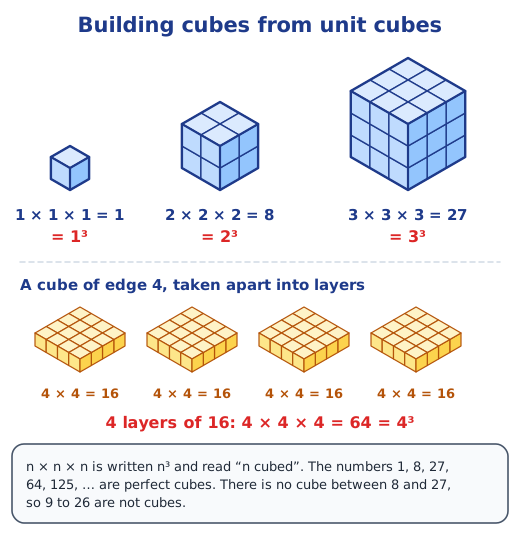
Stack small cubes of edge 1 cm into a bigger cube of edge 2 cm. You need 2 layers of 2 × 2, that is 8 small cubes. A cube of edge 3 cm needs 3 layers of 9, that is 27. In general a cube of edge n holds n × n × n unit cubes, which we write as n³ and read “n cubed”.
The numbers 1, 8, 27, 64, 125, … are called perfect cubes. Between 8 and 27 there is no cube, because 2³ = 8 and 3³ = 27, so 9 to 26 are not cubes.
Which cubes should you know?
It helps to know the first twenty cubes:
- 1³ to 10³: 1, 8, 27, 64, 125, 216, 343, 512, 729, 1000.
- 11³ to 20³: 1331, 1728, 2197, 2744, 3375, 4096, 4913, 5832, 6859, 8000.
Notice that 1 and 8 have one digit, 27 and 64 have two, and 125 to 729 have three. Cubes thin out even faster than squares.
Can fractions, decimals and negative numbers be cubed?
Yes, in the same way. (2/3)³ = (2 × 2 × 2)/(3 × 3 × 3) = 8/27. (1.5)³ = 1.5 × 1.5 × 1.5 = 3.375. A negative number cubed stays negative: (−4)³ = (−4) × (−4) × (−4) = −64, because the first two signs cancel and the third one remains.
What is a cube root?
The cube root goes backwards: it is the number that was cubed. Since 4³ = 64, the cube root of 64 is 4, written ∛64 = 4. In general, if y = x³, then x = ∛y, and ∛(n³) = n.
How do prime factors find a cube root?
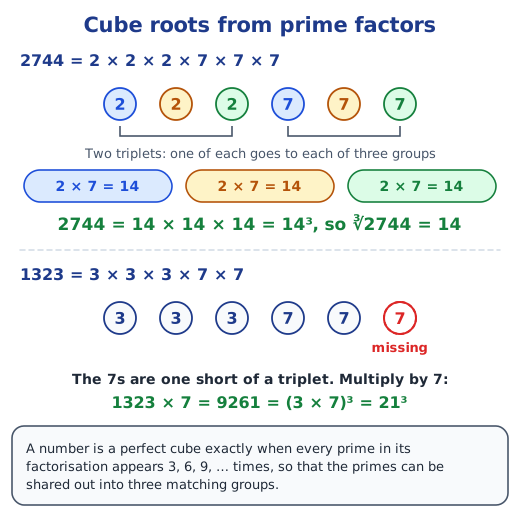
A cube is a number used three times in a product, so its prime factors can be shared out into three matching groups. Take 2744 = 2 × 2 × 2 × 7 × 7 × 7. Give one 2 and one 7 to each of three groups: every group is 2 × 7 = 14, so 2744 = 14³ and ∛2744 = 14.
If the factors do not form complete triplets, the number is not a cube. 1323 = 3 × 3 × 3 × 7 × 7 has only two 7s. Multiplying by one more 7 completes the triplet: 1323 × 7 = 9261 = 21³.
How can you guess a cube root quickly?
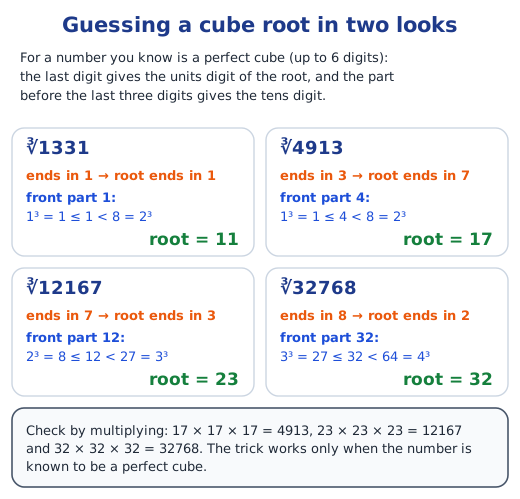
The last digit of a cube decides the last digit of its root, because each digit 0 to 9 gives a different last digit when cubed (2 gives 8, 3 gives 7, 7 gives 3, 8 gives 2, and the others keep their digit). So for a perfect cube of up to six digits:
- The last digit gives the units digit of the root.
- Cover the last three digits. The largest cube not bigger than what is left gives the tens digit.
For 12167: it ends in 7, so the root ends in 3. Cover 167 and 12 is left; 2³ = 8 is not bigger than 12 but 3³ = 27 is, so the tens digit is 2. The root is 23, and indeed 23 × 23 × 23 = 12167. This works only when you already know the number is a perfect cube.
Where do the words square, cube and root come from?
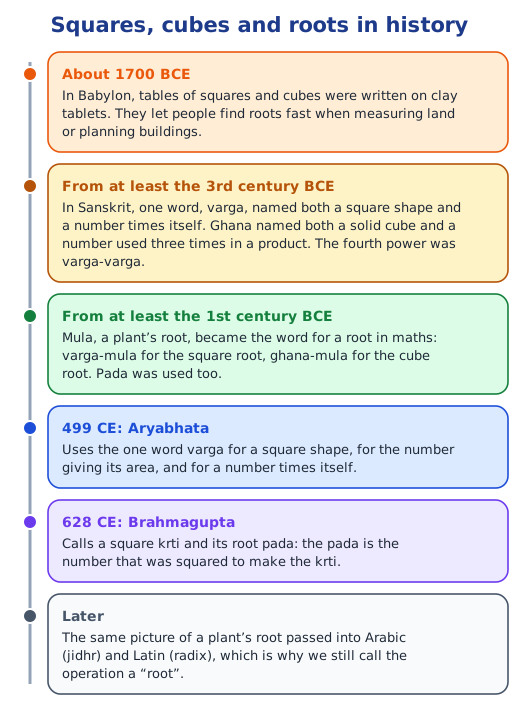
Lists of squares and cubes were written on Babylonian clay tablets around 1700 BCE. In ancient India, varga meant both a square shape and a number times itself, and ghana meant both a solid cube and a number used three times. Mula, the root of a plant, gave varga-mula (square root) and ghana-mula (cube root), and the same picture of a root later passed into Arabic and Latin.
Read next: patterns in squares and cubes, square numbers and square roots, the chapter notes and NCERT solutions.
Practice
-
Which of these is a perfect cube?
Show answer
Answer: (b) 343
-
∛5832 is:
Show answer
Answer: (b) 18
-
By which number must 72 be multiplied to make a perfect cube?
Show answer
Answer: (b) 3
-
Find ∛13824 using prime factors.
Show answer
Answer: 13824 = 2 × 2 × 2 × 2 × 2 × 2 × 2 × 2 × 2 × 3 × 3 × 3 = 2⁹ × 3³. Three identical groups of 2 × 2 × 2 × 3 = 24, so ∛13824 = 24.
-
How many unit cubes make a cube of edge 6 cm, and how many are on its top layer?
Show answer
Answer: 6 × 6 × 6 = 216 unit cubes in all. Each layer is 6 × 6 = 36, so the top layer has 36.
Questions students ask
What is a perfect cube?
A perfect cube is a natural number multiplied by itself three times, such as 1, 8, 27, 64 or 125. In its prime factorisation, every prime appears 3, 6, 9, … times.
Can a perfect cube end in 2?
Yes. 8³ = 512 ends in 2. Unlike squares, a cube can end in any digit, because every digit from 0 to 9 gives a different last digit when cubed.
Can a cube root be negative?
Yes. (−3) × (−3) × (−3) = −27, so the cube root of −27 is −3. A negative number cubed stays negative, so a negative cube has a negative cube root.
Where does the word root come from?
Ancient Indian mathematicians used mula, the root of a plant, for this operation: varga-mula for square root and ghana-mula for cube root. Arabic and Latin later did the same with their own words for a plant’s root, which is why we still call it a “root”.
Stuck on a question?
Take a photo and Lagnever AI explains it step by step. Try it for 7 days for ₹2.
Get it on Google Play Open in browser
For parents: after the trial, the plan renews monthly by UPI or card autopay. You can cancel anytime in the app.