
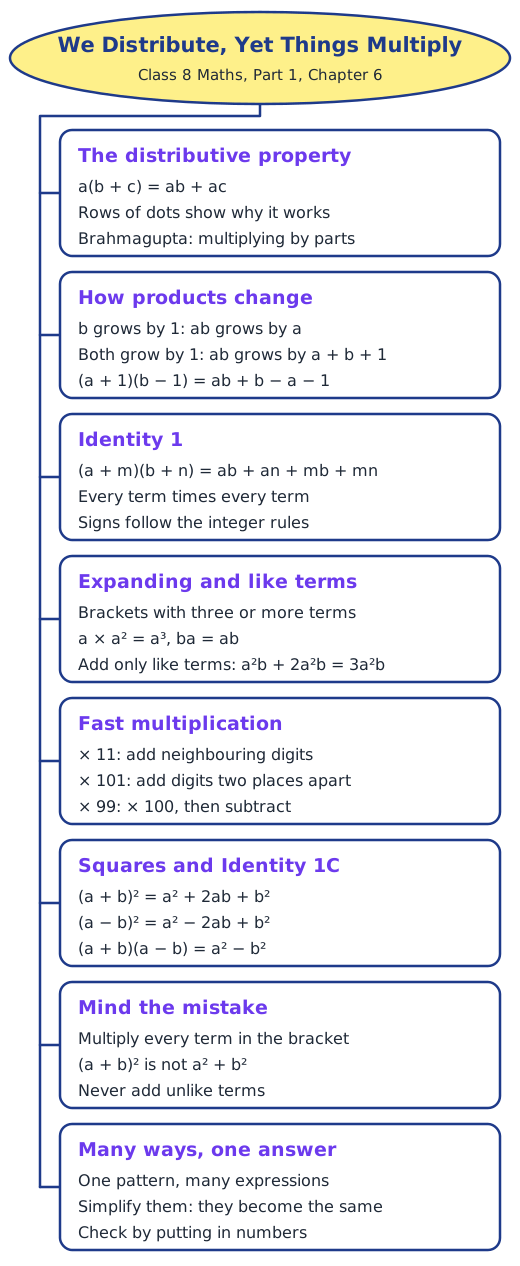
NCERT Solutions Class 8 Maths Chapter 6: We Distribute, Yet Things Multiply
Answers to the questions inside the chapter, all three Figure it Out sets, Mind the Mistake and the puzzle in Chapter 6, We Distribute, Yet Things Multiply, of Ganita Prakash, Grade 8 Part 1. Page numbers follow the book (pages 136–158). Every expansion here was checked by putting numbers in for the letters. Where a question asks for your own examples, ours are only examples. Short notes: Chapter 6 notes.
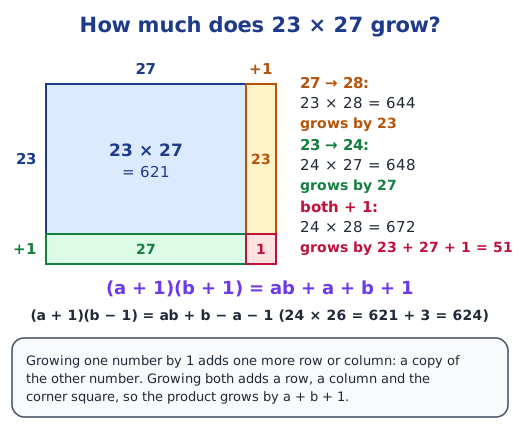
Increments in products (page 136)
1. 23 × 27: by how much does the product grow if 23 becomes 24? By 27. 24 × 27 = 648, and 648 − 621 = 27: one more row of 27.
2. If 27 becomes 28? By 23. 23 × 28 = 644, which is 621 + 23.
3. If both grow by 1? By 51. 24 × 28 = 672, and 672 − 621 = 51 = 23 + 27 + 1.
Is there a pattern for any two numbers? Yes. Growing one number by 1 adds the other number. Growing both adds the sum of the two numbers plus 1: (a + 1)(b + 1) = ab + a + b + 1. (On page 137 the book prints a(b + 1) = ab × a; it should read ab + a.)
Both numbers increased by 1 (page 138)
Expand (a + 1)(b + 1) taking (b + 1) as a single term. a(b + 1) + 1(b + 1) = ab + a + b + 1. It is the same answer as before.
One number up by 1 and the other down by 1: does the product change? (a + 1)(b − 1) = ab + b − a − 1, so it changes by b − a − 1. For 23 and 27 that is 27 − 23 − 1 = 3: 24 × 26 = 624 is 3 more than 621.
Does the product always go up? Three examples where it goes down. No. The change b − a − 1 is negative whenever b is not more than a. Our examples, with a going up and b going down:
- a = 10, b = 3: 10 × 3 = 30 becomes 11 × 2 = 22.
- a = 5, b = 5: 25 becomes 6 × 4 = 24.
- a = 8, b = 6: 48 becomes 9 × 5 = 45. When b = a + 1 there is no change: 5 × 6 = 30 and 6 × 5 = 30.
What if a and b are negative integers? The rules still hold, because the distributive property holds for all integers. The “increase” can then be negative.
- a = −5, b = 8: ab = −40. (a + 1)(b + 1) = (−4)(9) = −36, and a + b + 1 = 4; −40 + 4 = −36. (a + 1)(b − 1) = (−4)(7) = −28, and b − a − 1 = 12; −40 + 12 = −28.
- a = −4, b = −5: ab = 20. (a + 1)(b + 1) = (−3)(−4) = 12, and a + b + 1 = −8; 20 − 8 = 12. (a + 1)(b − 1) = (−3)(−6) = 18, and b − a − 1 = −2; 20 − 2 = 18.
Using Identity 1 (pages 139–140)
How can Identity 1 handle a number that is decreased? Take m or n negative. Decreasing by 2 means m = −2.
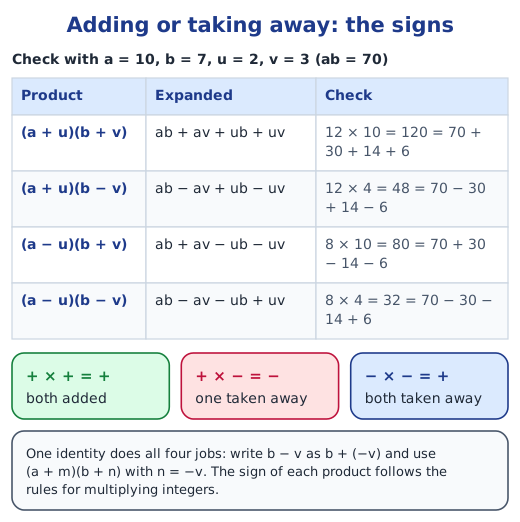
(i) One number decreased by 2, the other increased by 3. With m = −2 and n = 3: (a − 2)(b + 3) = ab + 3a − 2b − 6, so the product changes by 3a − 2b − 6. Directly: (a − 2)b + (a − 2)3 = ab − 2b + 3a − 6, the same. Check with a = 10, b = 7: 8 × 10 = 80 = 70 + 30 − 14 − 6.
(ii) Both decreased, by 3 and by 4. With m = −3 and n = −4: (a − 3)(b − 4) = ab − 4a − 3b + 12, so the product changes by −4a − 3b + 12. Directly: (a − 3)b − (a − 3)4 = ab − 3b − 4a + 12. Check: 7 × 3 = 21 = 70 − 40 − 21 + 12.
Check that (a + u)(b − v) is Identity 1 with m = u, n = −v. ab + a(−v) + ub + u(−v) = ab − av + ub − uv, the same as the book’s answer.
Expand (a − u)(b + v) and (a − u)(b − v). (a − u)(b + v) = ab + av − ub − uv, and (a − u)(b − v) = ab − av − ub + uv.
Expanding longer expressions (pages 140–142)
Do (3/2)a² and (3/10)a combine into one term? No. They have different letter-numbers (a² and a), so they are not like terms, and (3/2)a² − (3/2)ab + (3/10)a cannot be simplified further.
Why is a × a² = a³? a² means a × a, so a × a² = a × a × a, which is a³.
Figure it Out (pages 142–143)
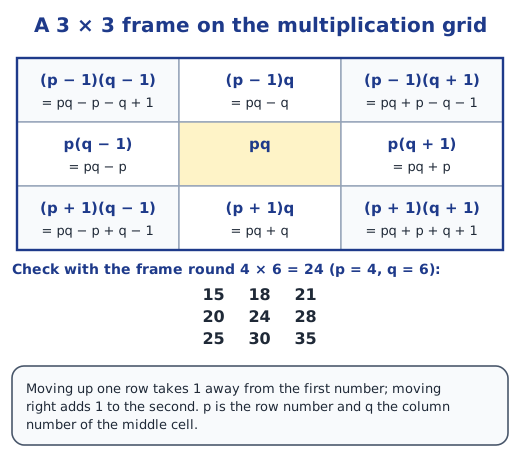
1. The middle number pq means row p, column q, so the row above uses p − 1 and the column to the left uses q − 1:
- top row: (p − 1)(q − 1) = pq − p − q + 1; (p − 1)q = pq − q; (p − 1)(q + 1) = pq + p − q − 1
- middle row: p(q − 1) = pq − p; pq; p(q + 1) = pq + p
- bottom row: (p + 1)(q − 1) = pq − p + q − 1; (p + 1)q = pq + q; (p + 1)(q + 1) = pq + p + q + 1
Check with the frame round 4 × 6 = 24: the top row is 15, 18, 21, and 24 − 4 − 6 + 1 = 15.
2. (i) (3 + u)(v − 3) = 3v − 9 + uv − 3u = uv + 3v − 3u − 9.
(ii) (2/3)(15 + 6a) = 10 + 4a.
(iii) (10a + b)(10c + d) = 100ac + 10ad + 10bc + bd. This is how two 2-digit numbers multiply: 23 × 45 = 800 + 100 + 120 + 15 = 1035.
(iv) (3 − x)(x − 6) = 3x − 18 − x² + 6x = −x² + 9x − 18.
(v) (−5a + b)(c + d) = −5ac − 5ad + bc + bd.
(vi) (5 + z)(y + 9) = 5y + 45 + yz + 9z.
3. Call the numbers a (increased by 2) and b (decreased by 4). We need (a + 2)(b − 4) = ab, that is ab − 4a + 2b − 8 = ab, so 2b = 4a + 8 and b = 2a + 4. Examples: a = 1, b = 6 (6 = 3 × 2); a = 2, b = 8 (16 = 4 × 4); a = 3, b = 10 (30 = 5 × 6).
4. (i) (a + ab − 3b²)(4 + b) = 4a + 4ab − 12b² + ab + ab² − 3b³ = 4a + 5ab + ab² − 12b² − 3b³. Check with a = 2, b = 3: (2 + 6 − 27) × 7 = −133, and 8 + 30 + 18 − 108 − 81 = −133.
(ii) (4y + 7)(y + 11z − 3) = 4y² + 44yz − 12y + 7y + 77z − 21 = 4y² + 44yz − 5y + 77z − 21. Check with y = z = 1: 11 × 9 = 99, and 4 + 44 − 5 + 77 − 21 = 99.
5. (i) (a − b)(a + b) = a² + ab − ab − b² = a² − b².
(ii) (a − b)(a² + ab + b²) = a³ + a²b + ab² − a²b − ab² − b³ = a³ − b³.
(iii) (a − b)(a³ + a²b + ab² + b³) = a⁴ − b⁴, as all the middle terms cancel in pairs.
The pattern: (a − b) times the sum of all the terms of the next power gives a power of a minus the same power of b. The next identity is (a − b)(a⁴ + a³b + a²b² + ab³ + b⁴) = a⁵ − b⁵. Expanding, a⁵ + a⁴b + a³b² + a²b³ + ab⁴ − a⁴b − a³b² − a²b³ − ab⁴ − b⁵ leaves a⁵ − b⁵. Check with a = 2, b = 1: 1 × 31 = 31 = 32 − 1.
Fast multiplication (pages 143–144)
(a) 3874 × 11 and (b) 5678 × 11. 38740 + 3874 = 42614, and 56780 + 5678 = 62458.
A general rule for multiplying by 11 in one line. Write the units digit. Then, moving left, write the sum of each digit and its neighbour on the right. Finish with the first digit. Whenever a sum is 10 or more, write its units digit and carry 1 to the next place on the left.
Evaluate. (i) 94 × 11: 9, 9 + 4 = 13, 4 gives 1034. (ii) 495 × 11 = 5445. (iii) 3279 × 11 = 36069. (iv) 4791256 × 11 = 52703816.
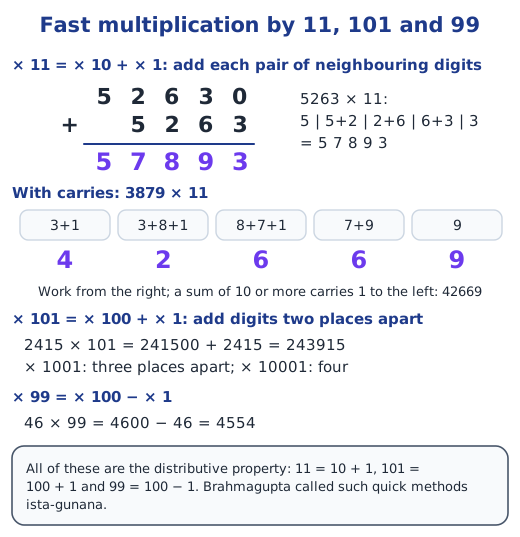
3874 × 101 in one line. The last two digits stay (7, 4); then 8 + 4 = 12 (write 2, carry 1), 3 + 7 + 1 = 11 (write 1, carry 1), then 8 + 1 = 9 and 3. The answer is 391274 (387400 + 3874).
A rule for 101, 1001, 10001, … For × 101, each answer digit is a digit of the number plus the digit two places to its left, with carries. For × 1001 the digits are three places apart, and for × 10001 four places apart. When the number is shorter than the gap, the number is simply written twice: 1234 × 10001 = 12341234.
Use these. (i) 89 × 101 = 8989. (ii) 949 × 101 = 94900 + 949 = 95849. (iii) 265831 × 1001 = 265831000 + 265831 = 266096831. (iv) 1111 × 1001 = 1112111. (v) 9734 × 99 = 973400 − 9734 = 963666. (vi) 23478 × 999 = 23478000 − 23478 = 23454522.
The square of a sum (pages 145–146)
Find the areas of the four parts of the square of side 65. 60 × 60 = 3600, 5 × 5 = 25, and two rectangles 60 × 5 = 300 each. Total 4225.
What about (30 + 35)² or (52 + 13)²? Both give 4225, with different pieces: 900 + 1050 + 1050 + 1225 = 4225, and 2704 + 676 + 676 + 169 = 4225.
Is (a + b)² bigger than a² + b² for all integers? No. (a + b)² − (a² + b²) = 2ab. It is greater when a and b are both positive or both negative, equal when one is 0, and smaller when one is positive and the other negative: a = 3, b = −2 gives 1 against 13.
Find 104² and 37². 104² = (100 + 4)² = 10000 + 800 + 16 = 10816. 37² = (30 + 7)² = 900 + 420 + 49 = 1369.
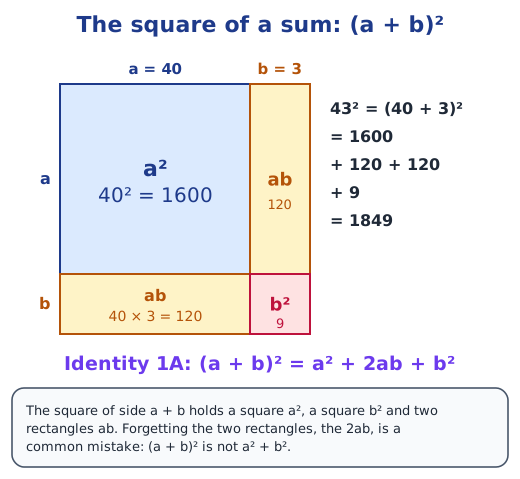
Write (m + 3)² and (6 + p)². (m + 3)² = m² + 6m + 9. (6 + p)² = 36 + 12p + p².
Expand (3j + 2k)² both ways. Identity: (3j)² + 2 × 3j × 2k + (2k)² = 9j² + 12jk + 4k². Distributive property: 3j × 3j + 2k × 3j + 3j × 2k + 2k × 2k = 9j² + 6jk + 6jk + 4k², the same.
Removing both rectangles takes away 5² twice. What should we do? Add 5² back once: 60² − 300 − 300 + 25 = 3025 = 55².
The square of a difference (page 147)
How can (a + b)² give (a − b)²? Put −b in place of b: (a + (−b))² = a² + 2a(−b) + (−b)² = a² − 2ab + b².
Find (a − b)² using geometry. Draw a square of side a and mark a smaller square of side a − b in one corner. Cut away two strips, each a by b. The b by b corner lies in both strips, so it was cut away twice; add it back once. So (a − b)² = a² − 2ab + b².
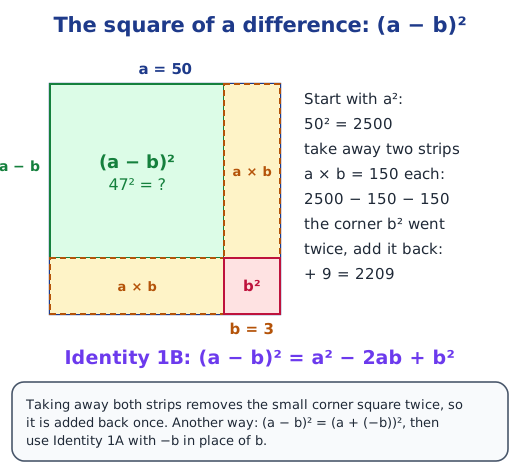
Find 99² and 58². 99² = (100 − 1)² = 10000 − 200 + 1 = 9801. 58² = (60 − 2)² = 3600 − 240 + 4 = 3364.
Expand using Identity 1B and the distributive property. Both ways give the same results.
- (i) (b − 6)² = b² − 12b + 36
- (ii) (−2a + 3)² = 4a² − 12a + 9 (the middle term is 2 × (−2a) × 3)
- (iii) (7y − (3/4)z)² = 49y² − (21/2)yz + (9/16)z²
Patterns 1 and 2 (pages 147–149)
Pattern 1: take a pair, find twice the sum of their squares, and write it as a sum of two squares. For 4 and 7: 2(16 + 49) = 130 = 11² + 3², and 11 = 7 + 4, 3 = 7 − 4. The two squares are always (sum)² and (difference)².
Do the identities explain it? Yes. Adding (a + b)² = a² + 2ab + b² and (a − b)² = a² − 2ab + b² gives 2a² + 2b², so 2(a² + b²) = (a + b)² + (a − b)².
Pattern 2: describe it with algebra. In each line, a² − b² equals (a + b) × (a − b): 9² − 1² = 80 = 10 × 8. Multiplying out (a + b)(a − b) = a² − ab + ab − b² = a² − b², so it always holds. (On page 148 the book’s working ends in − a²; it should be − b², as Identity 1C shows.)
Find 98 × 102 and 45 × 55. 98 × 102 = (100 − 2)(100 + 2) = 10000 − 4 = 9996. 45 × 55 = (50 − 5)(50 + 5) = 2500 − 25 = 2475.
Show (a + b)(a − b) = a² − b² geometrically. Cut a b by b square from a corner of an a by a square. Cut the L-shape that is left into a rectangle a by (a − b) and a rectangle b by (a − b). Turn the second one and place it beside the first: together they make a rectangle (a + b) by (a − b).
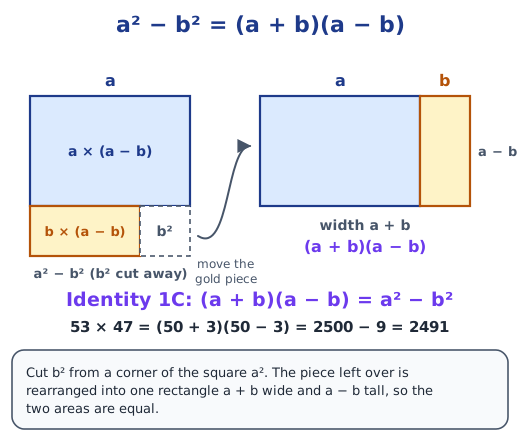
Why is a² = (a + b)(a − b) + b² true? By Identity 1C, (a + b)(a − b) = a² − b². Adding b² gives a².
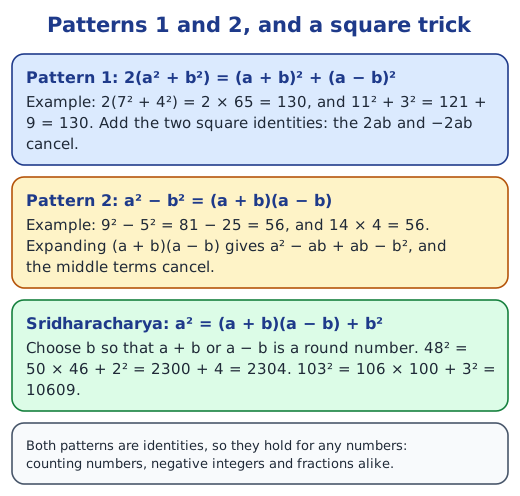
Figure it Out (page 149)
1. They are equal. b − a = −(a − b), and a number and its negative have the same square. Expanding, both are a² − 2ab + b².
2. 100 = (a + b)(a − b). Both factors must be even (or both odd) for a and b to be whole numbers; 100 = 50 × 2 gives a = 26, b = 24. So 100 = 26² − 24² (676 − 576). The pair 10 × 10 gives 10² − 0², if 0 is allowed. With fractions there are more, such as 12.5² − 7.5².
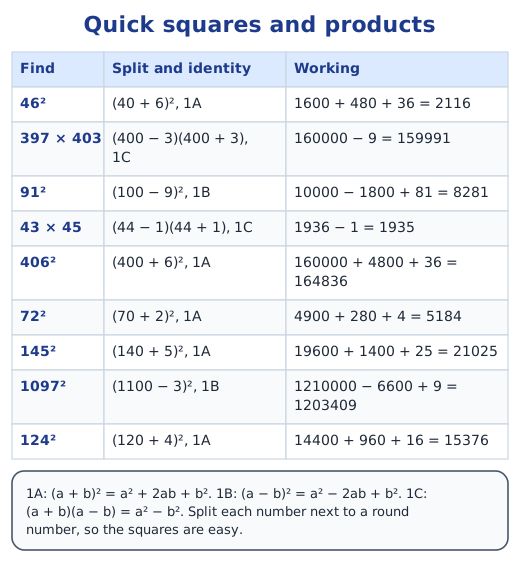
3. 406² = (400 + 6)² = 160000 + 4800 + 36 = 164836. 72² = (70 + 2)² = 4900 + 280 + 4 = 5184. 145² = (140 + 5)² = 19600 + 1400 + 25 = 21025. 1097² = (1100 − 3)² = 1210000 − 6600 + 9 = 1203409. 124² = (120 + 4)² = 14400 + 960 + 16 = 15376.
4. They hold for all of these. Both patterns are identities proved with the distributive property, which works for negative integers and fractions too. Checks: a = −3, b = 5 gives 2(9 + 25) = 68 = 2² + (−8)², and 9 − 25 = −16 = 2 × (−8). a = 1/2, b = 1/3 gives 2(1/4 + 1/9) = 13/18 = 25/36 + 1/36, and 1/4 − 1/9 = 5/36 = (5/6)(1/6).
Mind the Mistake, Mend the Mistake (page 150)
For each one: is there a mistake, what went wrong, and the correct expression.
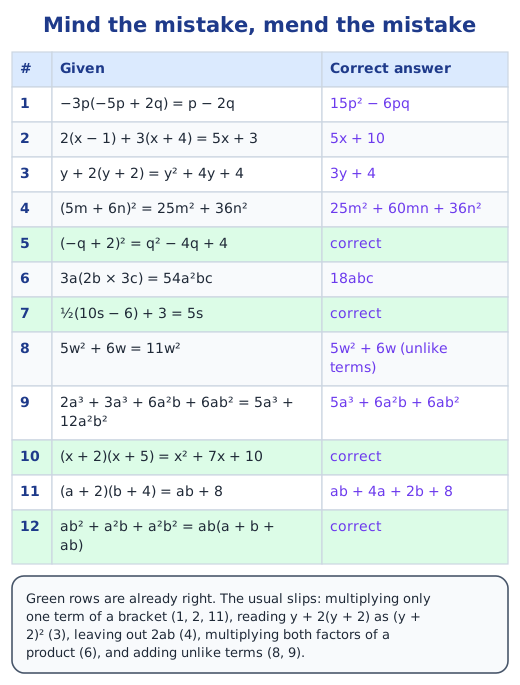
- Mistake. −3p was not multiplied into the bracket; it was added. Correct: −3p × −5p + (−3p) × 2q = 15p² − 6pq.
- Mistake. Only x was multiplied in each bracket. Correct: 2x − 2 + 3x + 12 = 5x + 10.
- Mistake. y + 2(y + 2) is not (y + 2)(y + 2). Correct: y + 2y + 4 = 3y + 4.
- Mistake. The middle term 2 × 5m × 6n is missing. Correct: 25m² + 60mn + 36n².
- Correct. (−q + 2)² = q² − 4q + 4.
- Mistake. 3a multiplies the product 2b × 3c once, not each factor. Correct: 3a × 6bc = 18abc.
- Correct. ½ × 10s − ½ × 6 + 3 = 5s − 3 + 3 = 5s.
- Mistake. 5w² and 6w are not like terms, so they cannot be added. Correct: 5w² + 6w (or w(5w + 6)).
- Mistake. 6a²b and 6ab² are not like terms. Correct: 5a³ + 6a²b + 6ab².
- Correct. x² + 5x + 2x + 10 = x² + 7x + 10.
- Mistake. Only first × first and last × last were multiplied. Correct: ab + 4a + 2b + 8.
- Correct. ab(a + b + ab) = a²b + ab² + a²b², the same three terms. This one takes out a common factor rather than expanding.
This Way or That Way (pages 150–154)
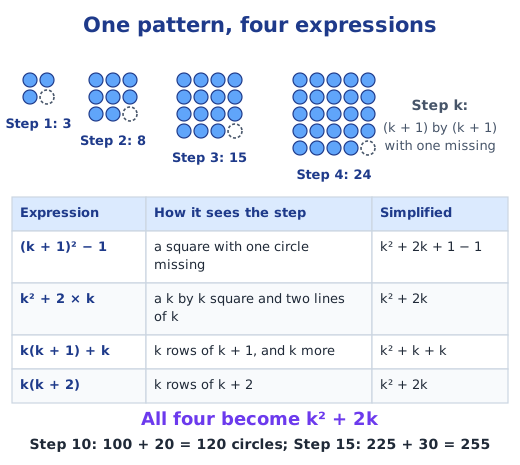
The circle pattern: the next figure, Step 10 and Step k. Step 4 is a 5 by 5 square of circles with one missing: 24 circles. Step k has k² + 2k circles, so Step 10 has 120. Any correct method works; the book’s four, (k + 1)² − 1, k² + 2 × k, k(k + 1) + k and k(k + 2), all simplify to k² + 2k.
Step 15. 15² + 2 × 15 = 225 + 30 = 255 circles.
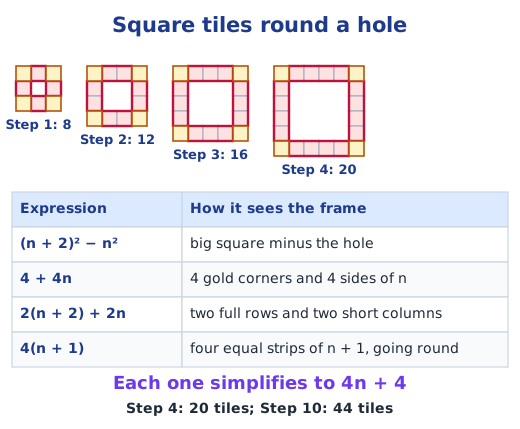
The square tiles: how many in each figure, Step 4, Step 10 and Step n? The figures have 8, 12 and 16 tiles. Step n is an (n + 2) by (n + 2) square with an n by n hole, so it has (n + 2)² − n² = 4n + 4 tiles: 20 at Step 4 and 44 at Step 10. Other methods give the same: 4 corners and 4 sides of n (4 + 4n), two rows of n + 2 and two columns of n (2(n + 2) + 2n), or four strips of n + 1 (4(n + 1)).
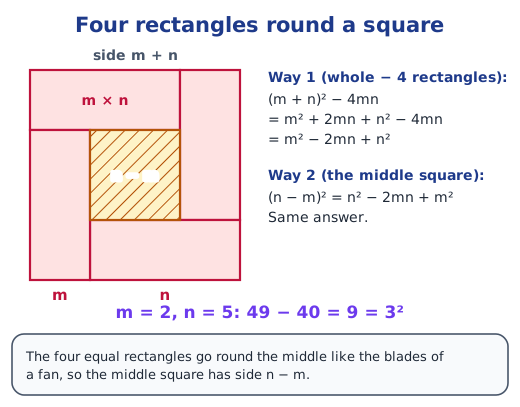
Show by expanding that (m + n)² − 4mn equals (n − m)². Left: m² + 2mn + n² − 4mn = m² − 2mn + n². Right: n² − 2mn + m². They are equal.
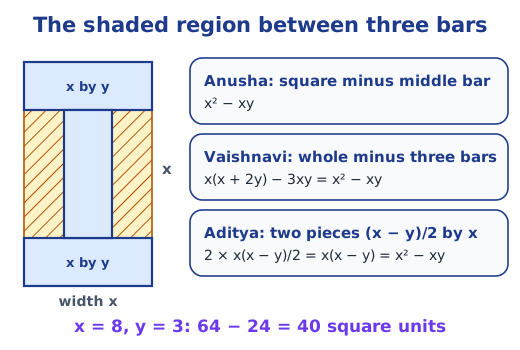
The region with slanting lines (Fig. 1): verify the three methods and find the area for x = 8, y = 3. Anusha: x² − xy. Vaishnavi: x(x + 2y) − 3xy = x² + 2xy − 3xy = x² − xy. Aditya: 2x((x − y)/2) = x(x − y) = x² − xy. All three are x² − xy, so the area is 64 − 24 = 40 square units.
The dashed region beside the L-shape. The region is a rectangle (s − r) wide and (p − r) tall. Way 1: (s − r)(p − r) = ps − pr − rs + r². Way 2: the whole rectangle sp minus the L, rp + r(s − r), which again gives sp − pr − rs + r². With p = 6, r = 3.5 and s = 9: 5.5 × 2.5 = 13.75 square units.
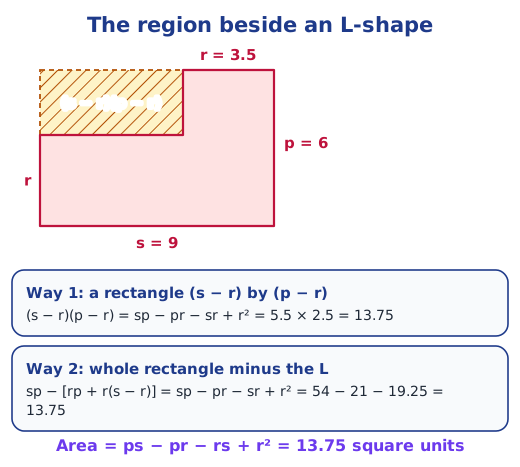
Figure it Out (pages 154–156)
1. (i) 46² = (40 + 6)² = 1600 + 480 + 36 = 2116. (ii) 397 × 403 = (400 − 3)(400 + 3) = 160000 − 9 = 159991. (iii) 91² = (100 − 9)² = 10000 − 1800 + 81 = 8281. (iv) 43 × 45 = (44 − 1)(44 + 1) = 1936 − 1 = 1935.
2. (i) (p − 1)(p + 11) = p² + 11p − p − 11 = p² + 10p − 11.
(ii) (3a − 9b)(3a + 9b) = (3a)² − (9b)² = 9a² − 81b².
(iii) −(2y + 5)(3y + 4) = −(6y² + 8y + 15y + 20) = −6y² − 23y − 20.
(iv) (6x + 5y)² = 36x² + 60xy + 25y².
(v) (2x − ½)² = 4x² − 2 × 2x × ½ + ¼ = 4x² − 2x + ¼.
(vi) (7p) × (3r) × (p + 2) = 21pr(p + 2) = 21p²r + 42pr.
3. (i) s² + 2. The others are two more than s (2 + s), a square ((s + 2)²), four more than a square (s² + 4), twice a square (2s²) and four times s (2²s).
(ii) m² + (m + 1)², and also m² + (m − 1)², since m − 1 and m are consecutive too. (2m)² + (2m + 1)² is always such a sum, but only for pairs whose smaller number is even, so it misses 3² + 4². The rest do not fit: m² + n² and (m + n)² use any two numbers, m² + 1 is m² + 1², and (m + (m + 1))² is the square of a sum.
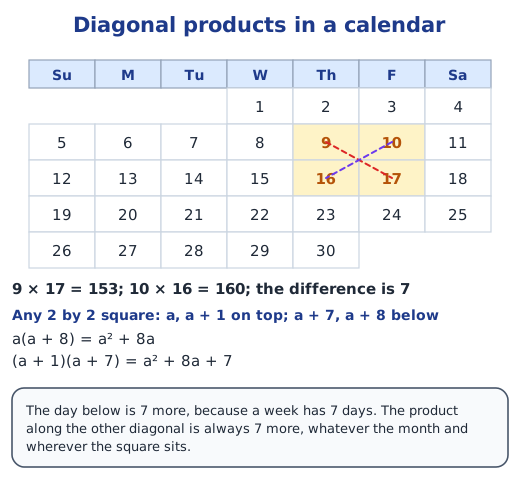
4. In the book’s calendar, 4 × 12 = 48 and 5 × 11 = 55. In any 2 by 2 square the product along one diagonal is always 7 more than along the other. Label the square a, a + 1 on top and a + 7, a + 8 below (the day below is 7 more, a week later). Then a(a + 8) = a² + 8a, and (a + 1)(a + 7) = a² + 8a + 7.
5. (i) False. (k + 1)(k + 2) − (k + 3) = k² + 3k + 2 − k − 3 = k² + 2k − 1. It is 2 only for k = 1 (and k = −3); k = 2 gives 7.
(ii) False. (2q + 1)(2q − 3) = 4q² − 4q − 3 = 4(q² − q − 1) + 1. It is odd, always 1 more than a multiple of 4. q = 2 gives 5.
(iii) True. (2n)² = 4n², a multiple of 4. (2n + 1)² = 4n² + 4n + 1 = 4n(n + 1) + 1, and n(n + 1) is a product of consecutive numbers, so it is even; then 4n(n + 1) is a multiple of 8. For example 49 = 48 + 1.
(iv) False. (6n + 2)² − (4n + 3)² = 36n² + 24n + 4 − 16n² − 24n − 9 = 20n² − 5. This is 5 less than 20n², which is a square only when n = 0. For n = 1 we get 15, and 20 is not a square.
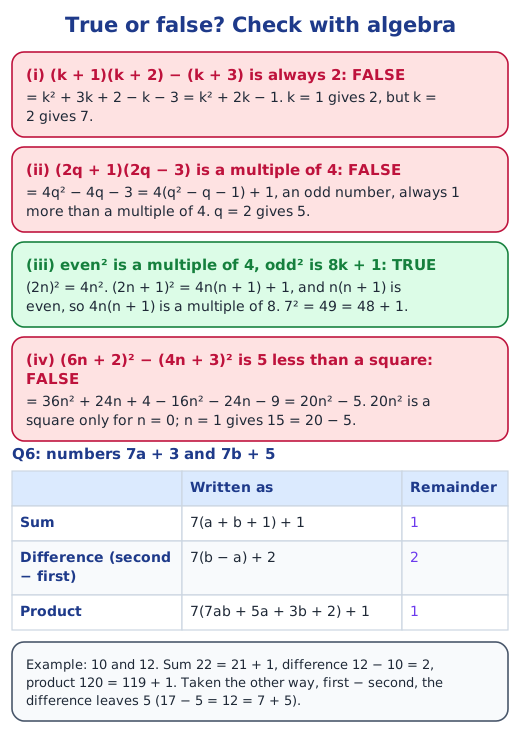
6. Write the numbers as 7a + 3 and 7b + 5.
- Sum: 7a + 7b + 8 = 7(a + b + 1) + 1, so the remainder is 1.
- Difference, second minus first: 7(b − a) + 2, so the remainder is 2. (First minus second leaves 5, for example 17 − 5 = 12.)
- Product: 49ab + 35a + 21b + 15 = 7(7ab + 5a + 3b + 2) + 1, so the remainder is 1.
For example, 10 and 12: 22 leaves 1, 2 leaves 2 and 120 = 119 + 1 leaves 1.
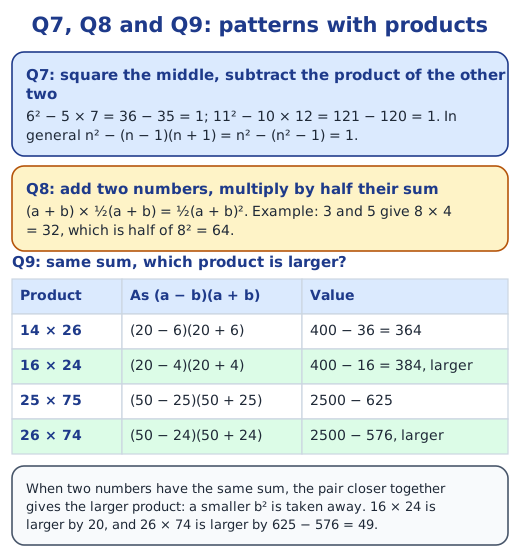
7. Our sets: 6² − 5 × 7 = 1, 11² − 10 × 12 = 1 and 20² − 19 × 21 = 1. The answer is always 1. With the numbers n − 1, n, n + 1: n² − (n − 1)(n + 1) = 1. Expanding, (n − 1)(n + 1) = n² + n − n − 1 = n² − 1, and n² − (n² − 1) = 1, so it is a true identity.
8. For numbers a and b the steps give (a + b) × ½(a + b). This is ½ × (a + b) × (a + b) = ½(a + b)², half the square of the sum. For 3 and 5: 8 × 4 = 32, half of 64.
9. Both pairs in each part have the same sum, so write them round the middle number with Identity 1C.
(i) 14 × 26 = (20 − 6)(20 + 6) = 400 − 36, and 16 × 24 = (20 − 4)(20 + 4) = 400 − 16. 16 × 24 is larger, by 20.
(ii) 25 × 75 = 50² − 25², and 26 × 74 = 50² − 24². 26 × 74 is larger, by 625 − 576 = 49.
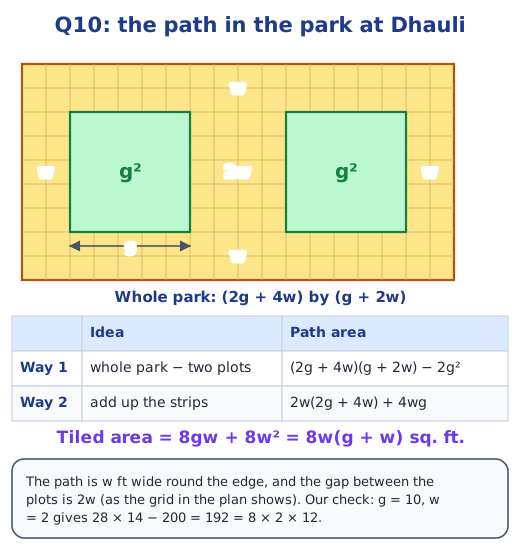
10. The path is w ft wide round the edge, and the gap between the plots is twice as wide, 2w, as the grid in the plan shows. So the park is g + 2w + g + 2w = (2g + 4w) ft long and (g + 2w) ft wide. Tiled area = (2g + 4w)(g + 2w) − 2g² = 2g² + 4gw + 4gw + 8w² − 2g² = 8gw + 8w² = 8w(g + w) sq. ft. Our check: g = 10, w = 2 gives 28 × 14 − 200 = 192, and 8 × 2 × 12 = 192.
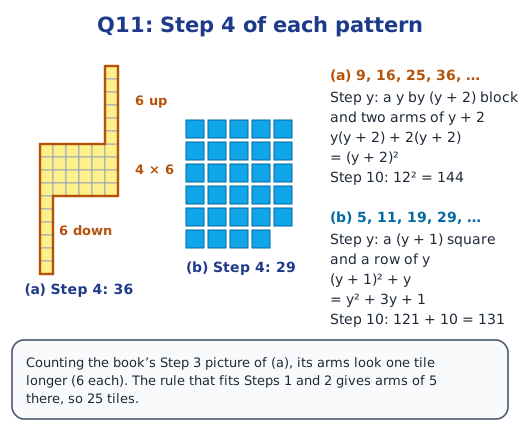
11. Pattern (a): Step y is a block of y rows of y + 2 tiles, with an arm of y + 2 tiles going up from one end and another going down from the other. Steps 1 to 4 have 9, 16, 25 and 36 tiles.
- (i) Step 4: a 4 by 6 block with arms of 6, 36 tiles.
- (ii) Step 10: 12² = 144.
- (iii) Step y: y(y + 2) + 2(y + 2) = (y + 2)².
(If you count the book’s Step 3 picture, its arms look one tile longer, 6 each; the rule that fits Steps 1 and 2 gives arms of 5 there.)
Pattern (b): Step y is a (y + 1) by (y + 1) square with one more row of y. Steps 1 to 4 have 5, 11, 19 and 29.
- (i) Step 4: a 5 by 5 square and a row of 4, 29.
- (ii) Step 10: 121 + 10 = 131.
- (iii) Step y: (y + 1)² + y = y² + 3y + 1.
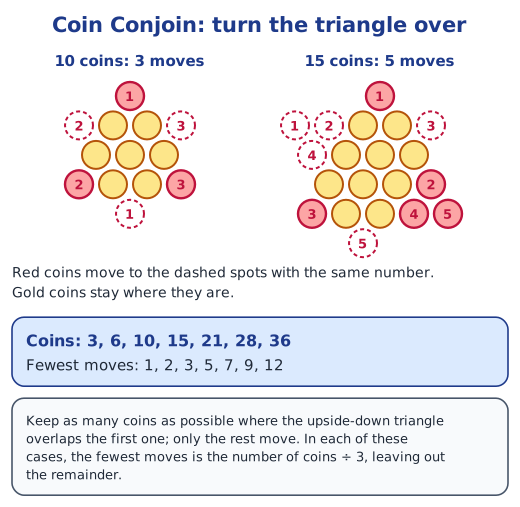
Puzzle Time: Coin Conjoin (page 158)
10 coins in 3 moves. Move the top coin to the spot below the middle of the bottom row. Then move the two end coins of the bottom row to the two ends of the second row. The second row becomes the new top row of 4.
15 coins. The fewest is 5 moves. Keep the 10 coins where the new, upside-down triangle overlaps the old one and move the other 5: the top coin, the right end of the fourth row, and the left end and two right-hand coins of the bottom row.
A simple way to find the fewest moves. Keep as many coins as possible in the overlap; only the rest must move. For triangles of 3, 6, 10, 15, 21, 28 and 36 coins, we found the fewest moves to be 1, 2, 3, 5, 7, 9 and 12. In each case this is the number of coins divided by 3, with the remainder left out.
Practice
-
(x − 7)(x + 7) equals:
Show answer
Answer: (a) x² − 49
-
Which product is larger?
Show answer
Answer: (b) 19 × 21
-
37 × 101 equals:
Show answer
Answer: (a) 3737
-
One number leaves remainder 2 on dividing by 5, and another leaves remainder 4. What remainder does their product leave?
Show answer
Answer: (5a + 2)(5b + 4) = 25ab + 20a + 10b + 8 = 5(5ab + 4a + 2b + 1) + 3, so the remainder is 3. Check: 7 × 9 = 63 = 60 + 3.
-
Simplify (2p + 3q)(2p − 3q) + 9q².
Show answer
Answer: (2p + 3q)(2p − 3q) = 4p² − 9q² by Identity 1C. Adding 9q² leaves 4p².
Stuck on a question?
Take a photo and Lagnever AI explains it step by step. Try it for 7 days for ₹2.
Get it on Google Play Open in browser
For parents: after the trial, the plan renews monthly by UPI or card autopay. You can cancel anytime in the app.