
One pattern, many expressions: why different methods agree
Answer in short
A pattern or a shape can often be counted in several ways, each giving a different-looking expression. If every method is correct, the expressions are equal: simplifying turns them into the same one. For a pattern of circles, (k + 1)² − 1, k(k + 2) and k² + 2k all give the count at Step k.
Stuck on a question? Take a photo and Lagnever AI explains it step by step. Try it for 7 days for ₹2. Get it on Google Play
How can one pattern have many expressions?
Look at a pattern of circles where Step 1 has 3, Step 2 has 8 and Step 3 has 15. One student sees a square of circles with one missing: at Step k, that is (k + 1)² − 1. Another sees k rows of k + 2 circles: k(k + 2). A third sees a k by k square with two extra lines of k: k² + 2 × k. A fourth sees k rows of k + 1 and k more: k(k + 1) + k.
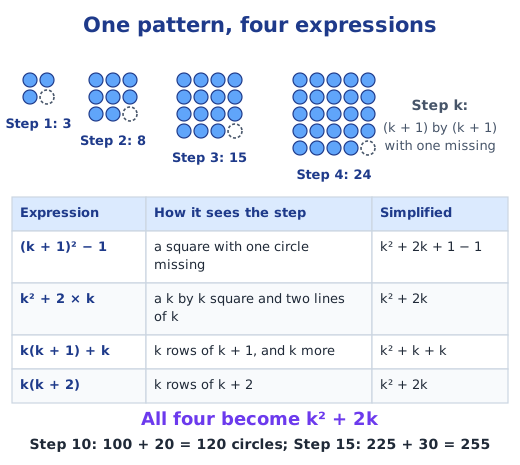
The four expressions look different, but they describe the same circles. Simplify each one with the distributive property:
- (k + 1)² − 1 = k² + 2k + 1 − 1 = k² + 2k
- k(k + 2) = k² + 2k
- k(k + 1) + k = k² + k + k = k² + 2k
So every method leads to k² + 2k. Step 10 has 100 + 20 = 120 circles.
How do you check that two expressions are the same?
There are two steps. First, try a few step numbers you can count: if an expression gives the wrong count even once, it is wrong. Second, prove it by expanding and simplifying, because a few matching numbers can be luck. For example, k² + 2 also gives 3 at Step 1, but at Step 2 it gives 6 instead of 8.
Square tiles round a hole
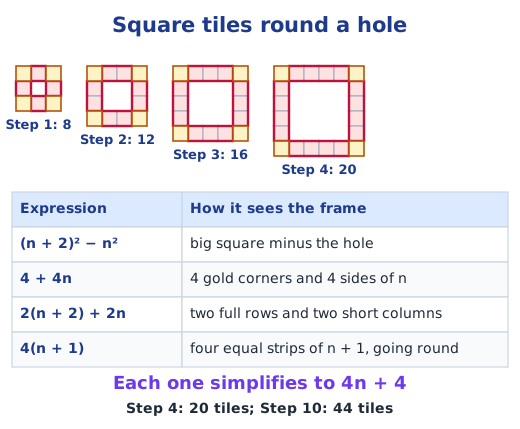
Now take square frames of tiles. Step n is an (n + 2) by (n + 2) square with an n by n hole, so the steps have 8, 12, 16, 20, … tiles. Here are four ways to count:
- whole square minus the hole: (n + 2)² − n²
- 4 corners and 4 sides of n: 4 + 4n
- two full rows and two shorter columns: 2(n + 2) + 2n
- four equal strips of n + 1 going round: 4(n + 1)
Each one simplifies to 4n + 4. For example, (n + 2)² − n² = n² + 4n + 4 − n² = 4n + 4. So Step 10 has 44 tiles.
Areas made from equal rectangles
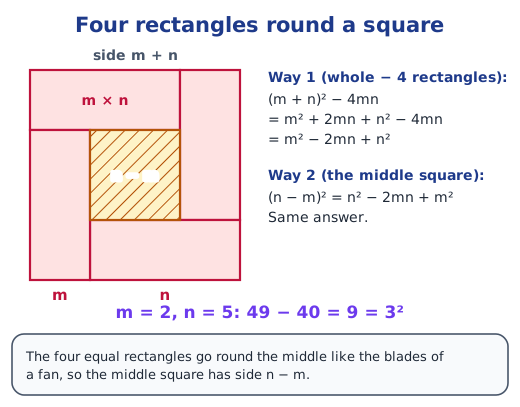
The same idea works for areas. Place four equal rectangles, m by n, round a square, like the blades of a fan. The outside is a square of side m + n, and the middle square has side n − m. Its area can be found two ways:
- the whole square minus four rectangles: (m + n)² − 4mn
- the middle square directly: (n − m)²
Expanding, (m + n)² − 4mn = m² + 2mn + n² − 4mn = m² − 2mn + n², and (n − m)² = n² − 2mn + m². They match. With m = 2 and n = 5, both give 9.
The region between three bars
In the chapter, three equal bars, each x by y, make a shape like a capital I, and the region beside the middle bar is shaded. One way takes the x by x square between the top and bottom bars and removes the middle bar: x² − xy. Another takes the whole shape, x by (x + 2y), and removes all three bars: x(x + 2y) − 3xy. A third sees two equal pieces, each (x − y)/2 wide and x tall: 2 × x(x − y)/2 = x(x − y). All three simplify to x² − xy, which is 40 square units when x = 8 and y = 3.
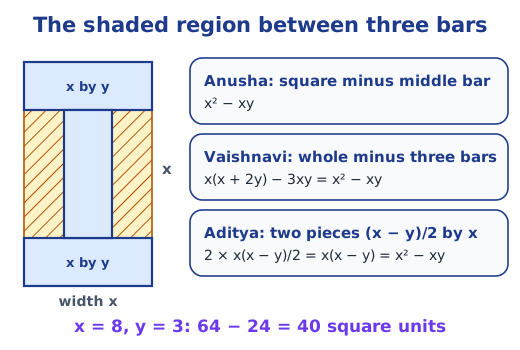
The lesson is that there is rarely only one right way. Pick the way you can see most clearly, then use algebra to check that it agrees with the others.
Read next: the chapter notes, the distributive property, squares of sums and differences and NCERT solutions.
Practice
-
Which expression equals k(k + 2)?
Show answer
Answer: (b) (k + 1)² − 1
-
Step n of a pattern is an (n + 2) by (n + 2) square of tiles with an n by n hole. How many tiles are in Step 6?
Show answer
Answer: (a) 28
-
(m + n)² − 4mn equals:
Show answer
Answer: (a) (m − n)²
-
A pattern has 5, 8, 11, 14, … tiles. Write two expressions for Step n and show that they are equal.
Show answer
Answer: Start with 5 and add 3 for each later step: 5 + 3(n − 1). Or see 3 tiles for each step plus 2 extra: 3n + 2. Expanding, 5 + 3n − 3 = 3n + 2, so they are equal. Step 4: 14 both ways.
-
Show that n(n + 3) + 2 and (n + 1)(n + 2) are equal.
Show answer
Answer: n(n + 3) + 2 = n² + 3n + 2. (n + 1)(n + 2) = n² + 2n + n + 2 = n² + 3n + 2. Both simplify to the same expression.
Questions students ask
What is This Way or That Way, All Ways Lead to the Bay in Class 8 Maths?
It is section 6.4 of Chapter 6. It takes patterns of circles and tiles and some shaded areas, finds expressions for them in different ways, and shows by simplifying that the expressions are all the same.
How do I know two algebraic expressions are equal?
Expand and simplify both. If they become the same expression, they are equal for every value of the letters. Putting in a few numbers is a good check, but only simplifying proves it.
How many circles are in Step 15 of the circle pattern in Chapter 6?
Step k has k² + 2k circles, so Step 15 has 225 + 30 = 255 circles. Step 10 has 120.
Why do different methods give the same answer?
They all count the same objects, only grouped differently. Algebra makes this visible: once each expression is simplified, they turn out to be one and the same.
Stuck on a question?
Take a photo and Lagnever AI explains it step by step. Try it for 7 days for ₹2.
Get it on Google Play Open in browser
For parents: after the trial, the plan renews monthly by UPI or card autopay. You can cancel anytime in the app.