
The distributive property: how products grow, and Identity 1
Answer in short
The distributive property says a(b + c) = ab + ac: multiply each part of a sum, then add. So if b grows by 1, ab grows by a. Used twice, it gives Identity 1: (a + m)(b + n) = ab + an + mb + mn, each term times each term.
Stuck on a question? Take a photo and Lagnever AI explains it step by step. Try it for 7 days for ₹2. Get it on Google Play
What does the distributive property say?
It says that a(b + c) = ab + ac. To multiply a number by a sum, you may multiply it by each part and then add. We use it in mental maths all the time: 7 × 23 = 7 × 20 + 7 × 3 = 140 + 21 = 161. Because a × b = b × a, the rule also works with the bracket first: (a + b)c = ac + bc. Here a(b + c) means a × (b + c); the × sign next to a bracket is usually left out, as in 5a or xy.
Why does it work?
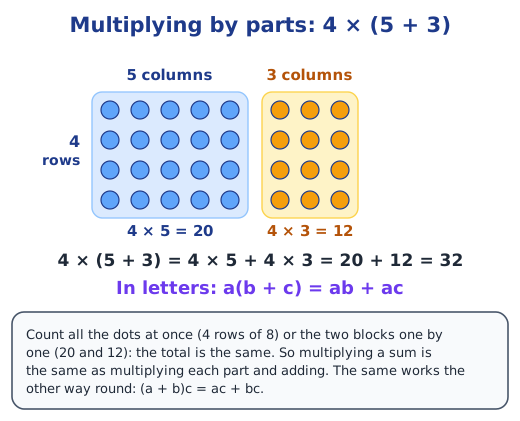
Arrange dots in rows. Four rows of 8 dots can be counted all at once, 4 × 8 = 32, or split into a block 5 columns wide and a block 3 columns wide: 4 × 5 + 4 × 3 = 20 + 12 = 32. The dots do not change, so the totals must match.
How much does a product grow?
Take a product ab. If b grows by 1, then a(b + 1) = ab + a: one more column of a dots, so the product grows by a. If both numbers grow by 1, use the property twice, treating a + 1 as one number:
(a + 1)(b + 1) = (a + 1)b + (a + 1) × 1 = ab + b + a + 1.
So the product grows by a + b + 1. For 23 × 27 = 621, the product 24 × 28 is 621 + 23 + 27 + 1 = 672.
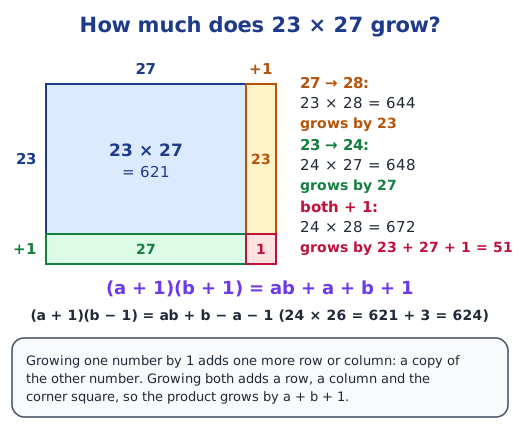
What if a grows by 1 and b shrinks by 1? Then (a + 1)(b − 1) = ab + b − a − 1. The product goes up when b is more than a + 1, stays the same when b = a + 1, and goes down otherwise. For 10 × 3 = 30, the new product 11 × 2 = 22 is smaller.
What is Identity 1?
Now let a grow by m and b grow by n:
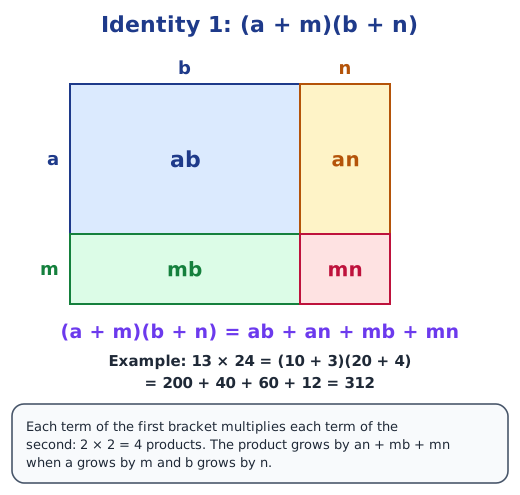
(a + m)(b + n) = (a + m)b + (a + m)n = ab + mb + an + mn.
This is Identity 1. Every term of the first bracket multiplies every term of the second, giving 2 × 2 = 4 products. An area picture shows the four pieces: ab, an, mb and mn. For example, 13 × 24 = (10 + 3)(20 + 4) = 200 + 40 + 60 + 12 = 312.
An identity is an equation that is true for every value of the letters, including negative integers. That is why we can check one by putting in numbers.
What if a number gets smaller?
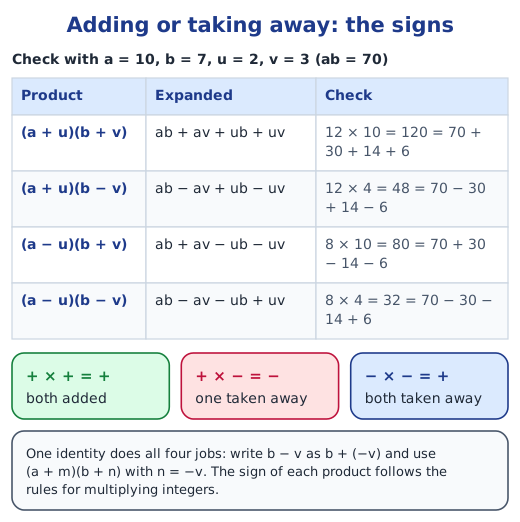
Taking away v is the same as adding −v. So (a + u)(b − v) is Identity 1 with m = u and n = −v: ab − av + ub − uv. The integer rules decide each sign: a plus times a minus gives a minus, and a minus times a minus gives a plus.
How do you expand longer brackets?
The rule stays the same with three or more terms: multiply every term by every term, then add the like terms, the ones with exactly the same letter-numbers. For example:
(2x + 3)(x² − x + 4) = 2x³ − 2x² + 8x + 3x² − 3x + 12 = 2x³ + x² + 5x + 12.
Here −2x² and 3x² are like terms, and so are 8x and −3x. Check with x = 2: the left side is 7 × 6 = 42 and the right side is 16 + 4 + 10 + 12 = 42.
How does it make multiplication quick?
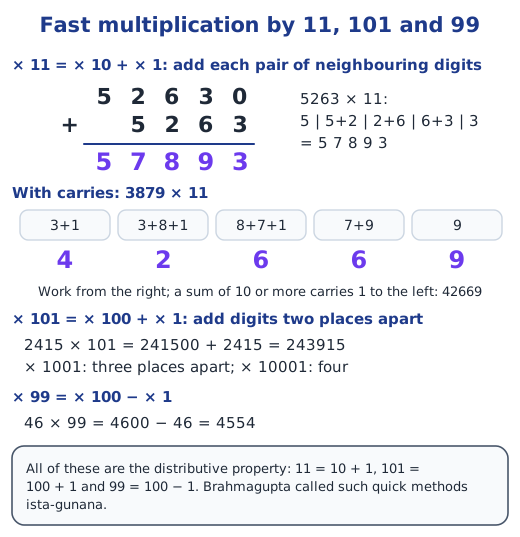
Since 11 = 10 + 1, a number times 11 is ten times the number plus the number. Each digit of the answer is then the sum of two neighbouring digits: 5263 × 11 gives 5, 5 + 2, 2 + 6, 6 + 3, 3, that is 57893. When a sum reaches 10, carry 1 to the left. For 101 = 100 + 1, add digits two places apart, and for 99 = 100 − 1, multiply by 100 and subtract the number.
Read next: the chapter notes, squares of sums and differences, one pattern, many expressions and NCERT solutions.
Practice
-
3(2x − 5) equals:
Show answer
Answer: (b) 6x − 15
-
(a − 2)(b + 3) equals:
Show answer
Answer: (a) ab + 3a − 2b − 6
-
Using the rule for 11, 67 × 11 equals:
Show answer
Answer: (a) 737
-
15 is increased by 1 and 9 is increased by 1. By how much does 15 × 9 grow? Check your answer.
Show answer
Answer: By 15 + 9 + 1 = 25. Check: 15 × 9 = 135 and 16 × 10 = 160, and 160 − 135 = 25.
-
Expand (3x + 2)(x − 4) and check with x = 1.
Show answer
Answer: 3x × x − 3x × 4 + 2 × x − 2 × 4 = 3x² − 12x + 2x − 8 = 3x² − 10x − 8. With x = 1: (5)(−3) = −15, and 3 − 10 − 8 = −15.
Questions students ask
What is the distributive property of multiplication over addition?
It is the rule a(b + c) = ab + ac. Multiplying a number by a sum gives the same answer as multiplying it by each part of the sum and adding, for example 7 × 23 = 7 × 20 + 7 × 3 = 161.
What is Identity 1 in Class 8 Maths Chapter 6?
Identity 1 is (a + m)(b + n) = ab + an + mb + mn. It tells you how a product ab changes when one number grows by m and the other by n: it grows by an + mb + mn.
How do you multiply a number by 11 quickly?
Write the last digit, then the sums of each pair of neighbouring digits from right to left, then the first digit, carrying when a sum is 10 or more. For 5263 × 11: 5, 5 + 2, 2 + 6, 6 + 3, 3 gives 57893.
Does the distributive property work for negative numbers?
Yes. It holds for all integers, so the rules for how products change also work when the letters stand for negative numbers. For example (−4)(9) = −36 is 4 more than (−5)(8) = −40, and a + b + 1 = −5 + 8 + 1 = 4.
Stuck on a question?
Take a photo and Lagnever AI explains it step by step. Try it for 7 days for ₹2.
Get it on Google Play Open in browser
For parents: after the trial, the plan renews monthly by UPI or card autopay. You can cancel anytime in the app.