
Properties of integer multiplication
Answer in short
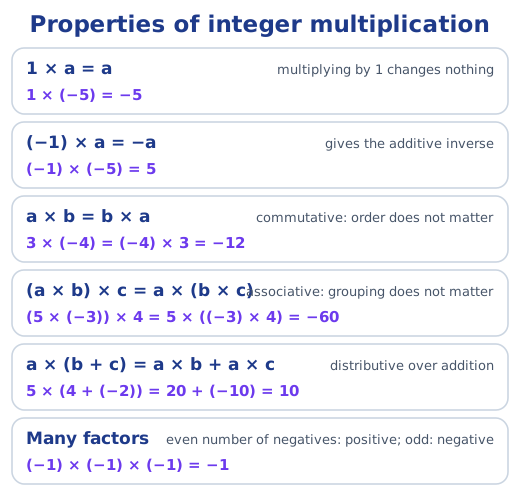
Multiplying integers follows the same laws as whole numbers. It is commutative (a × b = b × a), associative (grouping does not change the product) and distributive over addition. Also 1 × a = a and (−1) × a = −a, and a product with an odd number of negative factors is negative.
Stuck on a question? Take a photo and Lagnever AI explains it step by step. Try it for 7 days for ₹2. Get it on Google Play
Multiplying by 1 and by −1
Putting a group of tokens into an empty bag once leaves exactly that group, so 1 × a = a for every integer a, positive or negative. Multiplying by −1 takes the group out once, which leaves its opposite: (−1) × a = −a, the additive inverse of a. For example (−1) × 7 = −7 and (−1) × (−7) = 7.
Order does not matter: commutative
Compare 3 × (−4) = −12 with (−4) × 3 = −12, or (−15) × (−8) = 120 with (−8) × (−15) = 120. Swapping the numbers keeps the magnitude, because the magnitudes are just positive numbers being multiplied, and it keeps the sign, because the two signs are the same pair in either order. So multiplication of integers is commutative: a × b = b × a.
Grouping does not matter: associative
For 5 × (−3) × 4, work it either way: (5 × (−3)) × 4 = (−15) × 4 = −60, and 5 × ((−3) × 4) = 5 × (−12) = −60. Even (5 × 4) × (−3) = 20 × (−3) = −60. Multiplication of integers is associative: (a × b) × c = a × (b × c). Together with the commutative property, this means three or more integers can be multiplied in any order: 25 × (−6) × 12 is −1800 whichever pair you multiply first, and 25 × 12 = 300 first makes it easy.
The sign of a long product
Multiply −1 again and again: (−1) × (−1) = 1, then × (−1) = −1, then 1, then −1. The sign flips with every negative factor. So:
- an even number of negative factors gives a positive product;
- an odd number of negative factors gives a negative product.
For example (−2) × (−1) × (−5) × (−3) has four negative factors, so it is +30, while (−7) × 4 × (−1) has two, so it is +28.
Spreading over addition: distributive
Is 5 × (4 + (−2)) the same as 5 × 4 + 5 × (−2)? The left side is 5 × 2 = 10 and the right side is 20 + (−10) = 10. Tokens show why. Arrange tokens in 4 rows, with 2 columns of positives and 3 columns of negatives:
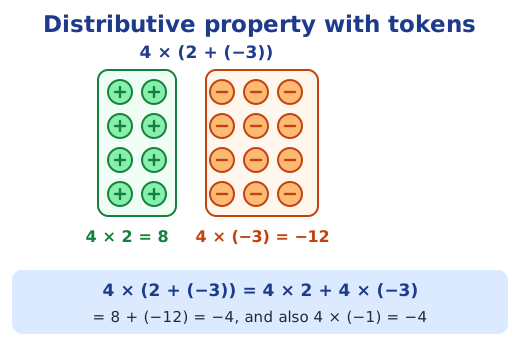
The whole rectangle is 4 × (2 + (−3)), and its two parts are 4 × 2 and 4 × (−3), so the two must be equal: a × (b + c) = a × b + a × c. It also holds with a negative multiplier: (−2) × (4 + (−3)) = (−2) × 1 = −2, and (−2) × 4 + (−2) × (−3) = −8 + 6 = −2.
Properties make sums easier
The properties help you calculate without long multiplication. Given (−548) × 972 = −532656, the value of (−547) × 972 is −532656 + 972 = −531684, because −547 is one more than −548. They also explain the magic grid in the chapter: its numbers form a multiplication table, and by the commutative and associative properties every set of circled numbers multiplies to the same product, −30240.
Why it matters
These laws let you rearrange and regroup a calculation safely, even with negative numbers, which is the basis of algebra later on. Review multiplying integers and dividing integers. Answers to the textbook questions are in the NCERT solutions for Part 2 Chapter 2; see all of Part 2 Chapter 2 notes.
Practice
-
(−5) × 7 × (−2) = ?
Show answer
Answer: (b) 70
-
Which statement shows the commutative property?
Show answer
Answer: (a) (−4) × 6 = 6 × (−4)
-
The product of seven negative integers and three positive integers is:
Show answer
Answer: (b) always negative Seven negative factors is an odd number, so the product is negative (none of the integers is zero).
-
Use the distributive property to find (−8) × 102.
Show answer
Answer: (−8) × 102 = (−8) × (100 + 2) = (−8) × 100 + (−8) × 2 = −800 + (−16) = −816.
-
Given (−548) × 972 = −532656, find (−547) × 972 without multiplying again.
Show answer
Answer: (−547) × 972 = ((−548) + 1) × 972 = (−548) × 972 + 1 × 972 = −532656 + 972 = −531684.
Questions students ask
What are the properties of multiplication of integers?
Multiplication of integers is commutative (a × b = b × a), associative ((a × b) × c = a × (b × c)) and distributive over addition (a × (b + c) = a × b + a × c). Multiplying by 1 leaves a number unchanged, and multiplying by −1 gives its additive inverse.
How do you find the sign of a product of many integers?
Count the negative factors. If there is an even number of them, the product is positive; if there is an odd number, it is negative. If any factor is 0, the product is 0.
Is integer multiplication associative?
Yes. (5 × (−3)) × 4 = (−15) × 4 = −60 and 5 × ((−3) × 4) = 5 × (−12) = −60. Grouping does not change the product, so three or more integers can be multiplied in any order.
Stuck on a question?
Take a photo and Lagnever AI explains it step by step. Try it for 7 days for ₹2.
Get it on Google Play Open in browser
For parents: after the trial, the plan renews monthly by UPI or card autopay. You can cancel anytime in the app.