
Class 7 Maths Part 2 Chapter 2: Operations with Integers Notes
This chapter in five lines
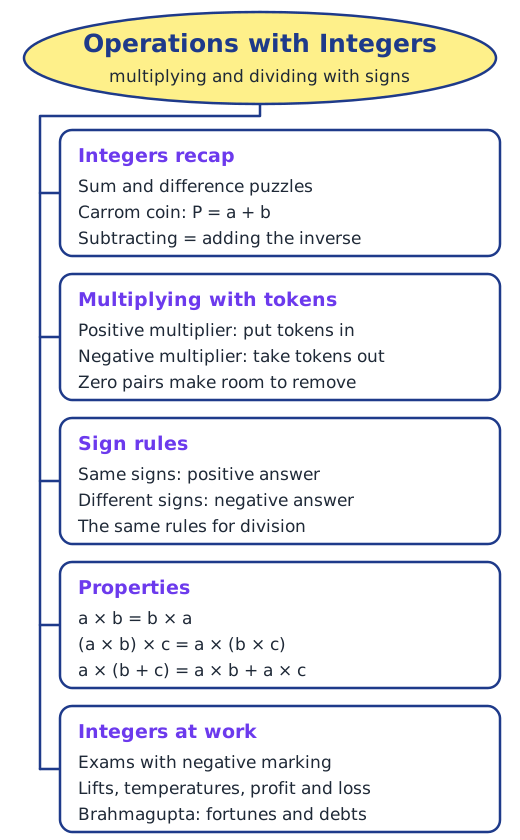
Operations with Integers extends multiplication and division to negative numbers. With tokens, a positive multiplier puts tokens into a bag and a negative multiplier takes them out. The product or quotient of two integers is positive when their signs are the same and negative when they differ. Integer multiplication is commutative and associative, and it distributes over addition, so a × (b + c) = a × b + a × c.
What is this chapter about?
In Class 6 you added and subtracted integers. Operations with Integers goes further: it gives meaning to multiplying and dividing negative numbers, using a bag of tokens and number patterns, finds the sign rules, and checks which properties of multiplication still hold. Along the way there are puzzles, a carrom coin, exam marks with negative marking, a lift in a mine, a magic grid and pattern machines.
A quick recap
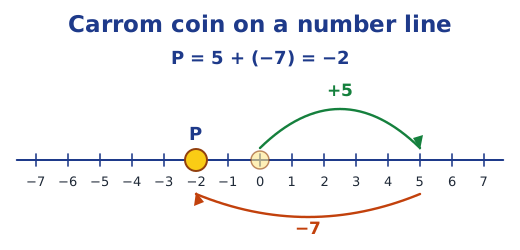
Rakesh thinks of two numbers whose sum is 25 and difference is 11: by trying pairs you find 18 and 7. For a difference of −11, swap them: 7 and 18. Integers also describe movement. If a carrom coin moves right for positive numbers and left for negative ones, two strikes a and b leave it at P = a + b: a strike of 5 and then −7 leaves it at −2.
With tokens, a green token is +1, a red token is −1, and a zero pair (one of each) is 0. To find 7 − 18, put in 11 zero pairs so that 18 positives can be removed; 11 negatives are left, so 7 − 18 = −11. Subtracting a number is the same as adding its additive inverse: 7 − 18 = 7 + (−18) and 4 − (−12) = 4 + 12.
Multiplying integers with tokens
Start with an empty bag. In a × b, the multiplier a says how many times, and the multiplicand b says which group of tokens. A positive multiplier puts groups in; a negative multiplier takes groups out.
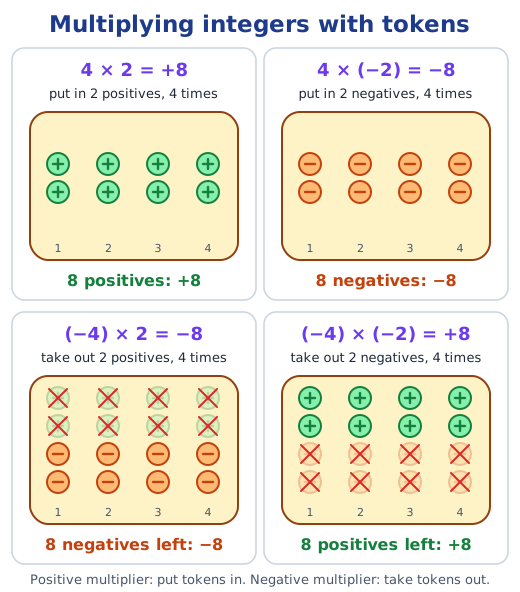
So 4 × (−2) puts 2 negatives in 4 times: −8. For (−4) × 2 the bag is empty, so put in 2 zero pairs each time and take out the 2 positives, 4 times; 8 negatives remain: −8. For (−4) × (−2), take out 2 negatives 4 times from zero pairs; 8 positives remain: +8. Read more in multiplying integers.
Patterns and sign rules
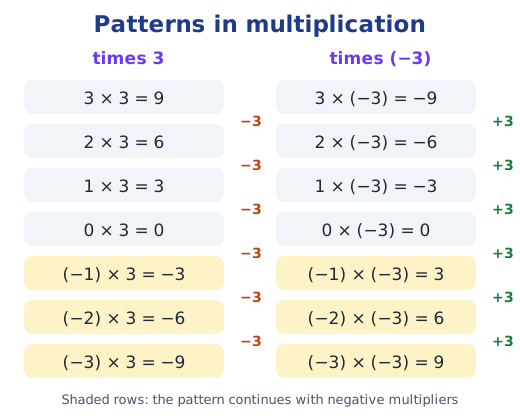
When the multiplicand is 3, each step down in the multiplier lowers the product by 3, and the pattern runs on past zero: (−1) × 3 = −3, (−2) × 3 = −6. When the multiplicand is −3, each step down raises the product by 3: (−1) × (−3) = 3, (−2) × (−3) = 6. So the size of the product is always the product of the sizes, and:
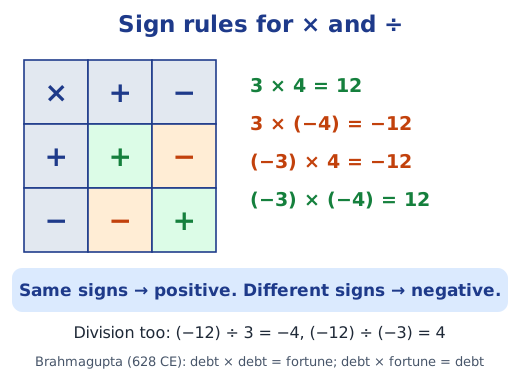
- Same signs (both positive or both negative): the product is positive.
- Different signs: the product is negative.
Also 1 × a = a, and (−1) × a = −a, the additive inverse of a. In 628 CE, Brahmagupta’s Brahmasphutasiddhanta gave these rules for the first time, calling positive numbers fortunes (dhana) and negative numbers debts (rina): the product or quotient of two fortunes, or of two debts, is a fortune, and of a fortune and a debt is a debt.
Integers at work
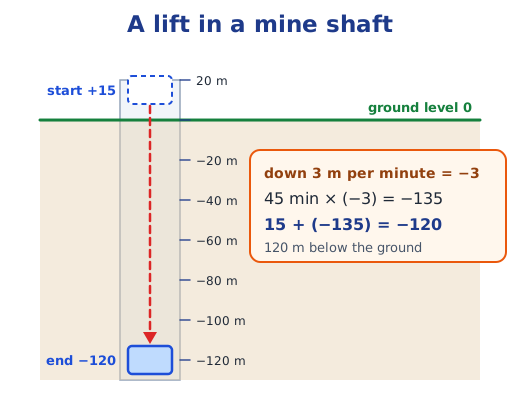
In an exam with +5 for a correct answer and −2 for a wrong one, Mala’s 30 correct and 20 wrong answers give 30 × 5 + 20 × (−2) = 150 + (−40) = 110 marks. A lift in a mine that goes down 3 m every minute changes its position by −3 each minute: from ground level it is at 60 × (−3) = −180 after an hour, and from 15 m above ground it is at 15 + 45 × (−3) = −120 after 45 minutes.
The magic grid
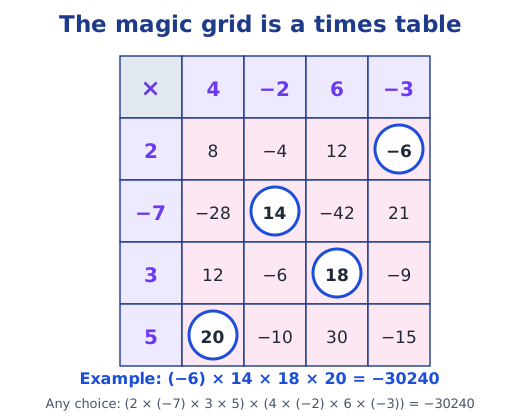
Circle a number in a 4 × 4 grid, strike out its row and column, and repeat until no number is left; then multiply the circled numbers. Whatever you choose, the product is −30240. The secret is that the grid is a multiplication table: each circled set uses every row number (2, −7, 3, 5) and every column number (4, −2, 6, −3) exactly once.
Dividing integers
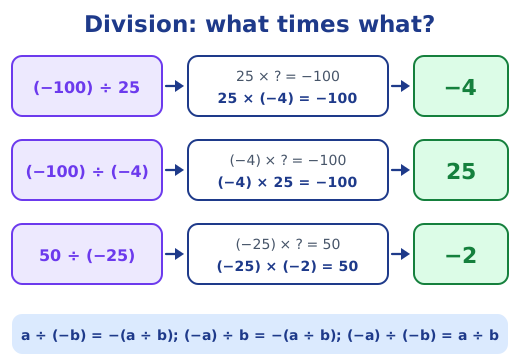
Division undoes multiplication. (−100) ÷ 25 asks what times 25 gives −100; since 25 × (−4) = −100, the answer is −4. In the same way (−100) ÷ (−4) = 25 and 50 ÷ (−25) = −2. Divide the magnitudes and use the same sign rules: same signs give a positive quotient, different signs a negative one. See dividing integers.
Properties of multiplication
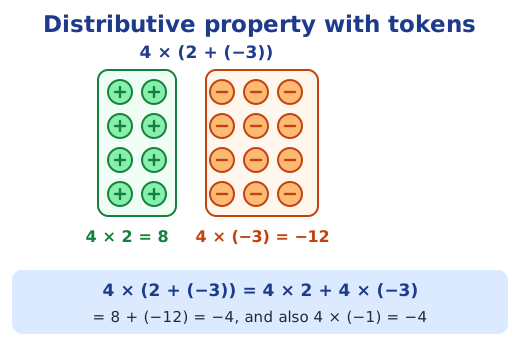
Multiplication of integers is commutative (3 × (−4) = (−4) × 3) and associative ((5 × (−3)) × 4 = 5 × ((−3) × 4) = −60), so several integers can be multiplied in any order. Multiplying −1 again and again gives 1, −1, 1, −1: a product with an odd number of negative factors is negative. Multiplication is also distributive over addition: 4 × (2 + (−3)) = 4 × 2 + 4 × (−3). Read properties of integer multiplication.
The chapter ends with pattern machines that take three numbers and give a result, such as a + b − c, for you to decode. Answers to every question are in the NCERT solutions for Part 2 Chapter 2.
Key terms
| Term | Meaning |
|---|---|
| Integer | A whole number that can be positive, negative or zero, such as −3, 0 or 7. |
| Additive inverse | The number that adds to a given number to make 0. The additive inverse of 18 is −18, and of −18 is 18. |
| Zero pair | One positive token and one negative token together. They cancel out, so a zero pair stands for 0. |
| Multiplier | In a × b, the first number a: how many times a group is put into, or taken out of, the bag. |
| Multiplicand | In a × b, the second number b: the group that is put in or taken out each time. |
| Magnitude | The size of an integer without its sign. The magnitude of −4 is 4; the sign gives the direction. |
| Commutative property | Swapping the numbers does not change the product: a × b = b × a. |
| Associative property | Grouping does not change the product: (a × b) × c = a × (b × c). |
| Distributive property | Multiplication spreads over addition: a × (b + c) = a × b + a × c. |
| Quotient | The answer to a division. In (−100) ÷ 25 = −4, the quotient is −4, the dividend is −100 and the divisor is 25. |
| Dhana and rina | Brahmagupta’s words for positive numbers (dhana, fortune) and negative numbers (rina, debt). |
Topics in this chapter
Practice
-
(−7) × (−6) = ?
Show answer
Answer: (b) 42
-
(−48) ÷ 6 = ?
Show answer
Answer: (b) −8
-
Which expression equals −a for every integer a?
Show answer
Answer: (b) (−1) × a
-
(−1) × (−1) × (−1) × (−1) × (−1) = ?
Show answer
Answer: (d) −1 There are five negative factors, an odd number, so the product is negative: −1.
-
A quiz gives +4 for a correct answer and −1 for a wrong one. Riya gets 5 right and 3 wrong. Her score is:
Show answer
Answer: (a) 17 5 × 4 + 3 × (−1) = 20 + (−3) = 17.
-
6 × ((−3) + 5) = 6 × (−3) + 6 × 5 shows which property?
Show answer
Answer: (c) Distributive
Questions students ask
What are the main topics of Class 7 Maths Part 2 Chapter 2?
A recap of integers with puzzles, a carrom coin on a number line and tokens; multiplying integers with tokens; patterns and sign rules; Brahmagupta’s rules; integers in word problems; the magic grid; dividing integers; the commutative, associative and distributive properties; and pattern machines.
Is Operations with Integers in the new Ganita Prakash book?
Yes. It is Chapter 2 of Ganita Prakash Grade 7 Part 2, the second Class 7 Maths book for the 2026-27 session, on pages 24 to 46.
Why is a negative times a negative positive?
With tokens, (−4) × (−2) means taking 2 negatives out of the bag 4 times. To do that you first put in zero pairs; removing the negatives leaves 8 positives, so the answer is +8. The pattern 1 × (−3) = −3, 0 × (−3) = 0, (−1) × (−3) = 3 shows the same thing.
Stuck on a question?
Take a photo and Lagnever AI explains it step by step. Try it for 7 days for ₹2.
Get it on Google Play Open in browser
For parents: after the trial, the plan renews monthly by UPI or card autopay. You can cancel anytime in the app.