
Multiplying integers
Answer in short
To multiply integers, multiply their magnitudes and then fix the sign: same signs give a positive product, different signs a negative one. With tokens, a positive multiplier puts groups of tokens into a bag and a negative multiplier takes them out, so (−4) × (−2) removes 2 negatives four times and leaves +8.
Stuck on a question? Take a photo and Lagnever AI explains it step by step. Try it for 7 days for ₹2. Get it on Google Play
The token model
Green tokens stand for +1 and red tokens for −1; a green and a red together form a zero pair, worth 0. To multiply, start with an empty bag. In a × b, the multiplier a tells you how many times, and the multiplicand b tells you which group of tokens:
- If the multiplier is positive, put the group into the bag that many times.
- If the multiplier is negative, take the group out of the bag that many times.
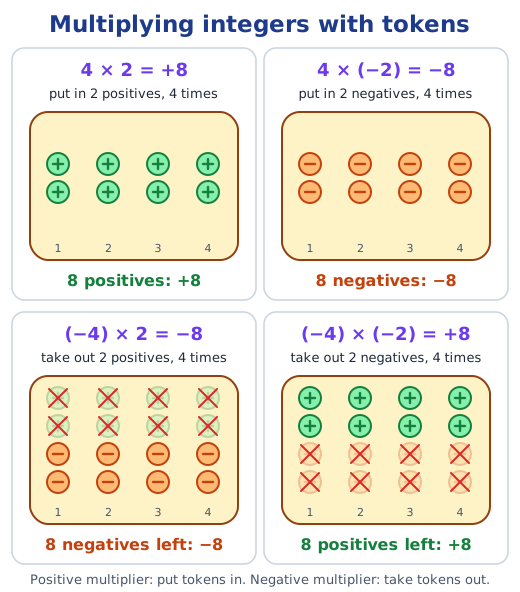
The four cases
- 4 × 2: put 2 positives in, 4 times: 8 positives, so +8.
- 4 × (−2): put 2 negatives in, 4 times: 8 negatives, so −8.
- (−4) × 2: take 2 positives out, 4 times. The bag is empty, so each time first put in 2 zero pairs, then take out the 2 positives. 8 negatives are left: −8.
- (−4) × (−2): take 2 negatives out, 4 times, again from zero pairs. 8 positives are left: +8.
Taking out positives does the same as putting in negatives, so (−4) × 2 can also be seen as adding 2 negatives 4 times. And a number gives the same answer however its tokens look: 2 red tokens, or 4 red and 2 green, both stand for −2, and 4 times either is −8.
Patterns that continue below zero
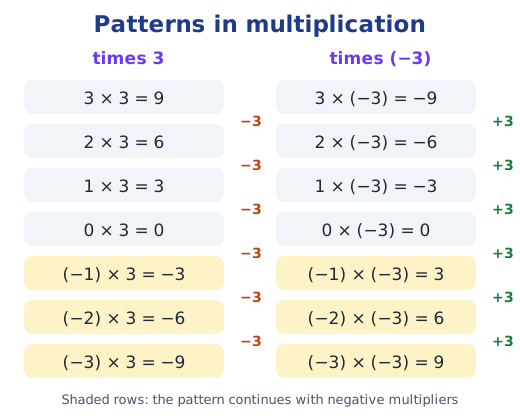
Write 3 × 3 = 9, 2 × 3 = 6, 1 × 3 = 3, 0 × 3 = 0. Each time the multiplier drops by 1, the product drops by 3, so the next ones are (−1) × 3 = −3 and (−2) × 3 = −6. With −3 as the multiplicand, each drop in the multiplier makes the product rise by 3: 0 × (−3) = 0, then (−1) × (−3) = 3 and (−2) × (−3) = 6. The patterns agree with the tokens.
The sign rules
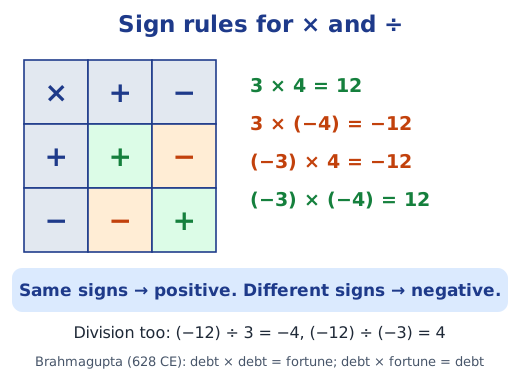
The magnitude of the product never depends on the signs: it is the product of the magnitudes. The sign follows these rules:
| Signs of the two numbers | Sign of the product |
|---|---|
| both positive, or both negative | positive |
| one positive, one negative | negative |
Two special cases are worth remembering: 1 × a = a, and (−1) × a = −a, the additive inverse of a. In 628 CE, Brahmagupta stated the same rules in words: the product of two fortunes, or of two debts, is a fortune; the product of a fortune and a debt is a debt. It was the first time anyone wrote them down.
Worked examples
- Negative marking: an exam gives +5 for a correct answer and −2 for a wrong one. Mala has 30 correct and 20 wrong: 30 × 5 + 20 × (−2) = 150 + (−40) = 110 marks. The highest possible score is 50 × 5 = 250 and the lowest, with all 50 wrong, is 50 × (−2) = −100.
- A lift in a mine: moving down 3 m a minute is −3 per minute, so in 60 minutes the change is 60 × (−3) = −180, that is 180 m below ground level.
- Without calculating: if 123 × 456 = 56088, then (−123) × 456 = −56088 and (−123) × (−456) = 56088, because only the sign changes.
Why it matters
Multiplying integers lets you handle repeated losses, falls in temperature, debts and movements below a starting point in one step. Next, learn dividing integers and the properties of integer multiplication. Answers to the textbook questions are in the NCERT solutions for Part 2 Chapter 2; see all of Part 2 Chapter 2 notes.
Practice
-
(−9) × 4 = ?
Show answer
Answer: (b) −36
-
Which product is positive?
Show answer
Answer: (c) (−6) × (−7)
-
If 123 × 456 = 56088, then (−123) × (−456) is:
Show answer
Answer: (b) 56088
-
Use tokens to explain why 3 × (−2) = −6.
Show answer
Answer: The multiplier 3 is positive, so put the group (−2), that is 2 red tokens, into an empty bag 3 times. The bag then holds 6 red tokens, which is −6.
-
A shop loses ₹15 on each damaged packet. What is the change in its money if 8 packets are damaged? Use integers.
Show answer
Answer: Each damaged packet is −15, so 8 × (−15) = −120. The shop’s money changes by −120, a loss of ₹120.
Questions students ask
What is the rule for multiplying integers?
Multiply the numbers without their signs. If both numbers have the same sign, the product is positive; if their signs are different, the product is negative. For example 5 × (−3) = −15 and (−5) × (−3) = 15.
How do tokens show (−4) × 2?
A negative multiplier means taking out. Starting from an empty bag, put in 2 zero pairs and take out 2 positive tokens, 4 times over. The 8 negative tokens left in the bag show that (−4) × 2 = −8.
Who first gave the rules for multiplying negative numbers?
Brahmagupta, in his Brahmasphutasiddhanta of 628 CE. He called positive numbers fortunes and negative numbers debts: the product of two fortunes or two debts is a fortune, and of a fortune and a debt is a debt.
Stuck on a question?
Take a photo and Lagnever AI explains it step by step. Try it for 7 days for ₹2.
Get it on Google Play Open in browser
For parents: after the trial, the plan renews monthly by UPI or card autopay. You can cancel anytime in the app.