
NCERT Solutions Class 7 Maths Part 2 Chapter 2: Operations with Integers
Answers to every “Figure it Out” question in Chapter 2, Operations with Integers, of Ganita Prakash Grade 7 Part 2 (2026-27), with the in-text, Math Talk and Try This questions. The page numbers match the Part 2 book (pages 24–46). Short notes: Part 2 Chapter 2 notes.
Rakesh’s puzzle (pages 24–25)
Sum 25, difference 11: the numbers are 18 and 7. Sum 25, difference −11: swap them, 7 and 18.
Figure it Out: find the pairs. (Tip: the first number is half of sum + difference, and the second is the sum minus the first.)
| Sum and difference | First and second number |
|---|---|
| (a) 27 and 9 | 18 and 9 |
| (b) 4 and 12 | 8 and −4 |
| (c) 0 and 10 | 5 and −5 |
| (d) 0 and −10 | −5 and 5 |
| (e) −7 and −1 | −4 and −3 |
| (f) −7 and −13 | −10 and 3 |
Check (f): −10 + 3 = −7 and −10 − 3 = −13.
Carrom coin integers (pages 25–27)
Two strikes of 4 and 3 units to the right: the coin is at 4 + 3 = 7. In general, strikes of a and b units leave it at P = a + b.
1. The first movement is −4 and the final position is 5. What is the second movement? −4 + b = 5, so b = 5 − (−4) = 9, that is 9 units to the right.
2. Movements 1, −2, 3, −4, …, −10. Final position? Pair them: (1 + (−2)) + (3 + (−4)) + … + (9 + (−10)) = five pairs of −1 = −5.
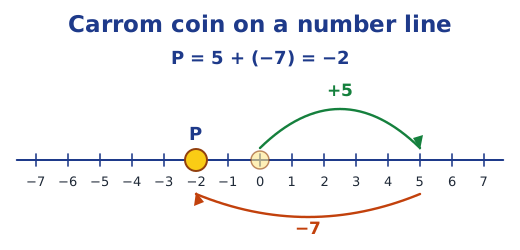
Try This: magnitudes and directions in the three figures.
- a is rightward (positive) and b is leftward (negative), and b is bigger in magnitude than a, so P is on the negative side.
- a is rightward (positive) and b is leftward (negative), and a is bigger in magnitude than b, so P is on the positive side.
- a is leftward (negative) and b is rightward (positive), with equal magnitudes, so P is back at 0.
Subtraction with tokens (page 28)
Math Talk: (a) 7 − 18 = 7 + (−18). Taking 18 positives from 7 positives needs 11 zero pairs and leaves 11 negatives. Adding 18 negatives to 7 positives makes 7 zero pairs and also leaves 11 negatives. Both give −11. (b) 4 − (−12) = 4 + 12. To take 12 negatives from 4 positives, put in 12 zero pairs and remove the negatives: 16 positives are left. Adding 12 positives to 4 positives also gives 16.
Multiplying integers (pages 29–31)
Find 4 × (−6) and 9 × (−7). Put 6 negatives in 4 times: −24. Put 7 negatives in 9 times: −63.
How can we read (−4) × 2? Why remove green tokens, not red? The negative multiplier says take out; the multiplicand 2 says the group is 2 positives. So we remove 2 green tokens, 4 times, after putting in zero pairs. We remove green because the group being multiplied is positive.
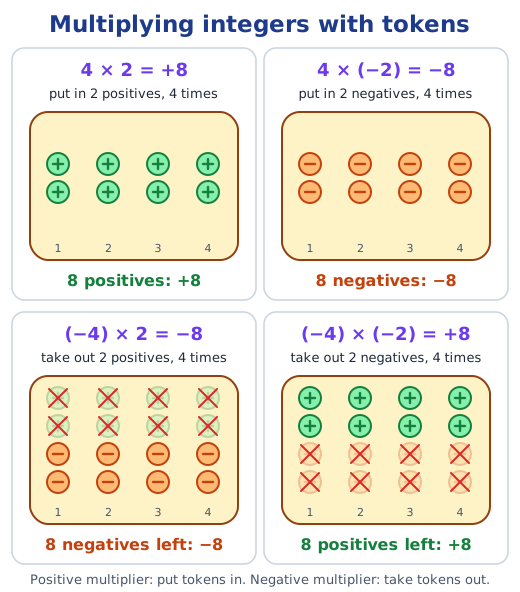
Figure it Out (page 31)
1. Using tokens: (a) 3 × (−2) = −6 (put 2 negatives in 3 times); (b) (−5) × (−2) = 10 (take 2 negatives out 5 times, leaving 10 positives); (c) (−4) × (−1) = 4; (d) (−7) × 3 = −21.
2. If 123 × 456 = 56088: (a) (−123) × 456 = −56088; (b) (−123) × (−456) = 56088; (c) 123 × (−456) = −56088. Only the sign changes.
3. A simple rule to multiply two integers: multiply the numbers without their signs; the product is positive if the signs are the same and negative if they are different.
Token sets for −2, taken 4 times: each set (2 negatives; 4 negatives and 2 positives; 6 negatives and 4 positives) is worth −2, and placing it in the bag 4 times always gives −8. The answer is the same because all three sets represent −2. For 5 × 4, sets such as 4 positives, or 6 positives and 2 negatives, all give 20.
Can (−4) × 2 be found by adding? Yes. Removing 2 positives is the same as adding 2 negatives, so add 2 negative tokens to the empty bag 4 times: −8.
Patterns and products (pages 32–34)
The pattern for 3: each time the multiplier goes down by 1, the product goes down by 3, and this continues below zero: (−1) × 3 = −3, (−2) × 3 = −6, (−3) × 3 = −9. The pattern for −3: each time the multiplier goes down by 1, the product goes up by 3: (−1) × (−3) = 3, (−2) × (−3) = 6, (−3) × (−3) = 9.
Figure it Out: find the products. (a) 4 × (−3) = −12; (b) (−6) × (−3) = 18; (c) (−5) × (−1) = 5; (d) (−8) × 4 = −32; (e) (−9) × 10 = −90; (f) 10 × (−17) = −170.
Fill in the blanks: −30 × 12 = −360 and 12 × −30 = −360; −5 × 14 = −70. Swapping the numbers does not change the product.
Integers at work (pages 35–37)
Mala’s exam: maximum and minimum possible marks. All 50 correct gives 50 × 5 = 250; all 50 wrong gives 50 × (−2) = −100.
Lift, part (b) by Method 1: in 45 minutes the lift goes down 45 × 3 = 135 m. Starting at 15, its position is 15 − 135 = −120, that is 120 m below the ground.
The magic grid (pages 37–38)
What product do you get? Every choice gives −30240. For example (−6) × 14 × 18 × 20 = −30240, and 8 × 14 × 18 × (−15) = −30240 too. The second grid is the same, so it also gives −30240.
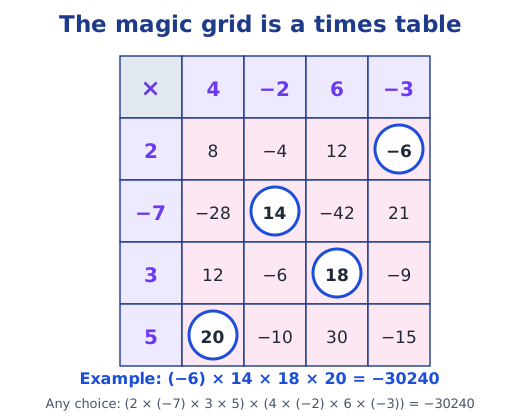
What is special about the grid? It is a multiplication table: each number is a row number (2, −7, 3 or 5) times a column number (4, −2, 6 or −3). One circled number from each row and column uses every row number and column number once, so the product is always (2 × (−7) × 3 × 5) × (4 × (−2) × 6 × (−3)) = (−210) × 144 = −30240. The magic is in the way the numbers are made. To make your own, pick four row numbers and four column numbers and fill each cell with their product.
Division of integers (pages 38–39)
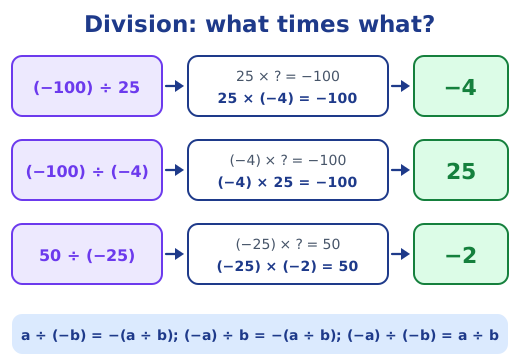
Rules from the pattern: for positive integers a and b, a ÷ (−b) = −(a ÷ b), (−a) ÷ b = −(a ÷ b) and (−a) ÷ (−b) = a ÷ b. Same signs give a positive quotient; different signs a negative one.
Figure it Out (page 39)
1. (a) 14 × (−15) = −210; (b) −16 × (−5) = 80; (c) 36 ÷ (−18) = −2; (d) (−46) ÷ (−23) = 2.
2. Room at 32 °C, lowered 5 °C every hour. Temperature after 10 hours? 32 + 10 × (−5) = 32 + (−50) = −18 °C.
3. Cement: profit ₹8 per bag of white (+8), loss ₹5 per bag of grey (−5). (a) 3,000 × 8 + 5,000 × (−5) = 24,000 + (−25,000) = −1,000: a loss of ₹1,000. (b) 6,400 grey bags give 6,400 × (−5) = −32,000. To balance this, white bags must earn 32,000: 32,000 ÷ 8 = 4,000 bags.
4. Fill in the blanks: (a) (−3) × (−9) = 27; (b) 5 × (−7) = −35; (c) 7 × (−8) = −56; (d) (−11) × (−12) = 132; (e) (−56) ÷ (−8) = 7; (f) (−132) ÷ 12 = −11.
Expressions using integers (pages 39–41)
Multiplying three integers in different groupings: (5 × −3) × 4 = −60 and 5 × (−3 × 4) = −60, so grouping does not matter (associative). Different orders for 5 × −3 × 4: (5 × 4) × −3, (−3 × 5) × 4, (4 × −3) × 5 and the others all give −60. 25 × −6 × 12 in all orders: 25 × −6 = −150 and −150 × 12 = −1800; −6 × 12 = −72 and −72 × 25 = −1800; 25 × 12 = 300 and 300 × −6 = −1800. The product is −1800 every time.
Multiplying −1 many times: the product is 1 when −1 is used an even number of times and −1 when it is used an odd number of times. Rule for the sign of a product of many integers: count the negative factors; an even count gives a positive product, an odd count a negative one.
Distributive property: (−2) × (4 + (−3)) = (−2) × 1 = −2, and (−2) × 4 + (−2) × (−3) = −8 + 6 = −2, so they are equal. Another check: (−5) × ((−3) + 7) = −20 and (−5) × (−3) + (−5) × 7 = 15 + (−35) = −20.
Try This: show −4 × (2 + (−3)) with tokens. Multiplying by −4 means adding the inverse 4 times. The inverse of 2 positives and 3 negatives is 2 negatives and 3 positives, so make 4 rows of that. The 4 rows of 2 negatives are −4 × 2 = −8, the 4 rows of 3 positives are −4 × (−3) = 12, and the whole rectangle is −8 + 12 = 4, which equals −4 × (−1).
Pick the pattern (pages 41–42)
Machine 1 does (first) + (second) − (third). The last row is (−10) + (−12) − (−9) = −13.
Machine 2 does −((first) × (second)) − (third), that is, −(a × b + c). Check: −(4 × 8) − (−3) = −32 + 3 = −29, and −(6 × (−11)) − 12 = 66 − 12 = 54. The last row is −((−10) × (−12)) − (−9) = −120 + 9 = −111.
Figure it Out (pages 42–44)
1. (a) (−5) × (18 + (−3)) = (−5) × 15 = −75; (b) (−7) × 4 × (−1) = 28; (c) (−2) × (−1) × (−5) × (−3) = 30 (four negative factors).
2. (a) (−27) ÷ 9 = −3; (b) 84 ÷ (−4) = −21; (c) (−56) ÷ (−2) = 28.
3. The integer whose product with (−1) is: (a) 27 → −27; (b) −31 → 31; (c) −1 → 1; (d) 1 → −1; (e) 0 → 0.
4. The second expression is the first one with every sign changed, that is, (−1) × (47 − 56 + 14 − 8 + 2 − 8 + 5). So its value is (−1) × (−4) = 4.
5. Collatz with integers (odd: multiply by −3 and add 1; even: halve). Note: in the book’s example, 11 is followed by 32; it should be −32, since 11 × (−3) + 1 = −32, which halves to −16 as shown.
- From −21: −21, 64, 32, 16, 8, 4, 2, 1, −2, −1, 4, 2, 1, …
- From −6: −6, −3, 10, 5, −14, −7, 22, 11, −32, −16, −8, −4, −2, −1, 4, 2, 1, …
Pattern: these sequences end in the loop 1 → −2 → −1 → 4 → 2 → 1, and 0 stays at 0. (Extra: a few starting numbers, such as 13 or −17, fall into a much longer loop of 31 numbers that never reaches 1, which a computer check shows.)
6. +4 for each correct answer, −2 for each incorrect one. (a) Anita’s 15 correct answers earn 60. Her score is 40, so incorrect answers cost 40 − 60 = −20, which is 10 incorrect answers. She answered all, so the test has 15 + 10 = 25 questions, with 10 incorrect. (b) Anil’s 5 correct answers earn 20. His score is −10, so incorrect answers cost −30, which is 15 incorrect answers. In the same 25-question test, he answered 20, so he left 5 unanswered.
7. Pick the pattern. The machine does (first) − (second) × (third). Check: 4 − 8 × (−3) = 4 + 24 = 28, and 6 − 9 × 6 = −48. The last row is (−16) − (−6) × (−9) = −16 − 54 = −70.
8. After 4 hours of falling 5 °C an hour: 8 + 4 × (−5), which is 8 − 20 = −12 °C.
9. (a) −3, −2, −1, since (−3) × (−2) × (−1) = −6. (b) 4, 5, 6, since 4 × 5 × 6 = 120. (−6, −5, −4 would give −120.)
10. Coins of +13 and −9 pibs.
| Total | Coins (+13s and −9s) |
|---|---|
| (a) +20 | 5 and 5: 65 − 45 |
| (b) +40 | 10 and 10: 130 − 90 |
| (c) −50 | 1 and 7: 13 − 63 |
| (d) +8 | 2 and 2: 26 − 18 |
| (e) +10 | 7 and 9: 91 − 81 |
| (f) −2 | 4 and 6: 52 − 54 |
| (g) +1 | 7 and 10: 91 − 90 |
(h) Yes. Since +1 can be made, any whole number of pibs can be made. For 1568: 122 coins of +13 and 2 coins of −9 give 1586 − 18 = 1568.
11. (a) (32 × (−18)) ÷ (−36) = (−576) ÷ (−36) = 16. (b) 32 ÷ ((−36) × (−18)) = 32 ÷ 648 = 4/81, a positive fraction, not an integer. (c) (25 × (−12)) ÷ (45 × (−27)) = (−300) ÷ (−1215) = 20/81, also positive. (d) (280 × (−7)) ÷ ((−8) × (−35)) = (−1960) ÷ 280 = −7.
12. Values: (a) −1412; (b) 716; (c) 1412; (d) 370272; (e) −370272; (f) 335472. In increasing order: (e) < (a) < (b) < (c) < (f) < (d).
13. Given (−548) × 972 = −532656: (a) (−547) × 972 = −532656 + 972 = −531684. (b) (−548) × 971 = −532656 + 548 = −532108. (c) (−547) × 971 = −531684 + 547 = −531137.
14. −207 × (33 − 7) = −207 × 26 and 207 × (−33 + 7) = 207 × (−26); both equal −(207 × 26). So the value is −5382.
15. (a) Maximum: ((−2) − (3 + 5)) × (−6) = (−10) × (−6) = 60. (b) Minimum: ((3 + 5) − (−2)) × (−6) = 10 × (−6) = −60. Checking every arrangement shows nothing bigger than 60 or smaller than −60.
16. Five ways each (other answers are possible):
- (a) ___ + ___ × ___ = −36: 0 + 6 × (−6); (−6) + (−5) × 6; 4 + (−8) × 5; 6 + (−6) × 7; 14 + (−10) × 5.
- (b) (___ − ___) × ___ = 12: (5 − 2) × 4; (2 − 5) × (−4); (−1 − 3) × (−3); (10 − 4) × 2; (0 − 6) × (−2).
- (c) (___ − (___ − ___)) = −1: (1 − (5 − 3)); (0 − (4 − 3)); (2 − (6 − 3)); (−3 − ((−5) − (−3))); (5 − (2 − (−4))).
Practice
-
(−12) × (−5) ÷ (−3) = ?
Show answer
Answer: (b) −20 (−12) × (−5) = 60, and 60 ÷ (−3) = −20.
-
Two integers have sum −3 and difference 11. They are:
Show answer
Answer: (a) 4 and −7 4 + (−7) = −3 and 4 − (−7) = 11.
-
The sign of (−2) × (−3) × (−4) × 5 is:
Show answer
Answer: (b) negative Three negative factors, an odd number, make the product negative: −120.
-
A submarine is at −40 m and rises 6 m every minute for 5 minutes. Where is it then?
Show answer
Answer: Its change is 5 × 6 = 30, so its position is −40 + 30 = −10, that is 10 m below the surface.
-
Find two different pairs of integers whose product is −24 and whose sum is 2 or −2.
Show answer
Answer: 6 × (−4) = −24 with sum 2, and (−6) × 4 = −24 with sum −2.
Stuck on a question?
Take a photo and Lagnever AI explains it step by step. Try it for 7 days for ₹2.
Get it on Google Play Open in browser
For parents: after the trial, the plan renews monthly by UPI or card autopay. You can cancel anytime in the app.