
Dividing integers
Answer in short
To divide integers, ask what number times the divisor gives the dividend. Since 25 × (−4) = −100, (−100) ÷ 25 = −4. Divide the magnitudes and then fix the sign: the quotient is positive when the dividend and divisor have the same sign and negative when their signs differ. You can never divide by zero.
Stuck on a question? Take a photo and Lagnever AI explains it step by step. Try it for 7 days for ₹2. Get it on Google Play
Division undoes multiplication
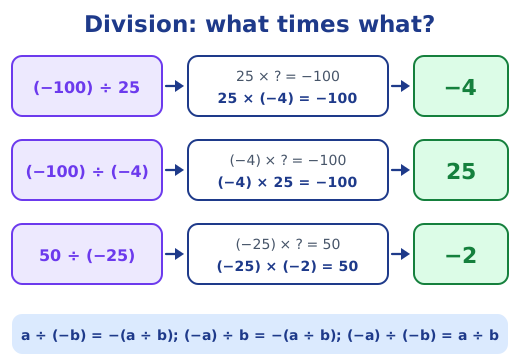
You already know that 20 ÷ 4 = 5 because 4 × 5 = 20. Division asks for a missing factor. The same idea works for negative numbers: to find (−100) ÷ 25, ask what number times 25 gives −100? Since 25 × (−4) = −100, we get (−100) ÷ 25 = −4.
In the same way:
- (−100) ÷ (−4): what times −4 gives −100? (−4) × 25 = −100, so the answer is 25.
- 50 ÷ (−25): what times −25 gives 50? (−25) × (−2) = 50, so the answer is −2.
The sign rules for division
Because division undoes multiplication, its signs follow the same rules. For positive integers a and b (b not 0):
| Division | Result |
|---|---|
| a ÷ (−b) | −(a ÷ b), negative |
| (−a) ÷ b | −(a ÷ b), negative |
| (−a) ÷ (−b) | a ÷ b, positive |
In short: divide the magnitudes; same signs give a positive quotient, different signs a negative one. Brahmagupta’s rules from 628 CE cover division too: the quotient of two debts is a fortune, and the quotient of a fortune and a debt is a debt.
Worked examples
- 36 ÷ (−18) = −2 (different signs).
- (−46) ÷ (−23) = 2 (same signs).
- (−27) ÷ 9 = −3, and (−56) ÷ (−2) = 28.
- Missing numbers: ___ ÷ (−8) = 7 means (−8) × 7 = ___, so the blank is −56; ___ ÷ 12 = −11 means 12 × (−11), so the blank is −132.
Division in everyday problems
- Temperature: the temperature at a hill station fell by 18 °C over 6 hours, at a steady rate. The change each hour is (−18) ÷ 6 = −3 °C.
- Shared loss: four friends running a stall make a loss of ₹1,200 and share it equally. Each one’s share is (−1200) ÷ 4 = −300, a loss of ₹300.
- Going down: a lift moves from ground level to −180 m in 60 minutes at a steady speed. Each minute it moves (−180) ÷ 60 = −3 m, that is 3 m down.
Things to watch out for
Division is not commutative: 12 ÷ (−3) = −4, but (−3) ÷ 12 = −1/4. The quotient of two integers need not be an integer at all; for example 32 ÷ ((−36) × (−18)) = 32 ÷ 648 = 4/81, a positive fraction because both negative factors make the divisor positive. And no number can be divided by zero: no number times 0 gives a non-zero answer, so the question has no answer.
Why it matters
Division of integers answers questions like “how much each time?” or “how much each?” when the amounts are losses, falls or debts. To check a division, multiply back: the quotient times the divisor must give the dividend. Review multiplying integers and the properties of integer multiplication. Answers to the textbook questions are in the NCERT solutions for Part 2 Chapter 2; see all of Part 2 Chapter 2 notes.
Practice
-
(−56) ÷ (−8) = ?
Show answer
Answer: (b) 7
-
84 ÷ (−4) = ?
Show answer
Answer: (b) −21
-
Which number makes ___ ÷ 12 = −11 true?
Show answer
Answer: (b) −132
-
A diver goes down 45 m in 9 equal stages. What is the change in depth at each stage, as an integer?
Show answer
Answer: The total change is −45 m, so each stage is (−45) ÷ 9 = −5, that is 5 m down each time.
-
Explain why (−100) ÷ (−4) = 25.
Show answer
Answer: Division asks what number times −4 gives −100. Since (−4) × 25 = −100, the answer is 25. Both numbers are negative, so the quotient is positive.
Questions students ask
What is the rule for dividing integers?
Divide the numbers without their signs. If the dividend and the divisor have the same sign, the quotient is positive; if their signs are different, it is negative. For example (−36) ÷ 9 = −4 and (−36) ÷ (−9) = 4.
How is division of integers related to multiplication?
Every division can be turned into a multiplication with a missing number. (−100) ÷ 25 asks what times 25 makes −100; because 25 × (−4) = −100, the quotient is −4.
Is the quotient of two integers always an integer?
No. 32 ÷ 648, for example, is the fraction 4/81, and (−3) ÷ 12 is −1/4. The sign rules still apply even when the quotient is a fraction.
Stuck on a question?
Take a photo and Lagnever AI explains it step by step. Try it for 7 days for ₹2.
Get it on Google Play Open in browser
For parents: after the trial, the plan renews monthly by UPI or card autopay. You can cancel anytime in the app.