
Simplifying algebraic expressions
Answer in short
To simplify an algebraic expression, remove the brackets, remembering that a minus sign before a bracket changes every sign inside, and multiply out with the distributive property. Then add the like terms, those with the same letter-numbers, and the number terms: 5c + 3c + 10c = 18c. Unlike terms, such as 18c and 11d, stay separate.
Stuck on a question? Take a photo and Lagnever AI explains it step by step. Try it for 7 days for ₹2. Get it on Google Play
The same rules as numbers
In the chapter on arithmetic expressions we learnt that terms can be swapped and grouped, that brackets can be removed carefully, and that the distributive property holds: a multiple of a sum equals the sum of the multiples. Since letter-numbers stand for numbers, all these rules work for algebraic expressions too.
Simplifying the perimeter of a rectangle
The perimeter p of a rectangle of length l and breadth b is l + b + l + b. Swapping terms gives l + l + b + b, and since l + l = 2l and b + b = 2b, p = 2l + 2b. The two expressions look different but are equal: for l = 3 and b = 4 both give 14, and they give the same value for every l and b. The shorter one is called the simplified form.
Like and unlike terms
A shop sells 5, 3 and 10 pencils at c rupees each over three days, so the pencils earn 5c + 3c + 10c. Here c is added 5 + 3 + 10 times, so by the distributive property the total is (5 + 3 + 10) × c = 18c; with c = ₹50 that is ₹900. The erasers, at d rupees each, earn 4d + 6d + d = 11d, so the total is 18c + 11d. This cannot be simplified further, because c and d are different letter-numbers.
Terms with the same letter-numbers, such as 5c, 3c and 10c, or 12n and −4n, are like terms; terms such as 18c and 11d are unlike terms. Like terms add into a single term; unlike terms stay separate.
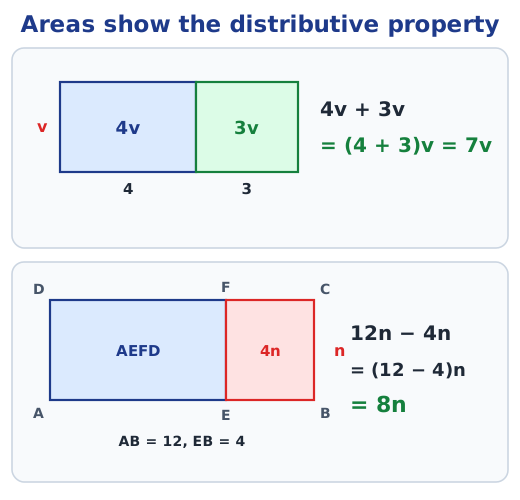
Brackets with a minus sign
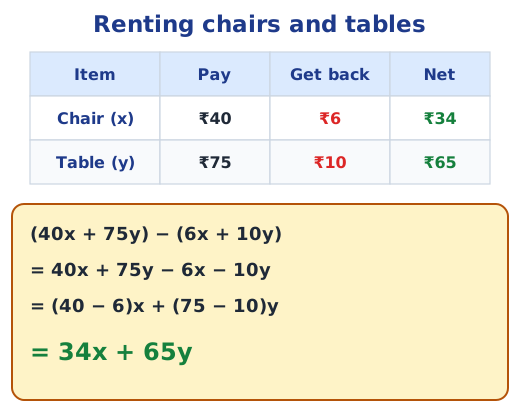
A shop rents chairs for ₹40 and tables for ₹75 and pays back ₹6 and ₹10 when they are returned. For x chairs and y tables the net amount is (40x + 75y) − (6x + 10y). The minus sign changes the signs inside the second bracket, giving 40x + 75y − 6x − 10y, and grouping like terms gives (40 − 6)x + (75 − 10)y = 34x + 65y. We could also write the start as (40x + 75y) + (−6x − 10y), since taking away a bracket is adding its inverse.
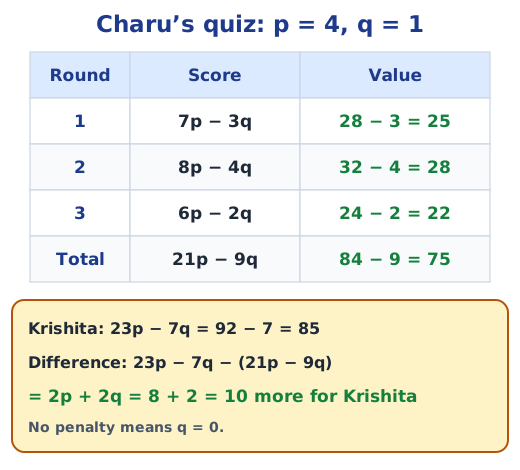
In a quiz, each right answer earns p points and each wrong one loses q. Charu’s rounds give 7p − 3q, 8p − 4q and 6p − 2q, which add to 21p − 9q; Krishita’s total is 23p − 7q. The difference, 23p − 7q − (21p − 9q), simplifies to 2p + 2q, which is positive, so Krishita scored more. A number before a bracket multiplies every term: 4(x + y) − y = 4x + 4y − y = 4x + 3y.
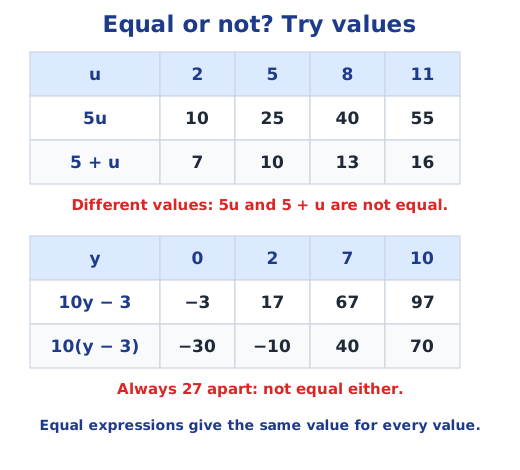
Equal or not?
Two expressions are equal only if they give the same value for every value of the letters. 5u means 5 times u, while 5 + u means 5 more than u; for u = 2 they give 10 and 7, so they are not equal. Similarly 10y − 3 (3 less than 10 times y) and 10(y − 3) (10 times 3 less than y) give 17 and −10 when y = 2.
Common slips
- 3a + 2b is not 5: unlike terms do not add.
- 6(p + 2) is 6p + 12: multiply both terms.
- (4x + 3y) − (3x + 4y) is x − y, not x + y: the minus sign changes both signs.
- 5 − (2 − 6z) is 3 + 6z.
- 2y + (3y − 6) is 5y − 6: a plus sign before a bracket changes nothing.
- 5(2w + 3x + 4w) is 30w + 15x, after adding the like terms 10w and 20w.
Why it matters
Simplified expressions are easier to read, compare and use. How letter-numbers are written and evaluated is explained in letter-numbers and algebraic expressions, and how simplifying proves patterns in patterns and relationships with algebra. Answers to every question are in the NCERT solutions for Chapter 4; see all of the Chapter 4 notes.
Practice
-
What is the simplest form of 7p − p + 5q − 2q?
Show answer
Answer: (b) 6p + 3q
-
What is 5 − (2 − 6z) in its simplest form?
Show answer
Answer: (b) 3 + 6z
-
Are 5u and 5 + u equal expressions?
Show answer
Answer: (b) No: for u = 2 they are 10 and 7
-
Simplify 4(x + y) − y.
Show answer
Answer: By the distributive property, 4(x + y) = 4x + 4y. Then 4x + 4y − y = 4x + (4 − 1)y = 4x + 3y.
-
Charu scored 7p − 3q, 8p − 4q and 6p − 2q in three quiz rounds. What is her total, and what is it when p = 4 and q = 1?
Show answer
Answer: Adding like terms: (7 + 8 + 6)p − (3 + 4 + 2)q = 21p − 9q. With p = 4 and q = 1 it is 84 − 9 = 75.
Questions students ask
What are like and unlike terms?
Like terms have the same letter-numbers, such as 5c, 3c and 10c, or 12n and −4n. They can be added into a single term: 5c + 3c + 10c = 18c. Unlike terms have different letter-numbers, such as 18c and 11d, and cannot be combined, so 18c + 11d is already in its simplest form.
How do you remove brackets in an algebraic expression?
If a plus sign comes before a bracket, just remove the bracket: 2 + (x + 3) = x + 5. If a minus sign comes before it, change the sign of every term inside: (40x + 75y) − (6x + 10y) = 40x + 75y − 6x − 10y = 34x + 65y. If a number multiplies a bracket, multiply each term: 6(p + 2) = 6p + 12.
How can you tell whether two expressions are equal?
Two expressions are equal if they give the same value for every value of their letter-numbers, which is certain when one simplifies into the other, like l + b + l + b and 2l + 2b. Trying a few values quickly shows when they are not: 10y − 3 and 10(y − 3) give 17 and −10 when y = 2.
Stuck on a question?
Take a photo and Lagnever AI explains it step by step. Try it for 7 days for ₹2.
Get it on Google Play Open in browser
For parents: after the trial, the plan renews monthly by UPI or card autopay. You can cancel anytime in the app.