
Patterns and relationships with algebra
Answer in short
Algebra describes patterns and explains why they hold. Describe the rule in words, choose letter-numbers, then write an expression: the nth C in A, B, C, A, B, C, … is at 3n; matchstick triangles need 2y + 1 sticks at step y; and in a calendar’s 2 × 2 square with top-left a, both diagonals add to 2a + 8.
Stuck on a question? Take a photo and Lagnever AI explains it step by step. Try it for 7 days for ₹2. Get it on Google Play
Patterns, then expressions
Algebraic expressions can do more than record a rule: they can show why a pattern must always hold. The approach is always the same. Describe the relationship in simple words, or draw it, then replace the changing quantity by a letter-number and write the expression.
Formula Detective
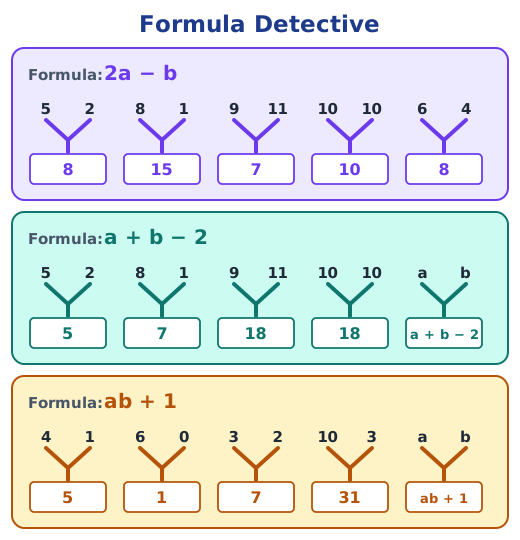
A number machine takes two numbers at the top of a Y and gives one at the bottom, doing the same thing every time. One machine turns 5 and 2 into 8, 8 and 1 into 15, 9 and 11 into 7, and 10 and 10 into 10. Its rule: double the first number, then subtract the second, 2a − b, so 6 and 4 give 2 × 6 − 4 = 8. Another turns 5 and 2 into 5, and 9 and 11 into 18: it adds the numbers and takes away 2, a + b − 2. A third turns 4 and 1 into 5 and 6 and 0 into 1: it multiplies and adds 1, ab + 1, so 10 and 3 give 31.
Repeating designs
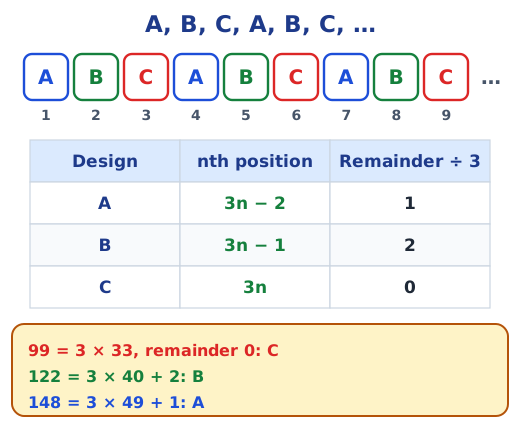
Somjit sees designs A, B and C repeating along a saree border. Design C is at positions 3, 6, 9, …, the multiples of 3, so its nth appearance is at 3n. B is always one place earlier, at 3n − 1, and A two places earlier, at 3n − 2. To go the other way, divide the position by 3: a remainder of 0 means C, 2 means B and 1 means A. So position 99 has C, 122 has B and 148 has A.
Patterns in a calendar
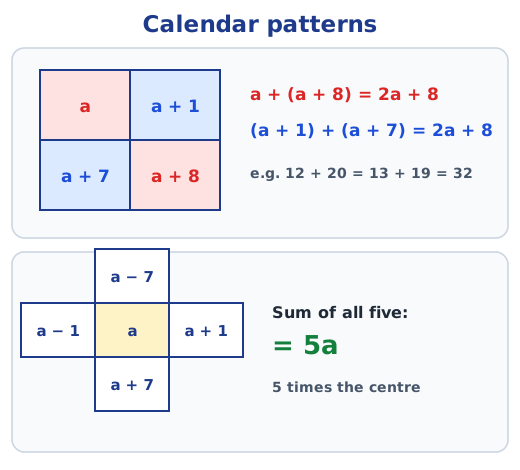
In the November 2024 calendar, the 2 × 2 square with 12, 13, 19 and 20 has equal diagonal sums: 12 + 20 = 32 and 13 + 19 = 32. Is that true for every 2 × 2 square, even in a calendar continued without end? Checking them all is impossible, but algebra settles it. Call the top-left number a. The number to its right is a + 1, the one below is a + 7, and the one diagonally below is a + 8. The diagonal sums are a + (a + 8) = 2a + 8 and (a + 1) + (a + 7) = 2a + 8: equal for every a, so for every square.
The same idea works for other shapes. In a plus shape with centre a, the numbers are a − 7, a − 1, a, a + 1 and a + 7, and they add to 5a, five times the centre.
Matchstick patterns
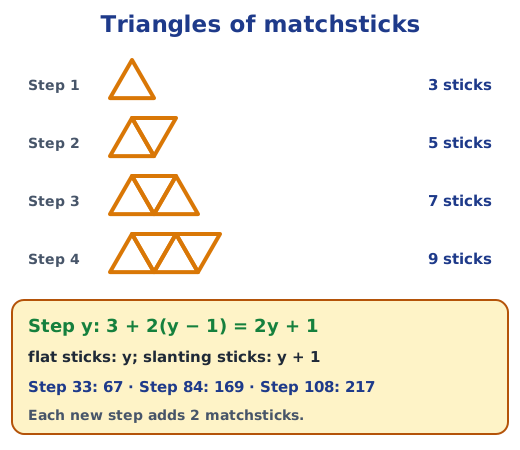
A row of triangles made of matchsticks needs 3 sticks for step 1, 5 for step 2, 7 for step 3 and 9 for step 4: each step adds 2. Step y adds 2 to the first 3 sticks y − 1 times, so it needs 3 + 2(y − 1) sticks, which simplifies to 2y + 1. Seeing that the first 3 is 1 + 2 gives 2y + 1 directly. Counting another way, there are y flat sticks along the top and bottom and y + 1 slanting ones, which again add up to 2y + 1. So step 33 needs 67 sticks, step 84 needs 169 and step 108 needs 217.
Why it matters
Mathematicians do not trust a pattern until they can explain it, and algebra is how they do it. The basics of writing expressions are in letter-numbers and algebraic expressions, and the simplifying used in these proofs in simplifying algebraic expressions. More patterns, such as traffic signals, ropes and number grids, are solved in the NCERT solutions for Chapter 4; see all of the Chapter 4 notes.
Practice
-
A number machine gives 5 from 4 and 1, 1 from 6 and 0, and 7 from 3 and 2. What is its formula?
Show answer
Answer: (b) ab + 1
-
In the pattern A, B, C, A, B, C, …, where is the nth B?
Show answer
Answer: (b) 3n − 1
-
How many matchsticks are needed for step 33 of the triangle pattern (2y + 1)?
Show answer
Answer: (b) 67
-
In a calendar, a plus shape has centre a. Show that the five numbers add to 5 times the centre.
Show answer
Answer: The numbers above and below are a − 7 and a + 7, and those to the left and right are a − 1 and a + 1. Their sum is (a − 7) + (a − 1) + a + (a + 1) + (a + 7) = 5a, since the numbers cancel out.
-
Which design is at position 148 in A, B, C, A, B, C, …?
Show answer
Answer: 148 = 3 × 49 + 1, so the remainder on dividing by 3 is 1. Positions with remainder 1 have design A, so position 148 has A.
Questions students ask
How is algebra used to describe patterns?
First describe the pattern in words, then choose a letter-number for the quantity that changes, and write the rule as an expression. In a saree border with designs A, B and C repeating, C appears at the multiples of 3, so the nth C is at position 3n; B is just before it, at 3n − 1, and A at 3n − 2.
Why are the diagonal sums of a 2 × 2 calendar square always equal?
If the top-left date is a, the date to its right is a + 1, the one below is a + 7 and the one diagonally below is a + 8. The diagonal sums are a + (a + 8) = 2a + 8 and (a + 1) + (a + 7) = 2a + 8. They are equal for every value of a, so for every 2 × 2 square, even in a calendar extended without end.
How do you find the formula for a matchstick pattern?
Count the sticks in the first few steps and see how they grow. Triangles in a row need 3, 5, 7, 9, …: start with 3 and add 2 at each new step. At step y there are y − 1 additions, so the total is 3 + 2(y − 1), which simplifies to 2y + 1. Counting flat sticks (y) and slanting sticks (y + 1) gives the same answer.
Stuck on a question?
Take a photo and Lagnever AI explains it step by step. Try it for 7 days for ₹2.
Get it on Google Play Open in browser
For parents: after the trial, the plan renews monthly by UPI or card autopay. You can cancel anytime in the app.