
NCERT Solutions Class 7 Maths Chapter 4: Expressions using Letter-Numbers
Answers to every question in Chapter 4, Expressions using Letter-Numbers, of Ganita Prakash Grade 7 Part 1 (Reprint 2026-27): the questions in the text, both Mind the Mistake sets, the Math Talk and Try This questions, and all three Figure it Out sets. Page numbers follow the book (pages 81–105). Every simplification was worked out twice. Short notes: Chapter 4 notes.
The Notion of Letter-Numbers (pages 81–84)
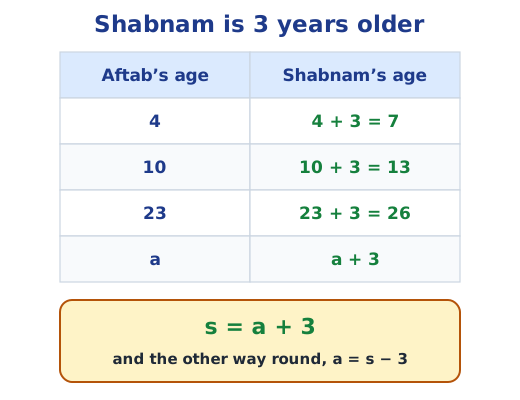
Aftab is 18. How old is Shabnam? 18 + 3 = 21. If Shabnam is 20, how old is Aftab? a = s − 3 = 20 − 3 = 17.
If a is 23, what is Shabnam’s age? s = 23 + 3 = 26 years.
Matchstick Ls. 5 Ls need 10 sticks, 7 Ls need 14, 45 Ls need 90, and n Ls need 2n.
Ketaki’s laddus. 8 coconuts and 9 kg of jaggery cost 8 × 35 + 9 × 60 = 280 + 540 = ₹820. With c × 35 + j × 60, 7 coconuts and 4 kg cost 245 + 240 = ₹485.
Perimeter of a square of side 7 cm. 4q = 4 × 7 = 28 cm.
Figure it Out (pages 84–85)
- With q for the side length: (a) triangle with equal sides: 3q; (b) regular pentagon: 5q; (c) regular hexagon: 6q.
- The combined length is 20 + k metres.
- The table, written as a list:
3, 5, 6 notes: 3 × 100 + 5 × 20 + 6 × 5 = 430
6, 4, 3 notes: 6 × 100 + 4 × 20 + 3 × 5 = 695 (the example)
8, 4, z notes: 8 × 100 + 4 × 20 + z × 5 = 880 + 5z
x, y, z notes: 100x + 20y + 5z - (d) 10 + 8 × y: 10 seconds to start, then 8 seconds for each of the y kg.
- With x for the number: (a) x + 5 (b) x − 4 (c) 13x − 2 (d) 2x − 13.
- (a) 8 × x + 3 × y: buying 8 notebooks at ₹x each and 3 pens at ₹y each costs 8x + 3y rupees.
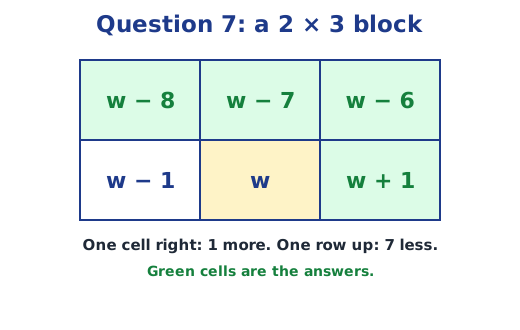
(b) 15 × j − 2 × k: a game gives 15 points for each of j goals and takes away 2 points for each of k fouls, so the score is 15j − 2k. - Bottom row: w − 1, w, w + 1. Top row, one week earlier: w − 8, w − 7, w − 6.
Revisiting Arithmetic Expressions (pages 85–86)
- 23 − 10 × 2 = 23 + (−20) = 3
- 83 + 28 − 13 + 32 = (83 − 13) + (28 + 32) = 70 + 60 = 130
- 34 − 14 + 20 = 40
- 42 + 15 − (8 − 7) = 57 − 1 = 56
- 68 − (18 + 13) = 68 − 31 = 37
- 7 × 4 + 9 × 6 = 28 + 54 = 82
- 20 + 8 × (16 − 6) = 20 + 80 = 100
Omitting the Multiplication Symbol (pages 86–87)
The sequence 4, 8, 12, 16, …. Third term: 4 × 3 = 12; 29th term: 4 × 29 = 116; nth term: 4n.
Mind the Mistake, Mend the Mistake (page 87)
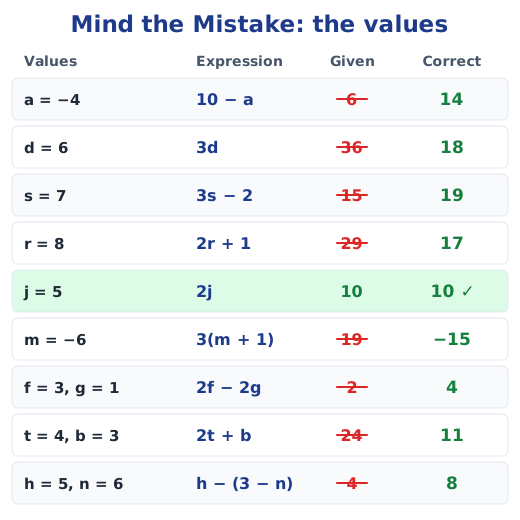
- Mistake. 10 − a = 10 − (−4) = 14, not 6: taking away −4 adds 4.
- Mistake. 3d = 3 × 6 = 18; 36 came from writing 3 and 6 side by side.
- Mistake. 3s − 2 = 21 − 2 = 19; 15 came from 3 × (7 − 2), but the 3 multiplies only s.
- Mistake. 2r + 1 = 16 + 1 = 17; 29 came from reading 2r as 28.
- Correct. 2j = 2 × 5 = 10.
- Mistake. 3(m + 1) = 3 × (−6 + 1) = 3 × (−5) = −15; 19 came from 3 × 6 + 1, ignoring the sign and the bracket.
- Mistake. 2f − 2g = 6 − 2 = 4; 2 came from reading 2f as 23 and 2g as 21.
- Mistake. 2t + b = 8 + 3 = 11; 24 came from multiplying 2 × 4 × 3.
- Mistake. h − (3 − n) = 5 − (3 − 6) = 5 − (−3) = 8; 4 came from opening the bracket wrongly.
Simplification of Algebraic Expressions (pages 87–93)
Pencils on days 2 and 3. 3c and 10c, so the pencils earn 5c + 3c + 10c = 18c; when c = ₹50, ₹900. Erasers earn 4d + 6d + d = 11d. Check: with c = 2, 5c + 3c + 10c = 10 + 6 + 20 = 36 and 18c = 36.
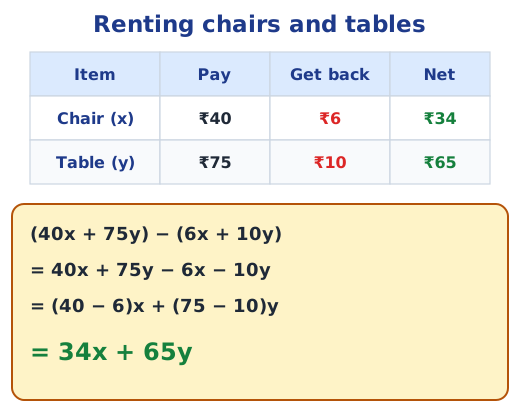
Renting chairs and tables: the procedure. Multiply the number of chairs by ₹40 and of tables by ₹75 and add, to get the amount paid: 40x + 75y. Multiply by ₹6 and ₹10 and add, to get the amount returned: 6x + 10y. The total paid is (40x + 75y) − (6x + 10y) = 34x + 65y. Could it be written as (40x + 75y) + (−6x − 10y)? Yes: taking away a bracket is the same as adding its inverse.
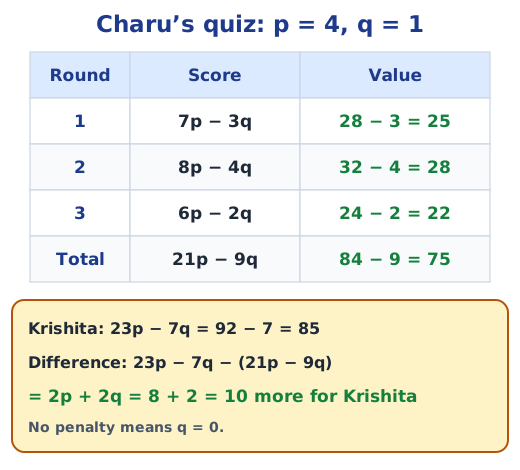
Charu’s quiz. 7p − 3q means 7 correct answers and 3 wrong ones in round 1, and so on. With p = 4 and q = 1: round 2 is 32 − 4 = 28 and round 3 is 24 − 2 = 22. With no penalty, q = 0. Her final score is 21p − 9q = 84 − 9 = 75.
Krishita’s rounds adding to 23p − 7q. For example 8p − 2q, 7p − 3q and 8p − 2q, or 9p − 3q, 7p − 2q and 7p − 2q. Who scored more? Krishita: 23p − 7q − (21p − 9q) = 23p − 7q − 21p + 9q = 2p + 2q, which is more than 0 because p and q are positive.
5u and 5 + u. u = 2: 10 and 7; u = 5: 25 and 10; u = 8: 40 and 13; u = 11: 55 and 16. Not equal.
10y − 3 and 10(y − 3). y = 0: −3 and −30; y = 2: 17 and −10; y = 7: 67 and 40; y = 10: 97 and 70. They are not equal; the first is always 27 more.
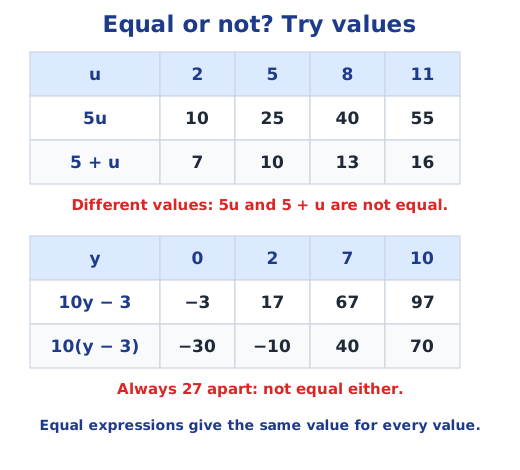
Figure it Out (pages 93–94)
- Adding the numbers in each picture:
(i) 5y, −6, x, x, 2, 5y: by like terms, (5y + 5y) + (x + x) + (−6 + 2) = 10y + 2x − 4; by rows, (5y − 6 + x) + (x + 2 + 5y) gives the same.
(ii) four 2p, four 3q and 3, −2, 3, −2: 8p + 12q + 2; adding column by column gives the same.
(iii) four −5g and twelve 5k: 60k − 20g; the outer columns give 10k − 10g each and the middle columns 40k. - Simplest forms:
(a) p + p + p + p = 4p; p + p + p + q = 3p + q
(b) p + q + p − q = 2p
(c) p − q + p − q = 2p − 2q
(d) p + q − p + q = 2q
(e) p + q − (p + q) = 0
(f) p − q − p − q = −2q
(g) 2d − d − d − d = −d
(h) 2d − d − d − c = −c
(i) 2d − d − (d − c) = c
(j) 2d − (d − d) − c = 2d − c
(k) 2d − d − c − c = d − 2c
Mind the Mistake, Mend the Mistake (pages 94–95)
- 3a + 2b given as 5: mistake; unlike terms cannot be added. Correct: 3a + 2b.
- 3b − 2b − b given as 0: correct.
- 6(p + 2) given as 6p + 8: mistake; 6 × 2 is 12. Correct: 6p + 12.
- (4x + 3y) − (3x + 4y) given as x + y: mistake; the minus sign changes +4y to −4y. Correct: x − y.
- 5 − (2 − 6z) given as 3 − 6z: mistake; −(−6z) is +6z. Correct: 3 + 6z.
- 2 + (x + 3) given as 2x − 6: mistake; a plus sign before a bracket changes nothing. Correct: x + 5.
- 2y + (3y − 6) given as −y + 6: mistake; the signs inside were changed although a plus sign comes before the bracket. Correct: 5y − 6.
- 7p − p + 5q − 2q given as 7p + 3q: mistake; the −p was dropped. Correct: 6p + 3q.
- 5(2w + 3x + 4w) given as 10w + 15x + 20w: not simplest; the like terms add. Correct: 30w + 15x.
- 3j + 6k + 9h + 12 given as 3(j + 2k + 3h + 4): equal, but a bracket is not the simplest form. Correct: 3j + 6k + 9h + 12.
- 4(2r + 3s + 5) given as −20 − 8r − 12s: mistake; all the signs were flipped. Correct: 8r + 12s + 20.
Number of terms and number of letter-numbers. In each simplest form, each letter-number appears in only one term, and at most one more term is a plain number. So the number of terms equals the number of letter-numbers, or one more when there is a number term (and 0 has none).
Pick Patterns and Reveal Relationships (pages 95–101)
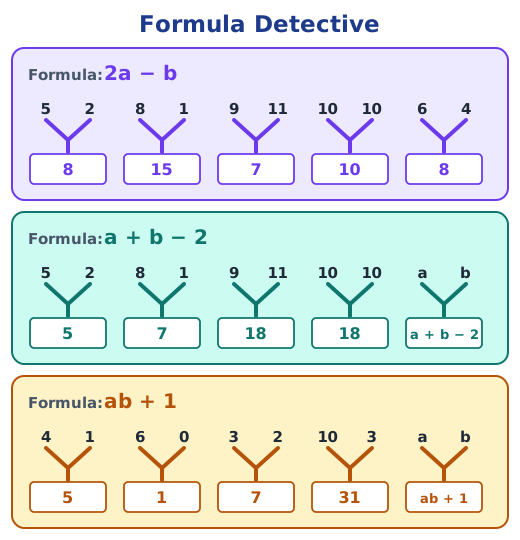
Formula Detective (page 95). The formula is 2a − b, so the last machine gives 2 × 6 − 4 = 8. The other outputs check: 2 × 8 − 1 = 15, 2 × 9 − 11 = 7, 2 × 10 − 10 = 10.
The two machines on page 96.
First machine: a + b − 2: 5 + 2 − 2 = 5, 8 + 1 − 2 = 7, 9 + 11 − 2 = 18, 10 + 10 − 2 = 18, and a + b − 2 for a and b.
Second machine: ab + 1: 4 × 1 + 1 = 5, 6 × 0 + 1 = 1, 3 × 2 + 1 = 7, 10 × 3 + 1 = 31, and ab + 1 for a and b.
Make your own formula. For example 3a − b: 4 and 2 give 10, 5 and 5 give 10, and 2 and 6 give 0. Challenge classmates to find the rule.
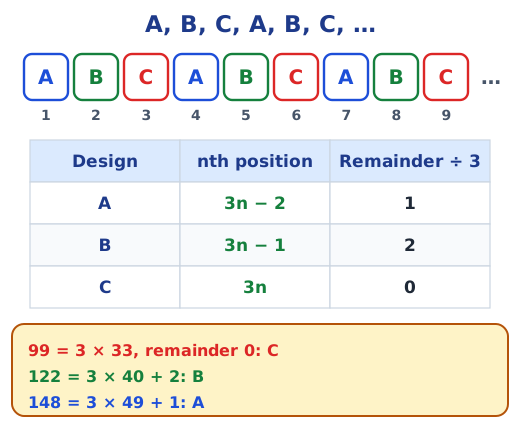
Saree designs (page 97). The nth A is at 3n − 2 and the nth B at 3n − 1. Position 99 (remainder 0) has C, 122 (remainder 2) has B, and 148 (remainder 1) has A.
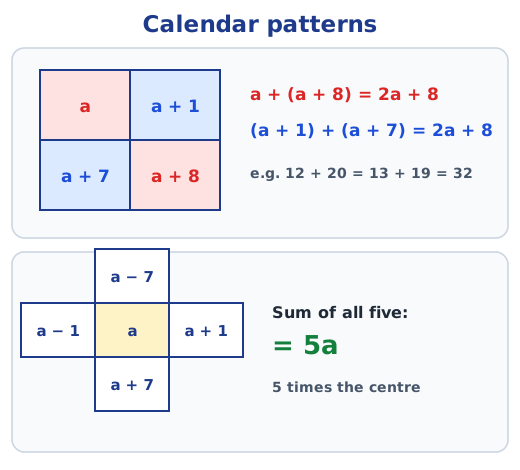
Verify the diagonal sums (page 99). For the square 5, 6, 12, 13: 5 + 13 = 18 = 6 + 12, and 2a + 8 = 2 × 5 + 8 = 18.
The plus shape: always 5 times the centre? Yes. With centre a, the numbers are a − 7, a − 1, a, a + 1 and a + 7, and their sum is 5a. For 8, 14, 15, 16 and 22 the sum is 75 = 5 × 15.
Other shapes. A vertical or horizontal line of three dates adds to 3 times the middle one; an X of five dates (a − 8, a − 6, a, a + 6, a + 8) adds to 5a; and a 3 × 3 square adds to 9 times its centre.
Matchstick triangles (pages 100–101). Step 33: 3 + 2 × 32 = 67; Step 84: 169; Step 108: 217. Both 3 + 2(y − 1) and 2y + 1 give the right count, and they are the same expression. Step 3 has 3 flat and 4 slanting sticks, and Step 4 has 4 and 5. At Step y there are y flat sticks and y + 1 slanting ones, which add up to 2y + 1.
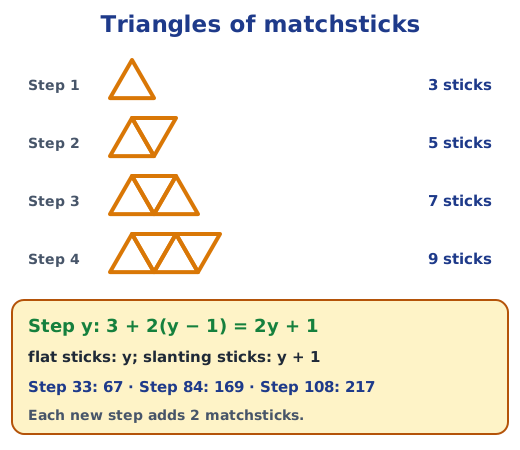
Figure it Out (pages 102–105)
- (a) 30x + 20y. The others either mix up the prices, multiply the totals together, or subtract.
- (a) p + q + r. Every customer got one flag, and there were p + q + r customers.
- (a) Each day and night the snail gains u − d cm, so after 10 days and nights it is 10(u − d) cm, that is 10u − 10d, above where it started.
(b) If d > u, it slips down more than it climbs, so it goes lower every day and ends 10(d − u) cm below its start; it can never climb out. - Week 1: 5 × 7 = 35 km; week 2: (5 + z) × 7 = 35 + 7z; week 3: (5 + 2z) × 7 = 35 + 14z. Total: 105 + 21z km.
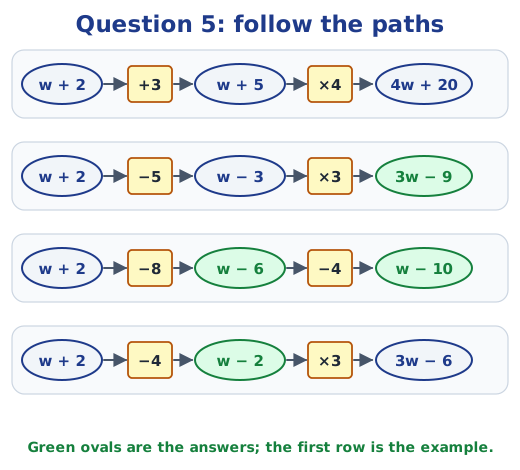
- Starting from w + 2: −5 gives w − 3, then ×3 gives 3w − 9; −8 gives w − 6, then −4 gives w − 10; −4 gives w − 2, then ×3 gives 3w − 6.
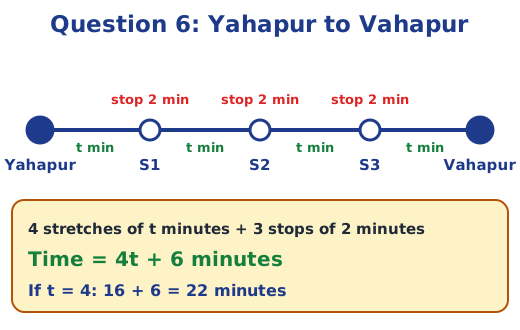
- There are 4 stretches between Yahapur, the three stations and Vahapur, and 3 stops of 2 minutes. (a) If t = 4: 4 × 4 + 6 = 22 minutes. (b) 4t + 6 minutes.
- (a) (3 + 8 − 7)a + (9 − 4)b + (−6 + 16) = 4a + 5b + 10
(b) 9a − 9b − 8a − 4b − 16 = a − 13b − 16
(c) 4x − 6 + 8x + 12 = 12x + 6
(d) 8x − 2x + 3 + 12 = 6x + 15
(e) 8h − 5 − 7h + 9 = h + 4
(f) 23 + 24m − 12n − 8n − 3m − 18 = 21m − 20n + 5 - (a) 13d + c − 2
(b) 7f + 4s − 4
(c) 8d − 14c + 9 + 16c − 11 − 9d = 2c − d − 2
(d) −7f − 4s + 3
(e) 0
(f) 0 - Subtracting A from B means B − A.
(a) (6a + 9b − 18) − (9a − 6b + 14) = −3a + 15b − 32
(b) (7y − 10 + 3x) − (−15x + 13 − 9y) = 18x + 16y − 23
(c) (11 − 10g + 3h) − (17g + 9 − 7h) = −27g + 10h + 2
(d) (6a − 9b − 18) − (9a − 6b + 14) = −3a − 3b − 32
(e) (−3y + 8 − 3x) − (10x + 2 + 10y) = −13x − 13y + 6
(f) (7h − 8g + 20) − (8g + 4h − 10) = 3h − 16g + 30 - (a) 8x + 3y: 8 kg of rice at ₹x a kg and 3 kg of dal at ₹y a kg cost 8x + 3y rupees.
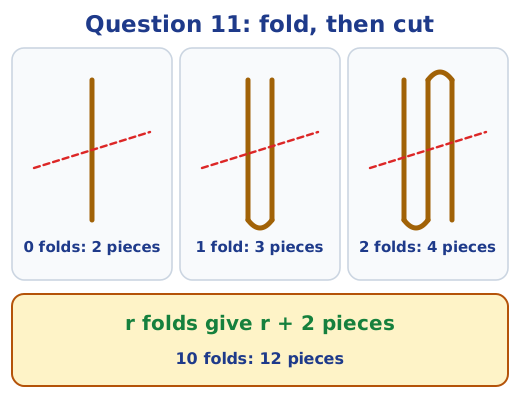
(b) 15x − 2x: a box holds 15 pencils at ₹x each, but 2 are broken and not sold, so the box earns 15x − 2x = 13x rupees. - As in the picture, each fold adds one more strand of rope for the cut to pass through: no fold gives 2 pieces, 1 fold 3, 2 folds 4. So 10 folds give 12 pieces, and r folds give r + 2.
- The first square needs 4 sticks and each new one 3 more. So 10 squares need 4 + 3 × 9 = 31, and w squares need 4 + 3(w − 1) = 3w + 1.
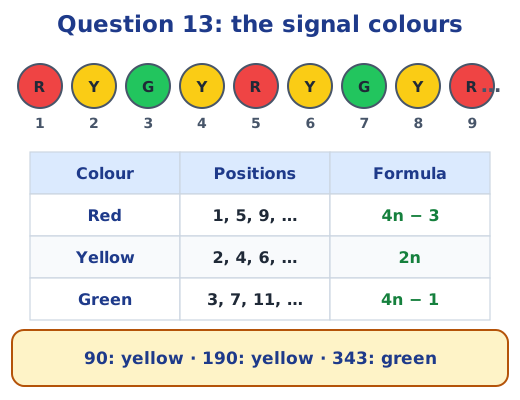
- The colours run red, yellow, green, yellow and then repeat every 4. Red is at 4n − 3, yellow at every even position, 2n, and green at 4n − 1. So position 90 is yellow, 190 is yellow and 343 (= 4 × 86 − 1) is green.
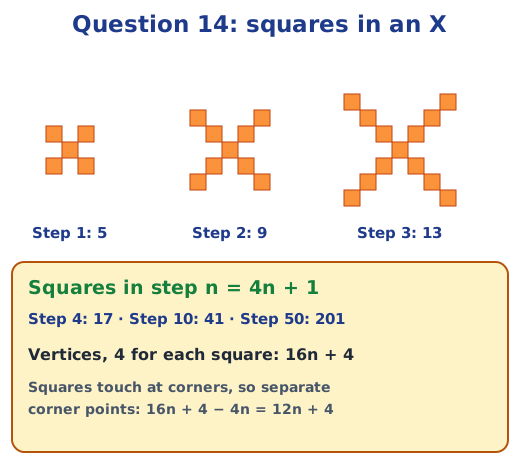
- The X has 5, 9 and 13 squares in Steps 1 to 3, adding 4 each time, so Step n has 4n + 1: Step 4 has 17, Step 10 has 41 and Step 50 has 201. Every square has 4 vertices, so all the squares together have 4(4n + 1) = 16n + 4 vertices. (Neighbouring squares touch at a corner, so the number of separate corner points is 16n + 4 − 4n = 12n + 4.)
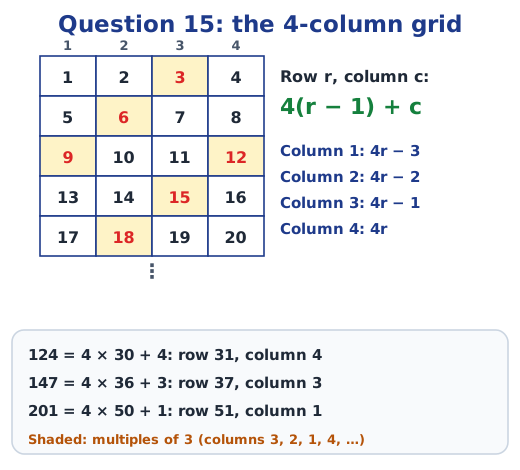
- (a) In row r: column 1 has 4r − 3, column 2 4r − 2, column 3 4r − 1 and column 4 4r.
(b) (i) 124 = 4 × 30 + 4: row 31, column 4; (ii) 147 = 4 × 36 + 3: row 37, column 3; (iii) 201 = 4 × 50 + 1: row 51, column 1.
(c) 4(r − 1) + c, which is 4r + c − 4.
(d) The multiples of 3 fall in columns 3, 2, 1, 4, 3, 2, 1, 4, … in turn. Other patterns: column 4 holds the multiples of 4; columns 2 and 4 hold the even numbers and columns 1 and 3 the odd ones; and each row adds up to 16r − 6.
Short notes are on the topic pages: letter-numbers and algebraic expressions, simplifying algebraic expressions and patterns and relationships with algebra.
Practice
-
What is 3d when d = 6?
Show answer
Answer: (b) 18
-
Simplify 8x − (2x − 3) + 12.
Show answer
Answer: (b) 6x + 15
-
Subtract 9a − 6b + 14 from 6a + 9b − 18.
Show answer
Answer: (a) −3a + 15b − 32
-
A train passes three stations between Yahapur and Vahapur, taking t minutes between stations and stopping 2 minutes at each. How long is the trip?
Show answer
Answer: There are 4 stretches of t minutes and 3 stops of 2 minutes, so the trip takes 4t + 6 minutes. When t = 4, that is 22 minutes.
-
How many matchsticks make w squares in a row?
Show answer
Answer: The first square needs 4 sticks and each new one 3 more, so w squares need 4 + 3(w − 1) = 3w + 1 sticks; 10 squares need 31.
Stuck on a question?
Take a photo and Lagnever AI explains it step by step. Try it for 7 days for ₹2.
Get it on Google Play Open in browser
For parents: after the trial, the plan renews monthly by UPI or card autopay. You can cancel anytime in the app.