
Class 7 Maths Chapter 4: Expressions using Letter-Numbers Notes
This chapter in five lines
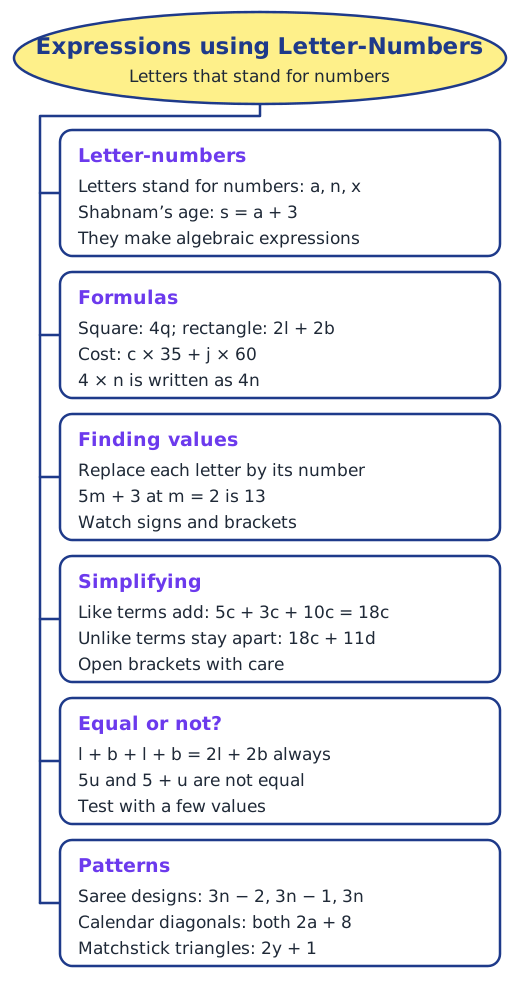
Expressions using Letter-Numbers introduces algebra. A letter-number such as a or n stands for a number, so a relation like Shabnam is 3 years older than Aftab becomes s = a + 3. Expressions with letter-numbers can be evaluated by replacing the letters, simplified by adding like terms and opening brackets, and used to describe and explain patterns.
What is this chapter about?
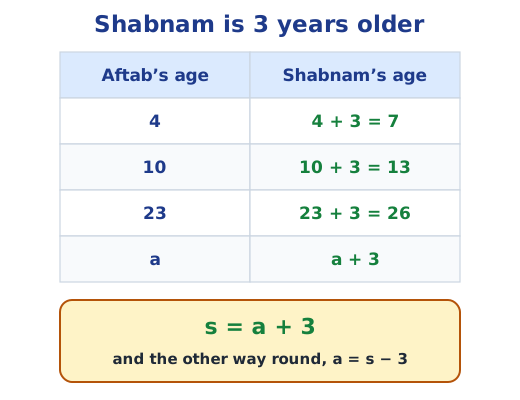
Shabnam is 3 years older than Aftab. Whatever Aftab’s age is, we add 3 to get Shabnam’s. Writing a for Aftab’s age turns this into a short rule, s = a + 3, that works for every age. This chapter is about using letters in place of numbers to state such relations briefly, to work with them, and to explain why patterns hold.
Letter-numbers and formulas
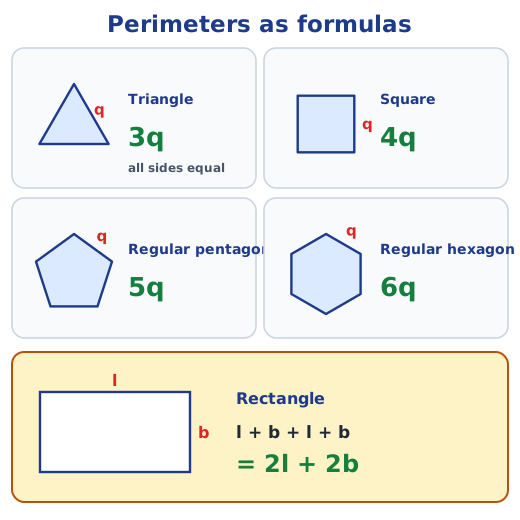
Letters such as a and s that stand for numbers are letter-numbers, and expressions that contain them, such as a + 3, are algebraic expressions. A matchstick L needs 2 sticks, so n Ls need 2 × n. Ketaki’s laddu ingredients cost c × 35 + j × 60 rupees for c coconuts and j kg of jaggery. The perimeter of a square of side q is 4 × q. General relations written like this are called formulas. Read more in letter-numbers and algebraic expressions.
Shorter writing and finding values
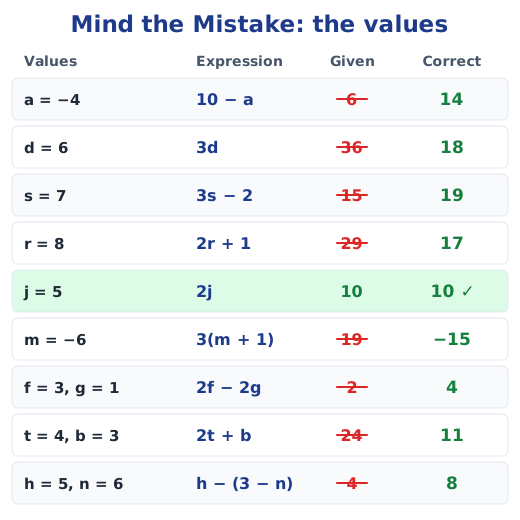
The multiples of 4 are 4, 8, 12, …, so the nth term is 4 × n, which we shorten to 4n: the number comes first and the multiplication sign is left out. An algebraic expression takes a number value when every letter-number is replaced by a number. So 7k is 28 when k = 4, and 5m + 3 is 5 × 2 + 3 = 13 when m = 2. Signs and brackets need care: if a = −4, then 10 − a = 10 + 4 = 14.
Simplifying expressions
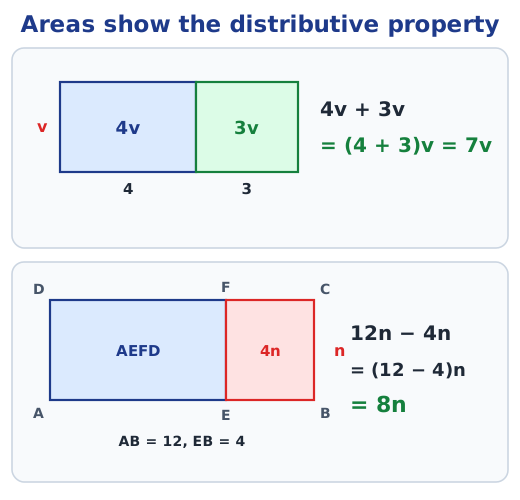
The rules for numbers work for letter-numbers too. The perimeter of a rectangle, l + b + l + b, rearranges to 2l + 2b, its simplified form; both give 14 when l = 3 and b = 4. Terms with the same letter-numbers, such as 5c, 3c and 10c, are like terms and add into one term, 18c, by the distributive property. Terms like 18c and 11d are unlike and cannot be combined. A minus sign before a bracket changes every sign inside it: (40x + 75y) − (6x + 10y) = 34x + 65y. Read simplifying algebraic expressions.
Equal or not?
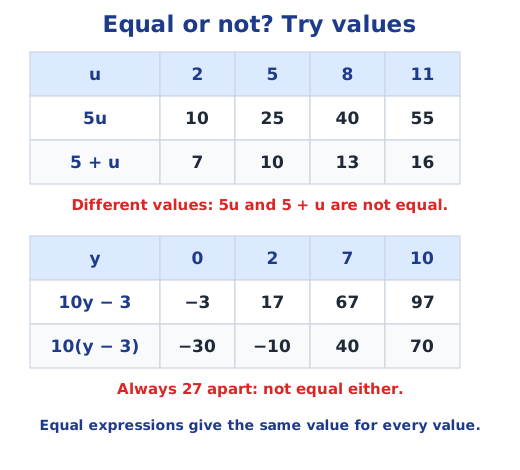
Two expressions are equal when they give the same value for every value of their letter-numbers. The simplified and original forms always do. But 5u (5 times u) and 5 + u (5 more than u) give 10 and 7 when u = 2, so they are not equal; nor are 10y − 3 and 10(y − 3).
Patterns and relationships
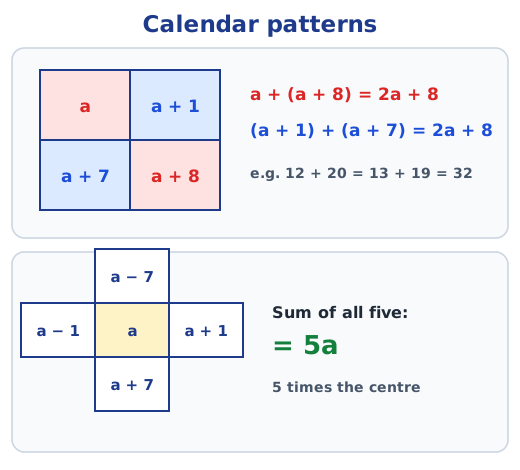
Algebra helps find and explain patterns. A number machine that turns 5 and 2 into 8, and 8 and 1 into 15, follows the formula 2a − b. In a saree border with designs A, B, C repeating, the nth C is at position 3n, the nth B at 3n − 1 and the nth A at 3n − 2, so position 122 has B. In any 2 × 2 square of a calendar with top-left date a, the numbers are a, a + 1, a + 7 and a + 8, so both diagonal sums are 2a + 8: the pattern holds for every square. A row of matchstick triangles needs 2y + 1 sticks at step y. Read patterns and relationships with algebra.
Before we move on
Algebraic expressions model relations between quantities, follow the same rules as numbers, and say in a few symbols what would take long sentences in words. Answers to every question, both Mind the Mistake sets and all three Figure it Out sets are in the NCERT solutions for Chapter 4.
Key terms
| Term | Meaning |
|---|---|
| Letter-number | A letter, such as a, n or x, used to stand for a number that can change or is not yet known. |
| Algebraic expression | A mathematical expression that contains letter-numbers, such as a + 3, 2n or 35c + 60j. |
| Formula | A general relation written with letter-numbers, such as 4q for the perimeter of a square of side q. |
| Value of an expression | The number an expression gives when each letter-number is replaced by a number: 5m + 3 is 13 when m = 2. |
| Term | A part of an expression joined to the rest by a + sign, such as 7p and −3q in 7p − 3q. |
| Like terms | Terms with the same letter-numbers, such as 5c, 3c and 10c; they can be added into one term. |
| Unlike terms | Terms with different letter-numbers, such as 18c and 11d; they cannot be combined. |
| Simplest form | An expression with its brackets removed and its like terms, and its number terms, added up, such as 2l + 2b for l + b + l + b. |
| Distributive property | A multiple of a sum is the sum of the multiples: 4(x + y) = 4x + 4y, and 5c + 3c = (5 + 3)c. |
Topics in this chapter
Practice
-
Aftab is a years old and Shabnam is 3 years older. Which expression gives Shabnam’s age?
Show answer
Answer: (b) a + 3
-
What is the value of 5m + 3 when m = 2?
Show answer
Answer: (b) 13
-
What is the simplest form of 5c + 3c + 10c?
Show answer
Answer: (a) 18c
-
If a = −4, what is 10 − a?
Show answer
Answer: (c) 14
-
In the repeating pattern A, B, C, A, B, C, …, which design is at position 122?
Show answer
Answer: (b) B
-
Which expression gives the perimeter of a rectangle of length l and breadth b?
Show answer
Answer: (b) 2l + 2b
Questions students ask
What are the main topics of Class 7 Maths Chapter 4?
Letter-numbers and algebraic expressions; writing formulas for ages, costs and perimeters; revising arithmetic expressions; leaving out the multiplication sign; finding the value of an expression; simplifying expressions with like terms and brackets; checking whether two expressions are equal; and using algebra to describe and explain patterns in number machines, sarees, calendars and matchsticks.
Is Expressions using Letter-Numbers in the new Ganita Prakash book?
Yes. It is Chapter 4 of Ganita Prakash, the Class 7 Maths textbook Part 1 (Reprint 2026-27), on pages 81 to 105. It begins with Shabnam, who is 3 years older than Aftab, and shows how the letter a for Aftab’s age turns this into the expression a + 3.
What is a letter-number?
A letter used in place of a number. It can stand for a number that changes, such as a person’s age or the number of matchstick Ls, or for one we do not know yet. Writing n for the number of Ls lets us say the number of matchsticks is 2n for every pattern at once.
How do you simplify an algebraic expression?
Remove the brackets, remembering that a minus sign before a bracket changes the sign of every term inside, and use the distributive property where a number multiplies a bracket. Then add the like terms, terms with the same letter-numbers, and add the number terms. For example, 4(x + y) − y = 4x + 4y − y = 4x + 3y.
Stuck on a question?
Take a photo and Lagnever AI explains it step by step. Try it for 7 days for ₹2.
Get it on Google Play Open in browser
For parents: after the trial, the plan renews monthly by UPI or card autopay. You can cancel anytime in the app.