
NCERT Solutions Class 10 Maths Chapter 3: Pair of Linear Equations in Two Variables
Answers to the questions inside Chapter 3, Pair of Linear Equations in Two Variables, all ten worked examples, and every question of Exercises 3.1, 3.2 and 3.3, from Mathematics, the Class 10 NCERT textbook. Page numbers follow the 2026-27 reprint (pages 24–37). The exercise questions are quoted from the book; the examples and in-chapter questions are restated in short and labelled by number and page. The book’s Fig. 3.1 and Fig. 3.2 are described in words, not redrawn, and every graph on this page is plotted from its own equations. Every solution below was checked by substituting it back into both equations. Short notes: Chapter 3 notes.
Questions inside the chapter (pages 24–26)
Pages 24–25: Akhila at the fair, with y = x/2 and 3x + 4y = 20. Can the pair be solved? Yes. Here x is the number of Giant Wheel rides and y the number of Hoopla games. Put y = x/2 into the second equation: 3x + 4 × (x/2) = 20, so 3x + 2x = 20, 5x = 20 and x = 4. Then y = 4/2 = 2. Akhila had 4 rides and played Hoopla 2 times. Check: 3 × 4 + 4 × 2 = 12 + 8 = 20 rupees, and 2 is half of 4.
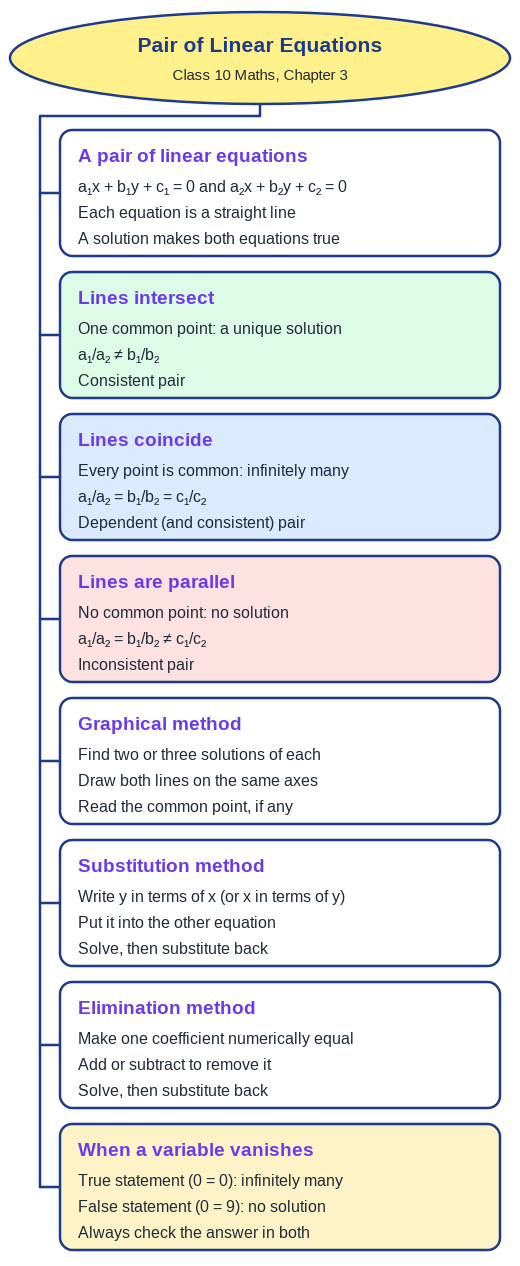
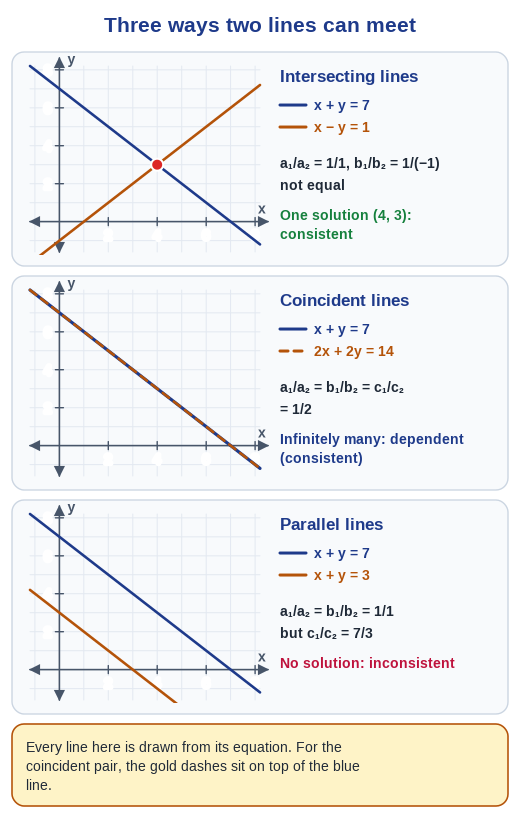
Pages 25–26: the three pairs and their ratios (Table 3.1). Write each pair as a₁x + b₁y + c₁ = 0 and a₂x + b₂y + c₂ = 0 and compare.
(i) x − 2y = 0 and 3x + 4y − 20 = 0: a₁/a₂ = 1/3 and b₁/b₂ = −2/4 = −1/2. They are not equal, so the lines intersect. Solving (x = 2y, so 6y + 4y = 20) gives the point (4, 2).
(ii) 2x + 3y − 9 = 0 and 4x + 6y − 18 = 0: a₁/a₂ = 2/4, b₁/b₂ = 3/6 and c₁/c₂ = −9/−18, all equal to 1/2. The lines coincide: the second equation is the first multiplied by 2.
(iii) x + 2y − 4 = 0 and 2x + 4y − 12 = 0: a₁/a₂ = 1/2 and b₁/b₂ = 2/4 = 1/2, but c₁/c₂ = −4/−12 = 1/3. The lines are parallel.
Page 26: checking the converse with more examples. Take 3x − y − 5 = 0 with three partners of our own. With 6x − 2y − 10 = 0 all three ratios are 1/2, and the lines coincide (the second is twice the first). With 6x − 2y + 4 = 0 the ratios are 1/2, 1/2 and −5/4, and the lines are parallel. With x + y − 3 = 0 the ratios 3/1 and −1/1 differ, and the lines cross at (2, 1). Each time, the kind of lines and the ratio condition agree.
Examples 1 to 3 (pages 26–28)
Example 1 (page 26): is the pair x + 3y = 6 and 2x − 3y = 12 consistent? If so, solve it by graph. The ratios a₁/a₂ = 1/2 and b₁/b₂ = 3/(−3) = −1 are not equal, so the lines intersect and the pair is consistent. Two solutions of x + 3y = 6 are (0, 2) and (6, 0); two solutions of 2x − 3y = 12 are (0, −4) and (3, −2). When these points are plotted and joined (Fig. 3.1 in the book), the two lines share the point (6, 0). So x = 6, y = 0. Check: 6 + 3 × 0 = 6 and 2 × 6 − 3 × 0 = 12.
Example 2 (page 27): does 5x − 8y + 1 = 0 and 3x − (24/5)y + 3/5 = 0 have no solution, one solution or infinitely many? Multiplying the second equation by 5/3 gives 5x − 8y + 1 = 0, exactly the first. The ratios agree: a₁/a₂ = 5/3, b₁/b₂ = −8 ÷ (−24/5) = 5/3 and c₁/c₂ = 1 ÷ (3/5) = 5/3. The lines coincide, so there are infinitely many solutions. The book suggests plotting a few points to see it: (3, 2), (−5, −3) and (11, 7) all satisfy both equations. For (3, 2): 15 − 16 + 1 = 0 and 9 − 48/5 + 3/5 = 9 − 9 = 0.
Example 3 (page 27): Champa’s pants and skirts. Let x be the number of pants and y the number of skirts. “Skirts are two less than twice the pants” gives y = 2x − 2, and “skirts are four less than four times the pants” gives y = 4x − 4. Points on the first line: (2, 2) and (0, −2); on the second: (0, −4) and (1, 0). Drawn on the same axes (Fig. 3.2 in the book), the lines meet at (1, 0). So Champa bought 1 pair of pants and no skirt. Verify with the story: 2 × 1 − 2 = 0 and 4 × 1 − 4 = 0, so both conditions give 0 skirts. (Algebra agrees: 2x − 2 = 4x − 4 gives x = 1.)
Exercise 3.1 (pages 28–29)
1. “Form the pair of linear equations in the following problems, and find their solutions graphically.”
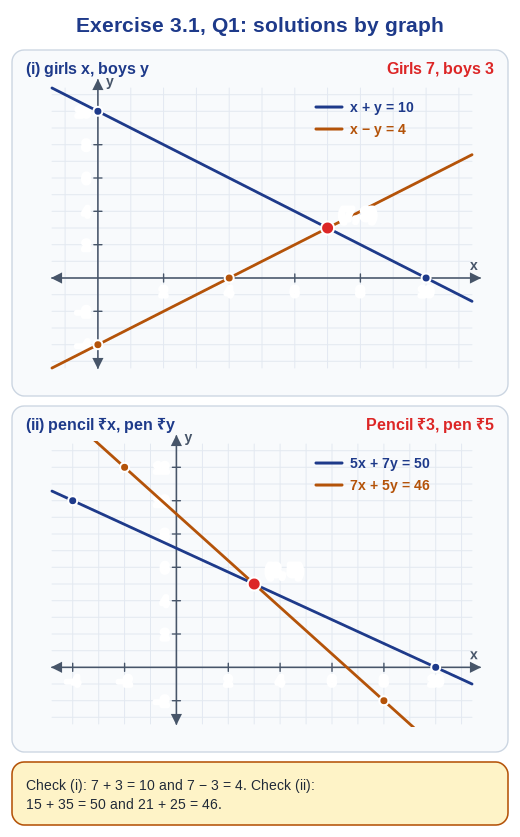
(i) “10 students of Class X took part in a Mathematics quiz. If the number of girls is 4 more than the number of boys, find the number of boys and girls who took part in the quiz.”
Given: 10 students in all. Girls are 4 more than boys.
To find: The number of girls and boys, by graph.
- Let the number of girls be x and the number of boys be y.
- Total 10 students: x + y = 10.
- 4 more girls than boys: x − y = 4.
- Points on x + y = 10: (0, 10), (5, 5), (10, 0).
- Points on x − y = 4: (4, 0), (6, 2), (0, −4).
- Plot both lines on the same graph. They meet at (7, 3).
- Check: 7 + 3 = 10 and 7 − 3 = 4.
Answer: 7 girls and 3 boys took part in the quiz.
(ii) “5 pencils and 7 pens together cost ₹50, whereas 7 pencils and 5 pens together cost ₹46. Find the cost of one pencil and that of one pen.”
Given: 5 pencils + 7 pens cost ₹50. 7 pencils + 5 pens cost ₹46.
To find: The cost of one pencil and one pen, by graph.
- Let one pencil cost ₹x and one pen cost ₹y.
- The equations are 5x + 7y = 50 and 7x + 5y = 46.
- Points on 5x + 7y = 50: (10, 0), (3, 5), (−4, 10).
- Points on 7x + 5y = 46: (8, −2), (3, 5), (−2, 12).
- Plot both lines on the same graph. They meet at (3, 5).
- Check: 15 + 35 = 50 and 21 + 25 = 46.
Answer: One pencil costs ₹3 and one pen costs ₹5.
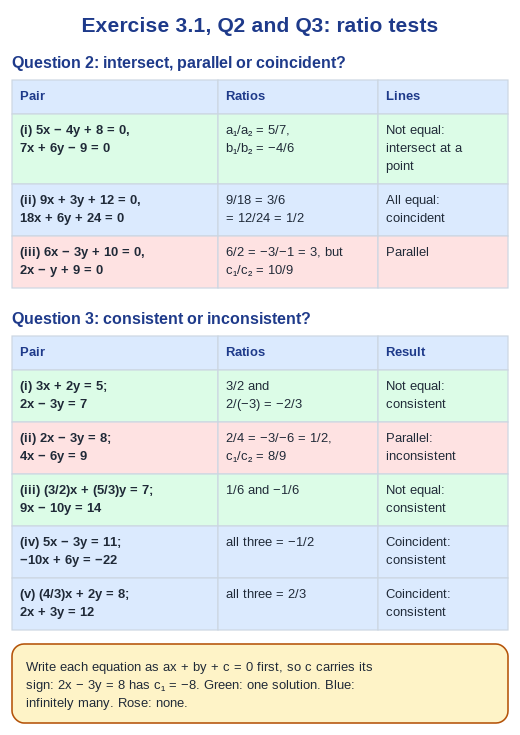
2. “On comparing the ratios a₁/a₂, b₁/b₂ and c₁/c₂, find out whether the lines representing the following pairs of linear equations intersect at a point, are parallel or coincident: (i) 5x − 4y + 8 = 0, 7x + 6y − 9 = 0 (ii) 9x + 3y + 12 = 0, 18x + 6y + 24 = 0 (iii) 6x − 3y + 10 = 0, 2x − y + 9 = 0”
(i) a₁/a₂ = 5/7 and b₁/b₂ = −4/6 = −2/3. Since 5/7 ≠ −2/3, the lines intersect at a point. (Solving shows the point is (−6/29, 101/58), which no graph could show exactly.)
(ii) a₁/a₂ = 9/18 = 1/2, b₁/b₂ = 3/6 = 1/2 and c₁/c₂ = 12/24 = 1/2. All three are equal, so the lines are coincident.
(iii) a₁/a₂ = 6/2 = 3 and b₁/b₂ = −3/−1 = 3, but c₁/c₂ = 10/9. Since a₁/a₂ = b₁/b₂ ≠ c₁/c₂, the lines are parallel.
Answer: (i) intersect at a point (ii) coincident (iii) parallel
3. “On comparing the ratios a₁/a₂, b₁/b₂ and c₁/c₂, find out whether the following pair of linear equations are consistent, or inconsistent. (i) 3x + 2y = 5 ; 2x − 3y = 7 (ii) 2x − 3y = 8 ; 4x − 6y = 9 (iii) (3/2)x + (5/3)y = 7 ; 9x − 10y = 14 (iv) 5x − 3y = 11 ; −10x + 6y = −22 (v) (4/3)x + 2y = 8 ; 2x + 3y = 12”
First write each equation as ax + by + c = 0, so that c carries its sign.
(i) 3x + 2y − 5 = 0 and 2x − 3y − 7 = 0: a₁/a₂ = 3/2 and b₁/b₂ = 2/(−3) = −2/3. Not equal, so the lines intersect: consistent (one solution, x = 29/13, y = −11/13).
(ii) 2x − 3y − 8 = 0 and 4x − 6y − 9 = 0: a₁/a₂ = 2/4 = 1/2 and b₁/b₂ = −3/−6 = 1/2, but c₁/c₂ = −8/−9 = 8/9. Parallel lines: inconsistent.
(iii) a₁/a₂ = (3/2) ÷ 9 = 1/6 and b₁/b₂ = (5/3) ÷ (−10) = −1/6. Not equal: consistent (one solution, x = 28/9, y = 7/5).
(iv) 5x − 3y − 11 = 0 and −10x + 6y + 22 = 0: a₁/a₂ = 5/(−10) = −1/2, b₁/b₂ = −3/6 = −1/2 and c₁/c₂ = −11/22 = −1/2. All equal: coincident lines, so consistent (dependent, infinitely many solutions).
(v) a₁/a₂ = (4/3) ÷ 2 = 2/3, b₁/b₂ = 2/3 and c₁/c₂ = −8/−12 = 2/3. All equal: coincident lines, so consistent (dependent).
Answer: (i) consistent (ii) inconsistent (iii) consistent (iv) consistent (v) consistent
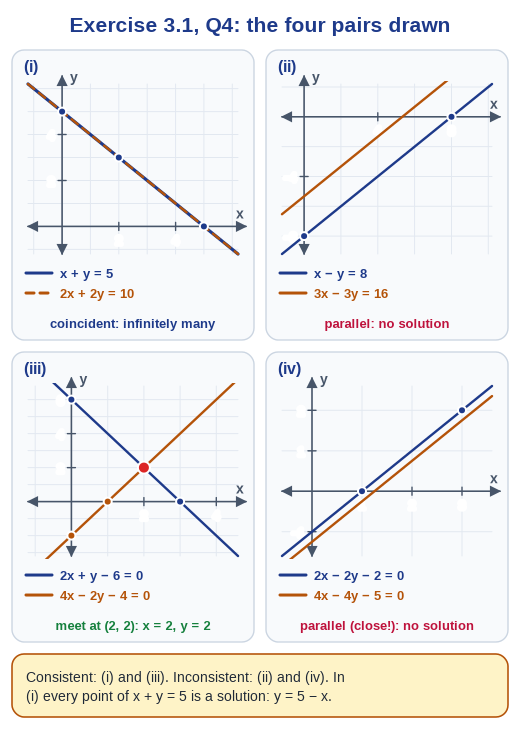
4. “Which of the following pairs of linear equations are consistent/inconsistent? If consistent, obtain the solution graphically: (i) x + y = 5, 2x + 2y = 10 (ii) x − y = 8, 3x − 3y = 16 (iii) 2x + y − 6 = 0, 4x − 2y − 4 = 0 (iv) 2x − 2y − 2 = 0, 4x − 4y − 5 = 0”
(i) a₁/a₂ = 1/2, b₁/b₂ = 1/2 and c₁/c₂ = −5/−10 = 1/2. Coincident lines: consistent, with infinitely many solutions. Both equations draw the same line through (0, 5), (2, 3) and (5, 0); every point on it is a solution, that is, y = 5 − x for any value of x.
(ii) a₁/a₂ = 1/3 and b₁/b₂ = −1/−3 = 1/3, but c₁/c₂ = −8/−16 = 1/2. Parallel lines: inconsistent.
(iii) a₁/a₂ = 2/4 = 1/2 and b₁/b₂ = 1/(−2) = −1/2. Not equal: consistent. Points on 2x + y − 6 = 0: (0, 6), (3, 0), (2, 2). Points on 4x − 2y − 4 = 0: (0, −2), (1, 0), (2, 2). The lines meet at (2, 2), so x = 2, y = 2. Check: 4 + 2 − 6 = 0 and 8 − 4 − 4 = 0.
(iv) a₁/a₂ = 2/4 = 1/2 and b₁/b₂ = −2/−4 = 1/2, but c₁/c₂ = −2/−5 = 2/5. Parallel lines: inconsistent.
Answer: (i) consistent, infinitely many solutions (y = 5 − x) (ii) inconsistent (iii) consistent, x = 2, y = 2 (iv) inconsistent
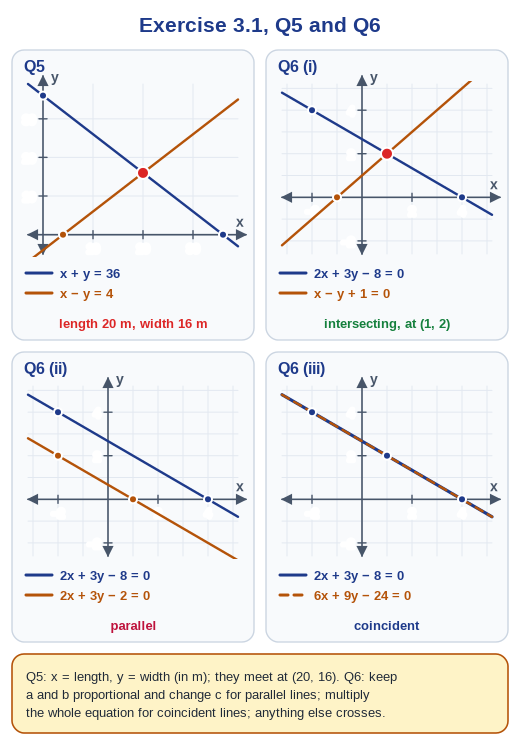
5. “Half the perimeter of a rectangular garden, whose length is 4 m more than its width, is 36 m. Find the dimensions of the garden.”
Given: Length = width + 4 m. Half the perimeter = 36 m.
To find: The length and width of the garden.
- Let the length be x m and the width be y m.
- Length is 4 m more than width: x − y = 4.
- Half the perimeter is length + width: x + y = 36.
- Points on x + y = 36: (36, 0) and (0, 36). Points on x − y = 4: (4, 0) and (24, 20).
- Draw both lines on the same graph. They meet at (20, 16).
- Check: 20 − 16 = 4 and 20 + 16 = 36.
Answer: The garden is 20 m long and 16 m wide.
6. “Given the linear equation 2x + 3y − 8 = 0, write another linear equation in two variables such that the geometrical representation of the pair so formed is: (i) intersecting lines (ii) parallel lines (iii) coincident lines”
Here a₁ = 2, b₁ = 3, c₁ = −8. Many answers are correct; here is one for each part, with the reason.
(i) Intersecting lines need a₁/a₂ ≠ b₁/b₂. Take x − y + 1 = 0: 2/1 ≠ 3/(−1). (The lines cross at (1, 2).)
(ii) Parallel lines need a₁/a₂ = b₁/b₂ ≠ c₁/c₂. Keep 2x + 3y and change only the constant: 2x + 3y − 2 = 0. The ratios are 1, 1 and 4.
(iii) Coincident lines need all three ratios equal. Multiply the whole equation by 3: 6x + 9y − 24 = 0. All three ratios are 1/3.
Answer (one possible set): (i) x − y + 1 = 0 (ii) 2x + 3y − 2 = 0 (iii) 6x + 9y − 24 = 0
The book’s key gives 3x + 2y − 7 = 0, 2x + 3y − 12 = 0 and 4x + 6y − 16 = 0, which are also correct.
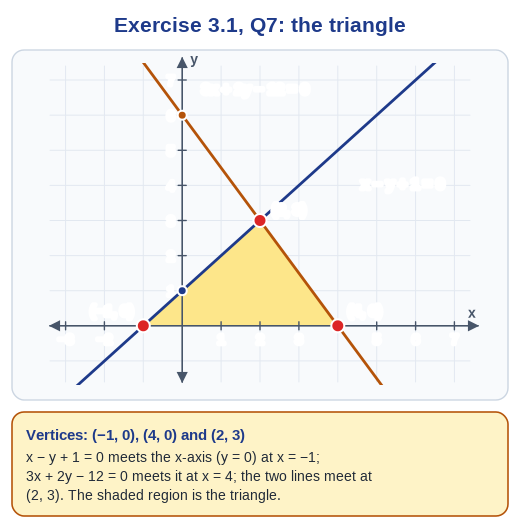
7. “Draw the graphs of the equations x − y + 1 = 0 and 3x + 2y − 12 = 0. Determine the coordinates of the vertices of the triangle formed by these lines and the x-axis, and shade the triangular region.”
Points on x − y + 1 = 0: (−1, 0), (0, 1), (2, 3). Points on 3x + 2y − 12 = 0: (4, 0), (2, 3), (0, 6).
- x − y + 1 = 0 meets the x-axis (y = 0) where x = −1: the vertex (−1, 0).
- 3x + 2y − 12 = 0 meets the x-axis where 3x = 12, x = 4: the vertex (4, 0).
- The two lines meet at (2, 3): 2 − 3 + 1 = 0 and 6 + 6 − 12 = 0.
The triangle is shaded in the graph below.
Answer: The vertices of the triangle are (−1, 0), (4, 0) and (2, 3).
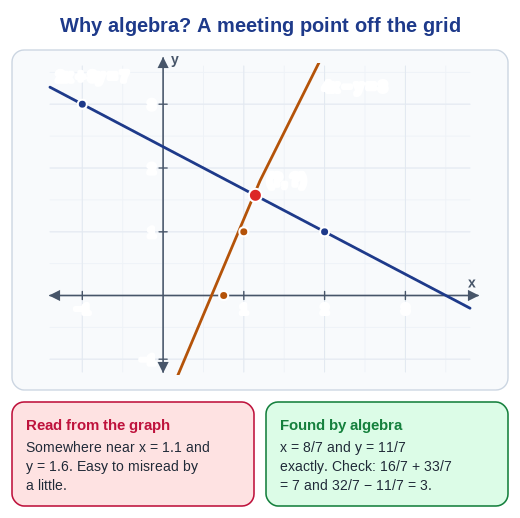
Why algebraic methods? (page 30)
Page 30: is there another way when the solution has awkward coordinates? Yes. When the meeting point has coordinates that are not whole numbers, a graph is easy to misread. The algebraic methods, substitution and elimination, give the exact values. Our own example: 2x + 3y = 7 and 4x − y = 3 meet at (8/7, 11/7), which a graph shows only roughly.
Examples 4 to 7: the substitution method (pages 30–33)
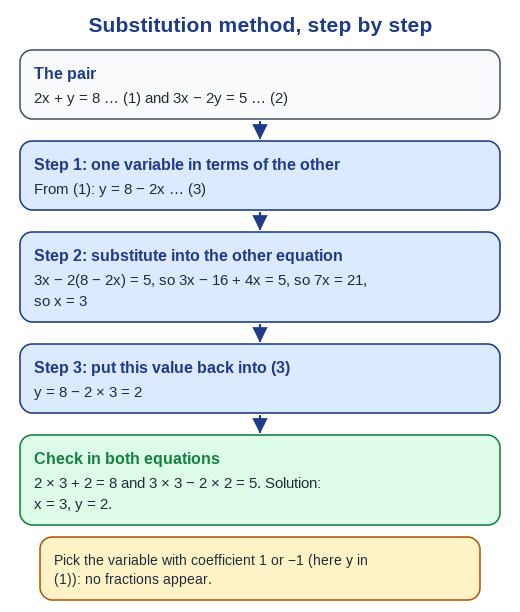
Example 4 (page 30): solve 7x − 15y = 2 and x + 2y = 3 by substitution.
From x + 2y = 3: x = 3 − 2y
Substitute into 7x − 15y = 2: 7(3 − 2y) − 15y = 2
21 − 14y − 15y = 2, so −29y = −19, and y = 19/29
Then x = 3 − 2 × 19/29 = 87/29 − 38/29 = 49/29
So x = 49/29, y = 19/29. The book leaves the check to you: 7 × 49/29 − 15 × 19/29 = (343 − 285)/29 = 58/29 = 2, and 49/29 + 2 × 19/29 = 87/29 = 3. Both are satisfied.
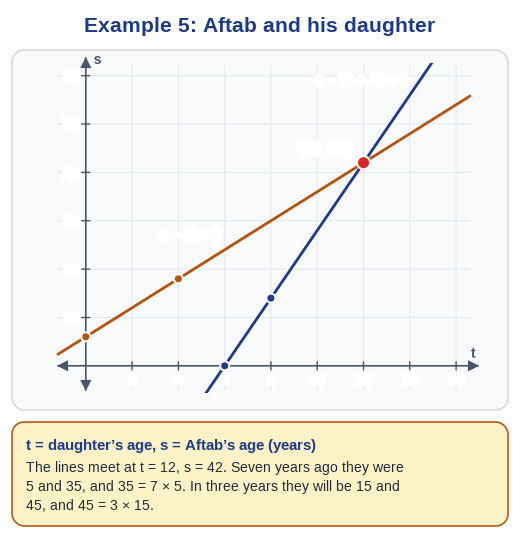
Example 5 (page 31): Aftab and his daughter, shown algebraically and graphically. Let Aftab be s years old and his daughter t years. Seven years ago: s − 7 = 7(t − 7), that is s − 7t + 42 = 0. In three years: s + 3 = 3(t + 3), that is s − 3t = 6.
From the second, s = 3t + 6. Substituting in the first: 3t + 6 − 7t + 42 = 0, so −4t + 48 = 0 and t = 12. Then s = 3 × 12 + 6 = 42. Aftab is 42 and his daughter is 12. Check: seven years ago they were 35 and 5, and 35 = 7 × 5; in three years they will be 45 and 15, and 45 = 3 × 15. The graph shows the same answer:
Example 6 (page 32): 2 pencils and 3 erasers cost ₹9, and 4 pencils and 6 erasers cost ₹18; find each cost. The pair is 2x + 3y = 9 and 4x + 6y = 18. From the first, x = (9 − 3y)/2. Substituting in the second: 4(9 − 3y)/2 + 6y = 18, so 18 − 6y + 6y = 18, that is 18 = 18. This is true for every y, so there are infinitely many solutions: the second equation is just the first doubled. So no single price for a pencil, or for an eraser, can be found.
Example 7 (page 32): rails along x + 2y − 4 = 0 and 2x + 4y − 12 = 0. Will they cross? From the first, x = 4 − 2y. Substituting in the second: 2(4 − 2y) + 4y − 12 = 0, so 8 − 12 = 0, that is −4 = 0, which is false. The equations have no common solution, so the rails are parallel and will not cross.
Note: the book’s list of steps on page 31 points to “Examples 9 and 10” for this case of a statement with no variable; in this edition, Examples 6, 7 and 9 show it.
Exercise 3.2 (pages 33–34)
1. “Solve the following pair of linear equations by the substitution method. (i) x + y = 14, x − y = 4 (ii) s − t = 3, s/3 + t/2 = 6 (iii) 3x − y = 3, 9x − 3y = 9 (iv) 0.2x + 0.3y = 1.3, 0.4x + 0.5y = 2.3 (v) √2x + √3y = 0, √3x − √8y = 0 (vi) 3x/2 − 5y/3 = −2, x/3 + y/2 = 13/6”
(i) From x − y = 4: x = y + 4. Then (y + 4) + y = 14, so 2y = 10, y = 5 and x = 9. Check: 9 + 5 = 14 and 9 − 5 = 4.
(ii) From s − t = 3: s = t + 3. Then (t + 3)/3 + t/2 = 6. Multiply by 6: 2(t + 3) + 3t = 36, so 5t + 6 = 36, 5t = 30, t = 6 and s = 9. Check: 9 − 6 = 3 and 3 + 3 = 6.
(iii) From 3x − y = 3: y = 3x − 3. Then 9x − 3(3x − 3) = 9, so 9x − 9x + 9 = 9, that is 9 = 9, which is always true. The equations are equivalent (the second is three times the first), so there are infinitely many solutions: y = 3x − 3 for any value of x, for example (1, 0), (2, 3) and (0, −3).
(iv) Multiply both equations by 10: 2x + 3y = 13 and 4x + 5y = 23. From the first, x = (13 − 3y)/2. Then 4(13 − 3y)/2 + 5y = 23, so 26 − 6y + 5y = 23, y = 3, and x = (13 − 9)/2 = 2. Check: 0.4 + 0.9 = 1.3 and 0.8 + 1.5 = 2.3.
(v) Note that √8 = 2√2. From √2x + √3y = 0: x = −(√3/√2)y. Substitute in the second: √3 × (−√3/√2)y − 2√2y = 0, so −(3/√2)y − 2√2y = 0. Multiply by √2: −3y − 4y = 0, so −7y = 0 and y = 0. Then x = 0. So x = 0, y = 0, and both equations give 0 = 0.
(vi) Multiply the first by 6: 9x − 10y = −12. Multiply the second by 6: 2x + 3y = 13, so x = (13 − 3y)/2. Then 9(13 − 3y)/2 − 10y = −12. Multiply by 2: 117 − 27y − 20y = −24, so −47y = −141, y = 3, and x = (13 − 9)/2 = 2. Check: 3 × 2/2 − 5 × 3/3 = 3 − 5 = −2 and 2/3 + 3/2 = 4/6 + 9/6 = 13/6.
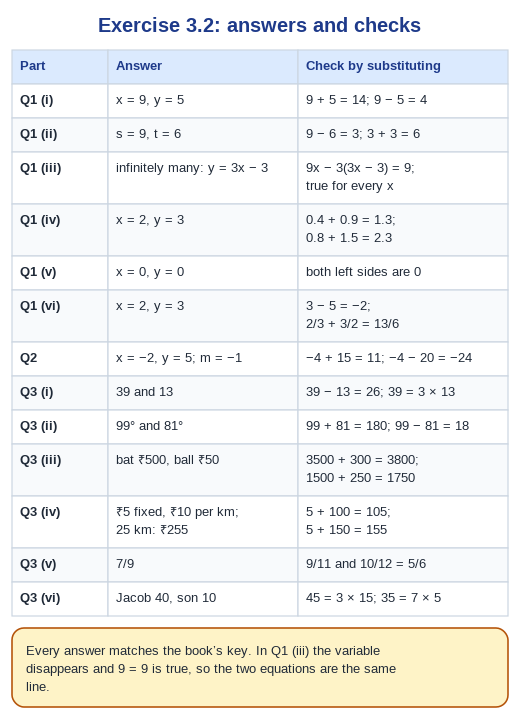
Answer: (i) x = 9, y = 5 (ii) s = 9, t = 6 (iii) infinitely many solutions, y = 3x − 3 (iv) x = 2, y = 3 (v) x = 0, y = 0 (vi) x = 2, y = 3
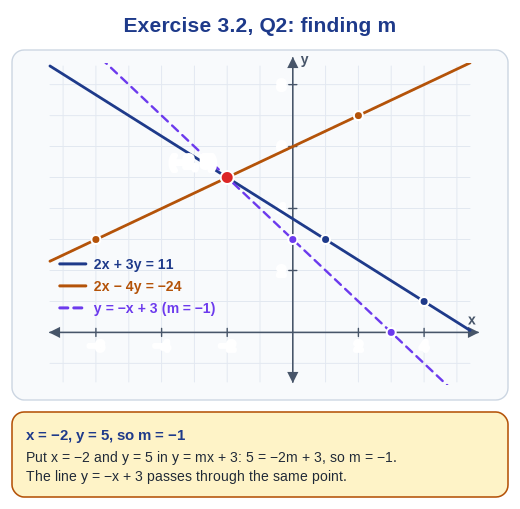
2. “Solve 2x + 3y = 11 and 2x − 4y = −24 and hence find the value of ‘m’ for which y = mx + 3.”
Given: 2x + 3y = 11 and 2x − 4y = −24. Also y = mx + 3.
To find: x, y and m.
- From the first equation, 2x = 11 − 3y.
- Put this into the second: (11 − 3y) − 4y = −24.
- So −7y = −35, and y = 5.
- Then 2x = 11 − 15 = −4, so x = −2.
- Check: −4 + 15 = 11 and −4 − 20 = −24.
- Put x = −2 and y = 5 into y = mx + 3: 5 = −2m + 3.
- So −2m = 2, and m = −1.
Answer: x = −2, y = 5 and m = −1.
3. “Form the pair of linear equations for the following problems and find their solution by substitution method.”
(i) “The difference between two numbers is 26 and one number is three times the other. Find them.”
Given: The difference of two numbers is 26. One number is 3 times the other.
To find: The two numbers.
- Let the larger number be x and the smaller be y.
- The equations are x − y = 26 and x = 3y.
- Put x = 3y in the first: 3y − y = 26, so 2y = 26 and y = 13.
- Then x = 3 × 13 = 39.
- Check: 39 − 13 = 26 and 39 = 3 × 13.
Answer: The numbers are 39 and 13.
(ii) “The larger of two supplementary angles exceeds the smaller by 18 degrees. Find them.”
Given: Two angles are supplementary (they add up to 180°). The larger is 18° more than the smaller.
To find: The two angles.
- Let the larger angle be x° and the smaller be y°.
- The equations are x + y = 180 and x − y = 18.
- From the second, x = y + 18.
- Put this in the first: y + 18 + y = 180, so 2y = 162 and y = 81.
- Then x = 81 + 18 = 99.
- Check: 99 + 81 = 180 and 99 − 81 = 18.
Answer: The angles are 99° and 81°.
(iii) “The coach of a cricket team buys 7 bats and 6 balls for ₹3800. Later, she buys 3 bats and 5 balls for ₹1750. Find the cost of each bat and each ball.”
Given: 7 bats + 6 balls cost ₹3800. 3 bats + 5 balls cost ₹1750.
To find: The cost of one bat and one ball.
- Let one bat cost ₹x and one ball cost ₹y.
- The equations are 7x + 6y = 3800 and 3x + 5y = 1750.
- From the second, x = (1750 − 5y)/3.
- Put this in the first: 7(1750 − 5y)/3 + 6y = 3800.
- Multiply by 3: 12250 − 35y + 18y = 11400, so −17y = −850 and y = 50.
- Then x = (1750 − 250)/3 = 1500/3 = 500.
- Check: 3500 + 300 = 3800 and 1500 + 250 = 1750.
Answer: One bat costs ₹500 and one ball costs ₹50.
(iv) “The taxi charges in a city consist of a fixed charge together with the charge for the distance covered. For a distance of 10 km, the charge paid is ₹105 and for a journey of 15 km, the charge paid is ₹155. What are the fixed charges and the charge per km? How much does a person have to pay for travelling a distance of 25 km?”
Given: Fare = fixed charge + charge for the distance. 10 km costs ₹105. 15 km costs ₹155.
To find: The fixed charge, the charge per km, and the fare for 25 km.
- Let the fixed charge be ₹x and the charge per km be ₹y.
- The equations are x + 10y = 105 and x + 15y = 155.
- From the first, x = 105 − 10y.
- Put this in the second: 105 − 10y + 15y = 155, so 5y = 50 and y = 10.
- Then x = 105 − 100 = 5.
- Fare for 25 km = 5 + 25 × 10 = 5 + 250 = 255.
Answer: Fixed charge ₹5, charge ₹10 per km, and the fare for 25 km is ₹255.
(v) “A fraction becomes 9/11, if 2 is added to both the numerator and the denominator. If, 3 is added to both the numerator and the denominator it becomes 5/6. Find the fraction.”
Given: Adding 2 to the numerator and denominator gives 9/11. Adding 3 to both gives 5/6.
To find: The fraction.
- Let the fraction be x/y (x = numerator, y = denominator).
- (x + 2)/(y + 2) = 9/11. Cross-multiply: 11x + 22 = 9y + 18, so 11x − 9y + 4 = 0.
- (x + 3)/(y + 3) = 5/6. Cross-multiply: 6x + 18 = 5y + 15, so 6x − 5y + 3 = 0.
- From step 3, x = (5y − 3)/6.
- Put this in step 2: 11(5y − 3)/6 − 9y + 4 = 0. Multiply by 6: 55y − 33 − 54y + 24 = 0, so y = 9.
- Then x = (45 − 3)/6 = 7.
- Check: 9/11 is right, and 10/12 = 5/6.
Answer: The fraction is 7/9.
(vi) “Five years hence, the age of Jacob will be three times that of his son. Five years ago, Jacob’s age was seven times that of his son. What are their present ages?”
Given: In 5 years, Jacob’s age = 3 × son’s age. 5 years ago, Jacob’s age = 7 × son’s age.
To find: Their present ages.
- Let Jacob’s present age be x years and his son’s be y years.
- In 5 years: x + 5 = 3(y + 5), so x − 3y = 10.
- 5 years ago: x − 5 = 7(y − 5), so x − 7y = −30.
- From step 2, x = 3y + 10.
- Put this in step 3: 3y + 10 − 7y = −30, so −4y = −40 and y = 10.
- Then x = 30 + 10 = 40.
- Check: 45 = 3 × 15 and 35 = 7 × 5.
Answer: Jacob is 40 years old and his son is 10 years old.
Examples 8 to 10: the elimination method (pages 34–36)
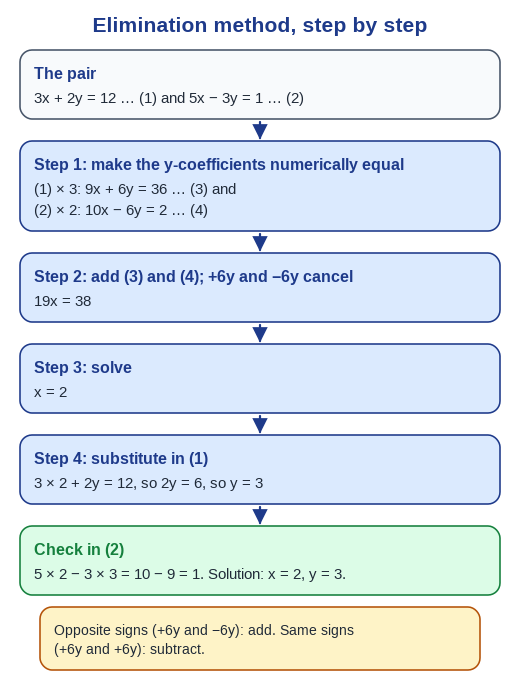
Example 8 (page 34): incomes in the ratio 9 : 7, expenditures in the ratio 4 : 3, and each saves ₹2000 a month. Find the incomes. Let the incomes be ₹9x and ₹7x and the expenditures ₹4y and ₹3y. Income − expenditure = saving gives
9x − 4y = 2000 … (1) and 7x − 3y = 2000 … (2)
Multiply (1) by 3 and (2) by 4: 27x − 12y = 6000 and 28x − 12y = 8000. Subtract the first from the second: x = 2000. Then 9 × 2000 − 4y = 2000 gives 4y = 16000 and y = 4000. The monthly incomes are 9 × 2000 = ₹18,000 and 7 × 2000 = ₹14,000. Check: 18000 : 14000 = 9 : 7, and the expenditures 16000 : 12000 = 4 : 3.
Page 35, Remark 1: eliminate x instead. Multiply (1) by 7 and (2) by 9: 63x − 28y = 14000 and 63x − 27y = 18000. Subtract the first from the second: y = 4000. Then 9x − 16000 = 2000 gives x = 2000, the same answer.
Page 35, Remark 2: try substitution or a graph. From (1), x = (2000 + 4y)/9. Put it into (2): 7(2000 + 4y)/9 − 3y = 2000. Multiply by 9: 14000 + 28y − 27y = 18000, so y = 4000 and x = 18000/9 = 2000. A graph would also show the lines meeting at (2000, 4000), but numbers this large make it clumsy to draw, so elimination is the more convenient method here.
Example 9 (page 35): find all solutions of 2x + 3y = 8 and 4x + 6y = 7 by elimination. Multiply the first by 2: 4x + 6y = 16. Subtract 4x + 6y = 7: 0 = 9, which is false. So the pair has no solution; its lines are parallel.
Example 10 (page 35): a two-digit number plus its reverse is 66, and its digits differ by 2. Find the number. Let the tens digit be x and the units digit y. The number is 10x + y and its reverse 10y + x, so 11(x + y) = 66, that is x + y = 6. The digits differ by 2, so either x − y = 2 or y − x = 2. With x − y = 2, adding to x + y = 6 gives 2x = 8: x = 4, y = 2, the number 42. With y − x = 2, adding gives 2y = 8: y = 4, x = 2, the number 24. There are two such numbers. Check: 42 + 24 = 66, and in each the digits differ by 2.
Exercise 3.3 (pages 36–37)
1. “Solve the following pair of linear equations by the elimination method and the substitution method : (i) x + y = 5 and 2x − 3y = 4 (ii) 3x + 4y = 10 and 2x − 2y = 2 (iii) 3x − 5y − 4 = 0 and 9x = 2y + 7 (iv) x/2 + 2y/3 = −1 and x − y/3 = 3”
(i) Elimination: multiply x + y = 5 by 3: 3x + 3y = 15. Add 2x − 3y = 4: 5x = 19, so x = 19/5. Then y = 5 − 19/5 = 6/5. Substitution: y = 5 − x, so 2x − 3(5 − x) = 4, 5x − 15 = 4, x = 19/5 and y = 6/5.
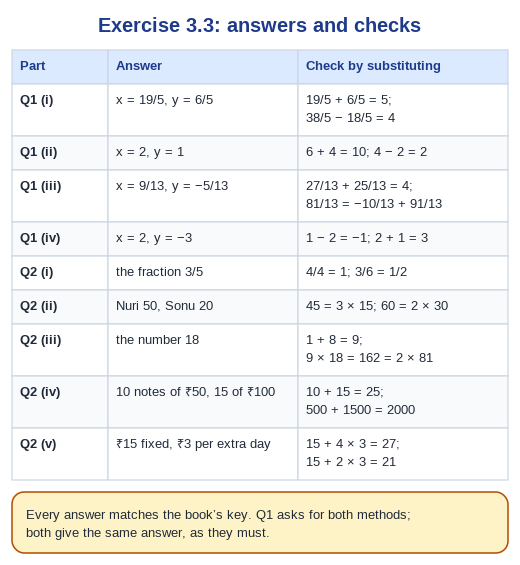
Answer: x = 19/5, y = 6/5. Check: 19/5 + 6/5 = 25/5 = 5 and 38/5 − 18/5 = 20/5 = 4.
(ii) Elimination: multiply 2x − 2y = 2 by 2: 4x − 4y = 4. Add 3x + 4y = 10: 7x = 14, so x = 2. Then 6 + 4y = 10 gives y = 1. Substitution: from 2x − 2y = 2, x = y + 1. Then 3(y + 1) + 4y = 10, 7y = 7, y = 1 and x = 2.
Answer: x = 2, y = 1. Check: 6 + 4 = 10 and 4 − 2 = 2.
(iii) Write the pair as 3x − 5y = 4 and 9x − 2y = 7. Elimination: multiply the first by 3: 9x − 15y = 12. Subtract it from 9x − 2y = 7: 13y = −5, so y = −5/13. Then 3x = 4 + 5y = 4 − 25/13 = 27/13, so x = 9/13. Substitution: x = (4 + 5y)/3, so 9(4 + 5y)/3 − 2y = 7, that is 12 + 15y − 2y = 7, 13y = −5 and y = −5/13; then x = 9/13.
Answer: x = 9/13, y = −5/13. Check: 27/13 + 25/13 = 52/13 = 4, and 9 × 9/13 = 81/13 while 2 × (−5/13) + 7 = −10/13 + 91/13 = 81/13.
(iv) Clear the fractions: multiply the first by 6 to get 3x + 4y = −6, and the second by 3 to get 3x − y = 9. Elimination: subtract the second from the first: 5y = −15, so y = −3. Then 3x = 9 + y = 6, so x = 2. Substitution: from 3x − y = 9, y = 3x − 9. Then 3x + 4(3x − 9) = −6, 15x − 36 = −6, 15x = 30, x = 2 and y = −3.
Answer: x = 2, y = −3. Check: 2/2 + 2(−3)/3 = 1 − 2 = −1 and 2 − (−3)/3 = 2 + 1 = 3.
2. “Form the pair of linear equations in the following problems, and find their solutions (if they exist) by the elimination method :”
(i) “If we add 1 to the numerator and subtract 1 from the denominator, a fraction reduces to 1. It becomes 1/2 if we only add 1 to the denominator. What is the fraction?”
Given: (numerator + 1)/(denominator − 1) = 1, and numerator/(denominator + 1) = 1/2.
To find: The fraction.
- Let the fraction be x/y.
- (x + 1)/(y − 1) = 1 gives x + 1 = y − 1, so x − y = −2.
- x/(y + 1) = 1/2 gives 2x = y + 1, so 2x − y = 1.
- Subtract step 2 from step 3: (2x − y) − (x − y) = 1 − (−2), so x = 3.
- From step 2, 3 − y = −2, so y = 5.
- Check: 4/4 = 1 and 3/6 = 1/2.
Answer: The fraction is 3/5.
(ii) “Five years ago, Nuri was thrice as old as Sonu. Ten years later, Nuri will be twice as old as Sonu. How old are Nuri and Sonu?”
Given: 5 years ago, Nuri’s age = 3 × Sonu’s age. In 10 years, Nuri’s age = 2 × Sonu’s age.
To find: Their present ages.
- Let Nuri’s present age be x years and Sonu’s be y years.
- 5 years ago: x − 5 = 3(y − 5), so x − 3y = −10.
- In 10 years: x + 10 = 2(y + 10), so x − 2y = 10.
- Subtract step 2 from step 3: (x − 2y) − (x − 3y) = 10 − (−10), so y = 20.
- From step 3, x = 2 × 20 + 10 = 50.
- Check: 45 = 3 × 15 and 60 = 2 × 30.
Answer: Nuri is 50 years old and Sonu is 20 years old.
(iii) “The sum of the digits of a two-digit number is 9. Also, nine times this number is twice the number obtained by reversing the order of the digits. Find the number.”
Given: Sum of the digits = 9. 9 × number = 2 × (number with digits reversed).
To find: The number.
- Let the tens digit be x and the units digit be y. The number is 10x + y; reversed, it is 10y + x.
- Sum of digits: x + y = 9.
- 9(10x + y) = 2(10y + x) gives 90x + 9y = 20y + 2x, so 88x − 11y = 0. Divide by 11: 8x − y = 0.
- Add steps 2 and 3: 9x = 9, so x = 1.
- Then y = 9 − 1 = 8.
- Check: 1 + 8 = 9 and 9 × 18 = 162 = 2 × 81.
Answer: The number is 18.
(iv) “Meena went to a bank to withdraw ₹2000. She asked the cashier to give her ₹50 and ₹100 notes only. Meena got 25 notes in all. Find how many notes of ₹50 and ₹100 she received.”
Given: Total amount ₹2000, only ₹50 and ₹100 notes, 25 notes in all.
To find: The number of ₹50 notes and ₹100 notes.
- Let x be the number of ₹50 notes and y the number of ₹100 notes.
- 25 notes in all: x + y = 25.
- Total ₹2000: 50x + 100y = 2000. Divide by 50: x + 2y = 40.
- Subtract step 2 from step 3: y = 15.
- Then x = 25 − 15 = 10.
- Check: 10 × 50 + 15 × 100 = 500 + 1500 = 2000.
Answer: Meena received 10 notes of ₹50 and 15 notes of ₹100.
(v) “A lending library has a fixed charge for the first three days and an additional charge for each day thereafter. Saritha paid ₹27 for a book kept for seven days, while Susy paid ₹21 for the book she kept for five days. Find the fixed charge and the charge for each extra day.”
Given: A fixed charge covers the first 3 days, then a charge for each extra day. 7 days cost ₹27. 5 days cost ₹21.
To find: The fixed charge and the charge for each extra day.
- Let the fixed charge be ₹x and the charge for each extra day be ₹y.
- 7 days = 3 days + 4 extra days: x + 4y = 27.
- 5 days = 3 days + 2 extra days: x + 2y = 21.
- Subtract step 3 from step 2: 2y = 6, so y = 3.
- Then x = 21 − 2 × 3 = 15.
- Check: 15 + 12 = 27 and 15 + 6 = 21.
Answer: The fixed charge is ₹15 and each extra day costs ₹3.
Practice
-
The solution of 2x + y = 7 and x − y = 2 is:
Show answer
Answer: (b) x = 3, y = 1
-
Which pair of lines is parallel?
Show answer
Answer: (a) 6x + 4y = 5 and 3x + 2y = 7
-
For which value of k do x + 2y = 3 and 3x + ky = 9 have infinitely many solutions?
Show answer
Answer: (c) k = 6
-
Solve 5x − 2y = 4 and 3x + 4y = 18 by elimination.
Show answer
Answer: Multiply the first by 2: 10x − 4y = 8. Add 3x + 4y = 18: 13x = 26, so x = 2. Then 5 × 2 − 2y = 4 gives y = 3. Check: 3 × 2 + 4 × 3 = 18.
-
The sum of two numbers is 50 and their difference is 14. Find the numbers by substitution.
Show answer
Answer: x + y = 50 and x − y = 14. From the second, x = y + 14; then (y + 14) + y = 50, so 2y = 36, y = 18 and x = 32. Check: 32 + 18 = 50 and 32 − 18 = 14.
Stuck on a question?
Take a photo and Lagnever AI explains it step by step. Try it for 7 days for ₹2.
Get it on Google Play Open in browser
For parents: after the trial, the plan renews monthly by UPI or card autopay. You can cancel anytime in the app.