
Class 10 Maths Chapter 3: Pair of Linear Equations in Two Variables Notes
This chapter in five lines
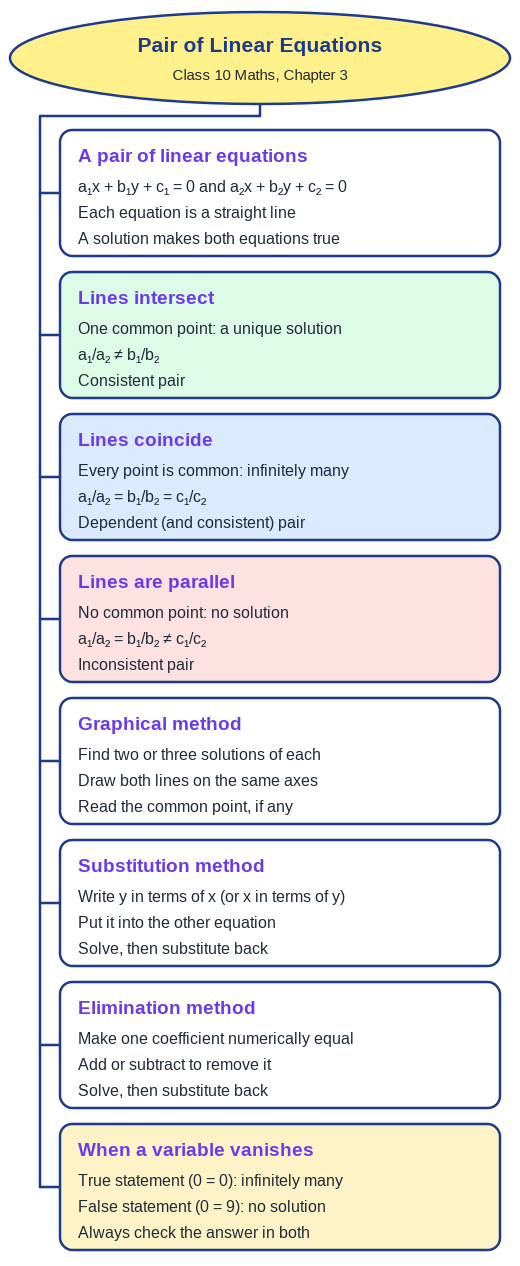
A pair of linear equations in two variables means two equations such as a₁x + b₁y + c₁ = 0 and a₂x + b₂y + c₂ = 0, each a straight line on a graph. The lines can intersect (one solution), coincide (infinitely many) or be parallel (none), and the ratios a₁/a₂, b₁/b₂ and c₁/c₂ tell which. A pair is solved by drawing the lines, or by substitution or elimination.
What is this chapter about?
Many everyday puzzles hide two unknowns at once. Two numbers add up to 7 and differ by 1: what are they? A notebook and a pen cost ₹50 together, and 3 notebooks with 2 pens cost ₹130: what does each cost? Each fact gives one equation, so we get two equations in two variables. This 14-page chapter shows what such a pair looks like on a graph, how to tell in advance whether it has a solution, and three ways to find that solution.
What is a pair of linear equations?
A linear equation in two variables can be written as ax + by + c = 0, where a and b are real numbers, not both zero. Its graph is a straight line. Two such equations in the same variables,
a₁x + b₁y + c₁ = 0 and a₂x + b₂y + c₂ = 0,
form a pair of linear equations. A solution of the pair is a value of x and a value of y that make both equations true at the same time. On a graph, that is a point lying on both lines.
What can the graph of a pair look like?
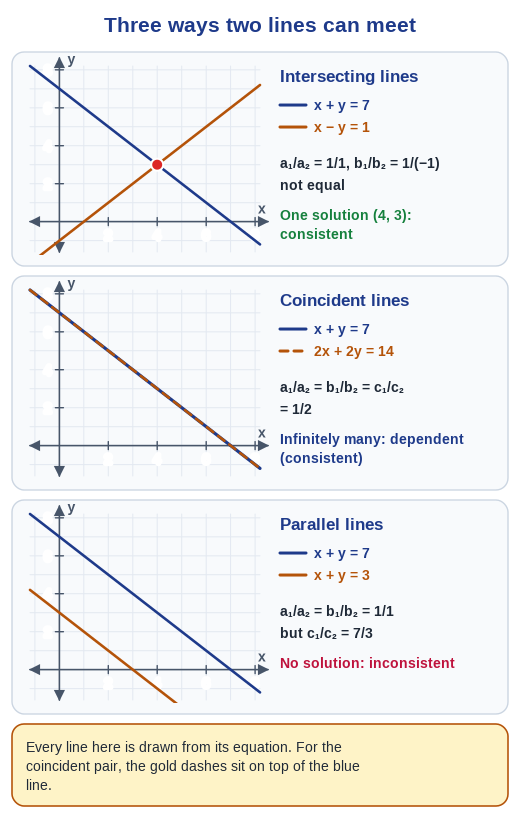
Two straight lines on the same axes can behave in only three ways.
- They intersect at one point. The pair has exactly one solution, and it is called consistent.
- They coincide, one lying on top of the other. Every point of the line is a solution, so there are infinitely many. Such a pair is dependent, and it is consistent too.
- They are parallel and never meet. There is no solution, and the pair is inconsistent.
How do the ratios tell you the kind of pair?
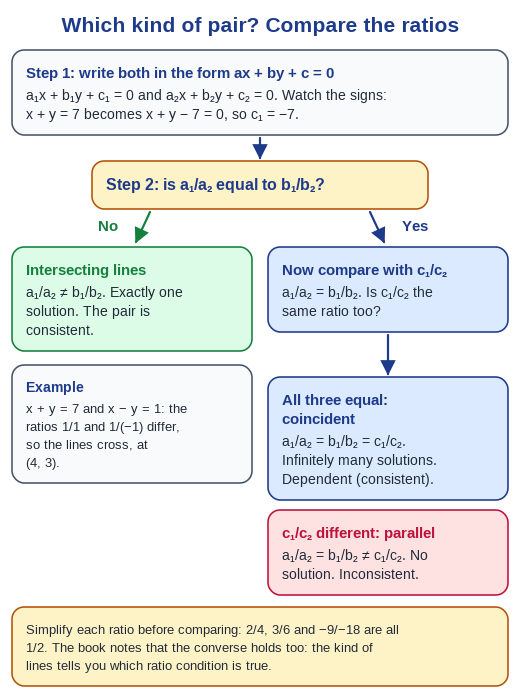
You do not have to draw the lines to know which case you have. Write both equations in the form ax + by + c = 0 and compare three ratios.
- a₁/a₂ ≠ b₁/b₂: the lines intersect, so there is a unique solution.
- a₁/a₂ = b₁/b₂ = c₁/c₂: the lines coincide, so there are infinitely many solutions.
- a₁/a₂ = b₁/b₂ ≠ c₁/c₂: the lines are parallel, so there is no solution.
For x + y = 7 and x + y = 3, written as x + y − 7 = 0 and x + y − 3 = 0, the ratios are 1/1, 1/1 and −7/−3 = 7/3. The first two are equal but the third is not, so the lines are parallel. The book adds that the converse also holds: the kind of lines tells you which condition is true. Read more on the graphical method.
How do you solve a pair by drawing graphs?
For each equation, find two or three solutions (pairs of x and y), plot them and draw the line through them. Draw both lines on the same axes. If they cross, the crossing point gives the solution. For x + y = 7 and x − y = 1, the lines meet at (4, 3), so x = 4 and y = 3. Check: 4 + 3 = 7 and 4 − 3 = 1.
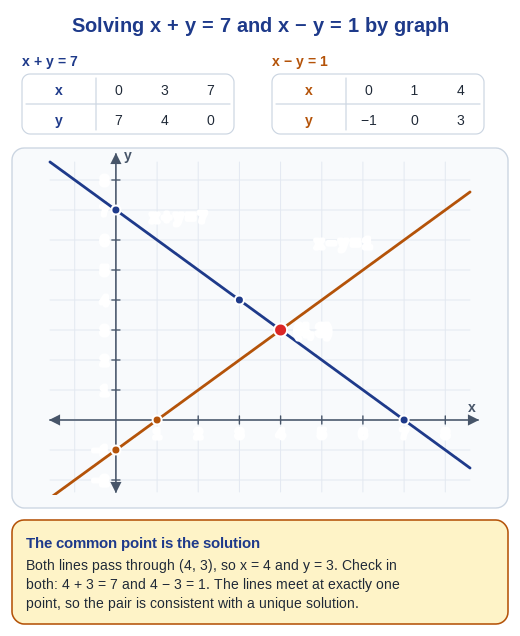
The graphical method has a weakness: when the answer has fractions, such as (8/7, 11/7), it is hard to read correctly from graph paper. That is why the chapter moves on to algebra.
How does the substitution method work?
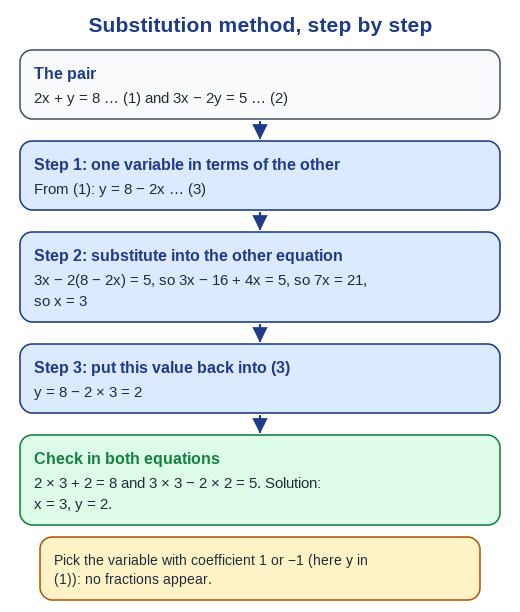
Take one equation and express one of its variables using the other, say y = 8 − 2x from 2x + y = 8. Substitute this into the other equation. You get an equation in x alone; solve it, then put the value back to find y. Read more on substitution and elimination.
How does the elimination method work?
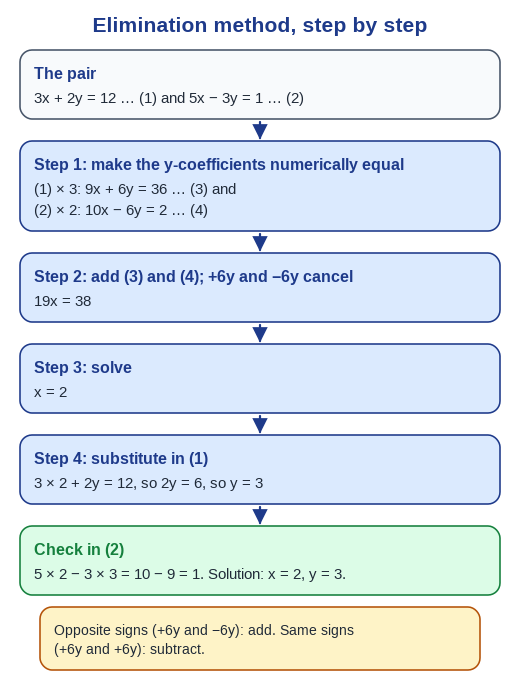
Multiply the equations by suitable non-zero numbers so that one variable has numerically equal coefficients in both. Then add or subtract the equations, and that variable is eliminated. Solve for the other variable and substitute back. For 3x + 2y = 12 and 5x − 3y = 1, multiplying by 3 and 2 gives +6y and −6y; adding gives 19x = 38, so x = 2 and then y = 3.
What if both variables disappear?
Sometimes, while substituting or eliminating, both variables cancel. If what is left is true, such as 18 = 18, the two equations are really the same line, and there are infinitely many solutions. If it is false, such as 0 = 9, the lines are parallel and there is no solution. So the algebra gives the same three cases as the graph.
Before we move on
You need to solve simple one-variable equations quickly; solving simple equations from Class 7 is a short refresher. The chapter summary still mentions equations that are not linear at first but can be reduced to linear ones; the current book has no section or exercise on them. Every example and all three exercises are answered in the NCERT solutions for Chapter 3. The previous chapter is Polynomials.
Key terms
| Term | Meaning |
|---|---|
| Linear equation in two variables | An equation that can be written as ax + by + c = 0, with a and b not both zero, such as x + y = 7. Its graph is a straight line. |
| Pair of linear equations | Two linear equations in the same two variables, a₁x + b₁y + c₁ = 0 and a₂x + b₂y + c₂ = 0, taken together. |
| Solution of a pair | Values of x and y that make both equations true. x = 4, y = 3 solves x + y = 7 and x − y = 1. |
| Consistent pair | A pair that has a solution: exactly one (intersecting lines) or infinitely many (coincident lines). |
| Inconsistent pair | A pair with no solution at all. Its lines are parallel. |
| Dependent pair | A pair of equivalent equations, with infinitely many common solutions. Its lines coincide, and it is always consistent. |
| Intersecting lines | Two lines that meet at exactly one point. That point is the unique solution. |
| Coincident lines | Two lines lying exactly on top of each other, so every point of one is a point of the other. |
| Parallel lines | Two lines in the same direction that never meet. |
| Ratio test | Comparing a₁/a₂, b₁/b₂ and c₁/c₂ to tell intersecting, coincident or parallel lines without drawing them. |
| Graphical method | Drawing both lines on the same axes and reading the point they share. |
| Substitution method | Writing one variable in terms of the other from one equation, and putting that into the other equation. |
| Elimination method | Making the coefficients of one variable numerically equal, then adding or subtracting the equations to remove it. |
Topics in this chapter
Practice
-
Which pair has exactly one solution?
Show answer
Answer: (c) x + y = 4 and x − y = 2
-
If a₁/a₂ = b₁/b₂ ≠ c₁/c₂, the two lines are:
Show answer
Answer: (b) parallel
-
The solution of x + y = 9 and x − y = 3 is:
Show answer
Answer: (b) x = 6, y = 3
-
A pair of linear equations that has no solution is called:
Show answer
Answer: (c) inconsistent
-
If 2x + 3y = 12 and y = 2, then x is:
Show answer
Answer: (a) 3
Questions students ask
What are the main topics of Class 10 Maths Chapter 3?
How a pair of linear equations looks on a graph (intersecting, coincident or parallel lines); consistent, inconsistent and dependent pairs; the test with the ratios a₁/a₂, b₁/b₂ and c₁/c₂; and three ways to solve a pair: the graphical method and the algebraic substitution and elimination methods.
Is the cross-multiplication method in the 2026-27 book?
No. The rationalised book (revised October 2022, marked Reprint 2026-27) teaches only the graphical, substitution and elimination methods. It also has no section on equations that reduce to a pair of linear equations, although the last point of the chapter summary still mentions them.
How many exercises does Chapter 3 have?
Three. Exercise 3.1 (7 questions) is about forming pairs, the ratio test and graphs; Exercise 3.2 (3 questions) uses substitution; Exercise 3.3 (2 questions) uses elimination. Every part, and all ten examples, are worked out on the NCERT solutions page.
Which method should I use to solve a pair of linear equations?
Use the one the question asks for. If the choice is yours, substitution is quick when a variable has coefficient 1 or −1, and elimination is quick when coefficients are easy to make equal. A graph shows the picture, but answers with fractions are hard to read from it.
Stuck on a question?
Take a photo and Lagnever AI explains it step by step. Try it for 7 days for ₹2.
Get it on Google Play Open in browser
For parents: after the trial, the plan renews monthly by UPI or card autopay. You can cancel anytime in the app.