
How do you solve a pair of linear equations by the graphical method?
Answer in short
Draw the line of each equation on the same axes by plotting two or three of its solutions. If the lines intersect, the common point gives the unique solution. If they coincide, there are infinitely many solutions; if they are parallel, there is none. The ratios a₁/a₂, b₁/b₂ and c₁/c₂ predict which case you will get.
Stuck on a question? Take a photo and Lagnever AI explains it step by step. Try it for 7 days for ₹2. Get it on Google Play
How do you draw the line of one linear equation?
A linear equation in two variables, such as x + y = 7, has many solutions: (0, 7), (3, 4), (7, 0) and so on. Pick a value of x, work out y, and you have a point. Plot two or three such points and join them with a ruler: the straight line you get is the graph of the equation. Every point on it is a solution, and every solution is a point on it.
For x − y = 1, the same idea gives (0, −1), (1, 0) and (4, 3). Putting x = 0 and then y = 0 is often quickest, because it gives the points where the line meets the axes.
How do you solve the pair from the graph?
Draw both lines on the same axes. A solution of the pair has to lie on both lines at once, so look for the point they share.
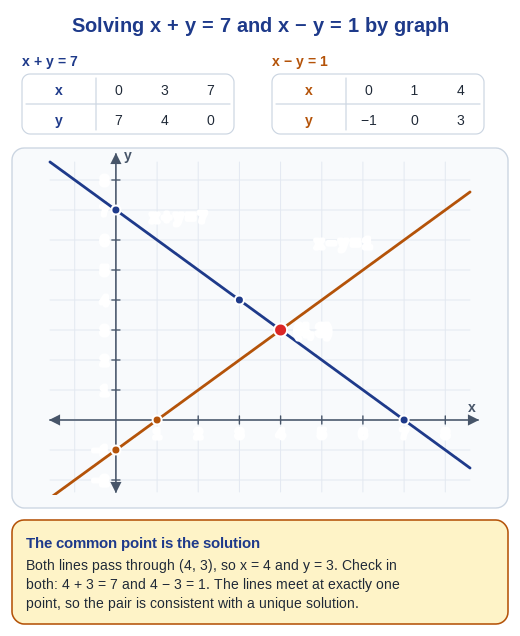
Here the lines cross at (4, 3), so x = 4 and y = 3. Always check: 4 + 3 = 7 and 4 − 3 = 1, so both equations are true. In a word problem, also check the answer against the story. If x and y are two numbers that add up to 7 and differ by 1, then 4 and 3 fit.
What are consistent, inconsistent and dependent pairs?
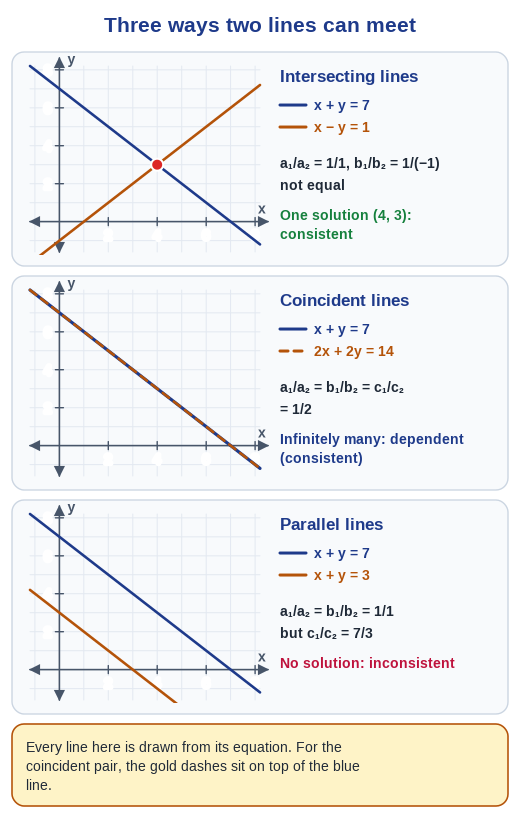
Two straight lines can meet in only three ways, and each has a name.
- Intersecting lines meet at exactly one point. The pair has a unique solution and is called consistent.
- Coincident lines lie on top of each other, so every point is shared. The pair has infinitely many solutions. Its equations are equivalent, like x + y = 7 and 2x + 2y = 14 (the second is the first multiplied by 2). Such a pair is dependent, and a dependent pair is always consistent.
- Parallel lines never meet, like x + y = 7 and x + y = 3: no x and y can add up to both 7 and 3. The pair has no solution and is called inconsistent.
How do the ratios a₁/a₂, b₁/b₂ and c₁/c₂ decide the case?
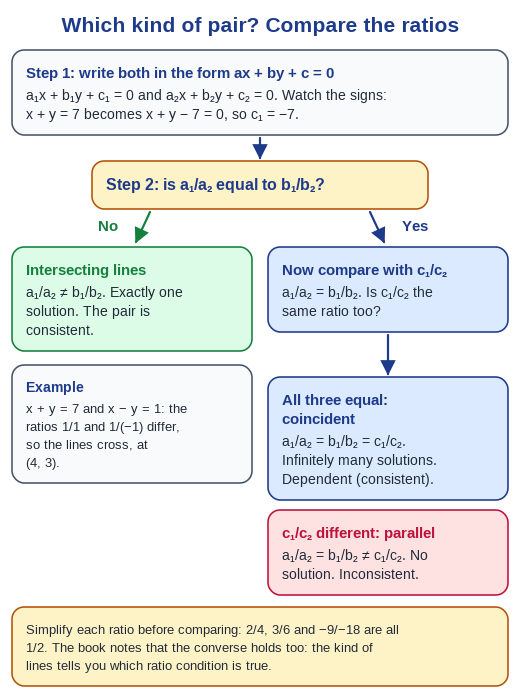
Write the pair as a₁x + b₁y + c₁ = 0 and a₂x + b₂y + c₂ = 0, keeping every sign. Then:
- if a₁/a₂ ≠ b₁/b₂, the lines intersect: one solution;
- if a₁/a₂ = b₁/b₂ = c₁/c₂, the lines coincide: infinitely many solutions;
- if a₁/a₂ = b₁/b₂ ≠ c₁/c₂, the lines are parallel: no solution.
Try 3x − y − 5 = 0 and 6x − 2y + 4 = 0. The ratios are 3/6 = 1/2, −1/−2 = 1/2 and −5/4. The first two are equal and the third is different, so the lines are parallel and the pair is inconsistent. Change the second equation to 6x − 2y − 10 = 0 and all three ratios become 1/2: the same line. Change it to x + y − 3 = 0 instead and the ratios 3 and −1 differ, so the lines cross, at (2, 1).
The book’s own three pairs on pages 25–26 follow the same pattern, and Table 3.1 there lists their ratios. The test also works backwards: if you know the lines are parallel, the ratios must satisfy the parallel condition.
When is the graphical method not enough?
Graphs show the picture clearly, but reading them has limits. If the lines meet at (8/7, 11/7), you might read (1.1, 1.6) or (1.2, 1.5), and both are wrong. The algebraic methods, substitution and elimination, give exact answers every time; see substitution and elimination methods. Exercise 3.1 practises the graphical method, and all of it is solved in the NCERT solutions.
Read next: the chapter notes. The line graphs page from Class 8 is a quick refresher on plotting and reading points.
Practice
-
The pair 3x + 2y = 5 and 6x + 4y = 9 has:
Show answer
Answer: (c) no solution
-
The lines x − 2y = 3 and 3x − 6y = 9 are:
Show answer
Answer: (c) coincident
-
The lines of a pair, drawn on graph paper, cross at (2, −1). The solution of the pair is:
Show answer
Answer: (b) x = 2, y = −1
-
Solve x + y = 6 and 2x − y = 0 graphically. Name points you would plot on each line.
Show answer
Answer: x + y = 6 passes through (0, 6), (6, 0) and (2, 4); 2x − y = 0, that is y = 2x, passes through (0, 0), (1, 2) and (2, 4). The lines meet at (2, 4), so x = 2, y = 4. Check: 2 + 4 = 6 and 2 × 2 − 4 = 0.
-
For which value of k are the lines 2x + 3y = 5 and 4x + ky = 7 parallel?
Show answer
Answer: Parallel lines need a₁/a₂ = b₁/b₂ ≠ c₁/c₂. 2/4 = 3/k gives k = 6. Then c₁/c₂ = −5/−7 = 5/7, which is not 1/2, so for k = 6 the lines are parallel.
Questions students ask
How many points do I need to draw the line of a linear equation?
Two points fix a straight line, but plotting a third is a good check: if the three do not lie on one line, a calculation has gone wrong. The points where the line meets the axes, found by putting x = 0 and then y = 0, are often the easiest.
What is the difference between a consistent and a dependent pair?
A consistent pair has at least one solution. A dependent pair is a special consistent pair whose two equations are equivalent, so they draw the same line and have infinitely many solutions. Every dependent pair is consistent, but a pair with exactly one solution is consistent without being dependent.
Is an answer read from a graph always exact?
Only when the lines meet at a point you can read clearly, such as (4, 3). If the meeting point has fractional coordinates, like (8/7, 11/7), a small drawing error changes the reading. Then solve by substitution or elimination, or at least check the reading in both equations.
Can two lines meet at exactly two points?
No. Two different straight lines meet at most once. So a pair of linear equations has exactly one solution, infinitely many (the same line) or none (parallel lines). It can never have exactly two.
Stuck on a question?
Take a photo and Lagnever AI explains it step by step. Try it for 7 days for ₹2.
Get it on Google Play Open in browser
For parents: after the trial, the plan renews monthly by UPI or card autopay. You can cancel anytime in the app.