
How do you solve a pair of linear equations by substitution and elimination?
Answer in short
In the substitution method, you use one equation to express one variable through the other, and put that into the second equation. In the elimination method, you make the coefficients of one variable numerically equal and add or subtract the equations to remove it. Either way, solve for one variable, then substitute back.
Stuck on a question? Take a photo and Lagnever AI explains it step by step. Try it for 7 days for ₹2. Get it on Google Play
Why do we need algebraic methods?
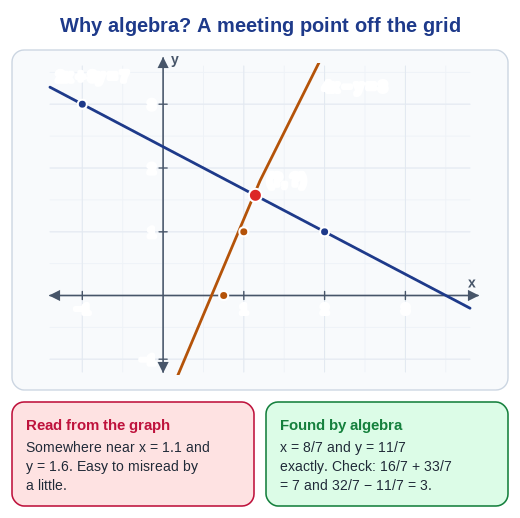
The graphical method works well when the lines meet at a point like (4, 3). But take 2x + 3y = 7 and 4x − y = 3. Their lines cross between the grid lines, near (1.1, 1.6), and nobody can read the exact point from graph paper. Algebra gives it exactly: x = 8/7 and y = 11/7. The chapter teaches two such methods.
How does the substitution method work?
There are three steps.
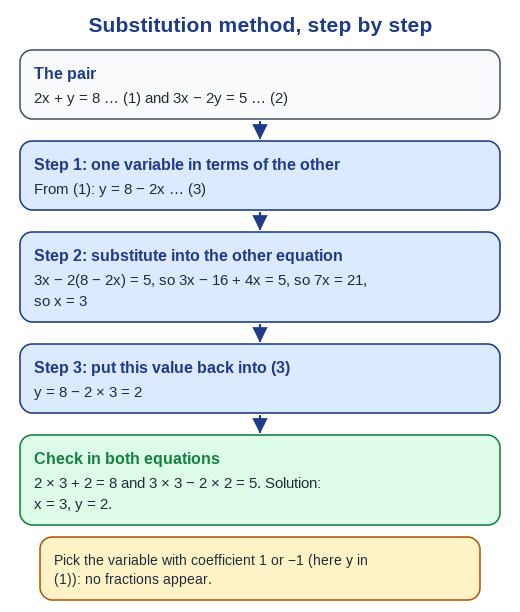
- From either equation, express one variable using the other. Choose a variable whose coefficient is 1 or −1 if you can, so no fractions appear.
- Substitute that expression into the other equation. Now it has only one variable; solve it.
- Put this value back into the expression from Step 1 to get the other variable.
Take 2x + y = 8 and 3x − 2y = 5. From the first, y = 8 − 2x. Putting this in the second: 3x − 2(8 − 2x) = 5, so 3x − 16 + 4x = 5, which gives 7x = 21 and x = 3. Then y = 8 − 2 × 3 = 2.
How does the elimination method work?
Here you remove (eliminate) one variable by combining the two equations.
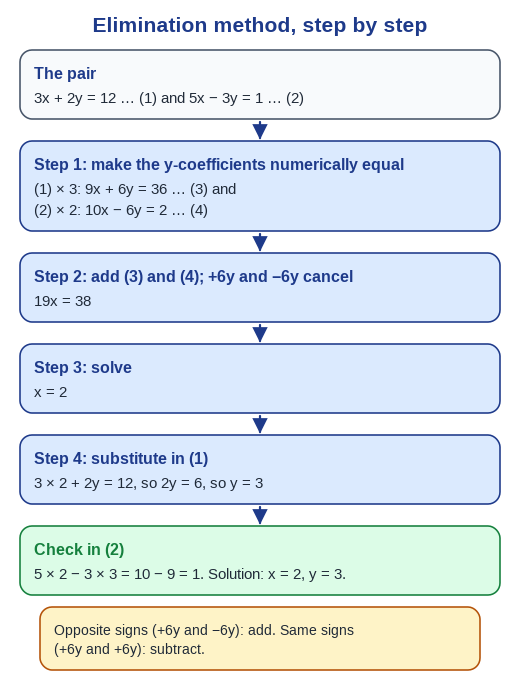
- Multiply each equation by a suitable non-zero number so that one variable has numerically equal coefficients in both.
- Add or subtract the equations so that this variable disappears.
- Solve the one-variable equation you are left with.
- Substitute the value into either original equation to find the other variable.
Take 3x + 2y = 12 and 5x − 3y = 1. Multiply the first by 3 and the second by 2: 9x + 6y = 36 and 10x − 6y = 2. The y-terms are +6y and −6y, so add: 19x = 38, and x = 2. Then 3 × 2 + 2y = 12 gives y = 3. Check in the second equation: 10 − 9 = 1.
What happens when both variables cancel?
Sometimes both variables vanish together. What is left decides the answer.
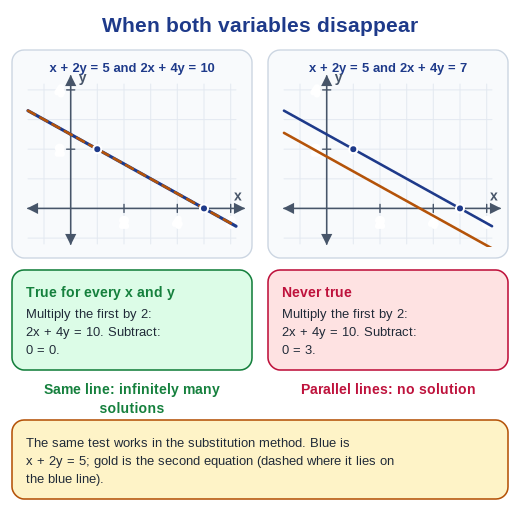
- A true statement, such as 0 = 0 or 18 = 18, means the equations are the same line: infinitely many solutions.
- A false statement, such as 0 = 3, means the lines are parallel: no solution.
For x + 2y = 5 and 2x + 4y = 10, doubling the first and subtracting leaves 0 = 0. For x + 2y = 5 and 2x + 4y = 7, it leaves 0 = 3. This matches the ratio test: in both pairs a₁/a₂ = b₁/b₂ = 1/2, and only c₁/c₂ decides.
How do you solve a word problem with these methods?
Name the unknowns, turn each sentence into an equation, solve, and check against the story. Say 3 notebooks and 2 pens cost ₹130, and 1 notebook with 1 pen costs ₹50. Let a notebook cost ₹x and a pen ₹y:
3x + 2y = 130 and x + y = 50
From the second, y = 50 − x. Substituting: 3x + 100 − 2x = 130, so x = 30 and y = 20. A notebook costs ₹30 and a pen ₹20. Check: 90 + 40 = 130 and 30 + 20 = 50.
Which method should you choose?
If the question names a method, use it. Otherwise, choose substitution when a variable already has coefficient 1 or −1, and elimination when the coefficients are easy to match, such as 2y and 3y. Both always give the same answer, so you can solve by one and check with the other. Exercises 3.2 and 3.3 practise these methods, and every question is solved in the NCERT solutions.
Read next: the graphical method and the chapter notes. For one-variable equations, the Class 7 page on solving simple equations is a quick refresher.
Practice
-
Solving x + y = 10 and x − y = 2 gives:
Show answer
Answer: (b) x = 6, y = 4
-
If y = 2x and x + y = 9, then:
Show answer
Answer: (a) x = 3, y = 6
-
While solving a pair, both variables cancel and you get 0 = 5. The pair has:
Show answer
Answer: (b) no solution
-
Solve 4x + 3y = 24 and 2x − 3y = 6 by elimination.
Show answer
Answer: The y-coefficients are +3 and −3, so add the equations: 6x = 30, x = 5. Then 4 × 5 + 3y = 24 gives 3y = 4, y = 4/3. Check: 2 × 5 − 3 × 4/3 = 10 − 4 = 6.
-
A father is three times as old as his son, and their ages add up to 48 years. Form a pair of equations and solve it by substitution.
Show answer
Answer: Let the father be x years old and the son y years: x = 3y and x + y = 48. Substituting, 3y + y = 48, so y = 12 and x = 36. Check: 36 = 3 × 12 and 36 + 12 = 48.
Questions students ask
What is the difference between the substitution and elimination methods?
Both turn the pair into one equation in one variable. Substitution does it by replacing a variable with an expression taken from the other equation; elimination does it by adding or subtracting the equations after making one variable's coefficients equal. Done correctly, they give the same answer.
When do I add and when do I subtract in the elimination method?
Look at the two equal coefficients. If they have opposite signs, such as +6y and −6y, add the equations. If they have the same sign, such as −12y and −12y, subtract one equation from the other. Either way that variable disappears.
What does it mean if I get 0 = 0 or 18 = 18?
A true statement with no variable left means the two equations are equivalent: they draw the same line, so the pair has infinitely many solutions. A false statement such as 0 = 9 means the lines are parallel and there is no solution.
Do I have to verify my answer?
It is good practice, and the book verifies several of its examples. Put the values into both original equations; if either fails, there is a mistake. In a word problem, also check that the answer makes sense, for example that a number of notes is a whole number.
Stuck on a question?
Take a photo and Lagnever AI explains it step by step. Try it for 7 days for ₹2.
Get it on Google Play Open in browser
For parents: after the trial, the plan renews monthly by UPI or card autopay. You can cancel anytime in the app.